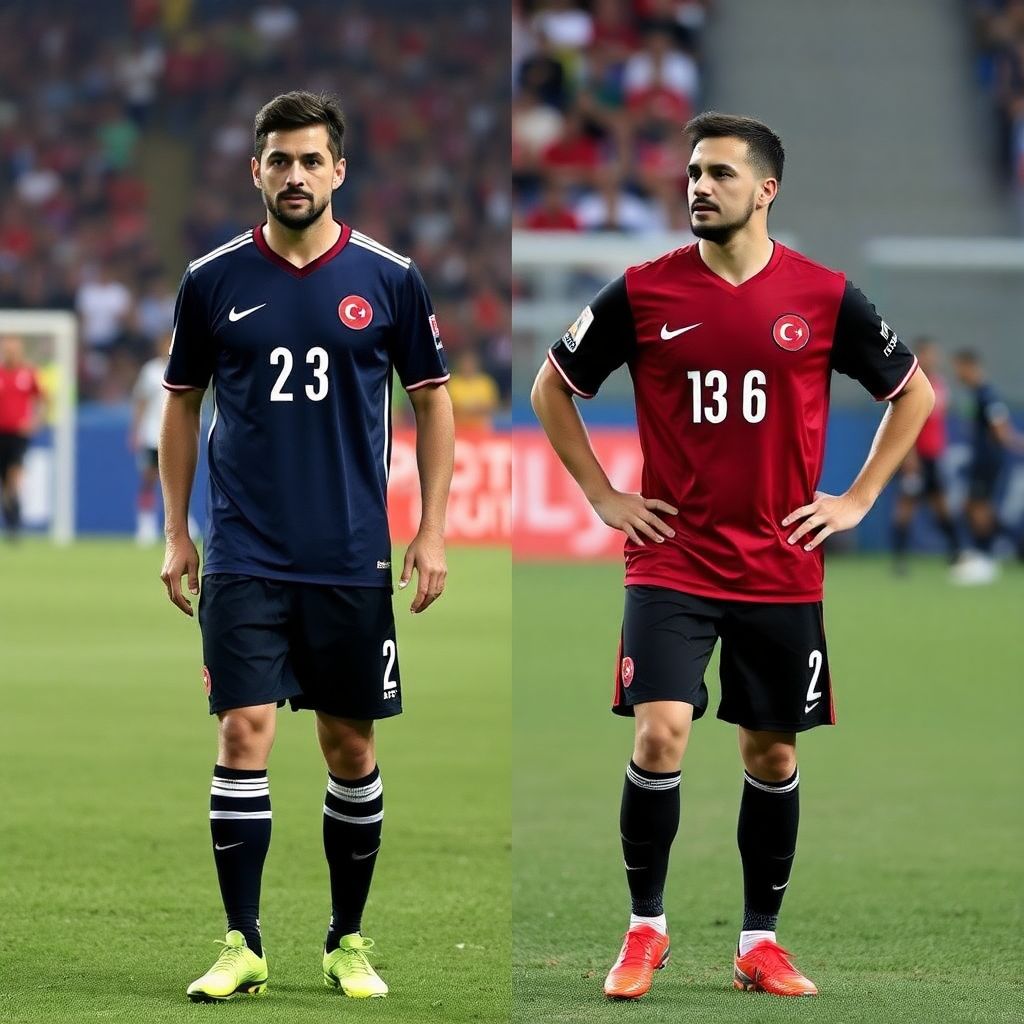
Today’s Turkish prospects offer higher technical depth and export potential than the 2002 squad, but they have not yet matched that team’s tournament resilience and leadership. For a coach or scout, the “best” option depends on role: 2002 as the benchmark for mentality and balance; today’s group for upside, transfer value and flexible modern systems.
Snapshot: Core Similarities and Differences
- Both generations are built around strong centre-backs, creative number 10 profiles, and emotionally charged home crowds, although current talents are more tactically versatile.
- The 2002 side was better at game management and tournament momentum; today’s group shows higher technical quality at younger ages but inconsistent composure.
- Modern prospects are more “export-ready” for top-five leagues, while the 2002 squad peaked inside Turkey and a few key European clubs.
- Physically, the new generation is broadly faster and more dynamic; the 2002 team compensated with compact blocks and elite positional discipline.
- For scouts, the current pool is clearly superior; for tournament coaches seeking ready-made leaders, 2002 still sets the reference model.
- Fan engagement has shifted: from collecting memories of 2002 to following Turkish Super Lig young talents transfer news and streaming every cap in real time.
Squad Building: Talent Pools and Pathways
Comparing the 2002 squad with today’s prospects is less about nostalgia and more about selection logic. Below is a concise qualitative table to frame age, experience and value without forcing artificial numbers.
| Profile | Typical Age Band | International Caps | Club Minutes Trend | Primary Positions | Market Value Trajectory |
|---|---|---|---|---|---|
| Core 2002 Starters | Mid-to-late 20s | Established, high | Stable at domestic/European clubs | Specialists in clearly defined roles | Plateaued or peaking during World Cup |
| 2002 Rotation/Depth Players | Mid 20s | Moderate | Regular in Süper Lig, occasional Europe | Role players, physical profiles | Limited upside beyond regional level |
| Current Elite Prospects | Early 20s and under | Low-to-medium but growing | Rapid climb; minutes in top-five leagues | Hybrid roles (inverted full-back, half-space 10) | Strong upward curve, export-focused |
| Current Domestic Breakouts | 19-23 | Few or none | Recently established as starters | Attackers and ball-playing defenders | Speculative but attractive for mid-tier Europe |
When you build a “best possible” squad, treat the 2002 team as a template for role clarity and chemistry, and today’s group as a database of higher-ceiling options. For a scout, the decision is about projection; for a coach, it is about reliability under pressure.
Key criteria for comparing and selecting between 2002 profiles and the new generation:
- Role clarity vs. versatility: 2002 players were role specialists; many modern prospects can cover two or three zones without losing quality.
- League context: Compare players’ impact in the Turkish Super Lig versus top-five European leagues rather than raw highlight clips.
- Minutes under stress: Prioritise players who have delivered in European knockout ties or decisive league games, not just routine fixtures.
- Injury robustness: The 2002 core stayed consistently available; many modern prospects still need to prove durability over multiple seasons.
- Tactical education: Younger players exposed to modern pressing schemes and build-up patterns adapt better to complex national-team plans.
- Psychological profile: Compare reaction to conceding late goals or hostile atmospheres; 2002 veterans excelled here.
- Leadership density: Count not just the captain, but how many natural communicators you can field at once.
- Market pressure: Rising transfer fees can destabilise some prospects; evaluate how they perform after big moves or rumours.
- Fit with current coach: Selection must follow the head coach’s tactical script, not purely nostalgia or hype cycles.
Tactical DNA: Coaching, Systems and Roles
From a coach’s angle, the “better” generation is the one that executes your preferred system with fewer compromises. For a journalist, the contrast is narrative: 2002’s rigid 4-4-2 with defined hierarchies versus today’s more fluid shapes built around young stars.
| Variant | Best Fit Persona / Squad Type | Strengths | Limitations | When to Favour This Variant |
|---|---|---|---|---|
| Pragmatic 4-1-4-1 (2002-style block) | National-team coach seeking stability with mix of 2002-like profiles and current workhorses | Compact mid-block, clear roles, easy to coach in short camps, maximises experienced holding midfielder | Less room for creative freedom, wide players must cover huge distances, can struggle chasing games | Qualifiers away from home, when betting odds Turkey next World Cup qualification feel tight and risk management is critical |
| Classic 4-4-2 (heritage reference) | Nostalgia-driven coach or journalist building comparisons to the 2002 World Cup run | Simple reference points, good for direct transitions, highlights traditional Turkish target forwards and second strikers | Outnumbered in midfield versus modern 4-3-3; pressing triggers are outdated against top-tier opponents | Friendly matches, testimonial games, or when presenting a historical piece alongside a Turkey national team retro 2002 jersey buy online feature |
| Modern 4-3-3 with high press | Data-oriented scout and progressive coach prioritising current generation’s athleticism and technical ceiling | Leverages dynamic wingers and ball-playing centre-backs, suits export-ready players from top-five leagues, strong counter-pressing | Demands high tactical training time; some 2002-type specialists can look uncomfortable in pressing traps | Home qualifiers, tournament group games you must dominate, or marquee friendlies that fans watch via live stream Turkey national team matches HD |
| Flexible 3-4-2-1 / 3-4-3 hybrid | National-team selector who wants to fit in many current creative prospects without losing defensive balance | Allows half-space creators, inverts wing-backs, maximises modern centre-back depth, easy to flip between back three and four | Wing-back profiles are scarce; requires repeated camps to synchronise rotations and pressing angles | Tournaments where you expect tactical variety across opponents and need in-game structural changes |
| Asymmetric 4-2-3-1 “star-centric” | Coach building around one or two elite young talents highlighted in Turkish Super Lig young talents transfer news | System bends toward your best playmaker, supports modern 10/wing hybrids, good for attacking set-pieces | Risk of over-dependence on a single player; defensive coverage on the star’s side may be weaker | When you possess one clearly superior attacker relative to the rest of the XI and need to maximise his output |
In pure tactical terms, the 2002 squad was optimised for the Pragmatic 4-1-4-1 or Classic 4-4-2, while today’s group fits better in Modern 4-3-3 or Flexible 3-4-2-1. Your “best” option depends on whether you prioritise controllable structure (2002) or flexible talent maps (now).
Physical and Technical Profiles of Prospects
From a scout’s desk, the physical and technical gaps between eras define where you place your bets.
- If you need immediate reliability in duels and aerials for high-stakes qualifiers, favour profiles similar to the 2002 core defenders and midfield destroyers, even if they lack some ball progression.
- If your system demands fast, high-line pressing and short build-up from the goalkeeper, lean into current-generation prospects who grew up under modern academy coaching and international exposure.
- If your club plays in a transitional league and you face a mix of direct and possession teams, blend an “old-school” ball-winner archetype with a younger deep-lying playmaker to bridge both eras.
- If you are recruiting for a top-five league side that already controls 60-70% possession, prioritise modern Turkish technicians who can operate in half-spaces over pure box-to-box runners.
- If your main objective is resale value and future-proofing, treat technically polished under-23 Turkish internationals as strategic assets, even if they are not yet as mentally robust as 2002 leaders.
- If you are a journalist assessing “golden generation” labels, focus on how many players can genuinely play at Champions League knockout level, not just domestic form spikes.
Club vs National Development: Infrastructure and Exposure
For decision-makers in Turkey and abroad, the real question is where each type of player develops best. Use this quick checklist to choose between club-driven and national-team-driven development emphasis.
- Define the player’s ceiling: decide whether his optimal role is as a domestic star or a European-level regular; this shapes whether club or national minutes should be prioritised.
- Audit club infrastructure: check quality of coaching, sports science, and video analysis; if the club is weak, national-team camps must fill more gaps.
- Track playing time objectively: favour environments where the player is trusted for full matches, rather than sporadic cameos that look good only in highlight packages.
- Use the national team as a benchmarking tool: compare how a prospect looks when surrounded by the best compatriots, not just against domestic peers.
- Exploit international exposure: strong national appearances raise transfer interest and shape market narratives, especially when combined with smart Turkey national football team tickets 2024 campaigns that fill the stadium.
- Align with career timing: for younger prospects, club stability is vital; for mid-20s players, national-team tournaments can unlock the next move.
- Monitor fan and media pressure: high scrutiny around qualifiers and the race reflected in betting odds Turkey next World Cup qualification can accelerate or damage development; decide who shoulders that load.
Mentality, Leadership and International Composure
Most people overrate pure talent and underrate composure. The 2002 squad’s edge came from avoiding the following mistakes, while the new generation is still learning.
- Assuming big-club contracts automatically translate into leadership; many modern prospects are still followers in national-team environments.
- Confusing emotional intensity with emotional control; 2002 leaders channelled pressure, while some current players still react impulsively to setbacks and refereeing decisions.
- Overloading young stars with captain-like responsibilities before they have a full qualifying cycle behind them.
- Ignoring language and communication gaps inside multinational club squads, which can slow tactical understanding and confidence.
- Underestimating the memory power of tournaments; 2002 players built aura through decisive moments, while the new group still lacks signature knockout wins.
- Relying on social-media narratives and highlight clips instead of staff reports from inside camps about training habits and resilience.
- Failing to diversify leadership: putting all responsibility on one veteran instead of building a spine of two or three communicators through the lines.
- Projecting World Cup or EURO expectations too early onto teenagers after a few good club games in the Turkish Super Lig.
- Neglecting how travel, match congestion, and constant live stream Turkey national team matches HD exposure affect young players’ mental fatigue.
Outlook: Market Value, Transferability and Future Impact
For pure talent upside and transfer value, today’s prospects are the better option; for tournament readiness and proven resilience, the 2002 model still wins. Coaches seeking immediate qualification success should lean toward 2002-style profiles, while scouts, analysts and clubs targeting long-term upside and European resale should prioritise the current generation.
Common Concerns and Practical Clarifications
Is the current Turkish generation already stronger than the 2002 squad?
On paper, the current group has more players in top leagues and higher technical range at young ages. However, until they reproduce deep tournament runs and knockout wins, 2002 remains the benchmark for “strongest generation” in practical terms.
How should a scout prioritise between 2002-style profiles and modern versatile prospects?
Start from your league’s tactical demands. In high-pressing or possession-focused contexts, modern versatile prospects should dominate your shortlist; in more direct, duel-heavy leagues, 2002-style specialists with robust mentality can still be premium fits.
What does this comparison mean for World Cup qualification chances?
The improved depth and export-ready talent give Turkey a higher theoretical ceiling in qualifiers. Yet composure swings results, which is why betting odds Turkey next World Cup qualification still price in inconsistency alongside potential.
How does fan culture differ between 2002 and now?
In 2002, following the team meant packed bars and stadiums, replica shirts, and delayed TV broadcasts. Today, fans refresh Turkish Super Lig young talents transfer news, hunt for Turkey national football team tickets 2024, and expect on-demand access via live stream Turkey national team matches HD from anywhere.
Does nostalgia around 2002 distract from backing today’s players?
Nostalgia can be a trap if it becomes a permanent measuring stick. Used correctly, 2002 is a tactical and psychological reference, not a ceiling; it should guide standards while allowing the current generation to create its own identity.
Why is there so much interest in retro 2002 jerseys now?
Retro shirts crystallise emotion: fans associate the 2002 kit with optimism, identity and global respect. That is why features showing where to Turkey national team retro 2002 jersey buy online consistently perform well for media outlets and club shops.
Which persona benefits most from the current generation: coach, scout, journalist or fan?

Scouts and clubs probably benefit most thanks to higher resale value and tactical flexibility. Coaches gain tools but also face bigger management challenges, while journalists and fans enjoy richer storylines and narratives than at any time since 2002.