Turkish coaches in Europe are reshaping modern tactics through aggressive pressing, fluid positional play, and smart use of data while still protecting the ball and player welfare. To apply their ideas safely, you need clear principles, simple training progressions, and constant alignment between academy, first team, and club constraints.
Strategic Insights from Turkish Coaches
- Blend Anatolian mentality (resilience, collective sacrifice) with European positional discipline instead of copying systems blindly.
- Use pressing and transitions as controlled weapons, not permanent chaos, with clear triggers and rest phases.
- Build multi-role players step by step so fluidity never destroys basic structure or confidence.
- Connect youth and first-team tactics early to avoid “dual football cultures” inside one club.
- Make data and video support coaching decisions instead of replacing pitch-side observation.
- Adapt ideas to league tempo, climate, squad age, and fixture load rather than chasing trends.
Philosophy Shift: Translating Anatolian Principles to European Contexts
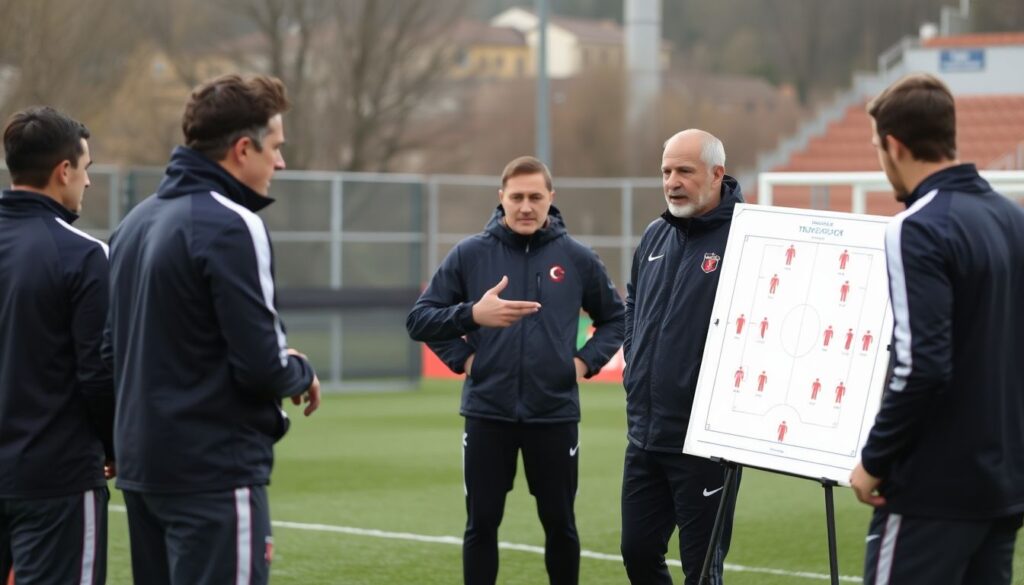
Turkish football coaches in Europe often start by translating familiar strengths-emotional intensity, collective work-rate, improvisation in tight spaces-into frameworks that fit European positional demands and club cultures.
This approach suits coaches and clubs that:
- Already have strong fitness standards and can sustain high-intensity play.
- Work with players comfortable in tight areas and quick combinations.
- Have support staff for video, opposition analysis, and individual development.
- Possess or aim for European football coaching licenses UEFA requires at elite level.
It is usually a poor fit when:
- The squad is older, slow, or built for low-block football with many deep defenders.
- Board expectations demand instant results with no patience for transition seasons.
- Facilities, staff, or time do not allow structured training weeks and recovery.
- There is no shared language or leadership group to transmit complex tactical ideas.
Many of the best Turkish football managers 2024 have shown that the key is not importing a “Turkish style”, but extracting portable principles: compact teams, aggressive ball-winning zones, and brave build-up under pressure, then adapting them to local players and match calendars.
Pressing and Transitional Play: New Patterns and Training Methods
To safely implement the pressing and transition ideas popularised by Turkish coaches, you need basic infrastructure and clear planning before you change your game model.
Core requirements:
- Physical and medical readiness
- Reliable fitness testing and regular monitoring (RPE, wellness reports, sprint loads).
- A medical team capable of managing increased high-intensity actions without overload.
- Video and data support
- Simple event data (pressing actions, high regains, counter-attacks created) and match video.
- Staff or interns able to tag clips: pressing triggers, successful traps, failed counter-presses.
- Clear communication channels
- Regular unit meetings (defence, midfield, attack) to review pressing plans.
- Shared terminology: lines, triggers, pressing “on” and “off” cues.
- Training time and pitch layout
- Access to at least half-pitch for 10v10 or 11v11 pattern work twice a week.
- Cones and mini-goals to mark pressing zones and transition goals.
- Coach education and reference models
- A modern football tactics course online or equivalent workshops to update terminology.
- Match libraries of leading Turkish coaches to show concrete pressing examples.
Typical training ideas inspired by Turkish practitioners:
- Small-sided 5v5+3 games with pressing bonuses for winning the ball in wide channels.
- 11v10 scenarios where the team out of possession must win the ball and attack within a set time.
- Wave drills: finishing one attack immediately followed by defending a counter-attack the other way.
Failure modes to watch:
- Players pressing alone without cover, leaving huge gaps between lines.
- Transition focus turning matches into end-to-end chaos, exhausting key attackers.
- High pressing used every minute instead of as a situational tool (score, minute, opponent fatigue).
Positional Fluidity: How Turkish Managers Build Multi-Role Systems
Before adopting multi-role systems, consider these safety risks and limitations:
- Overloading players with positions they cannot physically or mentally handle increases errors and injury risk.
- Excessive freedom without clear reference points leads to broken structure and dangerous counter-attacks.
- Changing roles too quickly between matches confuses young or new players.
- Copying elite examples without matching fitness, communication, and coaching time creates frustration.
Use the following progressive steps to build fluid positional systems inspired by leading Turkish football coaches in Europe.
- Define non-negotiable zones and roles
Start with simple principles: minimum width, depth, and rest defence numbers. Even in fluid systems, players must know where the team can never be empty.
- Examples: always two players behind the ball, one wide player each side in possession.
- In match review, pause whenever these rules break and discuss safer options.
- Select 2-3 “hybrid” players as pilots
Choose tactically intelligent, physically reliable players to carry extra fluidity first, such as an inverted full-back or an 8 who can drop between centre-backs.
- In early phases, keep others on more traditional roles to stabilise the structure.
- Use clear language: “in possession you are a full-back; in build-up phase you step into midfield.”
- Introduce fluidity in one phase of play only
Limit experiments to a single phase-build-up, consolidation, or final third-until behaviour is automatic.
- For instance, allow full-backs to invert only against a low block, not during fast transitions.
- Review clips from 2-3 matches to confirm players recognise correct moments.
- Design controlled training games
Use direction and touch constraints to force the new roles without exposing players to counter-attacks early.
- 7v7+3 neutral players where one full-back must enter midfield for the team to score in central goals.
- 9v9 on reduced width so inverted roles appear naturally in build-up.
- Build communication habits
Positional exchanges must be triggered by calls and eye contact, not improvisation alone.
- Create simple verbal codes for rotations (e.g. “switch”, “step”, “hold”).
- In post-session meetings, ask players to explain their decisions to reinforce understanding.
- Gradually expand fluidity across lines
Once first pilots are stable, add coordinated midfield and attack rotations, mirroring patterns seen under top Turkish coaches.
- Example: winger inside, 8 runs beyond, full-back overlaps; only one can attack the last line at a time.
- Use freeze coaching to correct spacing before restarting the game.
- Stress-test against different opponents
Trial the model versus high pressing, mid-blocks, and deep blocks to reveal structural weaknesses.
- Track where you lose the ball most often and how many players are ahead of the ball at those moments.
- Adjust rest defence numbers before adding more rotations.
- Document roles and review regularly
Write short role descriptions and use video clips to keep players aligned as the system evolves.
- Update the document after tactical meetings or changes in line-up.
- Integrate these expectations into individual development plans for each player.
Developing Talent: Integrating Youth Pathways into First-Team Tactics
Use this checklist to verify whether your youth-to-first-team pathway supports the tactical ideas used by leading Turkish coaches.
- U17-U21 teams use similar base formation and principles (pressing height, build-up zones) as the first team.
- Youth coaches attend first-team tactical meetings at least occasionally to align terminology and drills.
- Academy and senior analysts share video libraries and tagged clips for positional behaviours.
- Promising youngsters train with the first team on pre-planned days, not only in emergencies.
- You track minutes by position for each academy player, ensuring exposure to future first-team roles.
- There is a clear plan for one or two youth players to be integrated every season with realistic targets.
- Feedback flows both ways: the first team informs academy about tactical needs; academy reports on readiness.
- Set-piece routines in youth teams mirror at least the structure of senior-team routines.
- Adaptations are made for physical maturity, but core decision-making patterns stay consistent across ages.
- When a youngster debuts, you simplify their role instead of assigning the most complex tactical tasks.
Analytics in Practice: Data, Scouting and Match Preparation Techniques
Common pitfalls when applying analytics in the style of top Turkish coaches are mostly about misuse rather than lack of numbers.
- Relying on complex metrics without understanding the underlying events or sample size.
- Using pressing and running stats to punish players instead of guiding smarter effort.
- Ignoring context: climate, pitch quality, travel, and opponent style when reading high-intensity data.
- Letting data dictate selection without considering dressing-room dynamics and leadership roles.
- Scouting only by highlights, missing defensive work and off-ball positioning crucial for pressing systems.
- Over-preparing players with long video meetings that reduce freshness and attention before matches.
- Copying opposition analysis templates from elite clubs that your staff cannot maintain accurately.
- Failing to link training-theme metrics (e.g. high regains) directly to weekly session design.
- Not validating external data with your own coding when numbers seem inconsistent with what you see.
- Neglecting coach education: analysts attend courses, but coaching staff avoid modern football tactics course online resources.
Contextual Adaptation: Balancing Club Constraints, Squads and Leagues
When full implementation of the ideas from Turkish football is not realistic, use one of these alternative approaches.
- Controlled mid-block with selective pressing
Instead of constant high pressing, defend in a compact mid-block and trigger aggressive jumps only on specific cues (back-pass, poor touch, sideways pass to full-back). This suits ageing squads or congested fixture lists.
- Hybrid build-up with clear safety valves
Combine short build-up patterns with pre-agreed long-ball exits to a target player. This reduces risk on poor pitches or with centre-backs who are still improving in possession.
- Game-state-based aggression
Adopt full Turkish-style aggressiveness only in certain game states-chasing the result in last 20 minutes-while keeping a more stable structure when leading. This protects players from mental and physical burnout.
- Staged tactical evolution by competition
Use domestic league matches to practise more advanced ideas and keep a slightly safer model for high-stakes cup or European ties. This is often how the best Turkish football managers 2024 manage risk in new environments.
To deepen these approaches sustainably, consider visiting football coaching clinics in Turkey or shadowing staff who already blend local and European demands, and ensure your staff pathway and European football coaching licenses UEFA require are mapped out in advance.
Practical Answers to Tactical Challenges Posed by Turkish Coaches
How can I introduce high pressing without exposing my slow centre-backs?
Raise the pressing line with your forwards and midfield, but keep the back line slightly deeper than classic high lines. Press to delay and force long balls rather than to win every duel, and ensure one midfielder always screens runs in behind.
What is a safe starting point for positional fluidity in my team?
Begin with one inverted full-back in possession only, keeping the opposite full-back deeper. Limit rotations to build-up phase and use video review to check if your rest defence (two centre-backs plus one midfielder) always remains intact.
How do I align my academy with first-team tactics on a small budget?
Share simple principle documents and a few key drills instead of full playbooks. Rotate one academy coach into first-team sessions weekly and run joint video meetings for specific positions, such as number 6 or wide forwards.
Which basic metrics should I track to support a pressing-based game model?
Start with high regains per match, location of ball recoveries, and shots created within a short time after regain. Combine these with subjective player ratings from staff to cross-check what the numbers suggest.
How often should I change tactical roles for young players?

Keep each new role for several weeks of training and matches before changing again. Use one primary position and one secondary, avoiding more than two tactical roles per season for players still adapting physically and mentally.
What is the safest way to study Turkish-inspired tactics if my staff lacks experience?
Use a modern football tactics course online combined with match analysis of Turkish coaches who coach in Europe. Pause at clear pressing or rotation moments and discuss simple “if-then” rules instead of complex schemes.
How can I prepare for opponents coached by aggressive Turkish managers?
Train escape patterns from high pressure: third-man combinations, diagonal switches, and targeted long balls behind their full-backs. Emphasise calm decision-making and pre-planned exits rather than asking players to dribble out of pressure.