
The Süper Lig is shifting towards vertical, high-intensity football: more progressive passing, structured pressing, aggressive counter-pressing, and flexible full-back roles. Turkish coaches are borrowing modern European trends but adapting them to local player profiles, atmospheres, and fixture congestion, using performance data, video, and targeted training to implement these ideas realistically.
Tactical Overview: Core Shifts in the Süper Lig
- Verticality over sterile possession: quicker progression through thirds, more line-breaking passes and third-man runs.
- More organised pressing architectures with clear triggers, especially in home matches with strong crowd momentum.
- Full-backs moving inside to create overloads and support build-up, not just overlapping wide runners.
- Transitions and counter-pressing treated as primary chance-creation tools, not only as emergency defending.
- Growing use of Super Lig tactical analysis via data platforms, GPS and detailed video workflows.
- Coaching education mixing Turkish Super Lig coaching courses with modern European content and best Turkish football coaching books.
Immediate Practical Tips for Turkish Coaches
- Limit new tactical ideas to one main principle per mesocycle: for example, first focus only on vertical passing lanes before adding complex pressing triggers.
- Use a simple Super Lig match analysis service or in-house tagging to review five key moments: goal chances for and against, build-up under pressure, and rest defence.
- Introduce pressing in small-sided games with clear scoring bonuses for regaining the ball within five seconds in the middle third.
- Ask full-backs to invert only in controlled phases: after a backward pass to centre-backs, never in chaotic transition moments.
- Start a low-cost Super Lig advanced stats subscription and track three metrics only: PPDA, progressive passes and box entries.
- Build a micro-library with the best Turkish football coaching books that translate European ideas into the Süper Lig reality of travel, climate and squad depth.
From Possession to Purpose: Rise of Vertical Passing and Progressive Play
In the modern Süper Lig, possession is no longer valued for its own sake. Vertical passing and progressive play mean using circulation to open lines forward as early as possible, then attacking those lanes with timing and coordination. The focus shifts from sterile dominance to directly threatening the opponent goal.
Verticality here has clear boundaries. It is not blind long balls, nor chaotic transitions. Instead, it is controlled risk: centre-backs, pivots and inverted full-backs actively search for passes that break a line, often to a dropping forward or interior midfielder who can set a third-man runner. Team structure behind the ball, known as rest defence, must support this aggression.
Recent Süper Lig examples include big clubs at home patiently attracting the press with short build-up, then hitting firm ground passes into the feet of a false nine or advanced eight between lines. Smaller Anatolian sides imitate this in a simpler way: early vertical passes from half-spaces into wingers attacking the channel, followed by crosses or cutbacks.
This trend influences training design. Coaches run positional games where a goal only counts after a vertical pass breaks a line. Super Lig tactical analysis clips from recent games are shown before training, highlighting moments when a centre-back ignored a safe lateral pass and instead played through to a high midfielder facing forward.
Pressing Architectures: How Turkish Teams Structure High and Mid Presses
Pressing architectures describe how teams in Turkey organise collective pressure: who jumps, who covers, and which passing lanes they close first. Instead of uncoordinated running, modern Süper Lig pressing is built around triggers, cover shadows, and compact distances between lines.
-
Clear pressing triggers
Typical triggers include a backward pass to the opponent centre-back, a slow lateral switch, or a poor first touch from the full-back. When the trigger appears, nearest players jump forward while others move to block central options. In home games, some teams use the crowd as an extra trigger, pressing immediately after a loud reaction to a mistake. -
Defined roles for the front three
The striker often screens the pivot with his cover shadow, forcing play wide. Wingers curve runs to block inside passes and guide the ball towards the touchline trap. This creates a clear direction of press: inside-out or outside-in, depending on the game plan and opponent build-up structure. -
Compact midfield line as safety net
Midfielders maintain vertical compactness with defenders, shrinking spaces between lines. They are responsible for jumping to the opponent pivot if the striker fails to block, and for winning second balls after forced long passes. Communication between the six and eights is key to avoid leaving the half-spaces free. -
Back line height and rest defence
The defensive line must push up to support the press and compress the field. Full-backs stay ready to step out aggressively on wide players while one centre-back covers depth. Good rest defence allows teams to commit numbers forward without being punished on quick counters. -
Flexible switches between high and mid block
Many Süper Lig teams mix a very intense high press for first 10-15 minutes with a more controlled mid block later, especially in hot conditions or during congested weeks. The key is having a simple call from the bench or captain that signals when the block height changes. -
Integration with set-piece pressing
After their own attacking set-pieces, teams quickly organise a counter-press shape with defenders ready to lock the ball in. Corner routines now often include rest-defence positioning to immediately press second balls and maintain pressure on the opponent.
In practice, coaches in Turkey build pressing habits through repeated small-sided games on shortened pitches. A typical drill gives the attacking team a time limit to escape from the first pressing wave, rewarding defenders for regains in high zones. Staff then review clips from a recent matchday using a Super Lig match analysis service, comparing training behaviour with game reality.
Full‑Back Evolution: Inverted Profiles, Overloads and Defensive Trade‑offs
Full-backs in the Süper Lig have evolved from simple overlapping runners to multi-functional players. Inverted full-backs move into central zones in possession, creating passing triangles with pivots and eights, while still needing to defend wide transitions. This role demands tactical intelligence, scanning and body orientation under pressure.
-
Inverted full-back in build-up
Against high press, full-backs step inside next to or ahead of the pivot, forming a three-plus-one or two-plus-two structure. This gives extra central numbers to play through the first line and opens corridors for wingers to stay high and wide. -
Wide overloads in the final third
Some Süper Lig sides use asymmetric shapes: one full-back inverts, the other overlaps frequently. On the strong side, the overlapping full-back combines with winger and eight to overload the flank and create cutback situations near the byline. -
Covering half-spaces in defensive transition
When possession is lost, inverted full-backs are often closest to the central channel, enabling immediate counter-pressing. However, this leaves the touchline exposed. Teams solve this either by sliding the nearest centre-back outward or by using a holding midfielder to temporarily fill the vacated full-back lane. -
Late runs into the box
An advanced trend is using far-side full-backs as surprise finishers. While the attack develops on the opposite side, the weak-side full-back times a late run into the box to attack cutbacks or back-post crosses against unaware wingers. -
Adapting profiles to squad reality
Not every Süper Lig club has ready-made inverted full-backs. Coaches often convert intelligent central midfielders or wingers into hybrid full-back roles, especially when facing deep blocks at home where their technical quality is more valuable than pure defending.
To train this evolution, coaches run pattern play exercises where full-backs start wide, then move inside based on triggers: a centre-back driving forward or a pivot dropping between centre-backs. Players are coached on when to invert, when to overlap, and how to react defensively when combinations break down.
Transitions and Counter‑Pressing: Winning the Ball Back Instantaneously
Transitions in the Süper Lig are decisive because of the league s tempo and emotional swings. Counter-pressing, or gegenpressing, means trying to win the ball back immediately after losing it, within a few seconds, while the opponent is still disorganised. Teams increasingly use this as an attacking weapon.
Mini-scenarios show how this works. A big club at home loses the ball near the opponent box: nearest three players instantly close the carrier, block inside passes and force play towards the touchline, while the rest lock short options and prepare to attack any loose ball. A counter-press regain near the area often leads to shots before the defence sets its shape.
Smaller teams adapt counter-pressing in more compact zones. After long balls to a target striker, midfielders and full-backs swarm second balls. If they lose the first duel, they counter-press locally for a short burst, aiming to either win the ball or at least force the opponent to clear it long, buying time to recover shape.
Attacking and Defensive Upsides of Aggressive Counter‑Pressing
- Creates high-quality chances because regains happen close to the opponent goal, before their defence re-organises.
- Allows teams to maintain pressure and territorial dominance, especially important in Süper Lig stadiums with intense home crowds.
- Reduces the need for long build-up phases, suiting squads with physically strong but less creative midfielders.
- Helps protect technically weaker back lines by preventing clean opponent transitions and sustained attacks.
Structural and Physical Limitations to Manage
- Requires compact team shape and short distances; stretched structures make counter-pressing easy to bypass with one or two passes.
- Demands high fitness and sprint capacity, challenging during congested calendars and long away trips in the Süper Lig.
- Risky against technically superior opponents who can break the first wave and exploit open spaces behind the press.
- Can lead to unnecessary fouls and cards if players arrive late or press individually without coordination.
Performance Tech in Practice: Analytics, GPS and Video for Tactical Choices
Performance technology is now central to how Turkish coaches adopt European trends. However, misunderstandings and misuses are common, especially around data interpretation and over-complication. Using tools like GPS, tracking and video should always serve clear game model questions, not exist as separate projects.
-
Mistake: treating data as truth without context
Coaches sometimes chase PPDA or possession numbers without linking them to squad strengths, game state or opponent style. A low PPDA is not automatically good if it comes from disorganised pressing and constant fouling. -
Mistake: overloading players with irrelevant clips and stats
Presenting long video meetings with dozens of scenes dilutes key messages. Better to show a few targeted clips of pressing triggers or vertical passes, then repeat those behaviours on the pitch in the very next session. -
Mistake: copying European benchmarks directly into Süper Lig reality
Some staffs use pressing or running benchmarks from top European clubs without adjusting for climate, travel, and squad depth in Turkey. This can lead to overtraining and injuries rather than improved intensity. -
Myth: only big clubs benefit from analytics and subscriptions
Even smaller teams can use an affordable Super Lig tactical analysis platform or a basic Super Lig advanced stats subscription, focusing on simple indicators like field tilt, box entries and shot locations to refine match plans. -
Myth: technology replaces coaching intuition
Tools are decision-support, not decision-makers. Video and data should confirm or challenge what coaches feel from the touchline, helping adjust details such as pressing height, rest-defence positioning, or full-back inversion timing. -
Mistake: ignoring learning resources in local language
Many staffs skip high-quality local material, yet combining Turkish Super Lig coaching courses with the best Turkish football coaching books and selected European webinars gives a more grounded, actionable knowledge base.
Changing Coaching Pathways: Practical Steps for Implementing Modern Systems
Tactical evolution in the Süper Lig is not only about theory; it depends on how clubs structure staff development and daily work. Coaches must translate modern European trends into step-by-step processes that fit their squad, budget and schedule.
Consider a mini-case of a mid-table Süper Lig club wanting to adopt more vertical play and structured high pressing within one pre-season.
-
Define a simple game model core
The head coach and staff select three non-negotiables: vertical progression through central lanes, high press after backward passes, and inverted full-back on the strong side. Everything else is flexible. -
Audit current squad profiles
Analysts review last season using a Super Lig match analysis service, tagging moments of build-up, pressing, and transitions. Staff identify players naturally suited to pressing and those who can handle inverted roles. -
Map a four-week implementation plan
Week 1 focuses on build-up and first vertical passes. Week 2 adds front-line pressing structures. Week 3 integrates counter-pressing principles. Week 4 combines everything in full-size games with opponent-specific prep. -
Design aligned training drills
Each session contains: one positional game for verticality, one pressing game on shortened pitch, one transition exercise and a short video review. GPS loads are monitored to keep intensity high but sustainable. -
Create a player education routine
Before training, players watch three-to-five-minute clips of Super Lig tactical analysis focusing on that day s topic. After training, unit meetings (defence, midfield, attack) discuss what worked and what needs adjustment. -
Iterate using match feedback
In the first month of competition, staff compare planned behaviours with real games every week, adjusting pressing height, rest-defence numbers and full-back instructions without abandoning the core principles.
This structured approach helps Turkish coaches move from vague ideas about European trends to concrete, trainable behaviours that fit the Süper Lig context.
Practical Clarifications for Coaches and Analysts
How is vertical play in the Süper Lig different from simple long-ball football?
Vertical play aims to progress through lines with controlled passes and coordinated runs, not just hit hopeful long balls. The ball travels forward quickly, but with support structures, rest defence and clear patterns to attack second balls or lay-offs.
Can smaller Süper Lig clubs realistically apply complex pressing systems?
Yes, but they must simplify. Instead of many pressing triggers, choose one or two, such as backward passes or wide touches, and train them intensively. Structure the block height according to player fitness and depth rather than copying big-club models.
When should Turkish teams use inverted full-backs and when keep them wide?
Inverted full-backs are best against opponents who defend narrow or allow central build-up. Against fast wingers or dangerous counters, keeping full-backs wider and more conservative offers better defensive stability and safer rest-defence coverage.
How can coaches train counter-pressing without overloading players physically?
Use short, high-intensity games with clear time limits on counter-pressing actions and longer rest between repetitions. Emphasise spacing, angles and anticipation so players run smarter, not just harder, and monitor loads with GPS when available.
Which performance data metrics are most useful for intermediate-level Süper Lig staffs?
Focus on a few: PPDA for pressing behaviour, progressive passes for verticality, entries into the box for chance creation, and field tilt for territorial control. These link directly to common game models and are easier to explain to players.
Are Turkish Super Lig coaching courses enough to learn modern European trends?
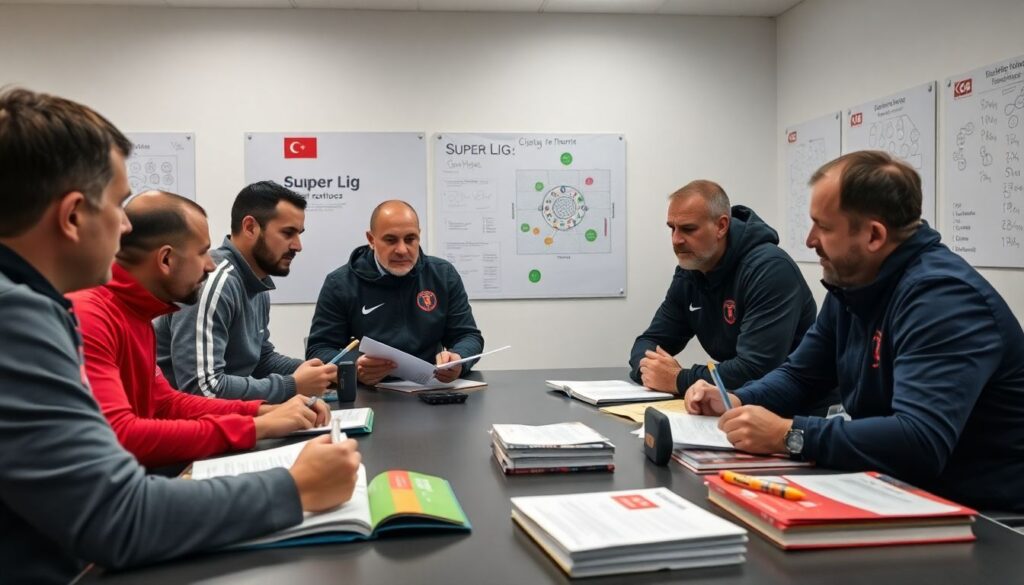
They are a solid foundation but work best when combined with club-internal mentoring, targeted Super Lig tactical analysis and selected reading, including the best Turkish football coaching books and reputable European coaching materials.
How should analysts present tactical insights to head coaches and players?
Use brief, focused reports and short video compilations tied to the game model. Highlight trends, not only single moments, and always connect findings to specific training exercises or match-plan adjustments.