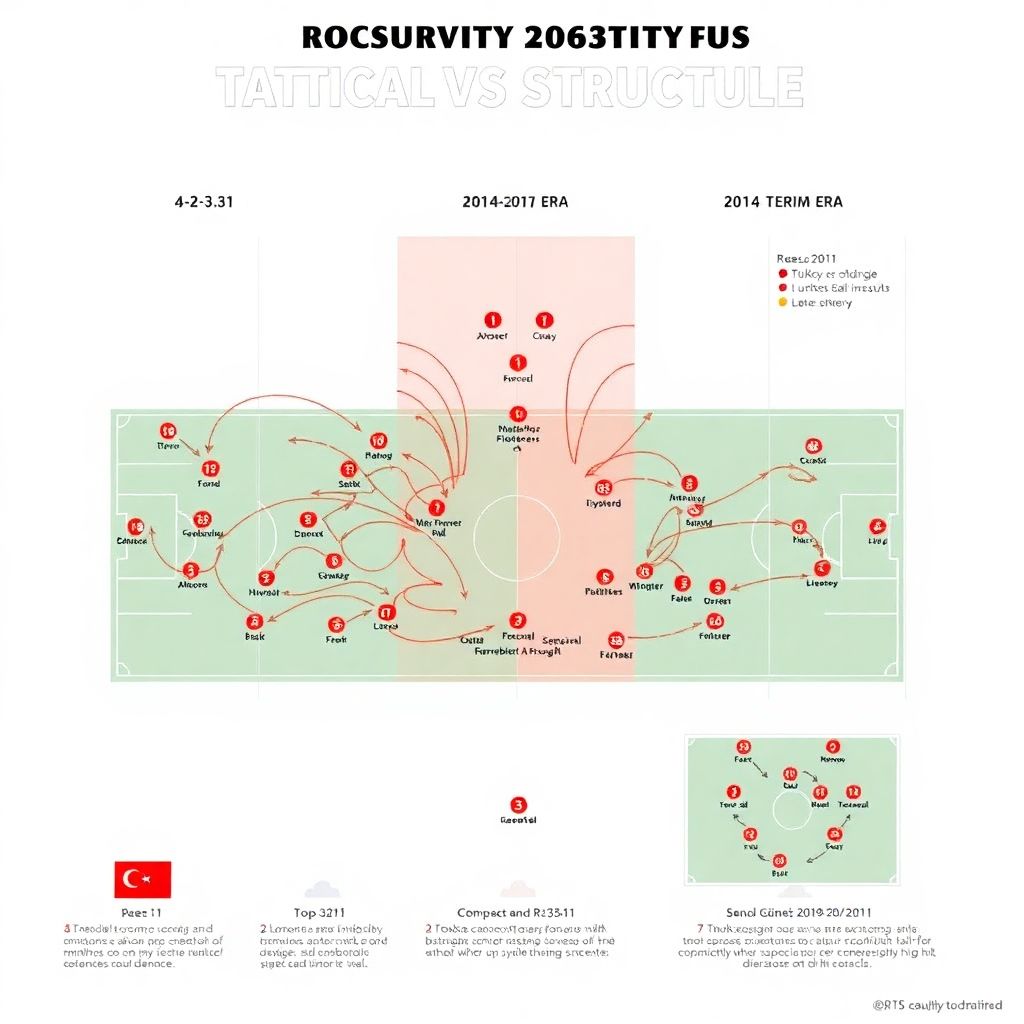
Setting the Stage: Why Turkey’s Tactical Journey Matters
Over the last ten years, the turkey national team tactical evolution last decade has been anything but linear. It’s swung between bold attacking ideas and cautious pragmatism, between emotional momentum and structural fragility.
This isn’t just a story about formations. It’s about:
– How Turkey tried to modernise its game
– Why some ideas clicked while others crashed
– What we can realistically expect next, looking ahead from 2026
I’ll walk through it шаг за шагом (step by step), with warnings about common misreadings and practical tips if you’re just starting to dive into turkey national football team tactics analysis.
—
Step 1. The Late Terim Era (2014–2017): Emotion vs Structure
The Core Idea
Under Fatih Terim’s last spell, Turkey leaned heavily on:
– Emotional intensity
– Individual talent in advanced areas
– Flexible but often vague positional play
On paper it was usually a 4-2-3-1 or 4-3-3. In reality, it was a shape that constantly morphed, especially in possession.
Key principles:
– Ball progression through technical midfielders rather than rigid patterns
– Freedom for creative players (e.g., Çalhanoğlu, Arda Turan) to drift inside
– Full-backs encouraged to push high, often simultaneously
In short: entertaining, sometimes brilliant, often chaotic.
Strengths and Weaknesses
Strengths:
– Turkey could raise the tempo and overwhelm weaker teams.
– The side thrived in emotionally charged games, especially at home.
– Players had license to improvise, which suited many of them.
Weaknesses:
– Rest defence (the team’s defensive structure when attacking) was fragile.
– The press was more about desire than coordinated triggers.
– Big gaps appeared between midfield and defence when attacks broke down.
Euro 2016: A Missed Tactical Opportunity
At Euro 2016, Turkey arrived with expectations but without a consistently rehearsed plan. The team’s turkey national team euro and world cup tactics breakdown from this era shows a pattern:
– Mid-block without a clear pressing identity
– Attacks built around individual flashes instead of repeatable movements
– Inconsistent spacing between the lines
Warning for analysts:
Don’t confuse possession numbers with control. Turkey could keep the ball yet remain tactically vulnerable because of poor spacing and weak counter-pressing.
Tip for beginners:
When you rewatch these games, pause in moments when Turkey loses the ball. Look at:
– Where the full-backs are
– How many players are behind the ball
– Whether anyone is close enough to press the ball carrier
You’ll quickly see why counter-attacks hurt them.
—
Step 2. Şenol Güneş (2019–2021): Peak Qualifying, Harsh Reality
The Reboot: Compact 4-1-4-1 / 4-2-3-1
Şenol Güneş brought a more clear-cut structure. His turkey football team playing style under different coaches phase can be summarised as:
– Defensive compactness first
– Controlled, selective pressing
– Fast vertical attacks once the ball was won
In Euro 2020 qualifying, this worked extremely well:
– A narrow, organised block
– Strong central defenders (Söyüncü, Demiral) protecting the box
– Quick transitions via Yılmaz, Cengiz Ünder, and others
Why It Worked in Qualifiers
1. Clear roles.
– Holding midfielder shielding the back line
– Wingers instructed to sprint into space, not just come short
– Full-backs more measured in their forward runs
2. Match context.
– Many opponents tried to break down Turkey’s deep block and got punished in transition.
– Turkey scored from fast counters and set pieces, not elaborate positional play.
3. Psychological clarity.
– Players knew the team’s identity: “Be hard to beat, then strike.”
Euro 2020 (played 2021): Tactical Plan Exposed
On the bigger stage, that same plan backfired. The best tactical analysis of turkish national football team in this tournament usually points to three main issues:
– Turkey couldn’t defend as low and reactively against better opponents; pressure built up.
– The team struggled to build from the back under heavy pressing.
– Transition outlets were isolated; counter-attacks died quickly.
Common mistake in analysis:
Blaming “lack of effort.” The running and desire were there. The core problem was structural: Turkey were too stretched when they tried to step up, and too passive when they sat back.
Quick checklist for your own review:
– Did players have obvious passing lanes in buildup?
– Were there short options between the lines, or only long balls?
– When the press started, did the second line follow, or did the forwards press alone?
Most answers lean toward “no”, and that’s a tactical, not mental, issue.
—
Step 3. The Kuntz Experiment (2021–2023): Half-Modernisation
Attempting a More Modern Style
Stefan Kuntz tried to edge Turkey toward a more up-to-date European model:
– More structured high pressing
– Shorter buildup from the back
– Efforts to stabilise possession in midfield
You could see the intention: transform a counter-attacking side into a proactive, ball-playing team.
Mixed Implementation
The problem? Implementation lagged behind ambition.
– Pressing triggers were not consistently understood.
– Distances between lines remained irregular.
– When the first press was beaten, the whole block looked exposed.
Turkey often ended up in a tactical “in-between”:
– Not compact enough to be a classic reactive side
– Not choreographed enough to dominate through possession
Warning for newcomers:
Don’t judge this era only by results in weaker Nations League groups. Look instead at:
– How clean the team’s buildup looks against a mid-press
– Whether the team can sustain pressure for more than a few minutes
– How many players are involved in the first build-up phase
You’ll notice that the idea was there, but automatisms (repeated, rehearsed patterns) were lacking.
—
Step 4. Vincenzo Montella and Euro 2024 (2023–2024): Structured Proactivity
Tactical Reset: From Emotion to Mechanism
With Montella, there was a visible shift toward method over emotion. The turkey national football team tactics analysis during this period shows several clear features:
– A 4-2-3-1 or 4-3-3 in base shape
– More patient buildup, including controlled use of the goalkeeper
– Better spacing between the lines, allowing cleaner progression
Key principles:
– Full-backs used asymmetrically (one goes, one stays)
– Double pivot or single 6 always offering passing angles
– Wingers alternating between width and half-spaces instead of both crowding the middle
Pressing and Defensive Structure
The press became:
– Higher on cue, but less wild
– Oriented by triggers (bad touch, backward pass, sideline trap)
– Supported from the back line, not just from the forwards
In a compact mid-block, Turkey showed:
– Better vertical compactness (less space between defence and midfield)
– Faster squeezing of space around the ball after turnovers
– More coordinated retreats when the press was broken
Tip for beginners:
When watching Montella’s Turkey, count how many players are within one screen (on TV) around the ball when they lose it. The higher that number, the more organised the team usually is.
Euro 2024: A Step Forward, With Caveats
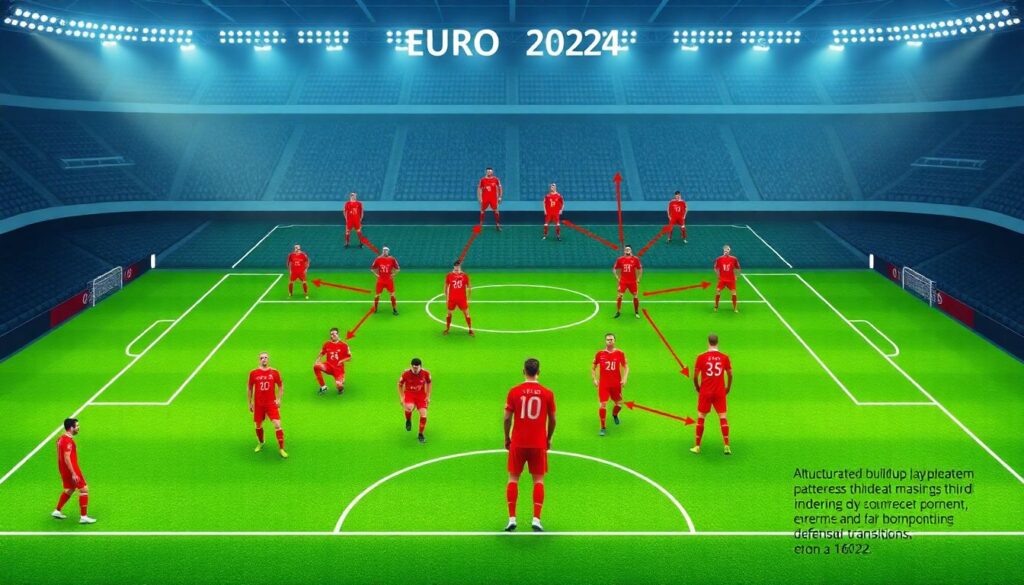
The turkey national team euro and world cup tactics breakdown for Euro 2024 suggests real progression:
– The team could build play against moderate pressure.
– There were visible patterns: third-man runs, overlaps timed with inside movements.
– Transition defending improved compared to previous tournaments.
But there were still issues:
– Under sustained siege from top-tier opponents, the box defence could still wobble.
– Individual errors in buildup occasionally undercut the plan.
– Some phases of games saw the team mentally and tactically drop back too deep.
Warning:
It’s easy to overrate this phase because it looked more modern. But looking modern is not the same as being consistently effective. The tactical progress was real, yet still incomplete.
—
Step 5. 2024–2026: Consolidation Attempts and Growing Pains
*(Given it’s 2026 now, we can step back and look at the arc a bit more clearly.)*
Tactical Identity by Mid-2020s
By 2026, Turkey’s identity has largely shifted toward:
– A proactive side that still values transitions
– Buildup from the back as a default, not an exception
– Flexible pressing: not constant, but well-timed and more collective
You see a hybrid model:
– Willingness to keep the ball in controlled phases
– Readiness to attack space quickly when it opens
– An evolving understanding of rest defence (keeping a solid structure behind the ball)
Structural Improvements
Across this period, the main upgrades have been:
– Positional discipline. Players are less likely to abandon their zones without cover.
– Passing triangles. More consistent support options around the ball-carrier.
– Rotations with purpose. Midfielders and full-backs swap spaces to unbalance opponents, not just out of habit.
This aligns with the global trend and positions Turkey better for modern tournaments.
Analyst’s tip:
If you compare early 2010s footage with mid-2020s matches, focus on:
– The number of times the goalkeeper is used to escape pressure
– The width of the back line in buildup
– The presence of at least one free midfielder between opponent lines
You’ll see the evolution quite clearly.
—
Frequent Misreadings and Pitfalls in Evaluating Turkey’s Tactics
To avoid superficial conclusions, keep an eye on these common errors:
– Overrating “fight” and underrating structure. Effort matters, but if spacing is poor, it won’t save you against elite teams.
– Blaming single players. Many errors at this level are system-induced—bad passing options, risky instructions—not just poor execution.
– Ignoring match context. A successful deep block vs a strong side may be a conscious choice, not tactical cowardice.
For newcomers to analysis:
– Always ask: *What is the intended game model?* (possession, transition, hybrid)
– Then judge whether Turkey is executing that model, not whether they “look busy.”
– Compare several games, not just one tournament exit.
—
How Coaching Changes Shaped the Evolution
The clearest way to see turkey football team playing style under different coaches is to think in three phases:
– Terim: High emotion, low structural consistency; freedom with the ball, vulnerability without it.
– Güneş: Compact and reactive; strong in qualifiers, limited attacking patterns against elite sides.
– Kuntz to Montella: Gradual shift toward a more modern, possession-capable but still transition-aware model.
Each coach left a tactical “layer”:
– Terim: belief in technical flair and improvisation.
– Güneş: discipline in compact defending and transitions.
– Montella: more nuanced buildup, pressing cues, and positional play.
The current mix in 2026 is basically this stack of layers, still being refined.
—
Practical Steps to Study Turkey’s Tactical Evolution
If you want to perform your own best tactical analysis of turkish national football team, especially over the last decade, here’s a step-by-step approach.
Step A. Start with Formations, Then Move Beyond Them
– Note the starting system (4-2-3-1, 4-3-3, etc.).
– Then watch what happens in three phases:
– Buildup
– Defensive block
– Transition (both directions)
Formations only tell you where players stand at kickoff, not how they interact.
Step B. Track 3 Key Indicators Over Time
1. Vertical compactness.
– Count how many metres (roughly) separate striker and last defender when the team defends.
2. Buildup risk profile.
– Are there safe short options, or only hopeful long balls?
– Does the team recycle possession back into defence and switch sides?
3. Counter-prevention.
– After losing the ball, are there 2–3 players in position to press?
– Or is the team stretched and chasing back?
Step C. Compare Tournaments and Qualifiers
Don’t just watch Euro or World Cup games; qualifiers show the intended baseline style when the pressure is lower. Then see how that style holds under tournament stress.
Common analytical trap:
Thinking a tournament disaster means the entire tactical idea is bad. Often, the concept is fine, but details (player selection, fitness, in-game adjustments) are off.
—
What Went Wrong Most Often: Tactical Warning Signs
Looking back, there are recurring weaknesses that analysts and coaches must keep in mind.
– Uncoordinated high presses. Forwards step up, midfield stays deep, back line hesitates → huge gaps.
– Slow defensive shifts. When the ball switches sides, the block doesn’t slide quickly enough → free crosses and cutbacks.
– Overcommitted full-backs. Both go high at once without cover → transitions kill the team.
If you’re new to tactics, watch for:
– Whether the back line moves *together* with the press
– How often the same type of goal is conceded (e.g., cutback from wide)
– If certain positions are constantly forced into last-ditch defending
These are structural red flags, not just “bad luck.”
—
Looking Ahead from 2026: Tactical Forecast for Turkey
Now to the question everyone really cares about: where is this all heading?
Short-to-Mid-Term Outlook (2026–2030)
Given the trajectory and the current blend of players, a realistic forecast:
1. Stabilised Hybrid Model
Expect Turkey to stick with a hybrid identity:
– Buildup from the back as the base
– Flexibility to drop into a compact block vs top sides
– Quick transitions utilised, but not the only plan
2. More Automated Possession Play
Over the next cycle, we should see:
– Better rehearsed patterns in the final third (third-man runs, overlaps-underlaps)
– Clearer roles for interior midfielders in creating overloads
– More sophisticated set-piece routines both in attack and defence
3. Incremental Defensive Maturity
The biggest gains will probably come from:
– Refining rest defence (how many stay behind the ball, and in what shape)
– Sharper pressing traps on the flanks
– A more unified offside line to squeeze space
Risks and Uncertainties
– Over-correction toward caution. After painful tournament exits, there’s always a temptation to become too reactive again.
– Coach turnover. A change in leadership could interrupt the current learning curve and reset many automatisms.
– Player profile mismatches. If youth development doesn’t supply enough press-resistant midfielders, the possession model may stagnate.
Optimistic but Grounded Projection
If the current tactical path is maintained and refined:
– Turkey should become a consistently awkward opponent for top nations rather than a boom-or-bust one.
– Qualifying for major tournaments should become the baseline, not a peak.
– Deep runs will still depend on matchups and individual form, but the structural floor will be higher.
In other words, the turkey national team tactical evolution last decade has moved from emotional volatility toward structured resilience. The next step is turning that structure into a reliable platform for high-level creativity, not just damage limitation.
—
Final Tips for Following Turkey’s Tactical Story
If you want to keep tracking this evolution beyond 2026:
– Rewatch key qualifiers and tournament games side by side to see trends.
– Pay more attention to spacing and movement than to commentary narratives.
– Continuously ask: *Is this a team with a clear game model—and is it getting better at executing it?*
Do that, and your own turkey national football team tactics analysis will naturally deepen over time, matching the complexity of a national side that has finally started to align its passion with a more coherent tactical identity.