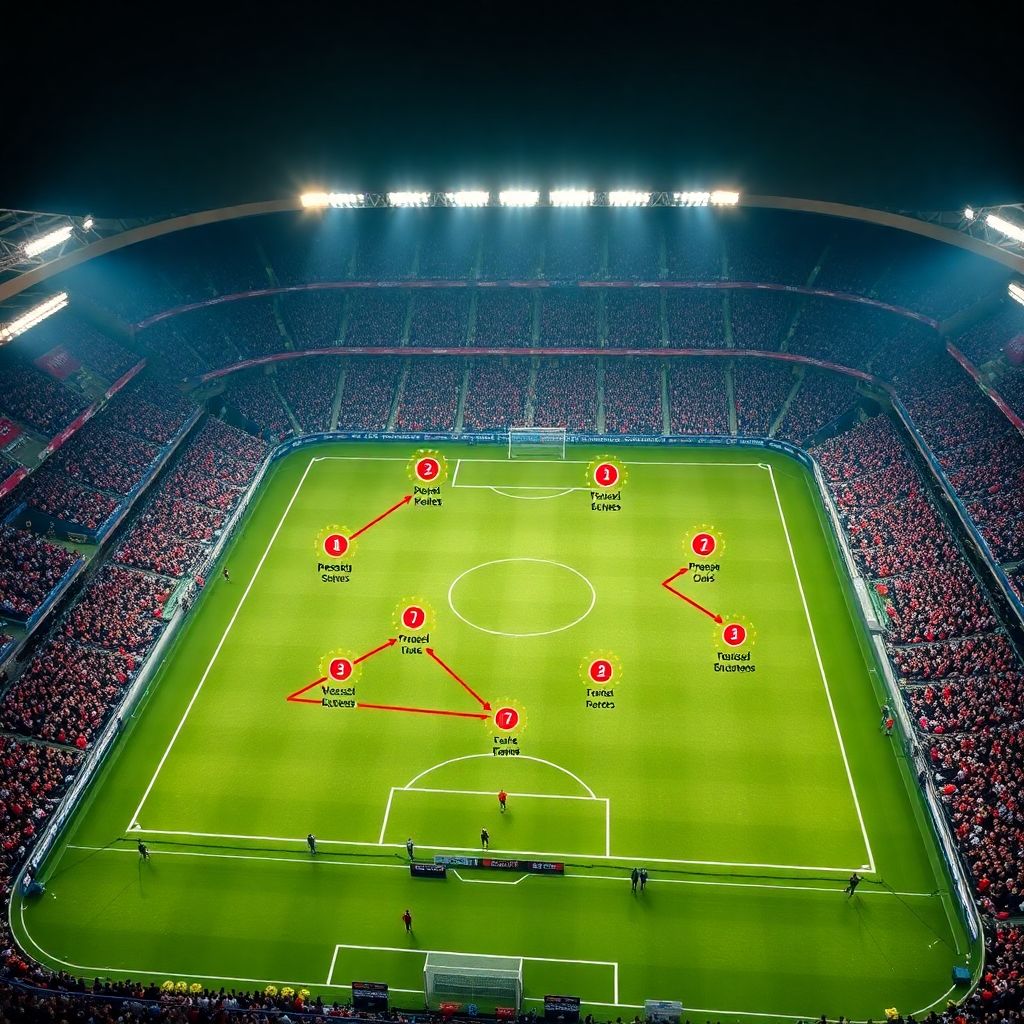
Origins: How 4-2-3-1 Landed in the Süper Lig
By 2026 it’s easy to forget that 4-2-3-1 wasn’t always the default in Turkey. In the late 90s and early 2000s, most big clubs still leaned on 4-4-2 or a narrow 4-3-1-2 with a classic No.10. The change started when Turkish coaches returning from Europe brought new ideas about pressing and compactness. The first versions were cautious: two holding midfielders sat very deep, full‑backs overlapped only on clear triggers, and the “3” behind the striker were more like conservative shuttlers than modern inside forwards.
The First Wave of Innovators
The early shift came from managers who wanted European control rather than pure chaos. Coaches like Christoph Daum and later Zico at Fenerbahçe moved toward 4-2-3-1 to stabilise transitions in Europe, even if line‑ups on paper sometimes looked like 4‑4‑1‑1. The logic was simple: Turkey’s tempo was high, counter‑attacks were ruthless, and teams needed a double pivot to survive. That period laid the groundwork for what we now call Süper Lig tactical evolution 4-2-3-1 formation, even if the shape was still rough around the edges.
From Shape on Paper to System: 2010s Transformation
By the early 2010s, 4-2-3-1 stopped being just a formation graphic and became a full game model. Fatih Terim at Galatasaray and Aykut Kocaman at Fenerbahçe started using it as a default against both domestic blocks and European pressing sides. The big shift was in the “3” line: wingers were encouraged to attack half‑spaces, not just hug the touchline, while the No.10 began pressing the opposition pivot instead of walking between the lines. That period is where any serious Süper Lig 4-2-3-1 tactics analysis has to start.
Key Structural Principles in the 2010s
In that decade, coaches refined three structural ideas that still define the Turkish version of 4‑2‑3‑1 today. First, the double pivot became asymmetrical: one controller, one runner. Second, the full‑backs were synchronised with the wingers so that only one side bombed on at a time. Third, the pressing trigger was codified: lose the ball, counter‑press for five seconds, then drop into a mid‑block if the ball escapes. These may sound obvious now, but in 2012–2015 they were a clear break from the more improvisational defending of the 2000s.
Technical detail block — Double pivot roles (2010s)
– One “6” stepping between centre‑backs in build‑up, turning 4‑2‑3‑1 into a 3‑1‑5‑1
– One “8” jumping to press opposition No.6 on goal‑kick build‑up
– Clear rule: if both full‑backs are high, at least one pivot stays between the lines
Modern Era (2018–2026): Pressing, Data and Hybrids
From about 2018 onward, the 4-2-3-1 in Turkey stopped being conservative and became a pressing machine. Abdullah Avcı at Başakşehir and later at Trabzonspor used it as a possession‑first structure, while Okan Buruk developed a more vertical variant with sharp counter‑pressing and rapid wing attacks. By 2026, the “basic” 4‑2‑3‑1 is almost extinct; what we actually see are hybrids that morph into 4‑4‑2, 4‑3‑3 or 3‑2‑5 depending on the phase of play. The number system stayed, but the behaviours changed dramatically.
What Makes the Turkish 4‑2‑3‑1 Distinct in 2026
The Süper Lig context is unique: high emotional tempo, noisy stadiums, and a league where momentum swings fast. That environment influenced how the 4‑2‑3‑1 evolved. Turkish sides emphasise fast vertical attacks, but now they balance that with structured rest‑defence. Top teams typically defend with at least four players behind the ball when crossing, precisely because they know how dangerous counters are in this league. The modern twist is that the No.10 is often a runner first and a playmaker second, pressing centre‑backs and sprinting into the box on the break.
Technical detail block — Rest‑defence in modern 4‑2‑3‑1
– Usually 2 centre‑backs + 1 pivot form the “triangle behind the ball”
– Far‑side full‑back tucks inside to create a temporary back three
– Winger on the far side holds a slightly deeper line to protect against long diagonals
Best 4‑2‑3‑1 Managers and Their Signatures
When we speak about the best 4-2-3-1 managers in the Turkish Süper Lig, we’re not listing names for nostalgia; we’re talking about specific tactical signatures. Avcı’s teams are defined by patient possession and strict positional play. Okan Buruk’s Galatasaray, especially from 2022 onward, built around an aggressive No.10, overlapping full‑backs and high‑risk vertical passes. Earlier, Kocaman’s Fenerbahçe used a safety‑first variant with a deeper block. Each of them used the same nominal structure, but the underlying principles could not be more different.
Case Study: Okan Buruk’s Hybrid 4‑2‑3‑1
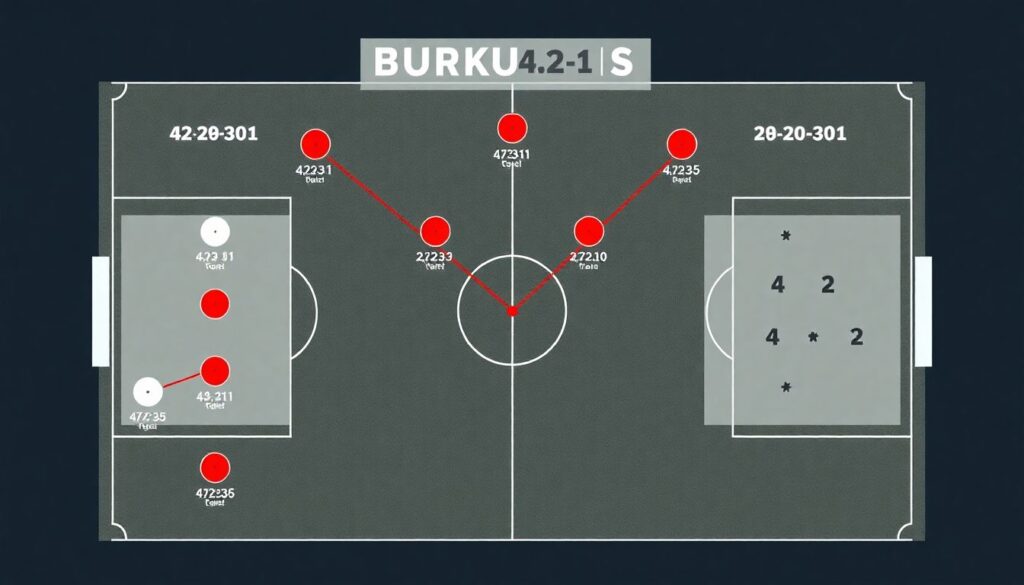
Buruk’s recent Galatasaray sides are a great live laboratory. In build‑up, one pivot drops to create a back three, the full‑backs push high, and the wingers come inside. On paper it’s still a 4‑2‑3‑1, but in possession it often looks like a 3‑2‑5. Out of possession, the shape flips to a 4‑4‑2 with the No.10 joining the striker to press the centre‑backs. That duality—positional patience in the first phase, then ruthless verticality once the ball hits the half‑spaces—captures where the formation is in Turkey right now.
Advanced Metrics: What the Numbers Say
Analytics have quietly reshaped how clubs think about structure. When you look at advanced stats for 4-2-3-1 teams in Süper Lig from 2020 to 2025, a few common threads appear. Teams using a well‑drilled 4‑2‑3‑1 tend to post higher PPDA (meaning more intense pressing) and slightly lower average pass length than those in a basic 4‑4‑2. They also concede fewer shots from central zones, because the double pivot and collapsing No.10 close the “golden zone” in front of the box. The shape isn’t magic, but it helps guide the behaviours analytics are rewarding.
Technical detail block — Typical data profile of top 4‑2‑3‑1 sides
– PPDA often in the 7–9 range: structured but not all‑out pressing
– 55–60% of attacks progressing through half‑spaces rather than the wings
– xG conceded per game reduced by ~0.15–0.25 compared to older 4‑1‑4‑1 setups
Using Data to Tune the Double Pivot
Coaches increasingly use tracking data to fine‑tune how the double pivot moves. Instead of telling one player to “stay” and the other to “go,” analysts measure how many times both are caught higher than the ball when possession is lost. When that number spikes, the staff tweak rest‑defence rules: maybe the near‑side pivot is no longer allowed to crash the box, or the far‑side winger has to stay a line deeper. In the Süper Lig’s chaotic rhythm, those small rules have a big impact on whether a 4‑2‑3‑1 looks solid or fragile.
Pressing and Counter‑Pressing: The Real Revolution
The biggest change from 2010 to 2026 is not where players stand, but how they hunt the ball. Early 4‑2‑3‑1 teams in Turkey often retreated into a low or mid‑block. Now the best sides use the No.10 and wingers as pressing triggers. As soon as the ball goes wide to an opposition full‑back, the winger jumps, the No.10 blocks the inside lane, and the far‑side winger tucks inside. The double pivot then squeezes the space behind. That coordinated pressure, not the starting formation, is what separates elite sides from the rest.
Technical detail block — Common pressing triggers in Turkish 4‑2‑3‑1
– Back‑pass from full‑back to centre‑back = front two sprint to press
– Square pass in midfield = nearest pivot jumps, others close cover shadows
– Lofted diagonal to far‑side wing = team drops to compact 4‑4‑2 block
How the Crowd Influences Tactical Choices
In the Süper Lig, tactics never exist in a vacuum; the stands shape decisions. Home crowds demand aggressive pressing and immediate forward passes, especially in big derbies. That social pressure is one reason why coaches prefer 4‑2‑3‑1 over more patient 4‑3‑3 structures—it offers the illusion of an extra attacker without sacrificing the protection of a double pivot. You can satisfy fans with numbers in attack while still having a safety net in rest‑defence, as long as your midfield understands timing and distances.
Practical Lessons for Coaches: Bringing 4‑2‑3‑1 to Life
If you’re designing a football coaching course 4-2-3-1 system Turkish league oriented, you should start from behaviours, not chalkboard lines. Base modules should focus on three pillars: double‑pivot spacing, winger–full‑back coordination, and role clarity for the No.10. Rather than running endless pattern plays, modern Süper Lig coaches build constraints‑based exercises: small‑sided games where the No.10 must choose between pressing and screening, or rondos that force the pivot to decide when to drop into the back line. The formation becomes a framework for decisions, not a rigid cage.
Core Training Priorities for a Turkish‑Style 4‑2‑3‑1
– Automate rest‑defence habits: at least three players behind the ball every time you cross
– Build winger intelligence: recognise when to attack the half‑space versus staying wide
– Clarify the No.10’s defensive job: first presser or passing‑lane blocker, not both at once
Future Trends: What 4‑2‑3‑1 Might Look Like by 2030
Looking beyond 2026, the direction is clear: more fluidity, more data, but the same underlying concepts. Expect even more back‑three morphing in possession, with full‑backs turning into auxiliary midfielders and the pivots acting as playmaking hubs. Younger coaches are already experimenting with “false full‑backs” in academy sides, where the base structure is still announced as 4‑2‑3‑1 for simplicity, but build‑up shapes are closer to 3‑2‑4‑1. The label may change, but the logic—two central protectors, three connectors behind a striker—will stay embedded in the Süper Lig’s tactical DNA.