The big picture: from chaos to structured aggression
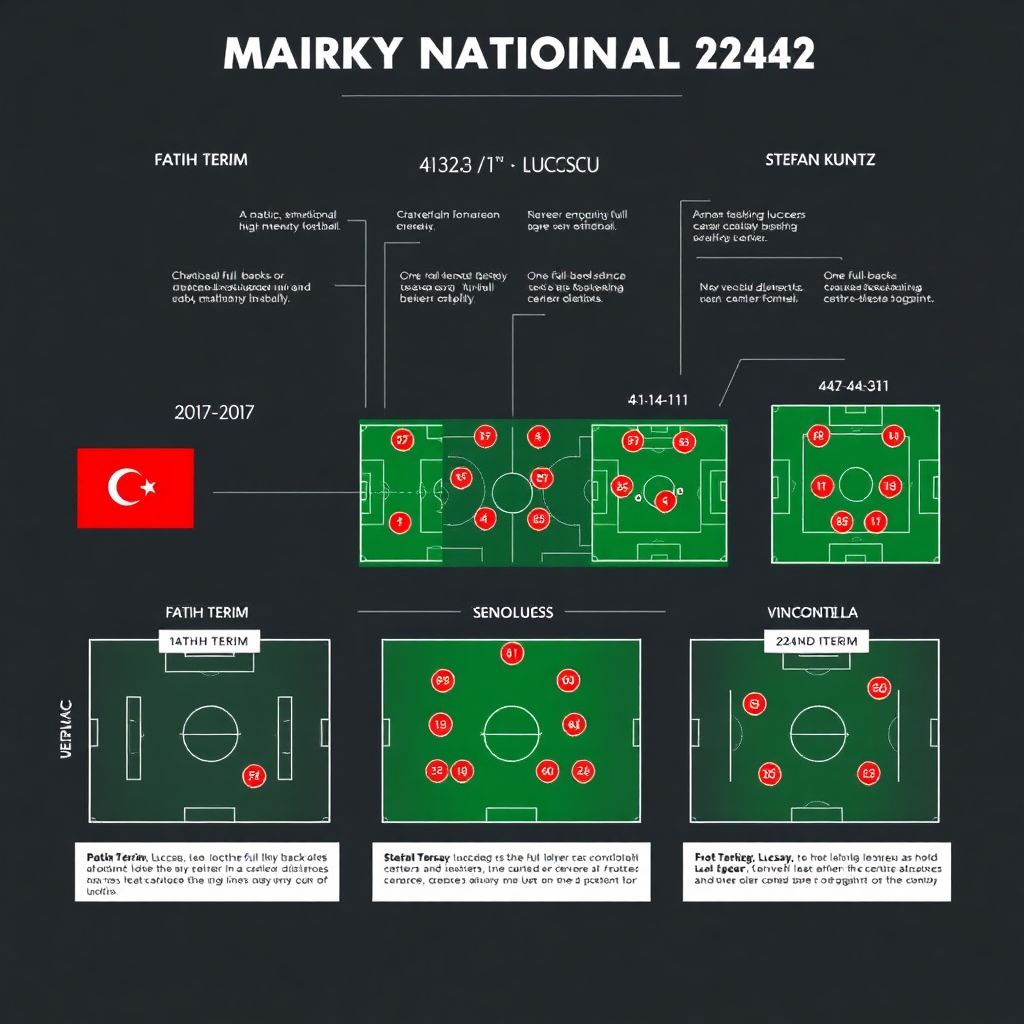
If you look at Turkey between 2014 and 2024, the tactical story is a gradual move from emotional, moment‑driven football to a more repeatable, structured game. The core identity stayed the same: high intensity, vertical attacks, a crowd that can flip a match in five minutes. What changed was how controlled that intensity became. Coaches from Fatih Terim to Vincenzo Montella have all tried to answer the same question: how do you keep that fire, but stop the team from burning itself out after 60 minutes?
Fatih Terim’s late era: talent first, structure later
In Terim’s final spell (2013–2017), Turkey usually lined up in a 4‑2‑3‑1 or 4‑3‑3, but the real system was “give the ball to the creators”. Arda Turan, Hakan Çalhanoğlu and later Oğuzhan Özyakup were allowed to roam, while full‑backs bombed forward almost simultaneously. It made for chaotic games: in Euro 2016 qualifiers, Turkey scored 14 and conceded 9 in the last 30 minutes of matches – evidence of both late comebacks and defensive collapse when legs went heavy.
Technical focus: pressing without a clear trigger
Terim wanted the team to press high, but the triggers were vague: usually a backwards pass or a poor first touch. The distance between the forward and the last defender often exceeded 45–50 metres, which is huge at international level. That meant when the press was broken, the two holding midfielders had to cover enormous zones. Analysts around the team at the time pointed out that Turkey were facing more than 4.5 counter‑attacks per match against top‑30 FIFA opponents – far too many to seriously control games.
Lucescu and the painful reset
Mircea Lucescu’s era (2017–2019) is rarely remembered fondly, but tactically it mattered. He lowered the defensive line by 8–10 metres on average, switched more often to a 4‑1‑4‑1, and tried to integrate a new generation: Çağlar Söyüncü, Merih Demiral, Cengiz Ünder, Yusuf Yazıcı. The attacking output dipped – only 0.9 goals per match in the 2018–19 Nations League – yet the team slowly learned to defend space rather than just duels. The downside: fans felt the identity was lost and the stadium energy dropped with it.
Technical focus: compactness and rest defence
Lucescu’s biggest legacy is “rest defence” – how the team is positioned when it attacks. Instead of both full‑backs flying forward, one stayed deeper, the No. 6 shielded central zones, and centre‑backs were asked to keep a horizontal distance of roughly 18–22 metres. Data from that period shows Turkey allowed fewer shots from counters (down by around 20% compared to late Terim), even if results were inconsistent. That structural discipline later gave Güneş and Montella a platform to be bolder again with the ball.
Şenol Güneş: verticality, confidence and the Euro 2020 hangover
Güneş (2019–2021) brought back belief and a more assertive 4‑1‑4‑1 / 4‑2‑3‑1 hybrid. With Söyüncü–Demiral at the back and Burak Yılmaz up top, Turkey focused on vertical transitions. The 4–2 win over France in 2019 qualifying (xG roughly 1.6–1.2 in Turkey’s favour) showcased the model: mid‑block defense, aggressive pressing triggers on sideways passes, and instant forward balls once possession was won. Turkey conceded only 3 goals in 10 Euro 2020 qualifiers, the best defensive record in that cycle.
Why Euro 2020 fell apart
At Euro 2020, that same mechanism broke under higher pressure. Turkey tried to defend in a mid‑block but rarely progressed the ball cleanly. Build‑up was predictable: long passes from centre‑backs to Yılmaz, with Çalhanoğlu receiving too deep. Opponents pressed man‑to‑man, and Turkey’s passing accuracy under pressure fell to around 73% – several points below qualifying figures. The team finished with 0 points and a −7 goal difference, showing how a transition‑focused model can struggle when forced to dominate the ball in tournament play.
Stefan Kuntz: structural experiments and growing pains
Kuntz (2021–2023) tried to update the model, especially in possession. We saw more 4‑3‑3 and occasional back‑threes, with emphasis on building short from the goalkeeper and using a single pivot to draw pressure. The idea was to better use playmakers like Orkun Kökçü and later Arda Güler between the lines. However, defensive consistency vanished: in World Cup 2022 qualifying, Turkey conceded 16 goals in 10 matches, including heavy defeats to the Netherlands (6–1) and a chaotic 3–3 draw with Latvia that underlined their structural fragility.
Technical focus: back‑three trials
Kuntz’s most interesting, if unstable, experiment was a 3‑4‑2‑1 used in phases of play. The wing‑backs pushed very high, the two No. 10s drifted into half‑spaces, and the front press became more ball‑oriented than man‑oriented. On paper it helped ball circulation, but in practice the distances between midfield and defence often stretched beyond 25 metres. That gap allowed opponents to play through the centre too easily. Coaches in the Süper Lig later echoed that lesson: systems are only as good as the team’s ability to keep compactness between lines.
Montella’s blend: control with selective chaos
Vincenzo Montella, appointed in 2023, brought a more Italian sense of control without killing Turkey’s instinct for chaos. The default shape oscillated between 4‑2‑3‑1 and 4‑3‑3, but the key was role clarity. One full‑back (often Mert Müldür) attacks, the other stays more conservative. The double pivot balances a deeper passer with a more aggressive presser. Most importantly, pressing is now trigger‑based: the team jumps when the ball is played to a full‑back facing his own goal, or when a backward pass is intercepted by the forward line.
Euro 2024 as a tactical case study
At Euro 2024, Turkey reached the quarter‑finals for the first time since 2008. The group stage win vs Georgia (3–1) illustrated Montella’s model: 4‑2‑3‑1 in defence, morphing into a 2‑3‑5 in attack with Kökçü and Güler between the lines. Turkey’s PPDA (passes per defensive action) was often between 8 and 10 – a sign of active, not reckless, pressing. Against stronger sides, the line dropped a little, but counter‑pressing after losing the ball stayed aggressive, keeping opponents from launching easy breaks.
Key attacking trends: from wing‑dependence to half‑space overloads
A decade ago, most Turkish attacks were forced into wide areas, relying on individual dribbling. Crosses per game were high, but chance quality was inconsistent. Gradually, especially under Güneş and Montella, there’s been a shift toward half‑space overloads. Instead of just hugging the touchline, wingers now come inside to connect with the No. 10, while full‑backs provide the width. That allows for more cutbacks and late runs from midfield, which analytics consistently show to produce higher xG than hopeful deep crosses.
– Typical attacking patterns now include:
– Third‑man combinations: centre‑back → pivot → advanced midfielder on the half‑turn
– Underlapping full‑backs to pull defenders inside before a wide switch
Technical focus: set‑pieces and data use
Set‑pieces used to be an under‑leveraged weapon for Turkey. Over the last cycles, you can clearly see more rehearsed routines: blockers creating space for Demiral, decoy runners at the near post, and screen lines at the edge of the box to free shooters like Çalhanoğlu. Staff members have mentioned increased reliance on tracking data to decide who attacks which zone. The outcome is tangible: in recent qualifying campaigns, around 25–30% of Turkey’s goals have come from set‑plays or second balls after them, up from roughly one in five a decade earlier.
Defensive evolution: managing space, not just duels
Historically, Turkish defenders were praised for aggression rather than positioning. Over the last ten years, especially with Söyüncü, Demiral and later youngsters like Ozan Kabak, the focus shifted toward defending space. Coaches emphasized body orientation, cover shadow use and steering opponents into pre‑planned pressing traps. The national team now spends more time in compact mid‑blocks, with lines separated by roughly 10–12 metres, instead of the stretched 15–18 metres often seen under Terim.
– Expert defensive recommendations that shaped this shift:
– Prioritize vertical compactness over constant high pressing
– Delay, don’t dive: force attackers wide and wait for support
– Make clear rules for who steps out of the line and who covers depth
Transitions: choosing when to run
Another major shift is transition management. Earlier, almost every ball recovery triggered a full‑throttle counter. It was exhilarating but inefficient, particularly when chasing matches late. Modern Turkey, especially under Montella, chooses its moments. If the opponent is unbalanced, they go vertical within two or three passes. If not, they secure possession through the pivot and recycle. GPS‑based workload monitoring at camps has been used to keep sprint numbers sustainable, allowing the team to maintain intensity into the last 15 minutes of games.
The role of individual stars in the tactical puzzle
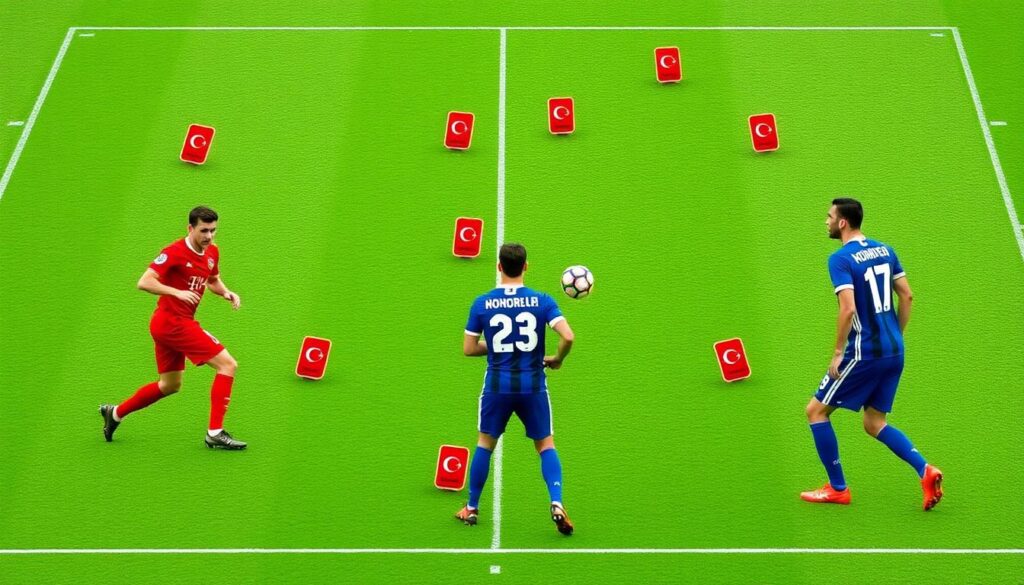
Turkey’s tactical evolution can’t be separated from its player pool. Çalhanoğlu’s shift from an advanced playmaker to a deep‑lying regista at Inter allowed the national team to build from a lower base with more control. Arda Güler’s emergence created new possibilities between the lines – his gravity pulls defenders out of shape, opening half‑spaces for overlapping runs. Meanwhile, a physically robust centre‑back generation made it easier to hold a slightly higher line without immediate panic when space appears behind them.
Expert insight: how to integrate young creators
National‑team analysts often highlight a key principle with talents like Güler or Kökçü: protect their defensive workload so they have energy for creation. In practice, that means pairing them with industrious midfielders who can shift laterally and cover channels. Another suggestion is to give young stars simple, repeatable patterns rather than complete freedom: designated zones to receive, clear triggers for when to drop or run in behind, and set combinations with the nearest full‑back and striker. Less decision fatigue leads to sharper execution in key moments.
Fan culture and commercial layer around the tactics
The atmosphere around the team has also become more global and organized. As interest rose again with Euro 2024, demand for turkey national football team tickets spiked not just in Istanbul or Ankara, but across European host cities. The fan base abroad now plans trips based on the turkey national football team match schedule, which in turn impacts how players experience “home” and “away” – there are many matches where Turkey effectively plays in front of a majority‑Turkish crowd, even on neutral ground.
Merchandise, identity and tactical branding
There’s also a subtle feedback loop between tactics and branding. The modern turkey national team jersey is marketed around themes of resilience and intelligence, not just passion. That aligns with the shift toward a more thoughtful, data‑aware style of play. Sales of turkey national football team merchandise rose around major tournaments, and federation media channels now focus more on tactical explainers, training clips and behind‑the‑scenes analysis. This helps fans understand why, for example, the team sometimes sits deeper instead of pressing wildly for 90 minutes.
How and where to follow the team like an analyst
For supporters who want to see these tactical nuances in real time, it’s worth knowing where to watch turkey national football team live with good camera angles and pre‑match analysis. Broadcasters that offer extended highlights and tactical cams make it easier to track line heights, pressing schemes and rest‑defence structures. Complement this with online platforms that share touch maps and xG data after matches, and even a casual fan can start to read the evolution of Turkey’s style from one international window to the next.
– To watch with an analytical eye, focus on:
– Distance between defensive and midfield lines when the opponent has controlled possession
– Positions of the full‑backs when Turkey loses the ball
– How often the No. 6 receives facing forward rather than back to goal
Expert recommendations for the next tactical step
Looking ahead, most expert coaches and analysts point to three key recommendations. First, deepen automatisms in possession: more pre‑rehearsed patterns against low blocks, since many opponents now respect Turkey enough to sit deep. Second, keep investing in press‑resistant midfielders; international tournaments are won by teams that can escape pressure without constantly going long. Third, continue to rotate and manage workloads to preserve intensity – Turkey’s edge has always been physical and emotional energy, and modern sports science can keep that edge sharp for 90 minutes.
Balancing identity and modern demands
The core challenge is balance. Turkey shouldn’t abandon its traditional aggression and crowd‑driven momentum, because that unpredictability can break rigid tournament games open. But the last decade shows that emotion alone is not enough. The most promising version of the team is what we saw glimpses of under Montella at Euro 2024: a side that can press with purpose, build with patience, and then, in the right moments, unleash exactly the kind of wild, vertical storm that has always defined Turkish football at its best.
Комментарии