Why the 4-2-3-1 Runs the Süper Lig (And Why It’s Not “One System Fits All”)
If you watch the Turkish league for even a couple of weeks, you start seeing it everywhere: one striker, three attacking mids, a double pivot behind them. On paper it’s simple, but in practice the 4‑2‑3‑1 in the Süper Lig is like a Swiss Army knife — same shape, wildly different uses.
This isn’t a dry manual; think of it as a deep dive with a coach’s whiteboard and a beer on the table. We’ll unpack why this shape dominates, how Süper Lig teams using 4-2-3-1 tactics actually look totally different from each other, and where coaches can push the system in non‑obvious, even slightly “weird” directions.
Historical Background: How the 4‑2‑3‑1 Became “Default” in Turkey
From 4‑4‑2 and 4‑3‑3 to the “Security Blanket” Shape

In the early 2000s, Turkish clubs leaned heavily on 4‑4‑2 and variations of 4‑3‑3. Two strikers, wide play, lots of crossing — very classic. But European competition started to expose a problem: Turkish midfields were getting outnumbered and outrun.
Coaches needed:
– One more passing option between the lines
– Better protection in front of often error‑prone back lines
– A way to fit in the “10” who didn’t always defend much
The 4‑2‑3‑1 solved all three:
– Two holding mids for stability
– A “10” plus two wingers to feed the lone striker
– Full‑backs with a bit more freedom to join attacks
Over time, what started as a “European solution” gradually turned into the standard template. Within a decade, if you took a snapshot of 4-2-3-1 formation analysis Süper Lig, you’d see that it wasn’t just the big three (Galatasaray, Fenerbahçe, Beşiktaş) using it; mid‑table and relegation‑battling sides adopted it almost by default.
Local Context: Why It Fits Turkish Football Culture
Two quirks of Turkish football made the 4‑2‑3‑1 particularly attractive:
– Many teams rely on foreign “10s” and wingers as their stars.
– Defensive organisation has often lagged behind attacking flair.
So you get a league where:
– The shape gives coaches defensive structure.
– The “three” behind the striker keeps room for individual flair.
– The double pivot hides some collective defensive weaknesses.
In short: the system bridged a cultural gap between chaos and control.
Basic Principles: What the 4‑2‑3‑1 Is Actually Trying to Do
The Core Idea: Control the Middle, Attack with Four
Strip away the jargon and the 4‑2‑3‑1 is built on two simple ideas:
1. Always have extra players near the ball in midfield.
2. Always have at least four players threatening the opponent’s box.
That’s why coaches who look for the best tactics for 4-2-3-1 football formation rarely start from the striker; they start from the double pivot and the “10.”
Key functional zones:
– The double pivot (the “2”) controls spacing, tempo, and cover.
– The “3” between the lines (10 + two wide playmakers/wingers) stretch and overload.
– The “1” pins the centre‑backs, opens space for others, and presses from the front.
The Double Pivot: The System’s CPU
If the double pivot is poorly built, the system collapses. In the Süper Lig, where transitions are brutally fast and chaotic, the two sixes/eights must:
– Occupy “rest defence” positions when the team attacks (protecting centre‑backs and halfspaces).
– Provide at least one vertical pass line between centre‑backs and the “10.”
– Slide wide to protect their full‑backs when possession is lost.
The more attacking full‑backs you have, the more conservative and positionally disciplined your pivots must be. Many Turkish teams get this wrong: they pick two similar “destroyers” or two similar “playmakers” and wonder why the block is either too passive or too open.
The “3”: Wide Playmakers vs Classic Wingers
Not all 4‑2‑3‑1s are built alike. Those three behind the striker define the personality of the system:
– Classic wingers: hug the touchline, stretch the play, cross a lot.
– Wide playmakers: drift inside, overload midfield, free full‑backs to attack the flank.
– Hybrid 10s on the wing: half‑space operators, combining and rotating with the central 10.
A possession‑oriented coach might turn the “3” into an extra midfield line, while a transition‑oriented coach uses them as sprinters ready to attack space the second the ball is won.
How Different Süper Lig Clubs “Bend” the 4‑2‑3‑1
1. Big Clubs: Territorial Dominance 4‑2‑3‑1
The giants usually face low blocks. Their 4‑2‑3‑1 is about suffocating territory, pinning the opponent back, and rehearsing patterns in the final third.
Typical traits:
– Full‑backs very high and wide, wingers coming inside.
– One pivot drops between centre‑backs to create a 3‑2 structure in build‑up.
– The “10” and weak‑side winger flood the box for cutbacks.
This morphs into a 2‑3‑5 or 3‑2‑5 in possession. The centre‑forward’s job is less about scoring every chance and more about:
– Occupying both centre‑backs.
– Making space for the inverted wingers.
– Pressing the first pass after a turnover.
In this model, the 4‑2‑3‑1 is just a starting point; in attack it’s almost a 3‑2‑5 disguised.
2. Mid‑Table Sides: Reactive, Transition‑Heavy 4‑2‑3‑1
Teams in the middle of the Süper Lig food chain often use the shape more defensively:
– The wingers drop into almost a flat 4‑4‑1‑1 in deep defence.
– The “10” is the outlet on counters, not a classic playmaker.
– The striker runs channels and presses, rather than acting as a target man.
Here, the double pivot is instructed not to over‑commit. One holds the central zone; the other has freedom to attack the passing lane to the opposition pivot. When they win the ball, the first action is vertical: find the 10’s feet or the winger in space.
This style suits the league’s physicality and the fact that many teams field one or two technically gifted but defensively lazy attackers they want to “hide” out of possession.
3. Relegation Fighters: Survival‑Mode 4‑2‑3‑1
At the bottom end, 4‑2‑3‑1 is sometimes just an organised 4‑4‑1‑1 with a label upgrade. The attacking three behind the striker are often:
– One creative player who is basically exempt from deep defending.
– Two hard‑working wide players who double as auxiliary full‑backs.
The structure is kept extremely compact. Distances between the back four and the pivots are tight, lines move as a block, and the main goal is:
– Don’t concede first.
– Use set‑pieces and fast breaks as the primary attacking weapons.
From the outside, these might look “boring,” but in a league full of emotional swings and tactical chaos, this disciplined version of 4‑2‑3‑1 can be the difference between staying up and going down.
Common Misconceptions About the 4‑2‑3‑1 in the Süper Lig
Myth 1: “It’s a Defensive System”
The label “two defensive mids” is misleading. The pivots aren’t necessarily destroyers; they’re stabilisers. In a high‑press 4‑2‑3‑1, the shape is one of the most aggressive you can use:
– Three players press the back line.
– Wingers jump on full‑backs.
– The 10 shadows the opposition pivot.
Whether it’s defensive or attacking depends far more on:
– Starting positions of the back four and pivot.
– Trigger rules for pressing.
– Risk level allowed in rest defence.
Treating 4‑2‑3‑1 as inherently conservative is a shortcut that leads to mediocre football.
Myth 2: “Every 4‑2‑3‑1 Is Basically the Same”
On the broadcast, the graphics show the same: 4‑2‑3‑1. But a coach’s version can vary massively depending on:
– Type of 10 (runner vs passer vs dribbler).
– Type of wingers (inside forwards vs classic wingers).
– Build‑up structure (2‑4, 3‑2, 2‑3‑2‑3, etc.).
That’s why serious 4-2-3-1 formation analysis Süper Lig work always goes beyond the starting positions and into behaviours: who drops, who overlaps, who inverts, and how they react on loss of possession.
Myth 3: “You Just Need One Good 10 and a Striker”
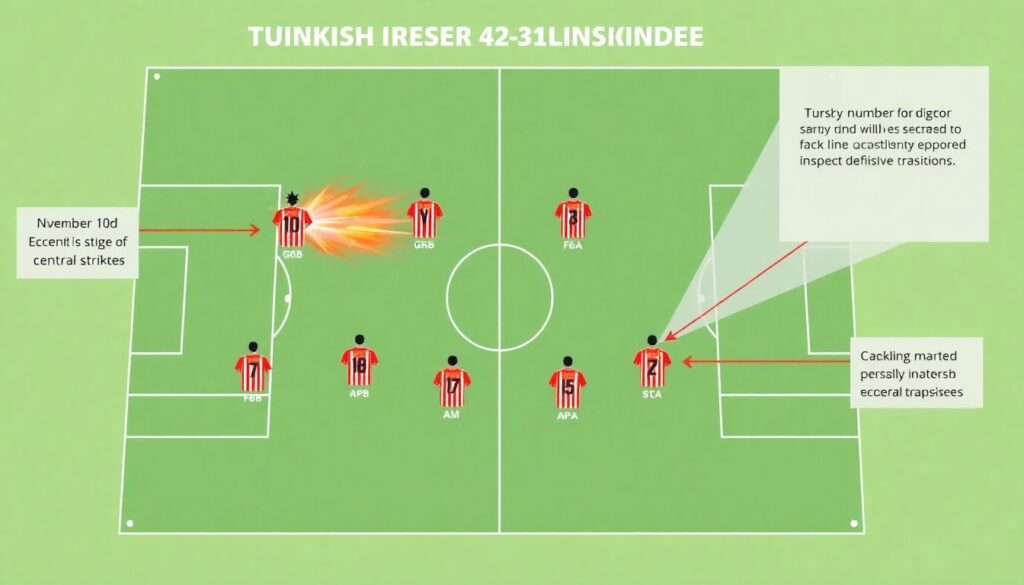
In Turkey particular, clubs overspend on the “10” and striker while under‑investing in the pivots and full‑backs. The result:
– A flashy front line stranded with poor service.
– A back line constantly exposed in transition.
In modern 4‑2‑3‑1, the quality and intelligence of:
– The right‑sided pivot.
– The ball‑progressing centre‑back.
– The more reserved full‑back.
often determine the ceiling of the team more than the 10 does. The “stars” finish the actions; the structure creates them.
Non‑Standard Tweaks: How to Evolve the 4‑2‑3‑1 in the Süper Lig
Asymmetry by Design, Not Accident
One of the most underused ideas: build an intentionally lopsided 4‑2‑3‑1.
Example concept:
– Left‑back plays like a winger (high and wide).
– Left winger comes inside as a second striker.
– Right‑back stays deeper as a third centre‑back.
– Right winger stays wide and holds width.
In possession this becomes:
– A 3‑2 base (RB + CBs) for security.
– A left‑side overload (LB + LW as striker, + 10 drifting).
– A weak‑side 1v1 weapon (RW vs full‑back).
You still defend in a classic 4‑4‑1‑1 or 4‑4‑2, but your attacking rest shape is custom‑built around your best players instead of a symmetrical template.
Rotating the “10” Into the Pivot Line
A more radical tweak: use a 10 who can drop into the double pivot to create a 3‑man midfield in build‑up. This turns your 4‑2‑3‑1 into:
– 2‑3‑2‑3 in early build‑up.
– 4‑2‑3‑1 in organised defence.
– 2‑3‑5 in the final third.
The logic:
– Against high presses, having a 3v2 in the middle (two pivots + 10 dropping) breaks lines.
– Once the team passes the first line, the 10 sprints into the space between opposition midfield and defence.
Few Süper Lig sides do this consistently, mostly because it demands a 10 with engine, discipline, and timing — not just flair. But when executed, it makes man‑oriented pressing schemes fall apart.
Using a “False Full‑Back” Instead of a Classic Inverted Winger
Everyone talks about inverted wingers; fewer talk about inverted full‑backs in 4‑2‑3‑1 in this league context.
Alternative idea:
– Keep wingers wide to stretch the last line.
– Ask the full‑back on the strong side to invert next to or ahead of the pivot.
– Use the near‑side pivot to cover the vacated zone at full‑back in transition.
This can:
– Create a box or diamond in midfield.
– Give cleaner central progression.
– Free the 10 from dropping too deep.
It also suits squads where full‑backs are ex‑midfielders or technically strong, but wingers are more traditional and prefer chalk on their boots.
Practical Coaching Takeaways for Süper Lig Context
What Coaches Should Actually Train (Not Just Draw)
If you’re designing sessions or even building an online course tactical analysis 4-2-3-1 system, the key is to link the chalkboard model to repeatable on‑pitch behaviours.
Core training priorities:
– Double pivot coordination: staggering, cover, and who steps to the ball.
– Role of the 10 in pressing: when to jump, when to screen.
– Winger–full‑back relationships on both sides: who goes, who stays.
– Rest defence mechanics when both full‑backs push up.
Simple but powerful training ideas:
– Positional games where the 10 must constantly choose between dropping to receive or pinning the 6.
– Transition games that punish poor pivot spacing with immediate counterattacks.
– Pattern play where one side is asymmetric (inverted full‑back) and the other is classic (overlapping full‑back).
Building a Game Model, Not Just Copying a Shape
Too many teams copy “a successful 4‑2‑3‑1” without asking: what are our players actually good at?
A more intelligent process:
– Start from your best three players and define zones where they’re most dangerous.
– Align your asymmetries (strong side vs weak side) to boost those players.
– Choose the pivot profiles (6/8 mixes) to protect their weaknesses.
Resources like a serious football coaching book 4-2-3-1 formation can help, but only if you treat them as frameworks, not strict recipes. In the Süper Lig especially, squad balance changes fast; imports, loans, and mid‑season overhauls are common. The coaches who thrive adapt the 4‑2‑3‑1 to their players, not the other way around.
Conclusion: The 4‑2‑3‑1 Is a Language, Not a Script
In Turkey, the 4‑2‑3‑1 isn’t going away. It fits the league’s rhythm, the player market, and the cultural preference for a “10” plus wingers. But thinking of it as a single tactical system misses the point.
It’s more useful to see it as a language:
– Same grammar (double pivot, line of three, lone striker).
– Different dialects (possession, transition, survival mode, asymmetric builds).
Coaches who treat the 4‑2‑3‑1 as a flexible platform — willing to skew it, invert it, and even “break” it in creative ways — will keep finding new edges in a league where everyone lines up in roughly the same shape, but very few use it to its full potential.