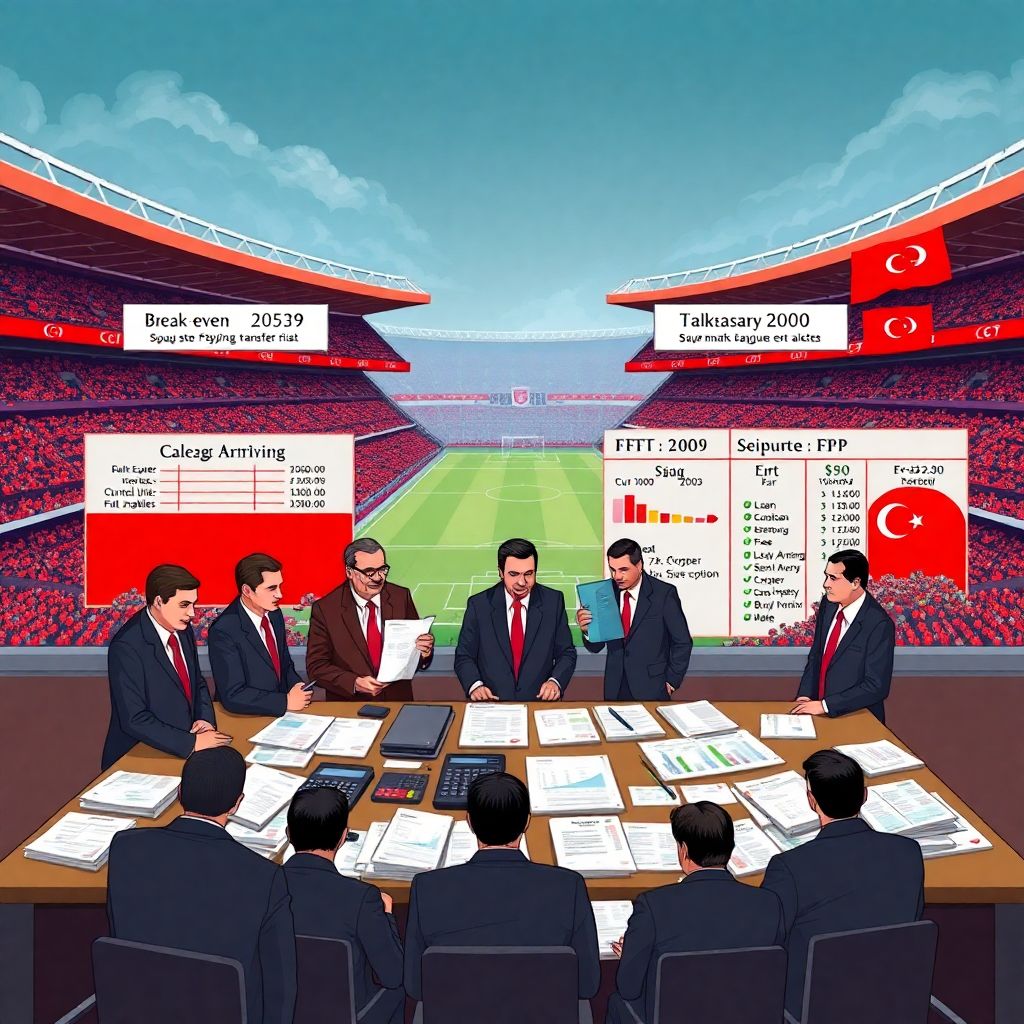
The story of how Financial Fair Play reshaped Turkish clubs isn’t just about dry regulations; it’s about how Galatasaray, Fenerbahçe, Beşiktaş and others went from transfer binges to calculators and spreadsheets. To understand why you now read turkish football transfer news full of loans, free agents and “obligation to buy” clauses, you have to go back to the early 2010s, when UEFA finally decided that permanent overdrafts and political bailouts were no longer a sustainable business model for European football. Turkish sides, who had long relied on ambitious presidents and short‑term borrowing, were suddenly under the microscope.
From glory years to financial hangover

In the late 90s and 2000s, Turkish clubs chased status as much as success. Galatasaray’s 2000 UEFA Cup win and regular quarter‑final runs set a high bar, and boards believed that buying big names guaranteed progress. The currency was stronger, banks were generous, and wage inflation felt like someone else’s problem. That model started to crack after the global financial crisis and, crucially, after UEFA rolled out Financial Fair Play in 2010. As the Turkish lira weakened in the mid‑2010s, euro‑denominated contracts exploded in cost, and debts ballooned. When UEFA began a deeper european transfer market analysis, Turkish balance sheets stuck out for the wrong reasons: high wages, low equity, volatile income and heavy dependence on unpredictable Champions League revenue.
Key moments: sanctions that changed behaviour
The turning point came with concrete sanctions. In 2016, Galatasaray were banned from UEFA competitions for one season for breaching FFP break‑even requirements, after years of aggressive spending and limited cost control. Beşiktaş, Fenerbahçe and Trabzonspor all signed settlement or monitoring agreements, committing to cap squad costs and reduce deficits over several seasons. These were not symbolic slaps on the wrist: clubs had to limit net transfer spending, cut wage bills and report detailed financials to UEFA. Some had prize money withheld whenever targets were missed. Suddenly, the risk of losing European exposure—and the lucrative TV pool linked to turkish clubs uefa champions league tickets—forced boards to treat budgets as seriously as tactics.
Technical detail: how FFP really measures a club
На практике требования FFP сводятся не только к одному показателю.
Technical detail block – core metrics used by UEFA
– Break‑even result: clubs must roughly balance “relevant income” and “relevant expenses” over a rolling multi‑year period, with a limited acceptable loss.
– Squad cost ratio (new rules): total spending on wages, transfers (amortisation) and agents must fall below a set percentage of club revenue, phased down over time.
– Overdue payables: no long‑term unpaid wages, taxes or transfer fees.
Для турецких клубов слабые коммерческие доходы и валютные риски делают выполнение этих критериев особенно болезненным.
Transfer strategy under the FFP microscope
Once FFP bit, recruitment habits changed overnight. Instead of paying big fees for aging European stars, Turkish clubs started scouring South America, Africa and second‑tier European leagues for cheaper assets with resale value. Loan‑with‑option deals became standard because they pushed the decisive cash outlay into the future and limited amortisation if the option wasn’t triggered. You can see this directly in turkish football transfer news: more emphasis on free agents, shorter contracts for veterans, and performance‑based bonuses instead of huge fixed salaries. Clubs also began using sell‑on clauses and buy‑back options more creatively, trying to turn at least a few signings per window into profitable exits that soothe the break‑even calculation.
Wages, currencies and the Turkish reality
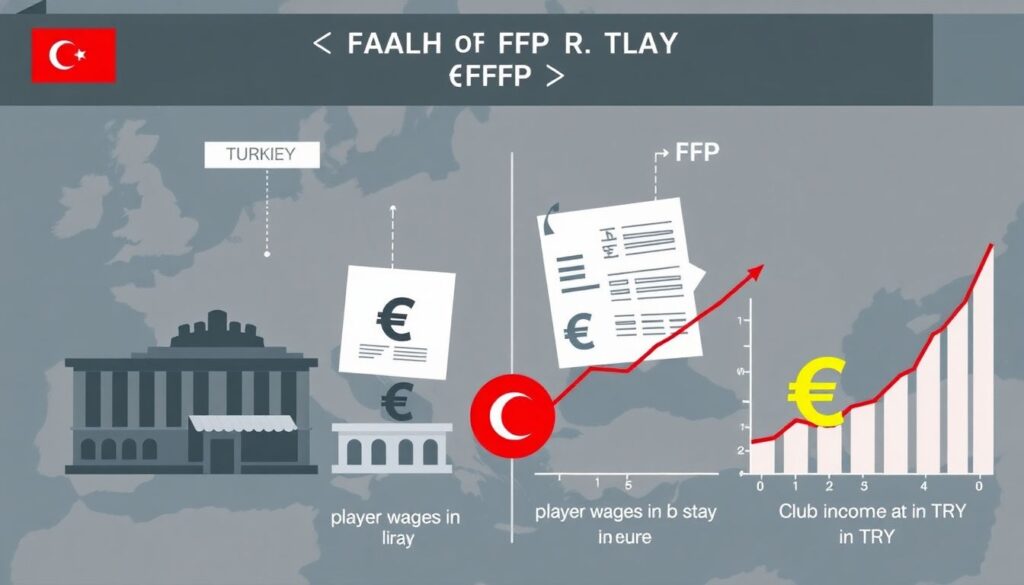
FFP doesn’t care whether your local currency collapsed; it still evaluates in euros. That’s brutal for Turkey, where player contracts are commonly in euros or dollars, but a big slice of domestic income is in lira. As the lira weakened in the late 2010s and early 2020s, wage‑to‑turnover ratios in some clubs shot past 80–90%, far above the levels UEFA considers healthy. To adapt, executives started pushing for mixed‑currency contracts, lira‑denominated bonuses and automatic wage‑adjustment clauses. Some clubs renegotiated older euro deals to avoid breaching limits. FFP effectively forced Turkish sides to treat currency risk as a core part of sporting strategy, not just a headache for the finance department.
Technical detail: amortisation, contracts and “creative” accounting
Technical detail block – why contract length matters
Suppose a club buys a player for €10 million on a 5‑year deal. In FFP terms, it doesn’t book a single €10m hit; it amortises €2m per year. A longer contract means a lower annual hit, but higher long‑term risk if the player underperforms. Turkish clubs have sometimes used extended contracts—4 or 5 years for players near 30—to reduce short‑term amortisation and fit within FFP windows. UEFA now watches this pattern more closely, limiting extreme contract lengths. Bonuses, loyalty payments and agent fees are also capitalised or expensed according to strict rules, so “creative” deals can still show up clearly in the monitoring process.
Impact on competitiveness in Europe
Has FFP made Turkish clubs weaker on the pitch? In the short term, yes. Reduced net spending and wage cuts made it harder to compete with Premier League and La Liga sides, whose media income dwarfs the Süper Lig. Deep Champions League runs have become rarer, and qualification itself is more volatile. At the same time, there’s a subtle advantage: leaner squads with higher running intensity and younger profiles have occasionally punched above their weight, especially in the Europa League and Conference League. For fans hunting the best turkish football jerseys shop online, the badge still matters, but the names on the back are increasingly unknown talents rather than ageing superstars collecting a final paycheque.
What this means for transfers in the mid‑2020s
By 2026, the “old normal” of Turkish clubs outbidding mid‑table Serie A or Ligue 1 sides is mostly over. Instead, the market niche has shifted. Turkish sporting directors now focus on 22–25‑year‑old players from undervalued leagues, offering a big stage, passionate crowds and the possibility of a quick move to a top‑five league. From a european transfer market analysis perspective, Turkey has become more of a stepping‑stone ecosystem than a final destination. Domestic academies are receiving relatively more attention, too, because homegrown players are cheap in FFP terms and help meet UEFA squad quotas, reducing the need for large transfer fees.
Three practical lessons for Turkish clubs
1. Front‑load analysis, not emotion. Before authorising any transfer, clubs must model currency scenarios, likely European income, and resale potential; the days of “sign now, justify later” are gone.
2. Build a pipeline, not a collection. A clear pathway from academy to first team to profitable sale is the only sustainable way to handle FFP while remaining competitive.
3. Protect Champions League access. Domestic strategy must account for the huge swing between playing and missing out on Europe; budgets should be based on conservative forecasts, with upside treated as bonus rather than baseline. These discipline points are the real competitive edge in an FFP era.
How fans and media should read FFP‑era news
Supporters and journalists also need to upgrade their lens. When you follow turkish football transfer news now, looking only at the size of a fee misses half the story. Questions like “What’s the annual amortisation?”, “How does this affect the squad cost ratio?” or “Is there resale potential in three years?” are just as important. Understanding uefa financial fair play rules explained in simple terms helps fans judge whether a splashy rumour makes sense or is pure fantasy. In the long run, clubs that communicate transparently about their financial plans tend to build more patience among supporters when a star is sold or a short‑term opportunity is sacrificed to protect medium‑term stability.
The road ahead: regulation as competitive skill
Financial Fair Play isn’t going away; it’s evolving into even stricter squad‑cost limits. For Turkish clubs, the challenge is to turn compliance into a competitive advantage instead of a handicap. Those who master detailed planning, currency hedging, data‑driven scouting and smart contract design will still find ways to assemble strong squads within the rules. Those who cling to the old habit of chasing headlines may keep bumping into sanctions and licence issues. In other words, the European transfer market is no longer won just on the pitch or in back‑room negotiations—it’s also won in the finance office, where every deal is judged not only on talent, but on how it looks under UEFA’s unforgiving spreadsheets.