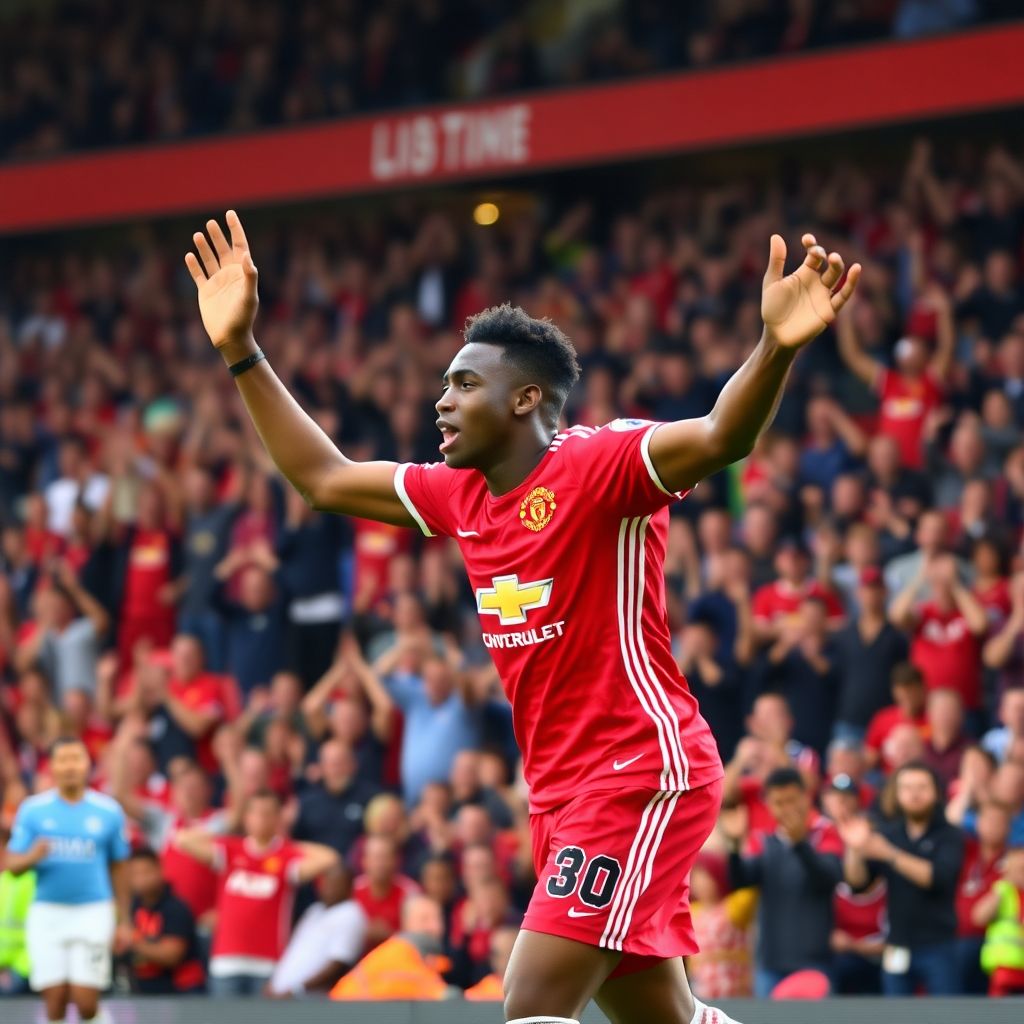
Manchester United dreaming of signing Victor Osimhen
Manchester United have set their sights on Victor Osimhen as a marquee attacking signing, with the club hierarchy reportedly “dreaming” of bringing the Nigerian international to Old Trafford ahead of next season.
The 28-year-old forward has been a standout performer for Galatasaray, emerging as one of the most decisive attacking players in Europe this year. With 22 goals already to his name this season, he has once again underlined his reputation as a prolific finisher and big‑game presence. That kind of output has naturally caught the attention of Manchester United, who are determined to strengthen their attacking department.
United’s need for a new striker is obvious. The team has lacked consistent firepower in the final third, and too much of the scoring responsibility has been placed on a small group of players. Bringing in an experienced, proven goalscorer like Osimhen would immediately raise the level of the forward line and provide the manager with a different dimension in attack.
One of Osimhen’s biggest selling points is his adaptability and track record across multiple top divisions. Having already showcased his qualities in France, Italy and Turkey, he has proven he can adjust quickly to different tactical demands and styles of play. His blend of physical strength, acceleration, aerial presence and intelligent movement suggests that he is well-equipped for the intensity of English football.
From Manchester United’s perspective, depth and variety in the attacking unit are now non‑negotiable, especially with the club set to compete on multiple fronts next season. The idea internally is not only to sign a starting-calibre striker, but also to build a frontline that can rotate without a significant drop in quality. In that context, Osimhen is viewed as an ideal profile: experienced, reliable, and still operating at the very peak of his powers.
A key aspect of the club’s planning revolves around how Osimhen would work in tandem with Benjamin Sesko. The Slovenian international is seen as a long-term project and focal point, but he cannot shoulder the full goal-scoring burden alone. Osimhen could share that responsibility, either partnering Sesko in a two‑man frontline or alternating with him depending on the opponent and competition. Such flexibility would make United more unpredictable and harder to defend against.
For Osimhen himself, the prospect of a move to the Premier League could be particularly appealing at this stage of his career. At 28, he is in what many consider the prime years for a striker. A transfer to a club of Manchester United’s stature would give him the opportunity to test himself in arguably the most competitive league in the world, while also competing regularly for major trophies and individual honours.
There is also the question of personal motivation. After achieving so much in Turkey and establishing himself as one of Galatasaray’s most decisive players, Osimhen may feel he has little left to prove in the Süper Lig. A new challenge, a new environment and the chance to write a fresh chapter in his career could all play into his thinking if a formal offer arrives from England.
However, United are not alone in their admiration. Chelsea have also been credited with strong interest in Osimhen, viewing him as a solution to their own long‑running issues in front of goal. The London club’s involvement complicates the situation: it introduces competition, potentially drives up the asking price, and forces Osimhen to weigh up not just financial terms, but also sporting projects, likely roles, and the direction of each club over the coming years.
From Galatasaray’s side, losing a player of this calibre is not something they will entertain lightly. Osimhen is a cornerstone of their attack, and replacing his goals and influence would be extremely difficult. As a result, any club wishing to sign him should expect tough negotiations and a premium price. Galatasaray know they hold a valuable asset and will be keen to maximise his transfer fee, especially with multiple elite clubs circling.
Whether Manchester United are prepared to “break the bank” is a central question. The club has been more cautious in recent windows, mindful of both financial regulations and the need to avoid repeating past mistakes on oversized contracts. To secure Osimhen, United may need to commit to a hefty transfer fee and a significant salary package, while also ensuring the deal fits within their broader squad-building strategy. Balancing ambition with sustainability will be crucial.
The timing of this potential transfer also intersects with a pivotal moment in United’s sporting project. The club will be back in the UEFA Champions League next season, which places even greater emphasis on squad depth and top-level quality. Competing in Europe’s premier club competition demands not just a strong starting XI, but also a bench full of players capable of stepping in without weakening the side. An addition like Osimhen would directly address that requirement.
On the pitch, his profile seems perfectly aligned with what United need. Osimhen thrives on quick transitions, can run in behind high defensive lines, and is equally comfortable battling centre‑backs physically in more static attacks. His movement in the penalty box often creates space for attacking midfielders, while his ability to press from the front fits with a more energetic, aggressive style of play.
There is also an intangible element to such a signing: message and mentality. Bringing in a striker widely regarded as one of the best in the world would send a clear signal to the rest of the league-and to United’s own dressing room-that the club is serious about closing the gap on the likes of Manchester City and Arsenal. Elite players tend to attract other elite players, and Osimhen’s arrival could act as a catalyst for further high‑level recruits.
At the same time, United must weigh the risks that accompany any major transfer. A big fee raises expectations, scrutiny and pressure. The Premier League’s physical intensity, congested fixture schedule and tactical complexity can pose challenges even to proven stars from other leagues. The club will have to be confident not only in Osimhen’s talent, but also in his durability, mentality and willingness to adapt to a new environment.
If United do go all in, the hope is that Osimhen would make an immediate impact. With his scoring record, versatility and experience in European competitions, he appears well-suited to hit the ground running rather than needing a long acclimatisation period. That immediacy could be crucial as United aim to start next season strongly in both domestic and continental competitions.
Long term, the plan would likely involve building an attack around a core of complementary profiles: Sesko’s height and link‑up play, Osimhen’s explosive movement and penalty-box instincts, and creative support from wide players and attacking midfielders. Such a structure would give United the tools to break down low blocks, threaten on the counter and dominate in big matches-something the club has struggled to do consistently in recent years.
Ultimately, the pursuit of Victor Osimhen reflects where Manchester United see themselves and where they want to go. To genuinely challenge for Premier League and Champions League titles, they must populate the squad with players who are already operating at the highest level. Osimhen fits that description. If the financial and sporting pieces fall into place, his arrival could mark a defining moment in United’s attempt to re-establish themselves among Europe’s elite.
For now, the dream of seeing the Nigerian striker leading the line at Old Trafford remains just that-a dream. But with Champions League football secured, a clear need for a top-class centre forward and a player seemingly ready for his next big step, all the ingredients are there for Manchester United to make a serious push for Victor Osimhen in the upcoming transfer window.