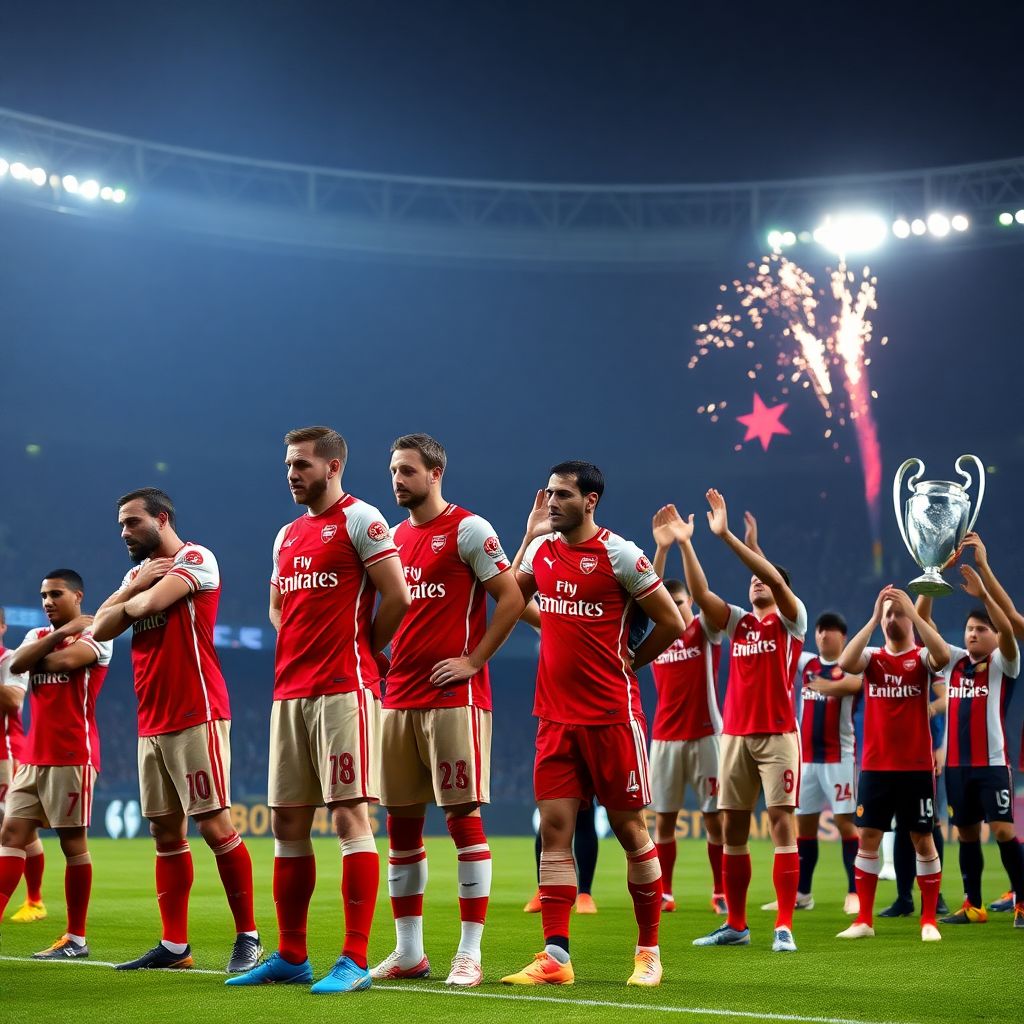
Three signings that could turn Arsenal into Champions League winners
Arsenal came within a heartbeat of conquering Europe, only to see their Champions League dream evaporate from the penalty spot in Budapest. A 1-1 draw with Paris Saint-Germain in the final, followed by a 4-3 defeat in the shootout, encapsulated both how far Mikel Arteta’s side have come and how painfully small the remaining gap to the very top now is.
The campaign they produced was worthy of champions in almost every respect. Across the 2025/26 edition of the tournament, Arsenal were arguably the standout team. They travelled to Budapest with an unbeaten record deep into the knockouts and had built their run on a defensive platform that few could match: nine clean sheets, supreme control in midfield, and a goalkeeper who radiated calm.
Declan Rice’s authority at the base of midfield, the Saliba-Gabriel partnership at centre-back and David Raya’s composure gave Arsenal an armour-plated core. They could suffocate opponents without the ball, dictate tempo in possession and survive hostile away legs with mature, resilient performances. Arteta’s labour over several seasons has forged a side that is positionally disciplined, tactically flexible and psychologically tougher than any Arsenal vintage in over a decade.
But the final, and some of the cagey knockout ties before it, ruthlessly highlighted one flaw that still separates them from serial European winners: a shortage of decisive, repeatable attacking threat in the moments that really count. Arsenal fashioned half-chances, enjoyed periods of slick combination play and forced PSG backwards. What they lacked was the ruthless finisher who turns half-chances into goals and the explosive wide threat who can unpick an elite defence on their own.
That thin margin of quality in the final third is exactly where this summer’s transfer business must be targeted. The structure is in place: an aggressive but coordinated press, full-backs who understand when to invert and when to overlap, and a midfield drilled in both progression and protection. To translate that into a Champions League trophy, Arsenal need a centre-forward and attacking support cast capable of matching their defensive excellence.
Below are three players who, if signed, could recalibrate the squad just enough to transform near-miss into continental triumph: Mateus Fernandes, Yan Diomande and Victor Osimhen.
—
Mateus Fernandes – the controller to perfect the midfield
Why he fits
Mateus Fernandes profiles as precisely the sort of metronomic, positionally intelligent midfielder Arteta prizes at the heart of his system. Calm under pressure, secure in possession and tactically disciplined, he offers a rare blend of ball-winning and ball-distribution. His passing numbers are consistently high, but more important than raw accuracy is his decision-making: Fernandes tends to choose the progressive option without forcing it, which aligns with Arsenal’s preference for patient but vertical football.
Physically, he has the engine to cover ground over 90 minutes and the robustness to cope with the relentless rhythm of Premier League and Champions League football. That durability is not a trivial detail; Arsenal’s calendar is packed, and Arteta’s most trusted players are often pushed to their limits. A midfielder who stays fit and maintains level performances across a full season is a genuine asset.
Tactical impact
Deploying Fernandes alongside Declan Rice would give Arsenal a highly fluid double pivot. In some phases, Rice could step slightly higher to engage opposition midfielders, safe in the knowledge that Fernandes will remain disciplined and screen the back line. In other phases, Fernandes could push forward to link play, while Rice drops between the centre-backs to facilitate buildup.
In European knockout ties, control and game management become paramount. Fernandes would help Arsenal keep opponents pinned back, recycle possession intelligently and smother counter-attacks before they fully develop. Late in games, when legs tire and concentration wavers, having two reliable midfield anchors who can both pass and anticipate danger is the kind of advantage that wins tournaments.
His presence would also free Martin Ødegaard and the wide players to take more risks in the final third. With a more secure platform behind them, Arsenal’s creative talents can attempt braver passes and more ambitious movements, knowing the rest defence is properly organised.
Squad need addressed
The second phase of the season exposed the fragility of Arsenal’s depth at the base of midfield. When their secondary options failed to assert themselves, the entire structure lost a little sharpness. Declan Rice shoulders an enormous amount of responsibility; on days when he is anything less than dominant, the team can look surprisingly ordinary.
Fernandes would immediately reduce that overreliance. Instead of a clear hierarchy in which Rice is the sole irreplaceable pivot, Arteta could rotate or even rest him in certain matches without a radical drop-off in quality. Over a long season that stretches from August to late May, this kind of shared burden is crucial not only to performance but also to injury prevention.
Transfer realities
At 21, Fernandes is already on the radar of several heavyweights. Clubs such as Manchester United, PSG and Liverpool are all in the market for midfielders who combine composure, intelligence and technical polish. Winning that race would require both a clear sporting project and financial decisiveness.
For Arsenal, the argument is straightforward: he would be walking into a system built to emphasise his strengths, joining a core of players at similar stages in their careers, and competing immediately for major honours. If the club are serious about winning the Champions League rather than merely contesting it, investing heavily in a long-term midfield partner for Rice is a rational step, not a luxury.
—
Yan Diomande – the unpredictable wide threat
Why he fits
Yan Diomande offers a profile Arsenal’s left flank has badly needed: direct pace, fearless dribbling and consistent output. A standout debut campaign with RB Leipzig, in which he registered 13 goals and 10 assists across 36 appearances, shows that his game has end-product, not just highlight-reel tricks.
He thrives in one-on-one situations, constantly driving at full-backs, forcing defensive lines to tilt toward his side and creating spaces for teammates to exploit. That sort of winger changes the geometry of attacks: defenders cannot simply shuffle across and compact the pitch if they know they can be beaten on the outside.
For a team that often dominates possession but occasionally struggles to translate that into clear chances, a winger who can break structure with individual brilliance is invaluable. Diomande looks tailor-made for that role.
Tactical impact
Arsenal’s right side, led by Bukayo Saka, has become one of the most studied attacking patterns in Europe. Opponents increasingly overcompensate by doubling up on Saka, blocking inside channels for Ødegaard and forcing Arsenal to funnel attacks toward a left side that, at times, has lacked the same cutting edge.
Introducing Diomande on that flank would instantly rebalance the threat. Defences would have to divide their resources more evenly, reducing the triple-teaming of Saka and opening up central pockets for Ødegaard and the striker. Diomande’s ability to carry the ball at speed would also make Arsenal more dangerous in transition, an area where they have been efficient but not explosive compared to some rivals.
He can operate either as a touchline winger who stretches the pitch horizontally or as an inverted forward drifting into half-spaces to combine with overlapping full-backs. That tactical flexibility is ideal for Arteta, who frequently tailors game plans to specific opponents in Europe.
Squad need addressed
Arsenal’s dependence on Saka for both creativity and goals is not sustainable if they want to conquer Europe. In the tightest knockout matches, opponents will happily sacrifice their attacking ambition just to double-mark the English winger. When that happens, the burden must fall on others to produce decisive contributions.
A high-volume, left-sided attacker like Diomande would diversify Arsenal’s attacking portfolio. He would lessen the pressure on Saka, offer genuine rotation opportunities to avoid burnout and give Arteta the option to field two goal-dangerous wingers simultaneously. That alone changes how rivals prepare for Arsenal in two-legged ties.
Adapting to Arteta’s demands
The main question around any attacking signing for Arsenal is not just their numbers in the final third, but their willingness to buy into the off-the-ball work. Wingers are expected to press smartly, track runners and understand complex positional roles when the ball is lost.
Diomande has already shown at Leipzig that he can function in a high-pressing structure. The step up to Arteta’s detail-heavy approach would require time, but his athleticism and work rate suggest he can adapt. If he adds that defensive intelligence to his attacking chaos, he could become one of Europe’s most complete modern wide forwards.
—
Victor Osimhen – the penalty-box killer
No matter how polished the buildup or how dominant the territory, knockout football often boils down to one thing: who has the better finisher. Victor Osimhen is, quite simply, one of the most menacing number nines in world football, and the most straightforward way for Arsenal to raise their ceiling is to install a striker of his calibre at the tip of their system.
Why he fits
Osimhen brings a skill set Arsenal currently lack in one package: explosive pace in behind, a ferocious leap for crosses, aggressive movement in the box and the mentality of a pure goalscorer. He is relentlessly direct; his first thought is always how to get into scoring positions, whether by darting across the near post, peeling to the back stick or spinning into channels.
In matches where Arsenal dominate but face a packed penalty area, Osimhen’s penalty-box instincts could turn recycled possession into a steady stream of high-quality chances. His ability to attack crosses from both full-backs and wingers would also add a dimension Arsenal only sporadically show at present.
Tactical impact
Arteta’s current forwards are technically gifted and intelligent, but none combines that with Osimhen’s sheer physical presence and penalty-box craft. With him leading the line, Arsenal could threaten in more varied ways: intricate combinations through the middle, low cut-backs to the edge of the box, and aerial bombardment if the situation demands it.
His runs in behind would stretch defensive lines, opening vertical lanes for Ødegaard and the midfield to exploit with through balls. Against high-pressing sides, Osimhen gives Arsenal an outlet to relieve pressure, turning hopeful clearances into genuine counter-attacks. In games where Arsenal need to sit a little deeper and play more directly, he offers a world-class transition threat.
Importantly, Osimhen fits the psychological profile of a big-game striker. He plays with visible edge, relishes hostile atmospheres and has already carried immense responsibility at club and international level. That kind of mentality is crucial in Champions League semi-finals and finals, where the margins are tiny and nerves can paralyse less assertive forwards.
Squad need addressed
The current forward options provide link play, pressing and intelligent movement, but none has yet proven to be a 25-30 goal-a-season striker at Champions League level. Arsenal’s goal distribution has been healthy across the squad, yet when games tighten, they still lack that inevitability in front of goal that defines the very best teams.
Osimhen would immediately become the focal point. Defenders would be drawn toward him, which in turn would create more space for Saka, Diomande (or another left winger) and Ødegaard operating at the edge of the box. Even on off days, the mere threat of his presence can distort defensive shapes and lead to second-ball opportunities.
Financial and sporting calculation
Osimhen would be eye-wateringly expensive, but this is exactly the sort of deal that separates clubs content with progress from those intent on trophies. Arsenal have spent heavily in recent windows to build an elite platform; investing in a truly world-class striker would be the final, logical step in that progression.
Balancing that fee with broader squad needs and financial regulations would require some outgoings and careful wage planning. However, the combination of Champions League prize money, commercial growth and sporting upside makes a marquee centre-forward signing defensible if it delivers Arsenal’s first European Cup.
—
How these three transform Arsenal’s European profile
Individually, Fernandes, Diomande and Osimhen all address specific weaknesses. Taken together, they would alter the entire trajectory of the side.
– With Fernandes, Arsenal gain more security and variety in midfield buildup, plus improved control in tense European away legs.
– With Diomande, they add a second unpredictable winger who makes their attack significantly harder to script against.
– With Osimhen, they finally field a striker who matches their defensive quality with world-class ruthlessness.
Arteta would be able to rotate without weakening the XI dramatically, adjust between possession-dominant and transition-heavy game plans, and maintain high-intensity pressing without overtaxing a core group of players. In Champions League terms, that means surviving injuries, suspensions and fixture congestion without the drop-off that has historically undermined Arsenal campaigns.
Integration and evolution under Arteta
Of course, transfers on paper do not automatically translate into European trophies. Arteta would face the challenge of integrating three high-profile signings without destabilising the cohesion he has carefully fostered. Training-ground work would focus on developing automatisms: how Fernandes and Rice share responsibilities, how Diomande synchronises with his full-back and interior midfielder, how Osimhen coordinates pressing triggers with the attacking midfielders.
Pre-season and group-stage fixtures would be crucial laboratories for these relationships. The aim would be to arrive at the Champions League knockouts with a settled core, well-rehearsed patterns and clear contingency plans for different types of opponents.
The risk of standing still
The most dangerous assumption for Arsenal would be believing they can simply run it back with the same squad and expect a different outcome. Europe’s elite do not stand still. Real Madrid, Manchester City, Bayern and PSG all refresh their squads aggressively, ensuring competition for places and tactical flexibility.
Arsenal’s narrow defeat in Budapest proves they are close, but it also serves as a warning: fine margins can flip either way. Adding two or three top-tier players is the most reliable way to make sure that, next time they reach a final, the decisive moments tilt in their favour.
Beyond signings: mentality and depth
While recruitment is central, Arteta will also know that mentality, experience and squad depth around those stars matter. New arrivals like Fernandes, Diomande and Osimhen would join a dressing room that has already tasted the pressure of a Champions League final. That shared pain can harden a group or scar it; the manager’s task is to turn it into fuel.
Deeper competition for places tends to sharpen standards. Training becomes more intense, rotation more accepted, and the team less vulnerable to dips in individual form. If Arsenal can pair that internal drive with smart external additions, they will not merely contend for the Champions League – they will enter seasons expecting to win it.
In that context, targeting a controlling midfielder, a devastating left-sided winger and an elite centre-forward is not just a wishlist. It is a blueprint for closing the final, agonising gap between being Europe’s best story and becoming Europe’s best team.