The Istanbul derby is defined by aggressive pressing, volatile transitions, and emotionally driven momentum swings. Understanding how Galatasaray and Fenerbahçe shift between high, mid, and reactive blocks, manage counter-pressing, and ride or resist crowd energy lets you decode the chaos into repeatable patterns you can train, scout, and explain to players.
Tactical Snapshot: Core Conclusions
- Pressing height in Istanbul derbies is rarely static; both teams oscillate between high and mid blocks, then drop into reactive shapes once game state or fatigue kicks in.
- Transitions are decided by where the first pass after regain goes: down the flanks, into the 10-space, or directly beyond the last line.
- Counter-pressing around second balls often matters more than initial duels; winning knockdowns structures the entire territorial battle.
- Crowd noise and rivalry history amplify emotional momentum, pushing managers to take more pressing risks and more vertical decisions than they might in normal league games.
- Set-pieces are weaponised for disruption as much as for scoring: tempo changes, blocking, and crowd activation are deliberate design features.
- Substitutions shift both physical intensity and tactical reference points, frequently transforming pressing triggers and build-up structures in the last 25-30 minutes.
Pressing Architectures: High, Mid and Reactive Lines in Istanbul Derbies
In Istanbul derbies, pressing architecture is the structured plan that defines how high up the pitch the block starts, how compact the team stays horizontally and vertically, and which passes are deliberately “offered” as pressing traps. The same team can cycle through high, mid, and reactive phases within ten minutes.
A high press typically means the front line starting around the opposition box, full-backs positioned aggressively on opposition full-backs, and a high defensive line compressing the pitch. In a mid block, the front line normally sets up around the halfway line, inviting the first pass out, then jumping as a unit. A reactive block appears deeper, with priority on protecting central spaces and winning counter-attacks rather than immediate ball recovery.
In a typical fenerbahce vs galatasaray tactical analysis, you will notice that both coaches adjust pressing height to game state: an early deficit often triggers a more aggressive high press, whereas a late lead invites a mid-to-low, counter-attacking posture. That is why derby pressing should be viewed as a dynamic “timeline” rather than a fixed style label.
Mini-scenario: Early high press at Kadıköy
Fenerbahçe go 1-0 up in minute 10. Instead of sitting back, they sustain a high press for another 10-15 minutes to force errors and emotionally “lock” Galatasaray in. The risk: one broken press and Galatasaray counter into huge spaces, flipping momentum back to the away end.
- If your centre-backs lack pace, cap the high press to defined periods (e.g., first 10 minutes of each half).
- Use the striker’s pressing angle to show play toward your stronger ball-winner, not simply toward the touchline.
- Pre-define the “drop” trigger (e.g., after three consecutive broken presses, fall into a mid block).
Transitions: Identifying Triggers, Channels and Support Angles

Transition moments in an Istanbul derby are the few seconds after ball loss or regain when structure is at its weakest and emotional intensity at its highest. To control them, you break transitions into clear triggers, channels, and support angles that players can recognise under pressure.
- Recognise clear regain triggers
Examples: a bad first touch from the opposition pivot, a backwards pass from their full-back, or a lofted, bouncing ball into the half-space. Programmable cue: the nearest three players sprint to compress space; far side tucks in to cut switches. - Define priority channels after regain
Against a stretched high line, instruct the ball-winner to play the first pass into outside channels (behind full-backs) rather than directly central. In derbies, wide transitions are usually safer and still create cut-back chances. - Train automatic support angles
When the 8 wins the ball, the 10 must appear diagonally ahead, the winger moves inside to offer a third-man option, and the full-back overlaps late. Draw these angles repeatedly in video sessions, linked to concrete derby clips. - Protect rest defence on your own attacks
While chasing a goal, Istanbul sides often overload the box and forget rest defence. Your “security triangle” (two centre-backs plus holding midfielder) must hold their positions until the ball is clearly secured. - Plan for emotionally driven over-commitments
After a controversial refereeing decision, players tend to charge forward impulsively. Use a timeout huddle message from your captain (agreed pre-match) to reset transition discipline. - Integrate set transition roles for each line
Centre-backs: delay and shepherd, not tackle, for first two seconds. Midfielders: sprint to block forward lanes. Forwards: stay high enough as immediate outlets to stretch the pitch once the ball is recovered.
Mini-scenario: Transition off a long clearance
Galatasaray clear a corner; the ball lands near halfway. The nearest Fenerbahçe midfielder does not try to win cleanly but instead focuses on getting first contact and directing the ball into a pre-agreed channel, where a second midfielder has sprinted early to control the second ball and launch an immediate attack.
Counter-Press and Recovery: Winning the Second Ball Battle
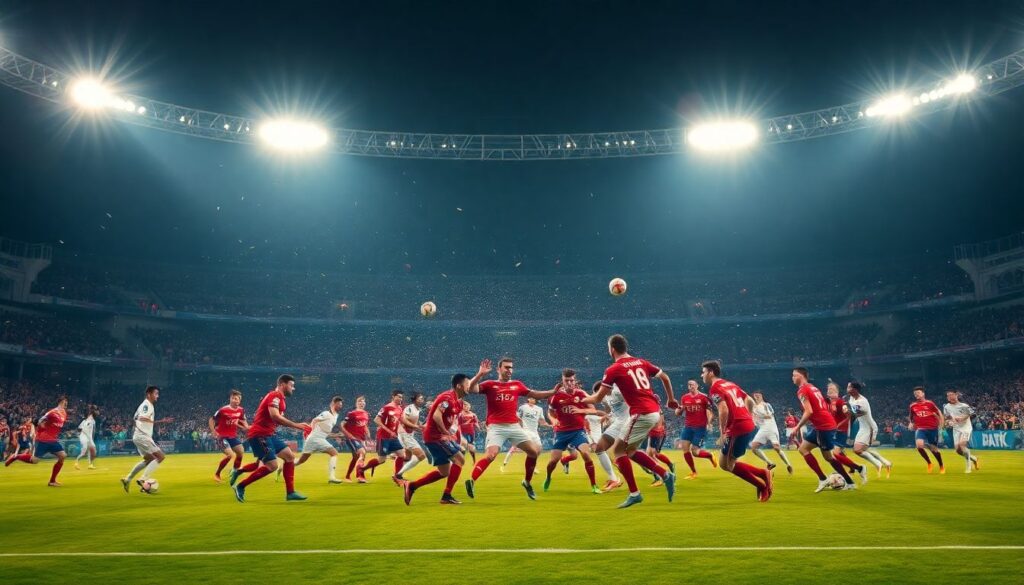
Counter-pressing in Istanbul derbies is less about textbook shapes and more about intense, rehearsed reactions to chaos: long clearances, ricochets, and half-won duels. Second balls become the true “territorial currency,” especially in the middle third and around set-pieces.
Teams that dominate second balls rarely allow the opposition to build sustained pressure. They compress the pitch after loss, swarm the immediate zone of the ball, and crucially, have two or three players positioned for the next contact rather than the first.
Typical application scenarios
- After your own long goal-kick: You instruct the striker not primarily to win the header, but to make contact and direct the ball into the inside channel. Two midfielders are tasked with attacking this “landing zone” at full speed to recover possession.
- Following a cleared cross: When a whipped ball is headed out, the edge-of-box 6 and 8 must anticipate and attack the clearance area. One commits to the ball; the other positions to receive a cushioned header or prepare for an interception if possession is lost.
- Post-press broken, but under partial control: Your high press fails and the opposition plays beyond. Instead of sprinting straight back, your nearest wide player turns and presses the receiver’s blind side, while the closest midfielder squeezes in to fight for the second ball created by the rushed clearance.
- Protecting a late lead in a hostile stadium: When defending a 1-0 advantage at Şükrü Saracoğlu, you may choose to drop deeper yet maintain intense counter-pressing just outside your box to prevent the opponent from reloading attacks. The aim: win second balls, draw soft fouls, and slow the rhythm.
Mini-scenario: Neutralising the opponent’s “crowd surge”
After Fenerbahçe equalise, the noise spikes and they send high, aggressive crosses. Galatasaray’s 6 and 8 move their starting positions two metres higher so they can win more second balls and immediately recycle possession, taking the sting out of the crowd surge.
Emotional Momentum: How Crowd and Rivalry Shape Tactical Choices
Emotional momentum in Istanbul derbies is the rolling wave of confidence, aggression, and crowd engagement that makes certain tactical choices more or less likely. A coach might plan for a controlled mid block but, after a big tackle or near-miss, the team naturally steps five to ten metres higher without explicit instruction.
Even when you secure the “best seats for istanbul derby football match” or invest in istabul derby vip hospitality packages, what you are really observing tactically is how noise levels, choreography, and hostility affect decision-making: risk appetite in pressing, verticality of passes, and compactness between the lines.
Advantages of harnessing emotional momentum
- Short, intense high-pressing waves can pin the opponent in, generate turnovers, and keep the crowd engaged on your side.
- Quick restarts (throw-ins, free-kicks) amplify tempo and prevent the opponent from emotionally resetting after a setback.
- Positive crowd energy allows you to demand extra sprints for counter-pressing in key phases, even from tired players.
- Strategic fouls and duels near the touchline can ignite stands and psychologically destabilise specific opponents.
Limitations and dangerous side-effects
- Over-pressing under crowd influence can stretch your compactness, gifting central spaces to composed opponents.
- Players may force vertical balls too early, bypassing controlled build-up patterns rehearsed in training.
- Impulsive tackles encouraged by the crowd risk cards and dangerous free-kicks around your box.
- After conceding, panic can flip momentum too far the other way, leading to a passive, deep block with no counter-attack threat.
Mini-scenario: Cooling the game after scoring away
Galatasaray score at Kadıköy. The away coach immediately signals for slower restarts and deeper full-back positions. The idea is to absorb the expected crowd-driven Fenerbahçe surge, then selectively counter only when rest defence is stable, rather than joining the chaos.
Set-Piece Design and Disruption Patterns Specific to the Derbies
Set-pieces in Istanbul derbies are not only scoring opportunities; they are tools to disrupt rhythm, manipulate the crowd, and create psychological pressure on goalkeepers and markers. Coaches adjust routines to the referee’s tolerance for contact and to specific aerial match-ups.
Common mistakes and persistent myths
- Myth: “More men in the box equals more threat.”
Overloading the box without clear blocking and timing patterns simply congests space and makes defensive clearing easier. Better: 3-4 high-quality runs with distinct lanes and one late edge-of-box arrival. - Mistake: Ignoring second-phase structure.
In derbies, first contacts are often messy. If you do not assign clear second-phase roles (who attacks the clearance, who protects transition), you hand the opponent counter-attacking opportunities from your own corners. - Myth: Short corners are “too risky” in intense games.
Used correctly, short corners can drag a dominant aerial defender away from the main zone and calm the tempo. Risk is managed by maintaining at least three players in rest defence positions. - Mistake: Repeating identical routines despite referee warnings.
Once the referee has punished blocking patterns, persisting with them increases the risk of soft fouls in your favour being overlooked and harsh fouls against you being called. - Mistake: Underusing rehearsed throw-in structures.
High-pressure derbies feature many throw-ins. Treat them as mini-set-pieces with clear third-man patterns rather than improvised restarts.
Mini-scenario: Corner routine to control the crowd
At home, Fenerbahçe use a rehearsed near-post flick corner early to create a shot on target. Even if it does not score, the crowd’s volume spikes, boosting pressing intensity for the next few minutes. The routine is less about the xG of the shot and more about the emotional leverage.
Managerial Interventions: Tactical Substitutions and In-Game Shifts
Managerial interventions in Istanbul derbies often revolve around when and how to trade physical freshness for tactical clarity. Substitutions are used not only to add pace or height but to redefine pressing triggers, build-up structures, or emotional anchors on the pitch.
From a coaching perspective, each change should be pre-modelled: “If we are leading and the press is breaking, we add a runner in midfield; if we are chasing and stuck in a mid block, we add a second striker and shift to aggressive man-oriented pressing.”
Mini-case: Reframing the press after 60 minutes
Imagine a derby where Galatasaray trail 0-1 away. Their high press is fading, lines are stretched, and the opponent is playing through easily. The coach decides on a double substitution:
- Take off a tired winger and a ball-playing 8.
- Introduce a high-energy winger and a pure ball-winner.
The in-game shift is simple but explicit:
- Change from 4-2-3-1 to a 4-4-2 out of possession.
- Front two press centre-backs in a curved pattern, showing play wide.
- Wide midfielders jump aggressively toward full-backs on any lateral pass.
- Double pivot stays connected, prioritising winning second balls from forced long passes.
Expressed as pseudo-code for players:
IF (ball at CB) THEN
    ST1 press inside shoulder
    ST2 screen pivot + press passing lane
    LW/RW sprint to FB on wide pass
    CM1/CM2 squeeze up to win long ball
ENDIF
A well-designed “if-then” structure like this can be rehearsed in a football tactics analysis course online and then customised for the specific tendencies of both clubs. It also helps players stay disciplined when crowd noise pushes them toward chaotic chasing.
Short self-checklist for analysts and coaches
- Can you map when each team shifts between high, mid, and reactive blocks across the 90 minutes?
- Have you identified 3-5 clear transition triggers for your team, with planned channels and support angles?
- Do your set-pieces explicitly account for second balls and rest defence, not only the first header?
- Have you defined pre-agreed substitution patterns linked to scoreline and pressing intensity?
- When looking at istanbul derby tickets galatasaray vs fenerbahce data or fan reports, can you connect crowd surges to specific tactical shifts in your analysis?
Tactical Clarifications and Quick Answers
How does pressing in Istanbul derbies differ from normal league games?
The pressing is more volatile and emotionally driven, with more frequent switches between high and mid blocks. Players tend to accept higher risk, so you often see more man-oriented pressing and more aggressive jumps toward the ball-carrier.
Why are second balls so decisive between Galatasaray and Fenerbahçe?
Both teams use direct play and crosses during intense phases, so many attacks are decided by deflections and half-clearances. Winning second balls lets you sustain pressure, control territory, and prevent the opponent from launching counter-attacks.
How can a coach prepare players for emotional momentum swings?
Use video to show past derbies where a goal or decision flipped the game, then attach simple behavioural rules (press or drop, slow or speed up) to those situations. Appoint a vocal on-field leader to trigger these rules in real time.
Do set-pieces really change the psychological flow of the derby?
Yes. A dangerous early corner or free-kick can energise the crowd and your team, whereas a poorly organised defensive set-piece can increase anxiety. Designing routines to manage tempo and emotion is as important as chasing a direct goal.
What should an analyst focus on when rewatching a derby?
Tag pressing height changes, transition triggers, and second-ball locations, then link them to key chances and momentum shifts. This produces a clearer tactical story than simply recording formations or possession percentages.
Is it useful for analysts to be in the stadium rather than watching on TV?
When possible, yes. Being in the stands, whether in standard seats or hospitality areas, lets you feel the rhythm changes and crowd reactions that TV audio often flattens, giving better context for why tactical decisions were made.
How can online courses help with analysing Istanbul derbies?
A structured football tactics analysis course online can give you frameworks for pressing, transitions, and set-pieces. You can then apply those frameworks directly to Galatasaray-Fenerbahçe matches to build consistent, repeatable reports.