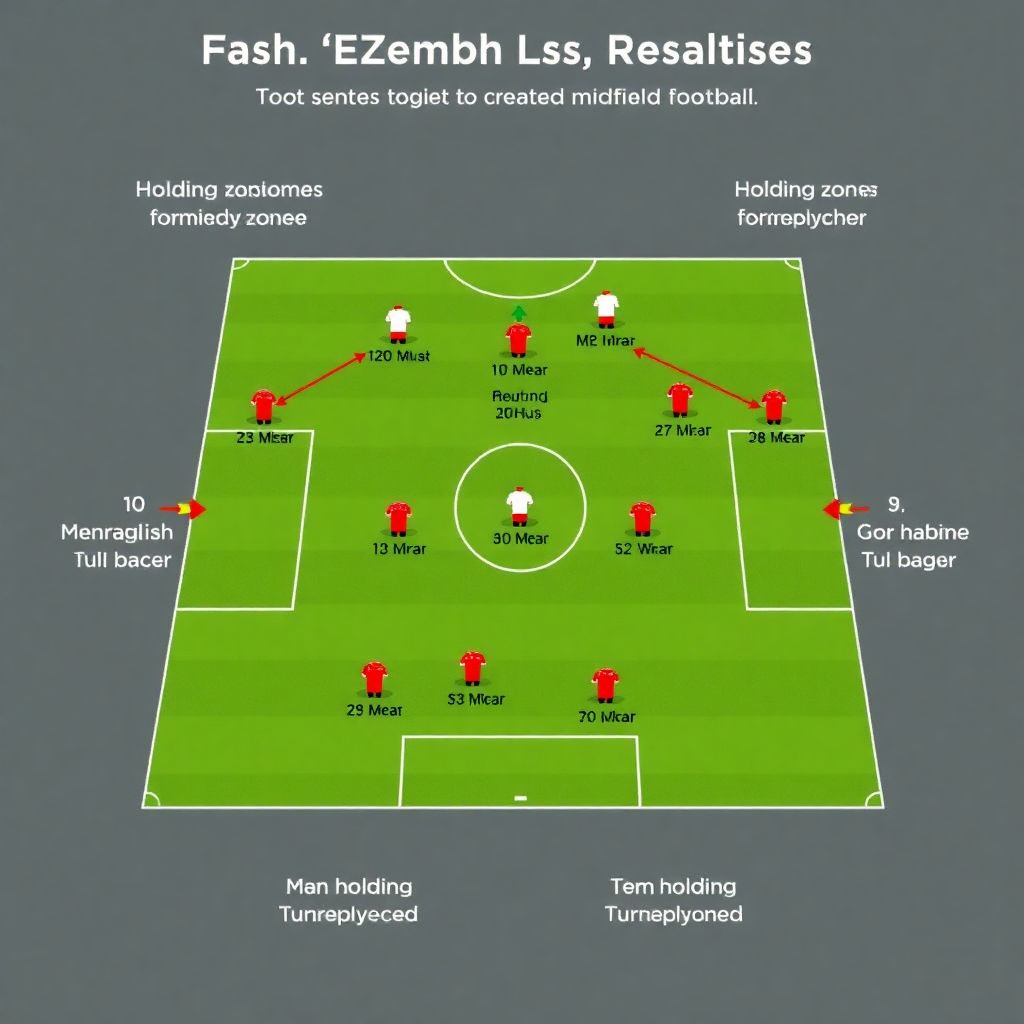
Hybrid full-backs and No.6s in modern Turkish football are defenders or holding midfielders who shift zones: wide to inside, deep to advanced, depending on phase. They support build-up, protect transitions and overload midfield, redefining how Turkish teams control space, tempo and pressing in Super Lig and Europe.
Core propositions on hybrid full‑backs and defensive midfielders
- Hybrid roles blur the line between full-back and defensive midfielder but never ignore basic defending and positional discipline.
- The ball, not just the formation, decides if a player is currently a wide defender, auxiliary centre-back or extra midfielder.
- Modern full-backs in Turkish football tactics must read pressing cues and occupation of half-spaces, not only overlap on the touchline.
- Many of the best defensive midfielders No 6 in Turkey Super Lig spend long phases between the centre-backs, acting as a third defender or deep playmaker.
- Hybrid solutions work only when training detail, communication and distances between units are rehearsed and measurable.
- Scouting Turkish Super Lig full-backs and defensive midfielders now focuses on scanning, passing under pressure and transition reactions more than traditional crossing volume.
Debunking myths: what people get wrong about full‑backs and No.6s in Turkey
Hybrid roles in Turkey are often misunderstood as “positionless football”. In reality, they are highly structured: players still have reference zones, reference opponents and clear pressing cues, but they change their line and lane according to the team’s game model and match plan.
A frequent misconception in Turkish football tactical analysis full-back roles is that an “inverted” full-back is simply a winger coming inside. The true hybrid full-back starts from a defensive mindset: body orientation to prevent counters, angles to receive under pressure, and permanent awareness of the rest-defence structure behind the ball.
Another myth is that the No.6 is only a destroyer or only a deep playmaker. In modern Turkish football, the holding midfielder alternates between screening passes, dropping between centre-backs, and arriving higher to support combinations. He or she is judged by connection quality and transition control, not just tackles or passes completed.
Finally, many coaches believe they must copy foreign blueprints. Yet coaching courses Turkey modern tactics full-back No 6 modules now emphasise adapting principles to local player profiles, fan expectations and pitch conditions, rather than cloning a Premier League or La Liga structure that does not fit the Super Lig context.
Tactical anatomy: roles, responsibilities and overlap on the pitch
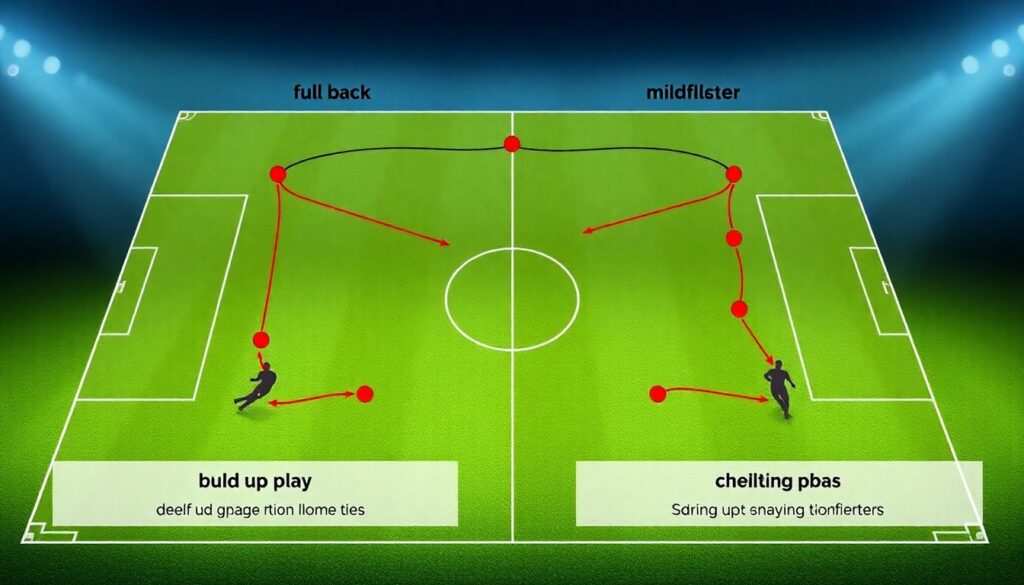
The tactical “anatomy” of hybrid full-backs and No.6s can be broken into recurring tasks across phases of play.
- First build-up line (goal-kick and deep circulation): One full-back tucks inside to form a back three, the No.6 may push slightly higher to be free between lines, or vice versa. The goal is to create a stable +1 or +2 against the opponent’s first press.
- Progression through half-spaces: As the ball advances, the inside full-back becomes a connector in the half-space, receiving on the half-turn and playing vertical passes, while the No.6 holds position to guard central transitions.
- Wide overloads and underlaps: On the strong side, the full-back may still overlap, but increasingly the trend is an underlap into the channel between opposition full-back and centre-back, with the winger fixing width. The No.6 slides laterally to cover the vacated zone.
- Rest defence against counters: When attacking, at least two of the three (two centre-backs plus either the tucked-in full-back or the No.6) must stay behind the ball to control long clearances and mark central runners.
- Pressing and counter-pressing: After losing the ball, the No.6 and nearest full-back immediately compress towards the ball carrier, blocking inside passing lanes and forcing play wide where the touchline acts as an extra defender.
- Deep block organisation: In low block, hybrids revert closer to traditional shapes: the No.6 screens the central zone, the full-backs narrow to protect the box, but their prior movements affect which opposition players they must track.
- Set pieces and secondary balls: The hybrid No.6 often guards the edge of the box on defensive corners, while the hybrid full-back covers the far side or marks a zonal lane, prepared for second balls and counters.
The table below summarises functional differences and overlap between a traditional full-back, a classic No.6 and a hybrid role in Turkish contexts.
| Aspect | Traditional full-back | Classic No.6 | Hybrid full-back / 6 |
|---|---|---|---|
| Starting line | Back four, wide | In front of centre-backs, central | Back four or midfield, shifts between wide and central |
| Main offensive duty | Overlap and crosses | Short circulation and switches | Underlaps, half-space connections, occasional overlaps |
| Main defensive duty | 1v1 wide defending | Screen and break up play | Protect central lanes, help wide 1v1s, control counters |
| Typical rotations | With winger only | With centre-backs only | With centre-backs, interiors and wingers |
| Profile focus in scouting | Pace, crossing | Duel strength, positioning | Scanning, passing under pressure, adaptability |
Historical forces: how Turkish football produced hybrid defenders
The evolution of hybrid full-backs and No.6s in Turkey is rooted in several overlapping historical forces rather than a single tactical revolution. Each wave of coaches and competitions added a new layer to how these positions are interpreted today.
- Import of foreign tactical models: Influential foreign coaches in Istanbul’s big clubs introduced back-three and inverted full-back concepts. Turkish assistants internalised these ideas and adapted them to local player strengths, creating a hybrid identity rather than a pure copy of any single European league.
- European competition demands: Facing higher pressing and quicker transitions in European matches forced Turkish sides to seek extra control in the first build-up line. Full-backs and No.6s had to become calmer on the ball and more responsible for circulation, not just emergency defending.
- Domestic pitch and climate conditions: Heavy pitches and intense atmospheres encouraged more direct play and second-ball battles historically. To balance this, coaches used the No.6 as a stabiliser and gave full-backs licence to step into midfield to secure loose balls and shorten passing distances.
- Youth development and positional flexibility: As academies modernised, more youngsters were trained to play multiple positions. Wide midfielders converted to full-backs, centre-backs to No.6s, creating naturally hybrid profiles that thrive in variable structures.
- Analytics and video culture: The rise of video-based Turkish football tactical analysis full-back roles highlighted the cost of leaving central zones empty when full-backs bomb forward. Data departments pushed for safer rest-defence shapes, nudging full-backs and No.6s towards more controlled, hybrid behaviour.
Club case studies: Galatasaray, Fenerbahçe, Beşiktaş and the Anatolian model
Different Turkish clubs interpret hybrid full-back and No.6 roles according to their squad profiles, fan expectations and coaching philosophies. The Big Three have more technical depth, while Anatolian clubs often rely on physical intensity and compact blocks.
Benefits observed in Turkish club implementations
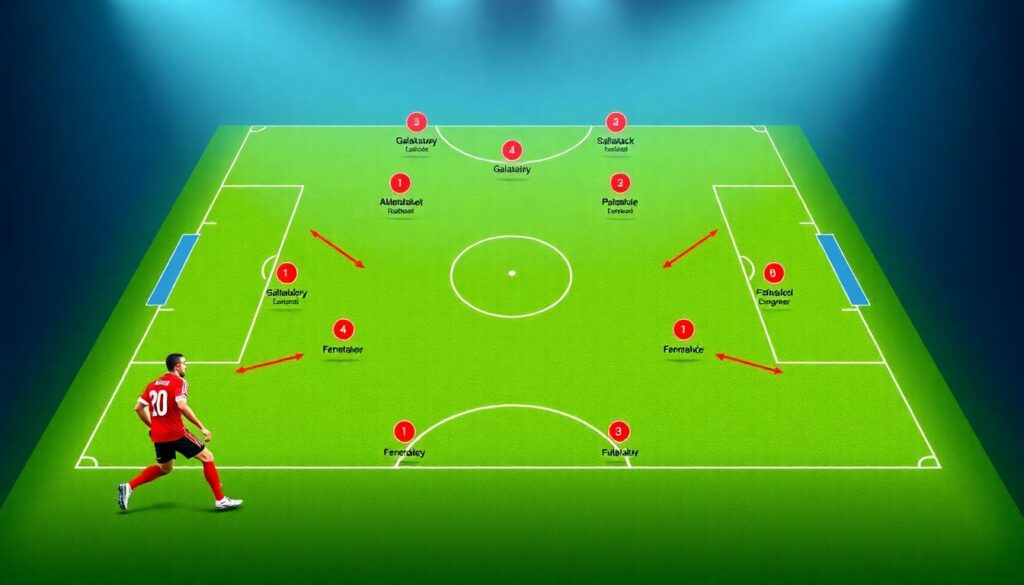
- Galatasaray-style inside full-back: Enables central overloads in possession, allowing attacking midfielders more freedom to receive between lines and combine, while maintaining at least three players behind the ball.
- Fenerbahçe’s flexible No.6: When used as a temporary third centre-back, improves first-phase passing angles and invites opposition forwards to press out of shape, opening spaces in midfield.
- Beşiktaş high-intensity hybrid wide players: Aggressive, front-foot full-backs can jump to press opposition full-backs early, knowing the No.6 or opposite full-back will narrow to protect central zones.
- Anatolian compact hybrid blocks: Smaller clubs often use a conservative hybrid, with full-backs rarely overlapping simultaneously and a No.6 constantly sliding across to double wide duels and protect the box.
Constraints and typical risks in these models
- Spacing overload: If full-backs and No.6 all collapse centrally at once, wingers can be isolated wide with no support for switches, slowing attacks and making play predictable.
- Transition exposure: When inside full-backs lose the ball under pressure, there may be no one left to defend the touchline, leading to open counters into wide channels.
- Role confusion: Players who do not fully understand whether they are defending as a back three or back four may hesitate, creating gaps between centre-back and full-back or between No.6 and centre-backs.
- Load management: Hybrid full-backs often rack up very high total running and high-intensity sprints; without rotation and conditioning, this can lead to late-season drop-off.
- Fan and media pressure: Supporters sometimes interpret inside full-backs and sitting No.6s as “negative football”, pushing coaches to open up more than the squad’s balance realistically allows.
Training and recruitment: skill sets, metrics and youth development
Developing and signing players for hybrid full-back and No.6 roles in Turkey requires clarity on required skills and the mistakes that can undermine the entire structure.
- Overvaluing straight-line pace and crossing: Many clubs still recruit full-backs mainly on sprint speed and crossing volume. For modern full-backs in Turkish football tactics, scanning, body shape to receive inside, and decision-making in tight areas are at least as important.
- Ignoring receiving angles for the No.6: In training, No.6s often work only on tackling and long passing. Elite holding midfielders in Super Lig must repeatedly receive under pressure with one or two touches, opening their body towards both sides.
- Neglecting communication drills: Hybrid structures fail when full-backs, centre-backs and No.6s do not communicate rotations. Simple verbal cues in Turkish (“inside”, “wide”, “drop”) must be drilled in positional games and small-sided matches.
- One-dimensional academy pathways: Youth teams sometimes freeze players too early in a single role. A promising No.6 should experience minutes as centre-back and full-back; young full-backs should try central midfield to understand angles and pressing triggers.
- Metrics that miss what matters: In scouting Turkish Super Lig full-backs and defensive midfielders, relying solely on tackles, interceptions or crosses per game misses their impact on structure. Staff should track actions like line-breaking passes received, progressive carries into half-spaces and defensive positioning preventing shots.
- Underusing coach education: Coaching courses Turkey modern tactics full-back No 6 modules provide frameworks, yet some clubs do not translate them into daily training design. Without aligning drills, analysis and recruitment, hybrid ideas remain on paper only.
Matchday patterns: in‑game triggers, transitions and opponent adaptations
On matchday, successful hybrid use depends on recognising specific triggers and quickly evaluating whether the plan is working. Coaches and analysts in Turkey increasingly use simple algorithms to review these roles live and post-match.
Typical in-game triggers for hybrid movements
- Goalkeeper in controlled possession: Signal for one full-back to tuck in and the No.6 to decide whether to stay in front of the defensive line or drop between centre-backs, depending on opposition press numbers.
- Ball enters opposition half-space: Ball-near full-back decides between underlap or wide support; No.6 positions slightly behind and inside the ball to close counter channels and offer a safe backward passing option.
- Loss of possession in central corridor: Immediate counter-press from closest players, while the No.6 sprints to block the direct vertical passing lane and the far-side full-back narrows into a temporary back three.
- Switch of play by opponent: Far-side hybrid full-back delays wide pressure until No.6 has shifted across; together they steer the opponent towards the touchline rather than allowing an inside drive.
- Leading or trailing by one goal: With a lead, inside full-back movements may become more conservative and the No.6 stays deeper. When chasing, the coach might free the ball-near full-back to overlap while the No.6 covers space behind.
Short algorithm to check if your hybrid plan worked
Use this simple sequence after a match (or at half-time) to evaluate hybrid full-back and No.6 effectiveness:
- Check rest-defence structure: Review video or live screenshots for attacking phases. Ask: “Did we keep at least two, ideally three, players behind the ball with central presence when both full-backs advanced?” If not, the hybrid risk level was too high.
- Assess central progression quality: Count how often the No.6 or inside full-back received between lines facing forward. If they mostly received with back to goal or under immediate pressure, adjust spacing and support angles.
- Analyse conceded transitions: Categorise each opposition counter: wide, central, or through half-space. If many counters ran through the zone vacated by your full-back or No.6, rethink timing and communication of their movements.
- Evaluate wide 1v1 exposure: Note how often your centre-backs were dragged to the touchline to defend. Frequent emergency wide defending suggests your full-back’s hybrid movements are not balanced by No.6 and winger support.
- Relate findings to player profiles: For each issue, decide if it stems from the game model (coaching) or from individual limitations (player profile). Only then adjust roles, not just personnel, for the next match.
Applied consistently over several games, this algorithm helps align tactical intention with actual behaviour on the pitch, making hybrid full-backs and No.6s a repeatable advantage rather than a one-off surprise.
Practical clarifications and tactical trade‑offs
What makes a player suitable for a hybrid full-back or No.6 role?
A suitable player has above-average game intelligence, scanning habits, and comfort receiving in traffic, plus enough pace to recover defensively. Pure sprinters or pure destroyers can struggle without these cognitive and technical layers.
How do hybrid roles change training design during the week?
Training must include position-specific rondos, positional games in half-spaces and transition drills where full-backs and No.6s repeatedly move between lines. Video feedback is essential so players see their spacing and learn to time movements.
Can smaller Anatolian clubs realistically use complex hybrid structures?
Yes, if the game model stays simple and principles are clear. They may use only one inside full-back or a more static No.6, focusing on compactness and clear triggers instead of constant rotations used by bigger squads.
Do hybrid full-backs reduce traditional wing play and crossing?
Not necessarily. Hybrid movements often free the winger to stay wide and receive in better conditions. What changes is who provides width at which moment, and how many players stay behind the ball when crossing.
How should youth coaches in Turkey introduce hybrid concepts?
Youth coaches should first teach positional basics, then gradually add simple rotations, like the No.6 dropping between centre-backs or the full-back stepping into midfield in build-up. Complexity can rise with age and tactical understanding.
Is a back three always better for hybrid roles than a back four?
Neither is automatically better. A back three offers inherent width and central stability, but a back four with smart full-backs and No.6 can morph into a back three in possession while remaining compact in defence.
How do analysts quantify success of hybrid full-backs and No.6s without overcomplicating reports?
Analysts focus on a few clear indicators: successful line-breaking passes, progressive carries, counters prevented or slowed in their zones, and contribution to expected goals for and against. Simplicity helps coaches and players apply insights.