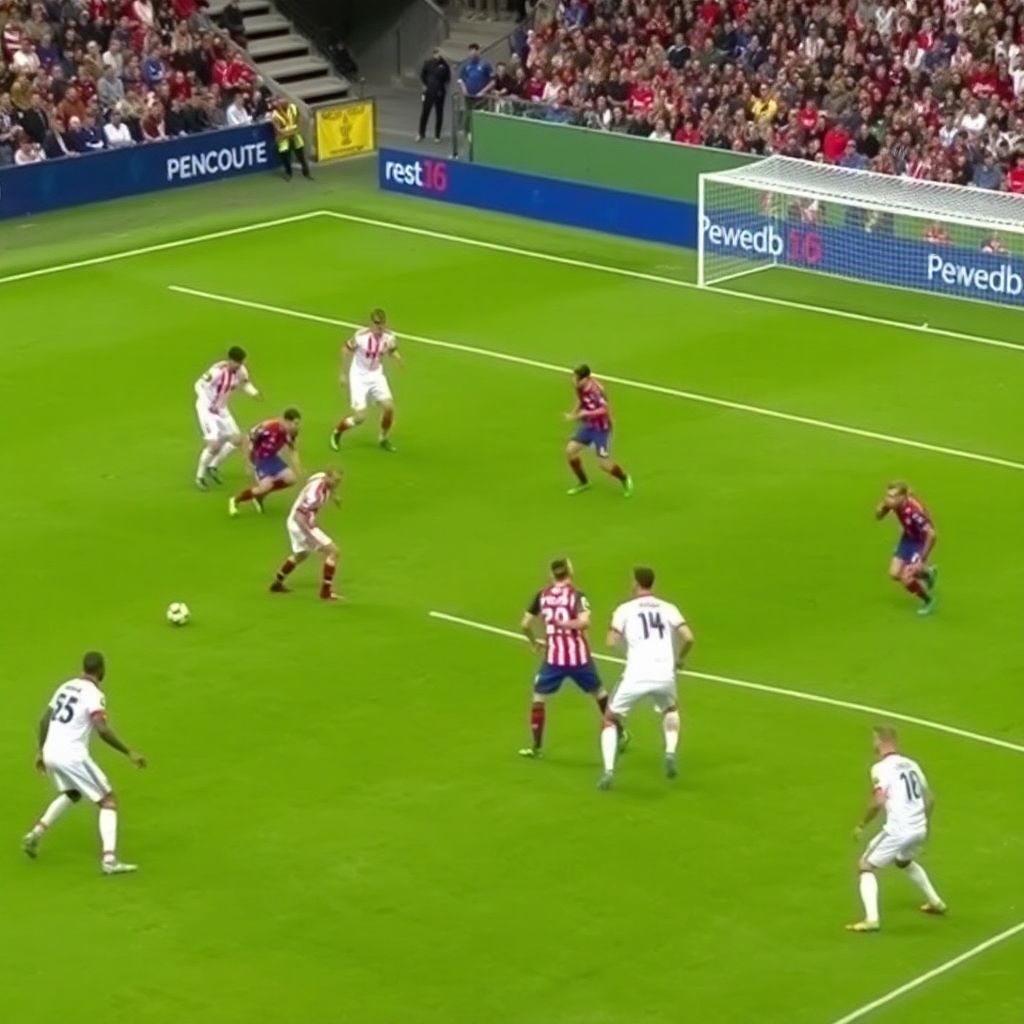
Pressing traps are pre-planned situations where your team deliberately invites a pass into a specific zone, then crowds and wins the ball with coordinated pressure. Top European teams use traps to control where opponents play, force predictable decisions, and create immediate counterattacking chances from advanced areas with minimal risk.
Core Principles to Remember
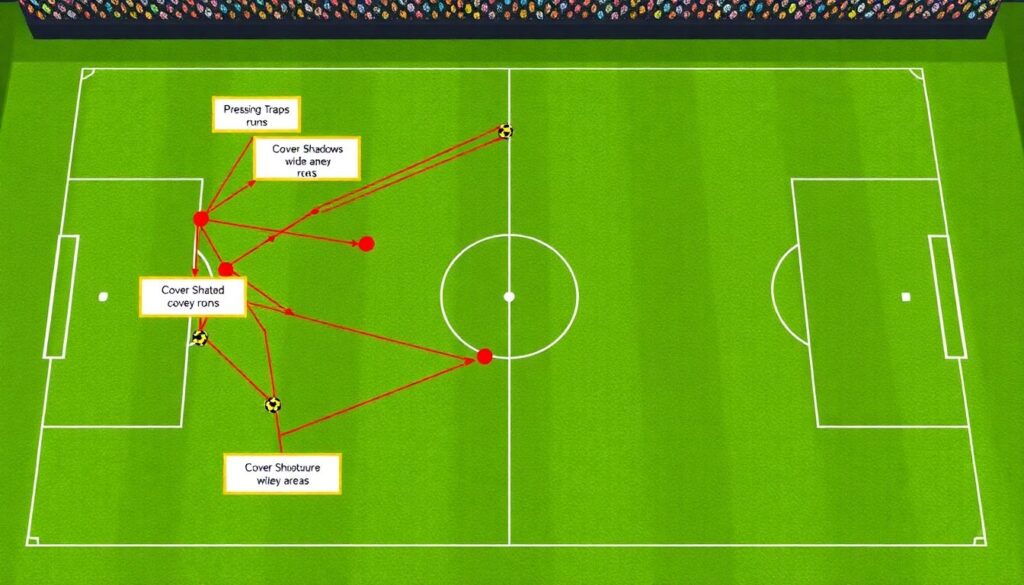
- Define exactly where you want to win the ball and where you are happy to let the opponent keep it.
- Link pressing traps to clear triggers: back pass, slow switch, bad touch, or isolated receiver.
- Use cover shadows to block inside passes while pressing the ball from an angle.
- Press in waves: one player presses, two support, and at least one protects depth behind.
- Train pressing traps with simple, repeatable soccer defensive pressing drills before adding full-game complexity.
- Always connect traps with an attacking plan for the first two passes after regaining the ball.
Anatomy of a Pressing Trap: Shape, Space and Sequence
Coaching intent: Design a repeatable team shape that funnels opponents into a pre-selected area where you can regain the ball aggressively and safely.
- Objective: Force play toward the touchline or into a specific interior pocket and crowd that zone with a compact block of 5-7 players.
- Primary triggers: Slow lateral pass; back pass to a foot that closes their body; isolated fullback receiving facing own goal.
- Shape cues:
- Front line curves run to block central build-up and show the pass outside.
- Midfield squeezes toward the ball side, leaving the far side apparently open.
- Back line steps up behind midfield to close vertical space and prevent easy long balls.
- Coaching cues: Say "show wide, lock wide, then jump"; demand side-on body position to protect the inside; insist on short, explosive runs, not long sprints.
- Core drill idea: 8v6 in one half with touchline trap: build-up team must use fullbacks; pressing team scores by winning the ball in a 5x10m wide channel.
- When not to use:
- Against opponents with superior pace behind your back line and high-quality long passing.
- When your team is fatigued and cannot close distances quickly enough.
- In extreme weather or poor pitch conditions that prevent quick shifting of the block.
Success indicators:
- Opponents play into your chosen trap side at least three times more often than into the opposite side.
- Your team concedes very few direct balls in behind when shifting to trap zones.
Positional Triggers and Timing: When to Snap the Trap
Coaching intent: Align the entire team on clear, shared signals for when to start, accelerate, or delay the press.
- Objective: Ensure that first, second, and third defenders move together on pre-agreed pressing triggers, not at random.
- Key triggers to define and rehearse:
- Back pass to centre-back or goalkeeper with weak foot.
- Sideways pass into fullback or pivot who is closed to the field.
- Heavy touch away from goal or receiving player facing their own goal.
- Vertical pass into an isolated striker between lines.
- Timing cues:
- First presser moves on the pass, not on the first touch.
- Supporting players sprint as the ball travels, arriving just as it is controlled.
- Back line and goalkeeper step up two to three metres when the press is triggered.
- Communication rules:
- One word for "go" (e.g. "jump") and one for "delay" (e.g. "hold"); rehearse in football pressing tactics training so all players react instantly.
- Nearest player names the trigger (e.g. "back", "touch") to focus the press on a specific cue.
- Core drill idea: 6v6+2 neutral in a 40x35m area. Coach calls a trigger type before each play; build-up team must attempt that action, pressing team reacts and tries to win possession within five seconds.
- Progression constraint: Limit pressing team to three players allowed to cross the halfway line at first, then remove the limit as coordination improves.
Success indicators:
- Pressing actions begin within a consistent, short time window after the trigger (no delayed lone runs).
- At least two supporting players arrive around the ball carrier every time the press is activated.
Spatial Structuring: Using Channels, Corridors and Exit Routes
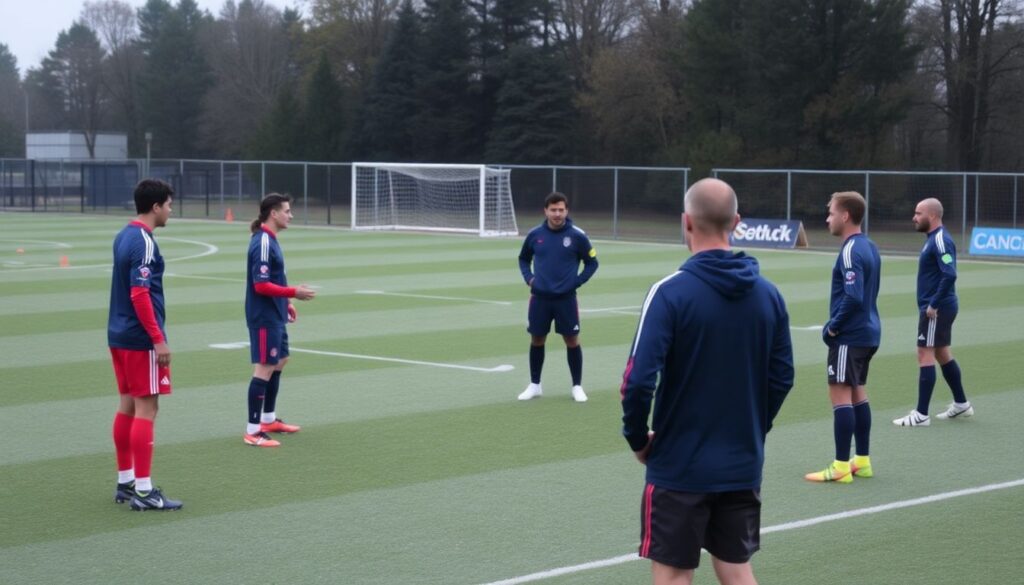
Coaching intent: Organise the pitch into clear pressing zones so your players know exactly where to steer the ball and where to spring the trap.
Pre-session preparation checklist:
- Mark vertical channels and central corridors with flat cones to visualise trap zones.
- Clarify for your team which wing you prefer to trap on, based on your strongest pressing players.
- Decide the "exit routes" you want to attack immediately after regaining the ball.
- Prepare two or three simple soccer defensive pressing drills that use the same pitch markings.
- Divide the pitch into functional pressing lanes
Use cones to create three vertical lanes (left, central, right) and, if possible, half-spaces. Explain that your priority is to protect central corridors and steer the ball into wide lanes.
- Make wide lanes slightly smaller to increase pressing density.
- Encourage players to "close doors" to the middle while leaving outside passes open.
- Define your preferred trap zones
Select one or two specific areas: for example, the right wide lane in your middle third and the left wide lane in your attacking third.
- Mark these zones with different coloured cones.
- Tell players: if the ball goes here, we must press aggressively; if not, we steer it there first.
- Set the steering roles for the front line
Instruct your striker to angle runs to cover the central passing lane, forcing the pass to the fullback or into your chosen wing.
- Wide forward presses centre-back from the outside-in, blocking the touchline pass when you are ready to trap.
- Agree which shoulder to show when pressing from each side.
- Compact the midfield behind the press
Ask ball-side midfielder to jump closer to the receiving opponent, while the opposite midfielder tucks in to protect the central lane behind.
- Distance between lines should allow cover on a short pass but protection against a long ball.
- Use a rule like "no more than one player beyond the ball on the weak side" for safety.
- Lock the trap and block the exit routes
Once the ball enters the trap zone, the nearest three players sprint to close space while others cut off backwards and inside passes.
- Fullback steps tight to press if the ball is on the wing; winger drops to cover the return pass.
- Six or pivot screens the inside, staying goal-side of the nearest central opponent.
- Pre-plan the first two passes after winning the ball
Design one or two automatic patterns: diagonal pass into the far half-space, or quick bounce to a supporting midfielder and then out to the weak-side winger.
- Use mannequins or poles to visualise these "exit routes" in training.
- Rehearse the same pattern from both wings to increase transfer into matches.
- Progress pressure and risk gradually
Start with small, directional games using only one trap side. When timing and distances are consistent, allow players to choose which side to trap based on the opponent.
- Final step: free 11v11, but reward goals that come within eight seconds of a regain in the trap zone.
- Use video or basic tactical analysis high pressing teams clips to review spacing and compactness.
Success indicators:
- Ball is recovered in your marked trap zones multiple times per session or match.
- Players consistently steer opponents into wide lanes instead of being dragged into the centre.
Role-Specific Responsibilities: Duties of Forwards, Midfielders and Fullbacks
Coaching intent: Give each line of the team simple, non-overlapping tasks so the press looks coordinated instead of chaotic.
- Forwards angle runs to show play into the trap side and keep one eye on the defensive midfielder.
- Wide forwards press fullbacks from the inside-out when trapping wide, then sprint beyond after regains.
- Central midfielders communicate triggers, protect the central corridor, and jump to press on vertical passes.
- Defensive midfielder screens the ball-side half-space, always on the line between the ball and your centre-backs.
- Fullbacks step high to support the press on the wing but never on the same line as the winger, to avoid one pass beating both.
- Ball-far fullback tucks in to become a third centre-back and protect against long diagonals.
- Centre-backs hold a compact line, ready to defend the space behind if the press is broken.
- Goalkeeper holds an advanced starting position to sweep long balls and allow a higher defensive line.
- All players know their "bail-out" rule: when the press is broken, drop together to a pre-agreed deeper block.
Success indicators:
- Clear staggering between lines: no more than two players caught on the same horizontal line around the ball.
- Minimal confusion about who presses and who covers when the ball enters the trap zone.
Creating Numerical Advantages: Overloads, Isolation and Forcing Lines
Coaching intent: Turn positional advantages into real overloads by forcing opponents into zones where you already have spare players.
- Relying on running instead of positioning, chasing the ball instead of closing passing lanes.
- Over-committing numbers to the ball side and leaving the far side completely free for switches.
- Not isolating a targeted opponent (e.g. weak fullback), allowing them multiple easy passing options.
- Forcing play wide but failing to push your back line up, leaving huge vertical gaps between units.
- Pressing in straight lines, so one simple vertical pass beats several players at once.
- Allowing your best 1v1 defenders to be far from the trap zones you use most often.
- Ignoring your team’s physical profile; asking slow defenders to defend huge spaces behind a high press.
- Designing complex patterns in theory but not investing regular time in football pressing tactics training.
Success indicators:
- Your team creates visible 3v2 or 4v3 moments in wide areas when the trap is activated.
- Opponents are forced to play long, low-percentage passes instead of controlled short combinations.
After the Ball Is Won: Immediate Transition and Counterattacking Options
Coaching intent: Connect the defensive action of winning the ball with a clear attacking idea so regains turn into chances, not just lost opportunities.
- Fast vertical counterattack
Use this when you have quick forwards and the opponent leaves space behind. First pass goes forward or diagonally forward, second pass aims to release a runner behind the last line.
- Controlled switch to the weak side
Ideal when the opponent overloads your trap side. After regaining, bounce one pass inside, then quickly switch to the far winger or fullback attacking open space.
- Stabilise with short passes
Useful when your team is tired or protecting a lead. Instead of forcing a rushed attack, secure the ball with 3-5 short passes, then build up calmly.
- Set-piece preparation after regains
If your team is strong on dead balls, consider drawing fouls or winning corners after regains in advanced wide areas.
Success indicators:
- A significant share of your shots or final-third entries come within a few seconds of a high regain.
- Players make pre-planned runs immediately after winning the ball, without needing sideline instructions.
To deepen your understanding beyond the pitch, combine live practice with a high press coaching course, match video, and selective football coaching books on pressing that offer detailed tactical analysis high pressing teams examples.
Common Practical Concerns from Coaches
How do I introduce pressing traps to amateur or youth players safely?
Start with low-intensity, position-based games in small areas, focusing on body shape and angles rather than speed. Gradually add pressing intensity only when distances and coordination are consistent, and always keep at least one spare defender behind the trap.
How often should I train pressing traps during the week?
Integrate one focused session on pressing concepts and one session where pressing traps are embedded in game-like practices. In busy weeks, use short blocks of 10-15 minutes inside regular small-sided games instead of separate sessions.
What if my players tire quickly when pressing high?
Reduce the number of consecutive presses before dropping into a deeper block, and shorten the pitch length in training. Rotate forwards more frequently and stress coordinated shifting over constant sprinting.
Can pressing traps work against teams that play long balls?
Yes, but you must protect the space behind. Keep your line slightly deeper, use a sweeper-keeper, and focus traps in the middle third rather than right on the opponent’s box.
How do I know if a trap should be cancelled mid-action?
Agree a clear "hold" call. If a key player is out of position, or the opponent breaks your cover shadow with a simple pass, players should instantly drop to a compact block instead of chasing.
What video or analysis tools help with pressing traps?

Even simple wide-angle match recordings let you review distances between lines, triggers, and trap zones. Add basic tags for regains and failed presses to build your own tactical analysis high pressing teams database over time.
Where do pressing traps fit in my overall game model?
Place them under your out-of-possession and transition-to-attack phases. Define where you want to press, where you want to rest, and how pressing links to your preferred attacking patterns.
Комментарии