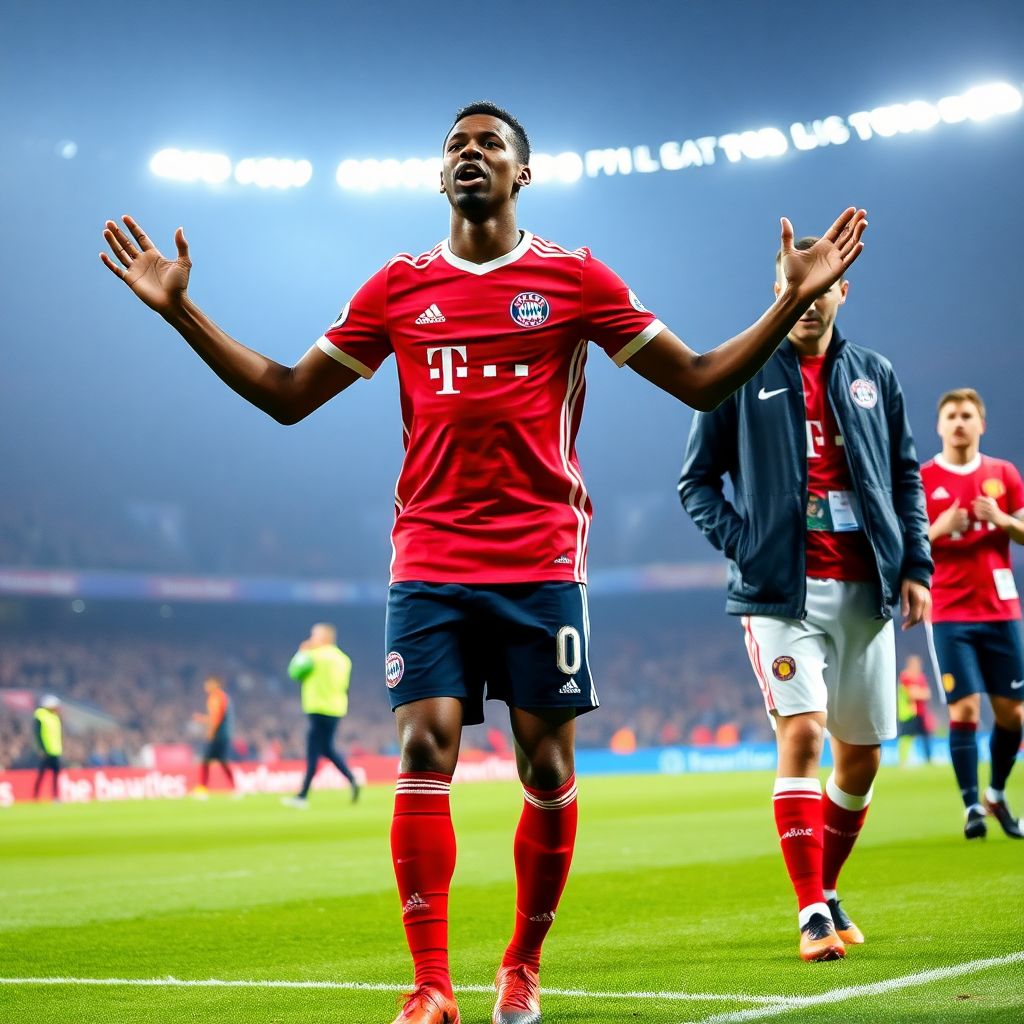
Manchester United end Victor Osimhen pursuit, clearing path for Bayern Munich
Manchester United have stepped away from the race to sign Victor Osimhen this summer, leaving Bayern Munich in a commanding position to secure the prolific striker ahead of the new season.
For months, United had been credited with strong interest in the Galatasaray forward, even being described as ready to activate his release clause. The club’s recruitment team viewed the Nigerian as an ideal solution to their issues in front of goal, given his blend of pace, power and penalty-box instinct.
However, fresh reports from France now indicate that United have cooled their interest and effectively abandoned their pursuit. That decision is expected to hand Bundesliga champions Bayern Munich a remarkably clear route to negotiate a deal for Osimhen.
Bayern eye long-term successor to Kane
Bayern’s interest is driven by the need to future-proof their attack. Harry Kane remains one of the most lethal strikers in world football, but at this stage of his career the German club must plan beyond the medium term.
Osimhen, firmly in his prime years, fits that strategic brief perfectly. His physical profile, direct running and aggressive movement in the box are tailor-made for a side that dominates possession and territory in the Bundesliga. Bayern’s hierarchy believe he can step in initially as a high-level partner or rotation option for Kane, before eventually inheriting the role as the club’s main centre-forward.
The Nigerian has already demonstrated he can adapt to different tactical systems and environments, having impressed in Italy with Napoli and continued to deliver in Turkey with Galatasaray. That track record suggests he could transition relatively quickly to German football.
Why Bayern is an attractive destination for Osimhen
From the player’s perspective, a switch to Bayern would tick several crucial boxes. The Bavarian club consistently competes for league titles and domestic cups, and almost always features deep into the knockout rounds of the UEFA Champions League. For a forward entering his peak, that is the kind of platform that can define a career.
Bayern also have a long history of developing and maximising top strikers. From Robert Lewandowski to Mario Gomez and Miroslav Klose, the club’s playing style and infrastructure are typically built to feed a No. 9 with constant service. Osimhen’s game, based on attacking space, attacking crosses and finishing quickly in the box, seems particularly compatible with that model.
The prestige of wearing the Bayern shirt, alongside the chance to fight for major honours every season, is likely to be a major pull. For a player with ambitions of being recognised among the very best in the world, such an opportunity will be hard to ignore.
Manchester United’s attacking dilemma
While Bayern appear to be moving into pole position, Manchester United are left reassessing their options in attack. The Premier League side have shown flashes of improvement but remain short of consistent, reliable firepower in the final third.
Benjamin Sesko has been a notable bright spot in recent weeks, delivering encouraging performances and showing why he is so highly rated across Europe. Yet, as a young striker still learning the nuances of English football, he cannot be expected to carry the entire scoring burden. Adapting to the physical and tactical demands of the Premier League typically takes time, even for the most gifted talents.
This is why a more experienced, ready-made forward like Osimhen would have been such a compelling fit. His ability to lead the line, occupy defenders and score across different types of games might have accelerated United’s progression. Instead, the club must now identify alternative targets who can both raise the team’s current level and help guide emerging talents like Sesko.
Alternative striker targets for United
With Osimhen seemingly off the table, United have already been linked to other attacking options. One of the names mentioned is Mateus Mane, a highly rated young striker who has also attracted the attention of Bayern Munich.
While Mane is a different profile to Osimhen, United’s interest underlines a broader strategy: blend youthful potential with enough ready-made quality to compete immediately. The club cannot afford another season of inconsistent scoring if they hope to remain competitive domestically and in Europe.
In the months ahead, United are expected to explore a range of profiles – from established European forwards in their mid-twenties to versatile attackers capable of playing across the front line. The eventual signing will need to complement Sesko, not block his development, while still being capable of leading the attack when required.
Osimhen’s numbers highlight his pedigree
Osimhen’s appeal is reflected in his output. Across the current campaign, he has produced 23 goal contributions, underlining his status as one of the most productive forwards in European football. Those figures do not merely reflect finishing ability; they also highlight his involvement in build-up play, link-up actions and creating space for others.
Having already proved himself in multiple leagues and under different managers, the Nigerian has built a strong case as a striker capable of lifting the level of almost any side he joins. His performances on the European stage have further enhanced his reputation and convinced top clubs he can deliver under pressure.
For a Bayern team looking to maintain its dominance at home and push harder in Europe, those traits are particularly valuable. For United, opting against continuing the pursuit of such a player underlines either budgetary constraints, a shift in tactical priorities, or a desire to bet more heavily on youth.
Strategic implications for Bayern and United
If Bayern complete a deal, the move would send a clear message to the rest of Europe. Adding Osimhen to a squad that already includes Kane, world-class wide players and creative midfielders would give them arguably the deepest attacking department on the continent. It would also offer tactical flexibility – from playing with two forwards to rotating without significant drop-off in quality.
For Manchester United, missing out on Osimhen increases the pressure on their recruitment team to find value and clarity in a crowded striker market. They must avoid short-term fixes that create long-term squad imbalances. Any signing this summer needs to align with the manager’s tactical blueprint and the club’s broader rebuilding project.
The risk for United is obvious: if they fail to add sufficient quality up front, they could find themselves once again struggling to convert chances, undermining efforts to close the gap on the Premier League’s leading sides.
The player’s ambition and the next step in his career
From Osimhen’s perspective, the next move of his career carries more weight than ever. At this stage, he will be intent on competing at the very highest level, season after season. He has already demonstrated he can be a talismanic figure in different environments; the logical progression is to join a club that is permanently in the conversation for continental trophies.
His versatility – being able to play as a lone striker, in a two-man front line, or as part of a fluid attacking trio – only increases his attractiveness. It allows a coach to adjust systems without losing his primary goal threat.
If the Bayern move materialises, it will be a significant test of whether he can translate his form into one of Europe’s most demanding football environments, where winning the league is considered the minimum and Champions League performance defines success.
United’s top-four push and Champions League ambitions
United, meanwhile, remain locked in a battle to secure a top-four finish in the Premier League. Achieving that objective is critical, not only for financial reasons but also for attracting the calibre of players they are targeting. Champions League football has become a decisive factor for many elite players when choosing their next club.
To compete effectively in that competition next season, United will need greater depth and variety in attack. A single striker, however talented, is unlikely to be enough across four competitions and a long, physically demanding campaign. Rotational options, different profiles of forwards and tactical flexibility will be essential.
The summer transfer window, therefore, is shaping up to be pivotal. The choices United make – particularly in the centre-forward position – could define the trajectory of the next few seasons.
What to watch for in the coming weeks
The coming weeks will likely bring clarity on three key fronts:
1. Whether Bayern formally moves to activate Osimhen’s clause or reach an agreement with his current club.
2. How Manchester United recalibrate their shortlist of attacking targets in light of stepping away from Osimhen.
3. Whether other top clubs decide to enter the race, potentially complicating Bayern’s seemingly clear path.
For now, the situation appears to favour the German champions. United’s decision to rule themselves out has removed one of the main competitors for Osimhen’s signature, leaving Bayern in an enviable position as they look to secure one of Europe’s most sought-after strikers.
What remains certain is that Osimhen’s next move, Bayern’s planning for life after Kane, and United’s search for a new attacking leader will all be central storylines of the upcoming transfer window.