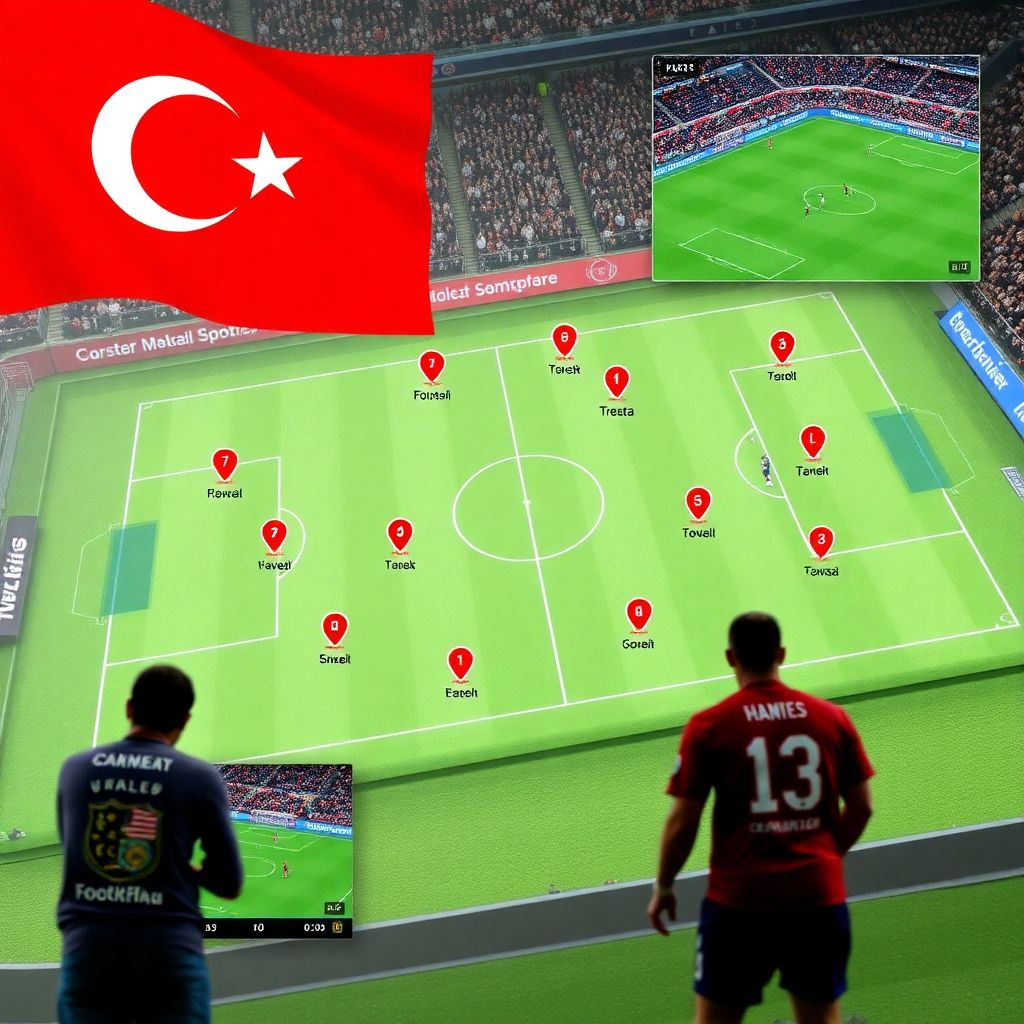
Pressing in the Süper Lig is a spectrum from aggressive high press to conservative low block, shaped by squad profiles, coaches, and match context. Understanding how Turkish clubs time their presses, choose man‑oriented or zonal references, and manage transitions is essential for Super Lig tactical analysis, coaching decisions, and informed predictions.
Pressing overview: core patterns in the Süper Lig
- Big clubs tend to press higher and more aggressively at home, while shifting to controlled midblocks and selective pressing away.
- Mid-table teams often mix man-oriented pressing on the flanks with zonal compactness in central areas.
- Pressing intensity usually drops after the 60th minute as physical and environmental factors in Turkey influence tempo.
- Common triggers include backward passes to the goalkeeper, slow switches, and poor first touches under pressure.
- High-risk pressing schemes expose full-backs and half-spaces, so counter-press structures are a critical differentiator.
- For Turkey Super Lig analysis and Super Lig betting tips and predictions, context (score, phase of season, opponent style) changes pressing behaviour more than formation labels.
Evolution of pressing philosophies among Turkish clubs
Pressing styles in the Süper Lig have shifted from reactive, deep defending to more proactive, ball-oriented systems. Traditionally, many Turkish teams relied on passionate home atmospheres, strong centre-backs, and direct transitions rather than collective pressing schemes. Lines sat deeper, and pressure mainly appeared around the defensive third.
As foreign coaches and detailed football pressing tactics analysis became more common, clubs started adopting structured pressing. Wide forwards began closing centre-backs, number 10s screened pivots, and full-backs jumped aggressively on opposition wingers. This created a clear separation between top sides using coordinated high or midblock pressing and smaller clubs staying in low blocks with selective counter-pressing.
Today, the league shows a hybrid landscape. Some title contenders build complex pressing traps in wide zones, inviting passes to one touchline before collapsing with three or four players. Others employ a more conservative midblock, prioritising vertical compactness and transition defence. Turkish Super Lig statistics and data from tracking and event providers now influence how backroom staffs fine-tune pressing heights, distances, and recovery routes.
Mini-scenario: A top-six team at home against a weaker opponent might start with a high press for 20-25 minutes to force early errors, then drop into a midblock once leading, managing energy and controlling counter-attacks rather than constantly chasing the ball.
- Define your team’s default pressing height (high, mid, or low) for home and away matches.
- Review at least three recent games to identify when your line of engagement changes during matches.
- Align pressing plans with player profiles, especially centre-backs’ speed and forwards’ work rate.
Man-oriented vs. zonal pressing: tactical choices and trade-offs
Most Süper Lig teams combine man-oriented and zonal principles rather than using a pure version of either. Choices depend on squad athleticism, communication level, and the opponent’s build-up structure. Below is a practical comparison relevant for Super Lig tactical analysis.
| Pressing style | Main reference | Typical triggers | Key pros | Main risks | Typical Süper Lig use-case |
|---|---|---|---|---|---|
| Man-oriented high press | Individual opponents | Goalkeeper receiving, backward pass, slow centre-back touch | Disrupts short build-up, simplifies roles for aggressive forwards | Vulnerable to long balls and switches, high physical load | Top clubs at home vs. short-passing teams |
| Zonal midblock | Spaces and lanes | Vertical pass into half-space, pass into pivot, bounce passes | Stable shape, good for transitions, easier to maintain for 90 minutes | Allows opponent more sterile possession, requires compact spacing | Mid-table sides vs. stronger possession teams |
| Hybrid flank pressing | Ball zone + nearest man | Pass to full-back or winger facing own goal, heavy touch near touchline | Traps near sideline, clear counter-attacking routes | Can leave opposite flank open, depends on quick shifting | Evenly matched games where both teams attack down the wings |
- Forwards and attacking midfielders match up directly on centre-backs and pivot in man-oriented schemes, aiming to block short options rather than spaces.
- In zonal pressing, the team forms compact horizontal and vertical lines, with players moving as a unit to close lanes instead of following opponents everywhere.
- Hybrid pressing in the Süper Lig often means zonal central compactness with man-oriented aggression near the touchline when the ball is played to full-backs.
- Coaches adjust references by phase: man-oriented in the first seconds after losing the ball (counter-press) and zonal once the opponent stabilises possession.
- Squads with many young, energetic players can sustain more man-oriented elements; experienced but slower teams usually prefer zonal controls.
- Mini-scenario: A mid-table club defending a narrow lead might stay zonal in central zones but assign strict man-oriented roles to the opposition number 10 and holding midfielder to stop through passes.
- Decide which players are allowed to follow opponents (e.g., number 6 on the pivot) and who must always keep zonal positions.
- Train clear communication cues for when to abandon a man and drop back into the line.
- Analyse one full match focusing only on whether your players react to spaces or to opponents, then adjust rules accordingly.
Press triggers: situational cues and coach-specific signals
Press triggers are the moments that tell a team to accelerate, jump, or stay. In the Süper Lig, press triggers are often simplified due to noise levels, stadium intensity, and varying communication quality. Clear, repeatable cues are essential for turning theory into a functional collective press.
- Backward or negative passes: Many coaches use a backward pass to a centre-back or goalkeeper as the main “go” signal. Forwards sprint to close the ball while midfielders step up to take away inside passes.
- Closed body shape: If an opposition full-back receives facing his own goal or the touchline, wide players are instructed to press aggressively from the outside in, using the line as an extra defender.
- Heavy touch or bouncing ball: On poor control, nearby players collapse on the receiver, while the line behind them squeezes forward to close spaces for the second ball.
- Pass into the pivot: When the ball enters the opposition pivot between lines, the closest midfielder jumps, central defenders squeeze up, and wingers narrow to block return passes to centre-backs.
- Specific opponent weaknesses: Based on scouting and football pressing tactics analysis, some Süper Lig teams use tailored triggers, such as pressing a nervous left centre-back more aggressively than the calmer right centre-back.
- Mini-scenario: Before a match, the staff highlight that the rival goalkeeper is uncomfortable with his weaker foot. Any back-pass to that side becomes an automatic high-intensity trigger, with both wingers and the striker converging to close angles.
- Limit your team to three or four primary triggers per phase (build-up, wings, central zones) to keep behaviour consistent.
- Use video clips to show both successful and failed presses for each trigger so players understand risks.
- Rehearse triggers in small-sided games with clear verbal cues, then gradually remove the verbal guidance.
High press in practice: formations, rotations and recovery routes
High pressing in the Süper Lig commonly appears in 4-2-3-1, 4-3-3, or 3-4-3 structures. The first line aims to force play to one side, the second line protects central lanes, and the back line holds a high starting position to compress space. Rotations are used to keep pressure on the ball without breaking compactness.
Teams that press high successfully usually invest heavily in recovery routes: how players reset when the press is broken. Instead of panic sprinting toward their own goal, they drop into pre-defined reference positions, especially protecting half-spaces and the zone just in front of centre-backs. This separation between “all-out chase” and controlled high press is a recurring theme in Turkey Super Lig analysis.
Upsides of an organised high press
- Creates short distances to goal after regains, supporting quick, direct attacks.
- Restricts time and vision for technically limited defenders and goalkeepers.
- Can generate momentum and crowd energy in intense home atmospheres.
- Allows defenders to defend facing forward rather than retreating toward their own goal.
Constraints and vulnerabilities of high pressing
- Large spaces behind a high defensive line, especially if centre-backs lack pace.
- High physical demands that can lead to inconsistent intensity across 90 minutes.
- Risk of being played through by calm, technically strong opponents.
- Requires synchronised movements; one late press can open vertical lanes.
Mini-scenario: A title-chasing club, trailing at home, switches to a 4-3-3 high press in the last 25 minutes. Full-backs push very high, holding midfielders share the responsibility of covering counters in the central channel, and centre-backs are instructed to step into midfield to delay transitions rather than sprint backward immediately.
- Define your highest allowed line for centre-backs in high press phases and train it repeatedly.
- Assign clear recovery routes for each line (forwards, midfielders, defenders) when the first press is bypassed.
- Use Turkish Super Lig statistics and data such as defensive actions per minute in the final third to monitor if your high press is sustainable.
Midblock and low block strategies: compactness, spacing and transition risks
Midblocks and low blocks are widely used in the Süper Lig, especially by underdogs and away teams. A midblock sits around the middle third, allowing the opponent some build-up but protecting the area in front of the box. Low blocks retreat near the penalty area, prioritising box defence and crosses over pressure on the ball.
Many teams adopt these structures for stability but suffer from poor spacing and transition planning. Lines can become passive, creating large gaps between midfield and defence. When the ball is won, the lack of pre-planned outlets leads to rushed clearances instead of controlled counters, which matters both for performance and for accurate Super Lig betting tips and predictions.
- Myth: A deep block means not pressing at all. Reality: Good low blocks still have micro-presses in wide areas and occasional jumps from midfielders to stop free crosses.
- Myth: Compactness only means staying narrow. Reality: Vertical distances between lines are just as important; a narrow but stretched team is easy to penetrate with wall passes.
- Common error: Full-backs drop too deep into the box, leaving space at the edge of the area for cut-backs and long shots.
- Common error: Forwards stay too high and disconnected, unable to help midfield, leading to a permanent 4v3 or 5v3 against the midfield line.
- Misconception: Low blocks automatically protect tired teams. In fact, continuous defending in and around the box can be more draining than a compact midblock with occasional ball possession.
- Mini-scenario: A relegation-threatened team away to a top side chooses a low block but designates two quick forwards to stay connected to the ball side. When the right winger recovers the ball, there is a pre-trained diagonal pass into the channel, turning defence into a coordinated counter-attack.
- Define target distances between defence and midfield lines (e.g., enough to contest second balls, not to invite easy through passes).
- Pre-plan two simple counter patterns from the low block, one through the wing and one through the central channel.
- Coach your forwards to drop into the midblock line when the ball is on the far side to avoid numerical inferiority.
Measurable signals: which metrics and video markers reveal pressing quality
Pressing quality in the Süper Lig can be evaluated with a mix of data and video. While access to detailed Turkish Super Lig statistics and data varies, coaches and analysts can still establish consistent markers to support both coaching decisions and wider Turkey Super Lig analysis.
Useful data-based indicators include the number of high regains per match, defensive actions in the final third, and passes allowed per defensive action. On video, analysts can assess line distances, body orientation, and the timing between the first presser jumping and the supporting movements behind him.
Mini pseudo-process for a simple club-level pressing audit:
{
  "step_1": "Tag all ball recoveries in the opposition half over 3 recent matches.",
  "step_2": "For each recovery, note whether it followed a clear press trigger (back-pass, heavy touch, pivot pass).",
  "step_3": "Review video to check if second-line support arrived within 1-2 seconds of the first press.",
  "step_4": "Classify regains: 'structured press' vs 'random turnover' to guide training priorities."
}
Mini-scenario: An analyst notices that most high regains come after pressing wide full-backs, not from central triggers. The staff then decide to shift their pressing scheme toward stronger flank traps and reduce risky jumps from central midfielders.
- Pick two or three core metrics (e.g., high regains and defensive actions in the final third) and track them every match.
- Combine numbers with targeted video clips to understand why pressing success or failure occurs.
- Adjust training themes weekly based on the most frequent pressing failures identified in your audits.
End-of-article self-check for Süper Lig pressing application
- Can you clearly describe your team’s default pressing height and when it changes during a match?
- Do all players know the main press triggers and their own roles when those triggers occur?
- Is there a clear balance between man-oriented and zonal principles suited to your squad’s physical profile?
- Have you defined recovery routes and counter-attack patterns for both high press and low block phases?
- Are you regularly combining data and video to refine your pressing behaviours over time?
Practical questions about adopting pressing methods in the Süper Lig
How should a mid-table Süper Lig team choose its main pressing style?
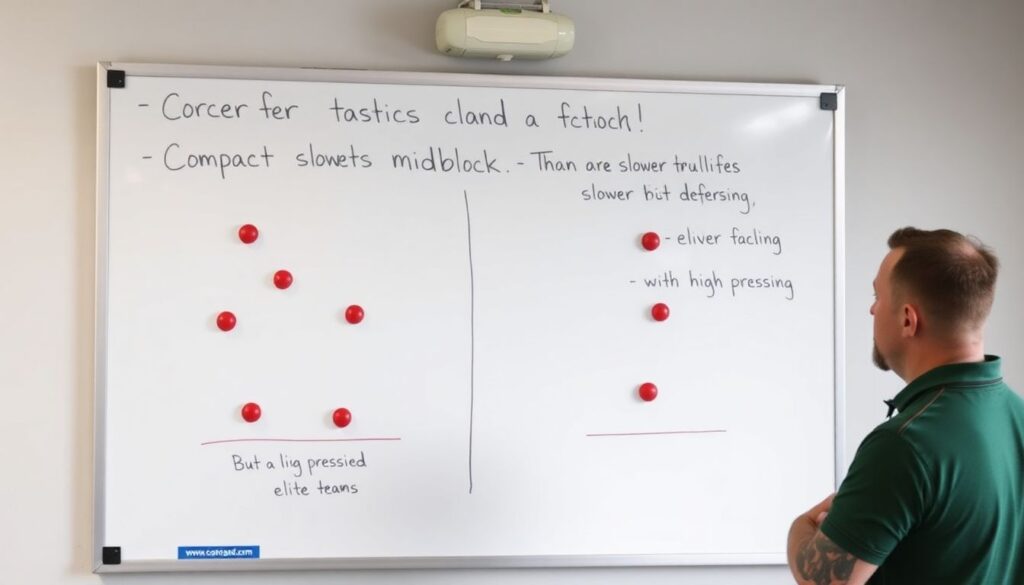
Start from player profiles and physical capacity rather than copying big clubs. If your back line lacks pace, prioritise a compact midblock with targeted presses instead of a full-time high press.
Is it realistic to press high for the full 90 minutes in the Süper Lig?
Continuous high pressing is rarely sustainable. Plan intentional phases of higher and lower intensity, using substitutions and in-game tactical shifts to manage energy.
What is the first pressing element a coach should train with limited time?
Focus on one or two clear press triggers and the reaction of the nearest three players. Building simple, repeatable behaviours is more valuable than a complex scheme poorly executed.
How can analysts support pressing development with limited data access?
Use basic match footage to tag high regains, pressing failures, and spacing between lines. Even simple manual logs can reveal patterns that guide training priorities.
Do betting models consider pressing styles in Super Lig betting tips and predictions?
Many advanced models integrate indicators of pressing intensity and field position of regains because they affect shot volume, game tempo, and volatility of results.
Should smaller clubs in Turkey always sit in a low block against stronger teams?
Not always. A disciplined midblock with occasional aggressive presses in specific zones can be more effective and less exhausting than defending permanently on the edge of the box.
How often should a coaching staff review and adjust pressing rules?
Pressing guidelines should be revisited at least every few matches or whenever opponents present a new structural challenge, ensuring principles stay clear and relevant.