
The tactical evolution of the Süper Lig from rigid 4-4-2 to modern fluid systems is about shifting from fixed lines to dynamic roles, pressing triggers and flexible structures that suit Turkish player profiles. Coaches should treat 4-4-2 as a reference, then layer rotations, hybrid roles and coordinated pressing without losing defensive stability.
Essential Tactical Summary for Coaches
- Use 4-4-2 as a clear reference shape, especially for Turkish players used to traditional structures.
- Shift to 4-3-3 or 4-2-3-1 mainly in possession, while keeping simple rest-defence principles out of possession.
- Redefine full-backs and wingers first; fluidity starts on the flanks, not in the centre.
- Introduce pressing rules step by step: first direction, then height, then triggers.
- Design drills that connect shape, roles and match scenarios, not isolated rondos only.
- Use your own Super Lig tactical analysis 2024 notes instead of copying European models blindly.
Historical Foundations: Why 4-4-2 Ruled Early Süper Lig
Classic 4-4-2 dominated early Süper Lig years because it matched the league’s physical intensity, direct attacking style and simple coaching structures. Two strikers suited Turkish clubs that favoured fast transitions, wing crosses and man-to-man defensive concepts rather than complex zonal pressing.
For many intermediate coaches in Turkey, 4-4-2 is still the easiest system to teach: two banks of four, clear vertical partnerships (full-back-winger, centre-back-striker), straightforward pressing cues and obvious substitutions. This is why any serious Turkish Super Lig tactical evolution article should start by understanding 4-4-2, not rejecting it.
However, pure 4-4-2 has structural issues against modern football tactics in Turkish Super Lig:
- Outnumbered in midfield against 4-3-3 and 4-2-3-1, especially between the lines.
- Wide midfielders must run box-to-box, often leaving full-backs isolated.
- Pressing is easily bypassed by teams using inverted full-backs and third-man runs.
4-4-2 still fits when:
- You have two complementary strikers (target + runner) who defend from the front.
- Your centre-backs dominate aerially and in duels, allowing a slightly deeper block.
- Your wingers are disciplined defensively and willing to track full-backs.
- You face opponents who build with two centre-backs and a single pivot only.
You should avoid a strict 4-4-2 when:
- Opponents overload midfield with a 3-2 build-up or box midfield.
- Your second striker does not work defensively, leaving the pivot unpressed.
- Both full-backs are very attacking but your wingers are not reliable defensively.
- You want to dominate ball possession and control the half-spaces.
Instead of abandoning it completely, use a Super Lig 4-4-2 vs modern systems analysis to decide: 4-4-2 can be your out-of-possession shape, while in possession you morph into 4-2-3-1 or 3-2-5 through simple, safe role adjustments.
Transitional Systems: Rise of 4-3-3, 4-2-3-1 and Hybrid Setups
The league’s shift towards 4-3-3 and 4-2-3-1 came with foreign coaches, more analytical staff and exposure to European competitions. Today, most Super Lig tactical analysis 2024 reports describe teams that change structures between phases instead of staying in one rigid formation.
To coach these transitional systems safely, you need:
- Clear game model and reference shapes
Define: base out-of-possession shape, in-possession structure, and transition principles. For example, defend in 4-4-2, attack in 2-3-5, counter-press in a 3-2 structure. - Role descriptions instead of position labels
Every player needs a short, practical role card: zones of responsibility, pressing triggers, build-up behaviours. Avoid complex terminology; prioritise 2-3 simple rules per phase. - Video and drawing tools
Use simple animation or board software to show rotations and zones. Even basic telestration on match footage is enough for intermediate-level squads. - Physical and cognitive profiles
Assess who can cover wide spaces, who can receive under pressure, who can switch play. Modern fluid systems demand players who scan, communicate and adapt, not only run. - Staff alignment
Assistants, analysts and fitness coaches must understand your structures so that the whole weekly plan supports the same tactical ideas. - Match-plan templates
Create 2-3 repeatable plans: for dominating games, balanced games and underdog scenarios. Each plan links formation choices, pressing height and rest-defence structure.
This structured approach keeps fluid shapes understandable and safe for players, reducing confusion and individual mistakes that are often punished in the Süper Lig.
Player Role Shifts: Full-backs, Wing-backs and Inverted Wingers
The biggest tactical evolution in the Süper Lig has been on the flanks. To move from classic 4-4-2 to fluid systems, start with full-backs, wing-backs and inverted wingers. Below is a step-by-step, safe procedure you can implement with intermediate players.
- Define your flank hierarchy
Decide who is the main wide progressor: full-back or winger. This determines if you lean towards 4-3-3/4-2-3-1 (advanced winger) or 3-4-3/3-2-5 (pushed-up wing-back).- If your full-back is more dynamic than your winger, consider building a wing-back role.
- If your winger is stronger 1v1, keep him high and wide; full-back supports from behind.
- Introduce inverted movements step by step
Teach wingers and full-backs simple, mirrored runs: one inside, one outside. Use safe, repeatable patterns first.- Pattern A (left): full-back overlaps, winger comes inside half-space.
- Pattern B (right): full-back underlaps into half-space, winger stays wide.
- Link these to clear cues: ball at 6/8, body shape to play wide, or isolated 1v1.
- Stabilise rest-defence behind the ball
When one full-back goes high, lock the opposite full-back; form a back three with two centre-backs + far-side full-back or pivot.- Clarify: who stays, who steps, who covers depth when the ball is lost.
- Train 3v2 and 3v3 defensive transition drills from your attacking patterns.
- Build rotations with the near-side midfielder
Create three-player triangles: full-back, winger, and 8 or 10. Rotations must have a purpose (free man inside, free man wide, or depth run).- Rotation 1: 8 drops wide, full-back goes inside, winger attacks depth.
- Rotation 2: full-back stays deep, 8 runs beyond winger to attack half-space.
- Clarify crossing and cut-back zones
Define three simple zones: early cross (deep), byline cross, cut-back zone. Assign which role attacks which zone based on their stronger foot.- Inverted wingers aim to reach cut-back zone and play low passes.
- Full-backs cross more from deep and traditional wide zones.
- Connect flank roles with pressing triggers
Flank roles are not only for attacking. Decide who jumps to press full-backs, who protects inside channels and who tracks long diagonals.- Against back four: winger presses full-back; full-back marks winger or covers inside.
- Against back three: wing-back jumps to outside centre-back; winger screens pass to wing-back.
Fast-track flank adaptation checklist
- Pick your main wide progressor (full-back or winger) on each side.
- Teach one overlap/underlap pattern per flank and repeat it all week.
- Lock the far-side full-back to maintain a back three in transition.
- Create a simple triangle with the near 8 or 10 for rotations.
- Link flank movements to clear pressing roles when the ball is lost.
Pressing Architecture: From Sit-and-Wait to Coordinated Counter-press
Historically, many Süper Lig teams preferred a mid or low block, waiting for mistakes. Modern systems increasingly rely on coordinated pressing and counter-pressing, but unsafe, chaotic pressing can expose big gaps. Use this checklist to assess whether your pressing architecture is ready for higher-level opponents.
- Your first line (striker/winger or front three) agrees on which side to force the ball every time.
- Your midfield line knows exactly who jumps to the pivot and who protects space behind.
- Full-backs have clear rules on when to jump to press opposition full-backs and when to hold.
- When the ball is lost, at least three players immediately attack the ball zone within one pass distance.
- Your rest-defence (usually 2-3 players) always protects the central lane and depth behind the line.
- Pressing height is pre-planned in match strategy (high, mid, low) and communicated before kick-off.
- Players recognise pressing traps on the side: touchline used as an extra defender, cover shadows active.
- You can switch off the press and drop into a block without chaos when the first trigger is missed.
- Video clips of your last games show compactness between lines when pressing, not stretched distances.
- Your conditioning work supports repeated high-intensity presses without losing structure after 60 minutes.
Designing Fluid Structures: Positioning, Rotations and Overloads
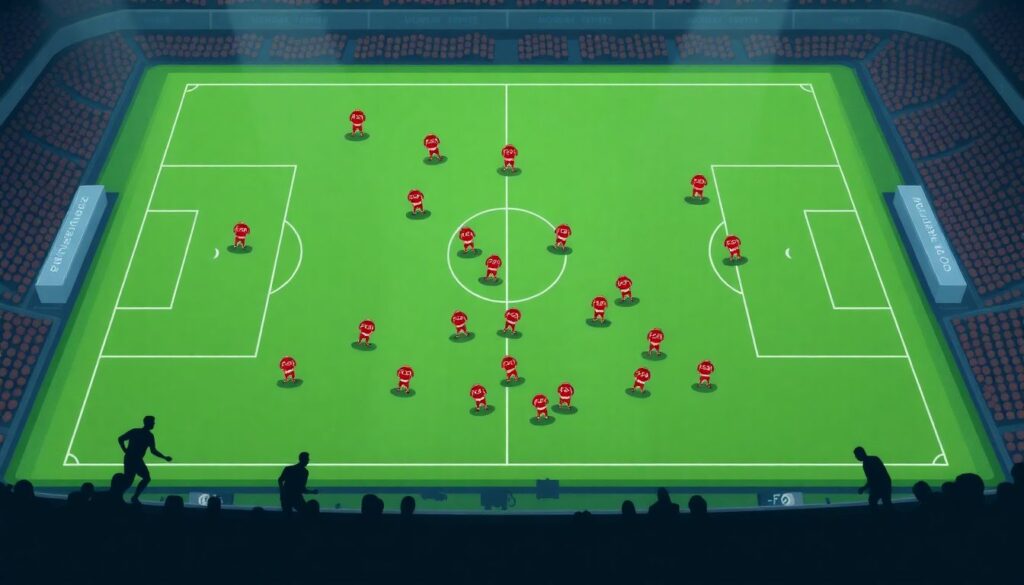
Moving from classic 4-4-2 to fluid shapes is attractive but dangerous if you ignore spacing and basic positional rules. These are frequent, costly errors observed in modern football tactics in Turkish Super Lig, especially when coaches copy elite teams without adjustment.
- Changing formation on the tactics board without defining clear in-possession and out-of-possession roles.
- Allowing all players to roam, destroying reference points and confusing passing lanes.
- Over-rotating in one corridor (e.g., right flank) and leaving the opposite side unused.
- Pushing both full-backs high simultaneously without a clear back-three security behind.
- Playing with two advanced 8s and a 10 but leaving the pivot isolated and overloaded in transitions.
- Forcing inverted wingers onto their weaker foot, harming both finishing and build-up security.
- Requesting constant third-man runs and overlaps while players lack physical capacity to repeat them.
- Introducing complex rotations too fast, before teaching base shape and distances.
- Ignoring the opponent’s shape when planning overloads, creating crowded zones with no true free man.
- Skipping simple drawing/diagram sessions; players then misunderstand zones and reference points.
To avoid these mistakes, plan your structure like a simple map: define five vertical lanes (wide, half-space, centre) and three horizontal bands (build-up, creation, finishing). Make sure every rotation keeps at least two players stabilising behind the ball and one player stretching depth.
Practical Implementation: Training Drills and Matchday Plans
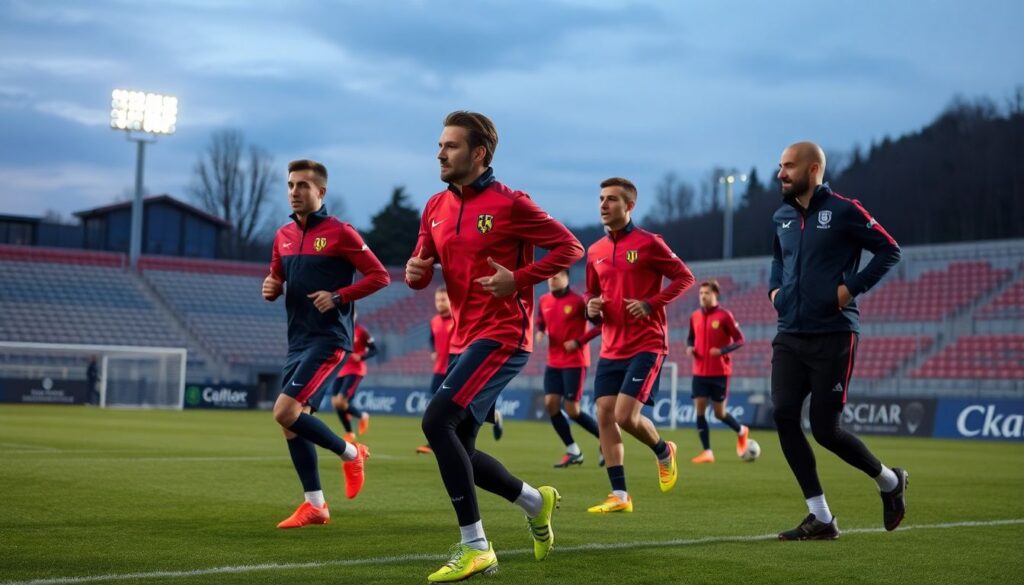
To apply the ideas from this Turkish Super Lig tactical evolution article, design your week around game-like exercises, not only fitness and technical drills. Below are alternative implementation pathways you can choose depending on your squad and resources, all keeping safety and clarity as priorities.
- Conservative evolution: 4-4-2 to 4-2-3-1
Best when players are used to 4-4-2.- Out of possession: stay in 4-4-2 mid-block.
- In possession: one striker drops into 10 space, wingers stay high; full-backs support cautiously.
- Training focus: shadow play and 11v0 to rehearse positioning, plus 8v8 with zones for 10 and wingers.
- Wing-focused evolution: 4-4-2 to asymmetrical 4-3-3
Suitable if you have one dominant winger.- Convert near-side wide midfielder into an 8, far-side winger stays high and wide.
- Build overloads on strong side, quick switches to far-side winger.
- Training focus: 7v7+3 possession with strong-side overloads and switches, pressing traps on that side.
- Back-three evolution: 4-4-2 to 3-4-3/3-2-5
Useful when one full-back can play as a third centre-back in build-up.- In build-up: drop one full-back inside, push opposite full-back high as wing-back.
- In defence: return to a back four to keep it simple.
- Training focus: 6v4 build-up patterns, then 10v10 with constraints on full-back movements.
- Principle-based evolution without formation labels
Ideal if players get confused by too many numbers.- Teach zones, roles and behaviours first (who gives width, who gives depth, who stabilises).
- Use simple magnets or cones to show lanes, not formation names.
- Training focus: large positional games (e.g., 10v10) with scoring bonus for structured occupation of zones.
Whichever path you choose, build a small library of your own clips as the best resources for Super Lig tactics and analysis. Use them in short meetings (5-10 minutes) so players see your ideas clearly and safely before going to the pitch.
Coaches’ Practical Concerns and Quick Solutions
How do I start evolving from 4-4-2 without confusing my players?
Keep 4-4-2 as your defensive reference and change only your attacking structure first. Turn one striker into a 10, stabilise rest-defence with one full-back staying. Introduce just one or two new patterns per week and repeat them in all drills.
What is the safest way to add pressing without exposing big gaps?
Begin with a mid-block and only add high pressing in specific moments, such as goal kicks or wide throw-ins. Define clear pressing triggers and make sure at least two players always stay behind the ball, protecting central and depth spaces.
How can I train inverted wingers with intermediate-level players?
Use simple 3v3+2 neutral games in half-spaces where wingers receive inside on their stronger foot and combine with full-backs wide. Add a finishing rule: inverted winger must either shoot from inside or play a cut-back, nothing else.
What if my full-backs are weak defensively but strong in attack?
Consider a back-three structure in possession, moving one midfielder into the back line when full-backs go high. Alternatively, lock one full-back and allow only the other to attack, adjusting your winger’s role on that side to help with rest-defence.
How do I adapt these ideas against stronger Super Lig opponents?
Reduce the number of rotations, focus on a compact block and use clear counter-attacking patterns. Let your structure be more conservative, with emphasis on rest-defence and safe outlets in wide areas for transition attacks.
How much video do I need to support tactical changes?
Short, focused clips are enough: a few examples from your own games plus 2-3 external situations that match your ideas. Show them just before training, then repeat the same patterns immediately on the pitch so players can connect theory and practice.
Can I mix 4-3-3 and 4-2-3-1 within the same season?
Yes, if you keep shared principles: same pressing rules, similar rest-defence and consistent roles for key players. Present both as variations of the same idea, not two separate systems, to keep learning curves gentle for your squad.