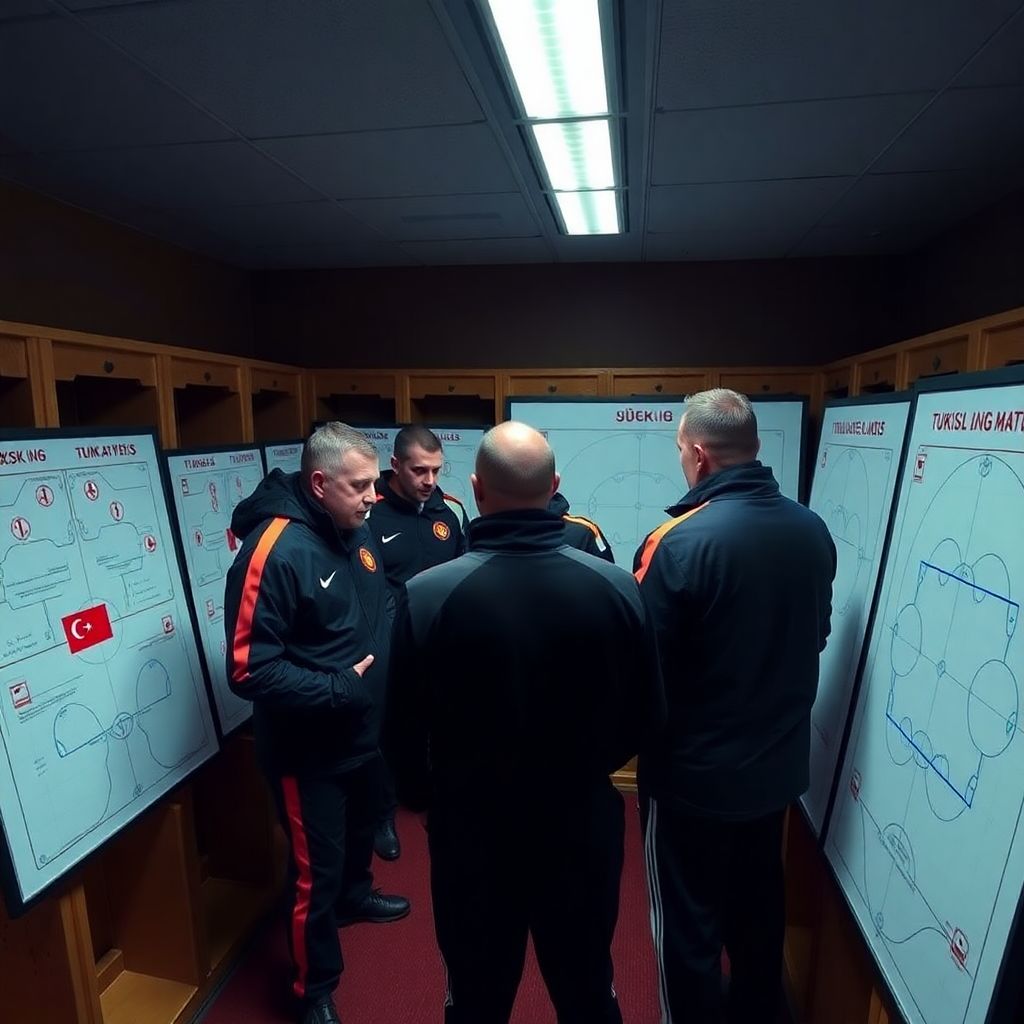
Top Süper Lig coaches prepare for big European clashes by building a specific match plan: detailed opponent profiling, small but clear formation tweaks, pre-agreed pressing triggers, tailored set-pieces, disciplined rotation and recovery, and structured in-game decision trees. The goal is to reduce chaos, control key spaces, and maximise the first 20 and last 20 minutes.
Pre-match Tactical Priorities
- Define a realistic game model for Europe: defend deeper or press higher than in the league, and why.
- Use a clear Super Lig tactics analysis for European competitions to identify what does and does not transfer well.
- Limit the plan to 3-4 non-negotiable principles every player can repeat under pressure.
- Design pressing and transition rules around your two or three most reliable players.
- Prepare 2-3 rehearsed set-piece routines in attack and 1-2 compact schemes in defence.
- Decide substitution patterns before kick-off, with clear minute ranges and scoreline triggers.
Opponent Profiling: Data, Video and Scout Reports
This stage suits staffs who already have a stable game model in the Süper Lig and want to adjust it, not reinvent it, for Europe. It is less useful for teams changing coach or style mid-season, because there is no clear baseline to modify. In those cases, focus first on your own identity.
Use opponent profiling to build a simple, shared picture of the rival, not a giant document no one reads. For an in-depth analysis of Super Lig clubs in European competitions, smart coaches compare how their own team behaves when facing similar profiles in domestic play, then adjust for higher tempo and individual quality in Europe.
Structure your profiling around three questions:
- How do they create chances? Wide overloads, half-space combinations, direct balls to a target, or transitions after pressing? Note where their best players receive the ball.
- How do they defend the first and second phases? Press height, compactness between lines, and how aggressively they jump to the ball when it enters midfield.
- Where do they suffer most? Crosses, cut-backs, shots from distance, set-pieces, long switches, or counter-attacks after losing the ball centrally.
Build your report in three layers:
- Staff pack: 5-6 pages with data visuals, pass maps, and pressing heat maps.
- Coaching deck: 10-12 short clips organised by phase (build-up, chance creation, pressing, transitions).
- Player version: 8-10 clips plus 3-4 key sentences for each line (defence, midfield, attack).
A practical Turkish Super Lig tactical breakdown vs European teams usually includes at least one comparison clip: how your team defended a similar pattern in the league versus how the European opponent executes it. This makes tactical instructions concrete and avoids abstract theory.
Adapting Formations: When Süper Lig Setups Change for Europe
Formation adaptation is about tools, not fashion. Before copying the best tactical strategies used by Super Lig managers in Europe, check what your squad can and cannot do physically, technically, and mentally. European opponents punish poorly rehearsed shape changes, especially in the first press and in wide defensive areas.
You will need three types of resources:
- Technical tools: Video software for drawing lines, highlighting zones, and exporting short clips for each line of the team.
- Data access: Simple event data (passes, pressures, duels) and positional information to see where your block actually defends and where you lose the ball most often.
- On-pitch time: At least two full sessions and one low-intensity walk-through to rehearse the European match structure.
Decide in advance how your domestic formation will transform:
- 4-2-3-1 in the league becoming 4-4-2 out of possession and 2-3-5 in attack in Europe.
- 3-4-2-1 domestically shifting to 5-4-1 against strong wide threats in European away matches.
Keep the transformation rules simple:
- Lines, not numbers: Defenders must know when they form a back five; midfielders when they flatten into two or three; forwards when one stays higher for the outlet.
- Clear role pairs: For example, in a 4-4-2 block, wide midfielders track full-backs, central midfielders protect half-spaces, and strikers screen pivots.
- Zone-based adjustments: Switch from man-oriented to zonal principles in your own third to control cut-backs and late runs.
When explaining how Super Lig coaches prepare for Champions League matches, many highlight one golden rule: no more than one new instruction per line of the team. Instead of overloading players, adapt your formation through small, repeatable behaviours (e.g. winger drops to full-back height when the ball enters your defensive third).
Pressing Triggers, Counter-Press and Transition Plans
This phase turns analysis into coordinated aggression. The aim is to define when to jump, who jumps, and where the rest of the team closes space. The steps below are a safe, structured way to install pressing and transition rules without confusing players.
- Define your pressing zones
Split the pitch into three horizontal zones (high, mid, low) and mark key vertical lanes. Decide in which zones you want to press aggressively, and where you prefer to delay and compact. - Select two or three simple pressing triggers
Typical triggers include backward passes, poor first touches, passes into the full-back, or a centre-back carrying the ball to the touchline. - Assign the first presser and cover shadows
For each trigger, identify the first runner and his pressing angle. Explain which passing lane he must block with his cover shadow, not just that he must “press”. - Connect the second and third players
After the first press, the nearest midfielder and winger complete the trap. Define who attacks the receiver, who protects the inside, and who covers the space behind. - Design a basic counter-press rule
For example, if you lose the ball in the half-space, the ball-loser presses, the nearest player blocks the forward pass, and the third closes the inside passing lane for three seconds. - Plan immediate attacking options after regain
When you win the ball, identify first look (vertical, switch, or secure pass) by zone. The clearer the first pass rule, the more dangerous your transition. - Rehearse with clear constraints
Use small-sided games where the team only scores after a regain in a targeted zone or where goals count double after a counter-press within five seconds.
Example: Against a build-up-heavy European side, you might set a pressing trigger when their right centre-back carries the ball wide. Your striker presses from inside-out, blocking the pass into midfield, your winger jumps to the full-back, and your near-side central midfielder steps into the pivot lane.
Fast-Track Mode: Simple Pressing and Transition Template
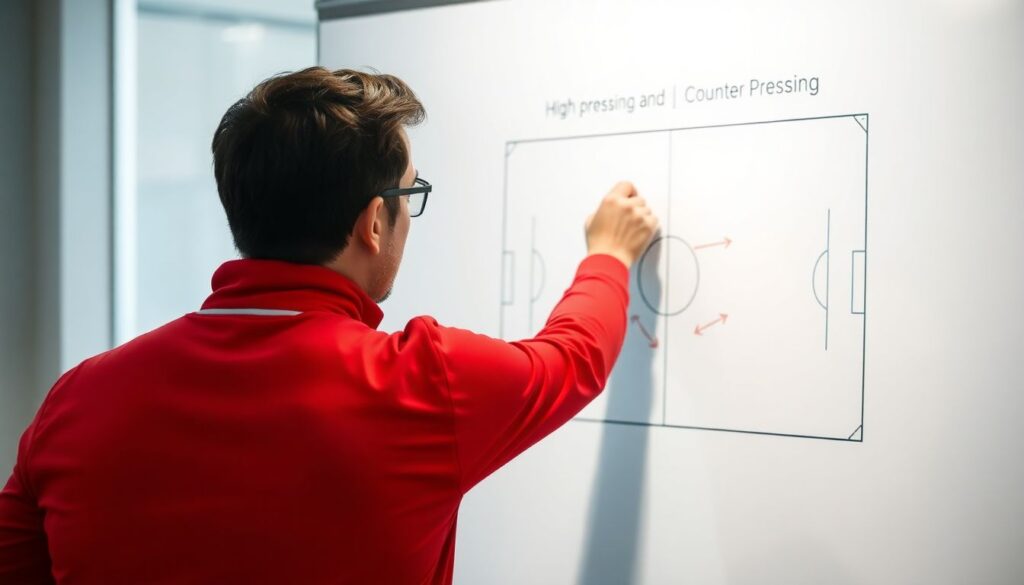
- Pick one main pressing zone (high or mid) and stick to it for the full match.
- Use two triggers only: backward pass and poor first touch facing own goal.
- Always counter-press for three seconds after losing the ball in the attacking half.
- On regains, first look forward; if no clear option, secure the ball to the free full-back.
Set-Piece Architecture: Defensive Schemes and Targeting Weaknesses
Set-pieces are often where Turkish sides feel the difference in European clashes. A structured set-piece plan should link directly to your Super Lig tactics analysis for European competitions, especially how your players cope with aerial duels and blocking patterns against stronger, taller opponents.
Use the following checklist to assess if your set-piece work is ready for a big night:
- Every player knows his exact role and starting position on defensive corners, including back-post responsibility.
- You have chosen one main defensive scheme (mostly zonal or mostly mixed) and are not changing it last minute.
- Near-post and far-post zones always have your most reliable headers, not just your tallest players.
- Blocking and screening movements on attacking corners are rehearsed and legal within the referee’s usual line.
- You have at least one short-corner routine to move the first defender and change the crossing angle.
- Free-kicks from wide areas have a clear default: inswing, outswing, or flat ball to a specific zone.
- Your rest-defence on your own attacking set-pieces is defined: how many stay back and who picks the opponent’s fastest players.
- Players know what to do after first contact: attack second balls in agreed zones, not randomly.
- Video clips for the day-before meeting show the opponent’s favourite runs and blocks, especially from their key takers.
- Goalkeeper and defensive line have a shared command word for holding, stepping, or dropping on wide free-kicks.
A practical Turkish Super Lig tactical breakdown vs European teams often reveals that the difference is not number of set-pieces, but clarity of roles. With this checklist, you increase clarity without overcomplicating your structure.
Squad Management: Rotation, Recovery and Role Clarity
Managing the squad around a major European fixture is as tactical as any formation choice. Poor rotation or vague roles can ruin even the best tactical plan. Below are frequent errors to avoid when preparing for high-intensity European nights.
- Rotating the spine too late: Leaving core players on the pitch for domestic matches right before Europe and expecting full freshness three days later.
- Changing three or more roles at once: Introducing a new full-back, new winger, and new pivot simultaneously, which breaks automatisms on one side.
- Using half-fit stars from the start: Starting key players who are not fully recovered instead of planning them as impact substitutes.
- Overloading players with information: Giving multi-role instructions (e.g. winger as extra full-back and second striker) to the same player in a single match.
- Ignoring recovery windows: Skipping low-intensity activation or light tactical sessions because of travel, which leads to mental and physical stiffness.
- Misaligning domestic and European roles: Asking a player to be the main creator in the Süper Lig but a pure runner or marker in Europe, without preparing him gradually.
- Late communication of the XI: Informing players of the starting line-up too close to kick-off, limiting time for mental rehearsal of tasks.
- Unclear hierarchy on set-pieces: Rotating takers without telling the squad who is first, second, and third choice for corners and free-kicks.
- Neglecting emotional load: Underestimating how big European clashes increase anxiety for local players and not offering simple routines (breathing, visualisation, early touches) to stabilise them.
Watching how Super Lig coaches prepare for Champions League matches, one pattern stands out: the most successful managers keep the spine stable, rotate around it, and give each player one main job plus, at most, one secondary responsibility.
In-Game Decision Trees: Substitutions, Tactical Tweaks and Contingencies
In-game decisions should follow pre-built trees, not emotion. Before kick-off, top staff create 2-4 alternative plans based on scoreline and game flow. This makes substitutions and tweaks quicker and calmer, especially in noisy European stadiums.
Consider the following structured options:
- Control variant (protecting a lead): Drop the block by one zone, bring on an extra midfielder, and shift wingers’ starting positions five metres deeper to protect full-backs. Use this when leading after 60 minutes and struggling to control half-spaces.
- Acceleration variant (chasing a goal): Replace one holding midfielder with a more vertical option, push full-backs higher, and instruct centre-backs to carry the ball into midfield when unopposed. Ideal for the last 25 minutes when you trail by one goal.
- Stability variant (under heavy pressure): Move from back four to back five, asking a midfielder to drop or bringing on a third centre-back. Wingers stay narrower to help against cut-backs. Use this when the opponent dominates wide overloads.
- Transition variant (open game, both teams stretched): Introduce a fast forward and a runner from midfield, reduce pressing height, and focus on quick, direct outlets after regains instead of long possession phases.
Link these options to clear triggers: specific minutes, fatigue signals, or repeated patterns (e.g. three consecutive dangerous crosses from one side). The best tactical strategies used by Super Lig managers in Europe rely less on surprise and more on executing one of these predefined variants at the right moment.
Tactical Clarifications and Practical Answers
How many new tactical ideas can players handle before a big European match?
Limit yourself to one main change per line of the team and two or three global principles. Beyond that, execution quality drops and players revert to habits from domestic matches.
Should a Süper Lig team press high or sit deeper against stronger European opponents?
Decide based on your squad’s physical capacity and the opponent’s build-up quality. Many Super Lig tactics analysis for European competitions show that a compact, aggressive mid-block is safer than an inconsistent high press.
How early should set-piece routines be trained before a major European clash?
Introduce your main routines at least one full training week before the game, then refresh them briefly in the last two sessions. Short, frequent rehearsals are more effective than one long block.
Is it better to rotate heavily in the league or in Europe?
Protect the spine for Europe but avoid changing more than three outfield starters at once in any match. The most coherent rotations keep structure stable and change profiles around it.
How detailed should opponent video sessions be for players?
Keep group sessions under 20 minutes, focusing on 8-12 clips linked directly to your plan. Extra detail can be shared individually with key players who enjoy deeper analysis.
What if the initial game plan clearly fails in the first 20 minutes?
Use pre-agreed emergency variants: adjust pressing height or wing positions without changing the full formation. Save systemic changes, like switching to a back five, for half-time unless the situation is critical.
How can a staff quickly review performance after a European match?
Within 24 hours, tag clips for each phase and create a short Turkish Super Lig tactical breakdown vs European teams comparison. Highlight two things to repeat and two to fix before the next domestic game.