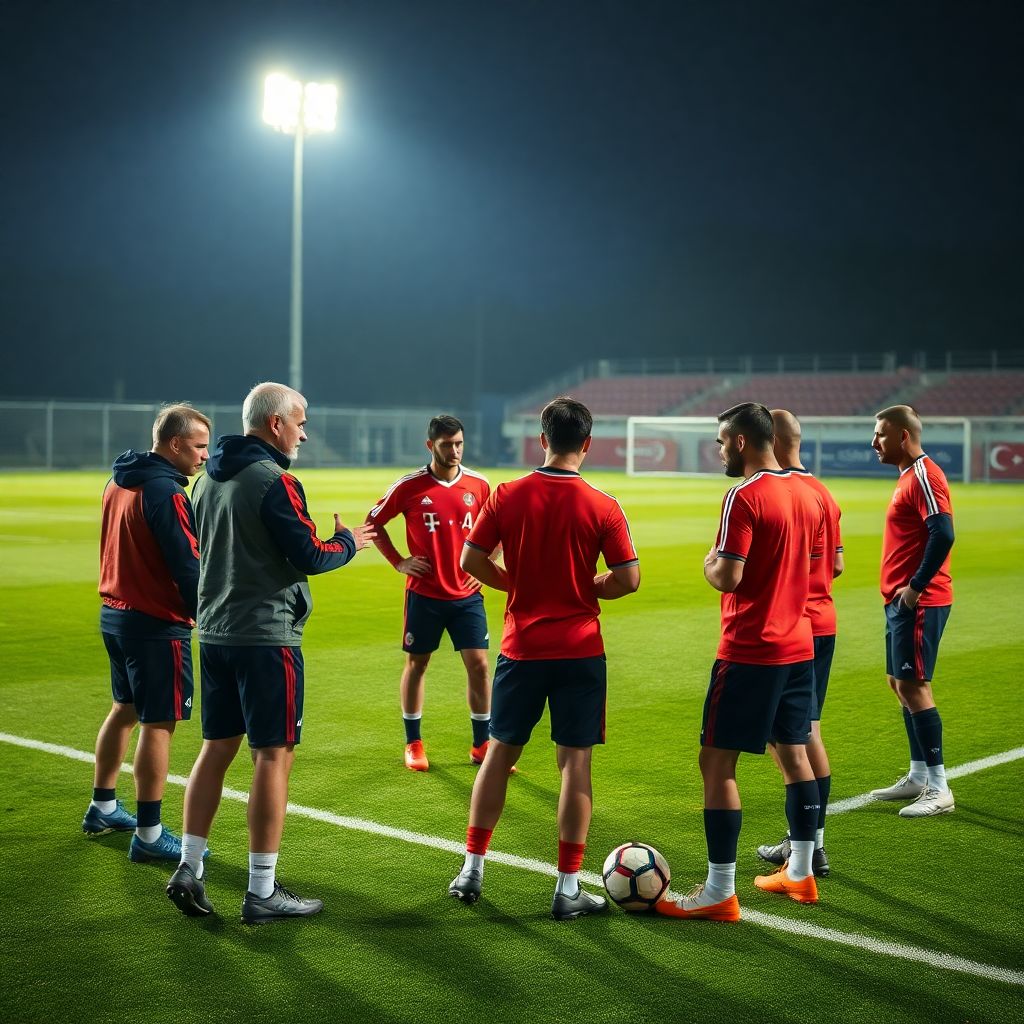
Turkish coaches are shaping modern European football through flexible tactics, intense training cultures, and a strong focus on mentality. Their impact is visible in mid-tier and emerging clubs that overperform budgets, develop undervalued players, and adapt quickly to changing match plans, often without the spotlight that follows bigger-name managers.
Core Ways Turkish Coaches Influence the Game
- Blending European positional play with high-intensity, emotion-driven pressing and counter-attacks.
- Turning physical and mentally strong squads into overachievers against richer opponents.
- Developing undervalued players and reselling them at a profit through clear role definitions.
- Adjusting game plans quickly in-match instead of rigidly sticking to one script.
- Transferring the Turkish football coaching philosophy in Europe into practical, day-to-day training detail.
- Bridging cultural gaps in diverse dressing rooms by using strong man-management and clear hierarchy.
Historical Roots: How Turkey Became a Coaching Exporter
Turkish football coaches in Europe are the result of several overlapping trends: the professionalisation of the Süper Lig, long exposure to European competitions, and a generation of coaches educated both in Turkey and abroad. Over time, this mix produced tactically flexible, emotionally strong managers who travel well.
Early waves of Turkish coaches mostly led domestic giants, but constant European qualification forced them to adapt to different styles: Italian defensive organisation, Spanish possession, German pressing, and Eastern European physicality. This exposure sharpened their ability to prepare for varied opponents, a key reason for Turkish coach success in European football.
Another factor is the pressure-heavy environment in Turkey. Clubs change coaches quickly, fans demand instant results, and media scrutiny is constant. Coaches who survive this must learn fast problem solving, crisis management, and short preparation cycles-skills that mid-table European clubs value highly.
Today, the best turkish football managers in european leagues often come from this school: experienced in chaos, comfortable with limited time, and ready to make immediate impact. They may not always lead top european clubs with turkish managers, but they frequently overperform with smaller or rebuilding sides.
- When defining a Turkish coach, think: crisis-proven, tactically flexible, emotionally intense.
- Remember that European competition experience in Turkey has shaped their tactical toolbox.
- Expect a background of high pressure and short-term contracts, which influences their decision-making.
Tactical Signatures: Patterns and Innovations Brought to Europe
Turkish coaches are rarely ideologues of one rigid system. Instead, they bring a pragmatic toolbox shaped by different influences. In Europe, that often looks like compact, aggressive teams that can switch from deep block to high press within the same match, with clear roles for each player.
- Hybrid pressing schemes. Many Turkish coaches mix mid-block organisation with selective high pressing triggers (poor back-pass, slow centre-back on the ball, weak-foot full-back). This keeps energy manageable while still forcing turnovers in dangerous zones.
- Asymmetrical full-back usage. A common pattern is one attacking full-back overlapping constantly while the opposite full-back tucks inside to create a back three in build-up, giving both width and rest defence stability.
- Double pivot with one destroyer, one connector. Instead of two playmakers, you often see one ball-winner and one deep-lying passer. This supports transitions while still allowing controlled first passes after regaining possession.
- Winger-striker partnerships. Many Turkish setups rely on wide players cutting inside to combine with a central striker who pins the centre-backs, creating room for late runs from midfield.
- Structured chaos in the final third. Attacking patterns are rehearsed, but once in zone 14 and the box, players are encouraged to improvise within loose guidelines, capitalising on individual flair.
- Rest-defence awareness. Even attack-minded Turkish coaches like to keep at least two, often three players positioned to stop counters, reflecting lessons from European competition.
These signatures mean that even without star players, squads can be organised, hard to play through, and dangerous in transition. For clubs looking to stabilise while remaining competitive, this blend can be attractive.
- Check whether a coach can switch between high press, mid block, and deep block within a game.
- Look for clear role definitions for full-backs, pivots, and wingers in video analysis.
- Assess if their teams maintain balance (rest defence) when committing players forward.
Player Development: Youth Systems and Long-Term Impact
Even when hired for short-term results, many Turkish coaches bring a strong focus on player development. Coming from leagues where squads are often rebuilt quickly and budgets are limited, they are used to improving existing players instead of just buying better ones.
In Europe, this translates into structured individual work: extra sessions for positional awareness, targeted physical conditioning for specific roles, and video-based feedback. For academies, the Turkish approach can offer a practical pathway from youth to first team, particularly for physically strong, high-intensity profiles.
Typical scenarios where they stand out include turning versatile midfielders into all-action box-to-box players, converting wingers into modern wing-backs, and preparing young centre-backs to defend large spaces behind the line. These role transitions can significantly increase a player’s market value.
Clubs aiming to benefit from turkish coach success in european football should evaluate not only match results but also how many players improve under the coach’s regime. This development focus helps sustain performance even when budgets are tight or star players leave.
- Track which players changed role or level under the coach (before vs. after performance).
- Review how often academy or fringe players earn minutes and defined roles.
- Ask for concrete examples of individual training plans and progression timelines.
Adaptation Strategies: Integrating into Diverse Club Cultures
Turkish coaches working abroad must adapt to new languages, fan expectations, and board structures. Many succeed by initially simplifying communication, using clear tactical keywords, and building trust with local staff rather than replacing them immediately.
The best-adapting turkish football coaches in europe also learn to modulate intensity. Training loads, media communication, and internal discipline are adjusted to match local norms while keeping their core standards: competitiveness, respect for hierarchy, and work ethic.
For clubs, the main question is how smoothly a coach’s style can fit existing structures. This is especially relevant for top european clubs with turkish managers or ambitious mid-table sides, where player egos, long-standing routines, and local politics all matter.
Fast Practical Tips for Clubs and Scouts
To quickly judge fit, focus on how the coach plans to use current key players, whether their staff list includes at least one local assistant, and how they describe communication with the board. These simple checks reveal whether adaptation is a priority or an afterthought.
- Ask how the coach will adapt training intensity to the league’s schedule and style.
- Clarify their approach to local staff: integration, replacement, or hybrid model.
- Check whether they have a clear plan for language learning and media handling.
Success Cases: Clubs and Leagues Transformed by Turkish Managers
Success stories involving Turkish coaches in Europe often share a similar pattern: underperforming club, limited budget, emotionally unstable environment, followed by renewed identity and improved competitiveness. These cases rarely make huge headlines but are well known among technical directors and scouts.
Common elements include stabilising leaky defences, improving set-piece effectiveness, and redefining the roles of two or three key players. Over a season or two, this often leads to higher league finishes, better home records, and increased transfer value of previously overlooked squad members.
However, several myths still circulate: that Turkish coaches can only work with passionate, noisy fanbases; that they rely solely on motivation; or that they are too short-term. Close analysis of the best turkish football managers in european leagues usually disproves these assumptions.
- Do not assume a Turkish coach is only a motivator; check their set-piece and build-up structures.
- Look beyond headline jobs; some of the best work is done in smaller European leagues and clubs.
- Avoid judging solely by trophy count; consider budget, squad quality, and starting context.
Challenges and Misconceptions Facing Turkish Coaches
Despite growing respect, Turkish coaches still face stereotypes in some European markets: being seen as too emotional, too reactive, or only suited for crisis management. This can limit opportunities at stable, long-term projects where their development skills would also be valuable.
One practical way to cut through bias is to analyse them with the same framework you would apply to any other manager: tactical clarity, adaptation speed, player development track record, and communication. When evaluated on these neutral criteria, many Turkish coaches compare favourably with more hyped names.
Mini Case: Neutral Evaluation Framework
Imagine a mid-table European club shortlisting three candidates: one local, one Western European with a big name, and one Turkish coach. Apply a simple four-line pseudo-check:
if (tactical_clarity && adaptation_speed && player_development && communication_quality) then shortlist_coach;
In many real-world situations, the Turkish option scores high on these fundamentals but is undervalued due to branding and nationality biases rather than football reasons.
- Challenge your own assumptions by reviewing at least five full matches of the coach’s team.
- Separate emotional touchline behaviour from structured training and tactical work.
- Compare them using the same criteria you use for non-Turkish coaches, without extra hurdles.
Quick Self-Check Before Working With Turkish Coaches
- Can you clearly describe the tactical profile and adaptation style you expect from a Turkish coach?
- Have you reviewed match evidence of their pressing, build-up, and player development patterns?
- Do your club structures support high-intensity training and strong hierarchy in the dressing room?
- Are you evaluating them with neutral criteria, not stereotypes about nationality or temperament?
Practical Answers on Hiring and Evaluating Turkish Coaches
How should a club start scouting Turkish coaches for European roles?
Begin by tracking Turkish coaches working in secondary European leagues and those with strong European competition experience. Focus on game models, adaptation in different contexts, and player improvement rather than just reputation.
What questions should be asked in an interview with a Turkish coach?
Ask for two recent examples of tactical adaptation, one case of developing a player, and how they structure a typical training week. Request video clips or session plans to verify the answers are concrete, not generic.
Are Turkish coaches a good fit for youth-oriented projects?
They can be, especially where physical intensity and mentality are priorities. Check their history of promoting academy players, changing player positions successfully, and their willingness to collaborate with academy directors.
How do language and communication barriers usually get resolved?
Most Turkish coaches working abroad quickly learn key football vocabulary and use trusted translators or bilingual assistants. Clubs should provide structured language support and ensure one staff member can bridge communication from day one.
What performance indicators are most useful when judging a Turkish coach?

Look at defensive structure, chance creation quality, set-piece effectiveness, and the progression of 3-5 key players. Compare these metrics to budget and squad value to judge whether they overperform or simply meet expectations.
Do Turkish coaches fit clubs that prefer long-term projects over quick fixes?
Many do, but they are often hired for short-term turnarounds. To test long-term fit, ask about three-year development plans, academy integration ideas, and how they would manage squad renewal over multiple seasons.
How different is the Turkish football coaching philosophy in Europe compared to at home?
In Europe it tends to be more controlled tactically and more data-aware, while still keeping intensity and emotional leadership. The core principles remain, but training loads, communication style, and risk levels are usually adjusted to the league.
Комментарии