
In 2025 the Süper Lig will borrow heavily from European football tactics 2025 trends: more structured pressing, smarter build-up, engineered set pieces, load-based rotation, and data-led scouting. This overview turns high-level Süper Lig 2025 tactical analysis into clear, practical ideas coaches and analysts in Turkey can apply quickly.
Executive summary: Tactical shifts Süper Lig clubs will adopt in 2025
- High-intensity pressing will be more targeted and situational, with triggers built from data and video rather than vague “press more” instructions.
- Build-up will prioritize half-space occupation, positional rotations and clear patterns to beat mid-blocks common in the Süper Lig.
- Set-piece work will move from improvisation to pre-designed templates based on opponent modeling and back-room analytics.
- Load-aware rotation will link GPS and medical data directly to weekly tactical plans, not just to conditioning decisions.
- Scouting will leverage Süper Lig data analytics and scouting platforms to sign players who fit game model roles instead of just reputation.
- Hybrid formations will aim to give European-level defensive compactness without sacrificing the attacking freedom typical in Turkey.
High-intensity pressing variants imported from continental labs
High-intensity pressing variants in 2025 go beyond generic “gegenpressing”. They are pre-planned team behaviors that activate only in specific zones, passes or body orientations of the opponent, usually defined with help from video and tracking data.
For Süper Lig 2025 tactical analysis, expect three main ideas to arrive from European football labs. First, pressing will be asymmetrical: the ball-side winger or 8 jumps aggressively while the far side stays compact instead of mirroring the shape. Second, teams will mix man-oriented and space-oriented references within the same press. Third, pressing height will change by phase: high press after goal kicks, medium press after long clearances, lower block after sustained defending.
On the training pitch this means designing 2-3 clear pressing packages for each opponent. For example, one routine could target their left-sided build-up, forcing them to weaker right defenders; another routine could trigger only when their pivot receives with back to goal. European football tactics 2025 trends show that fewer, clearer pressing cues create more consistent execution than trying to press “everywhere, always”.
Implementation tip: start with one pressing trap per match. Define who presses first, who covers central lanes, who protects the last line, and where you want to win the ball. Review these clips every Monday using your best football analytics tools for coaches 2025 to refine or discard the trap.
Evolving build-up: positional rotations and half-space exploitation
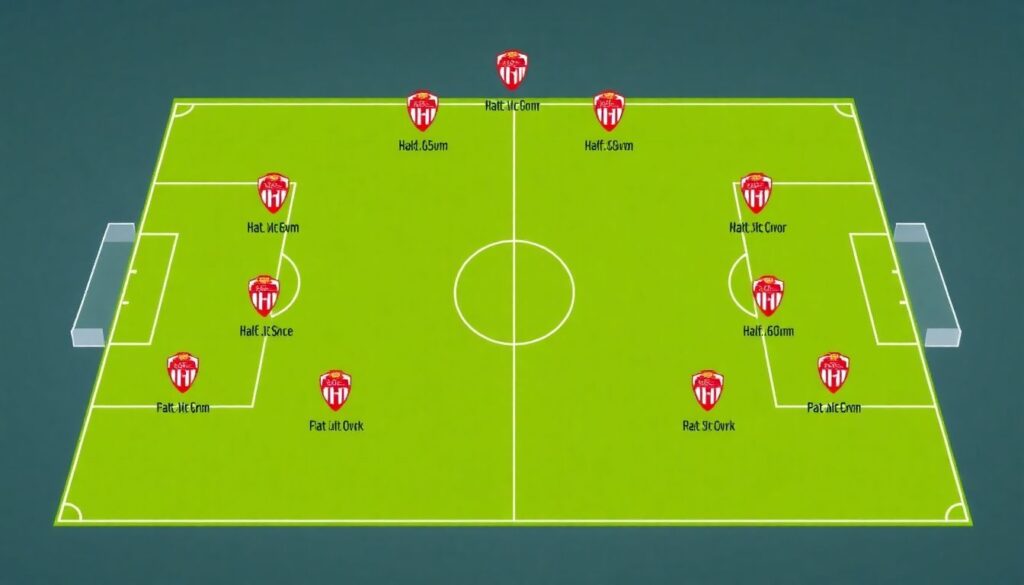
Modern build-up in the Süper Lig will increasingly focus on fixed principles with flexible roles. The aim is to open passing lanes into the half-spaces, destabilise flat back-fours, and keep the team prepared for counter-pressing once the ball is lost.
- Staggered first line: Instead of a flat back four, one centre-back steps wider or higher, creating diagonal lanes to the 6 and 8. This unlocks progressive passes without forcing risky balls through the middle.
- Inverted full-backs into midfield: At least one full-back steps inside to create a 3+2 or 2+3 structure in build-up. This shortens distances for counter-pressing and gives an extra man to dominate central zones.
- Wingers attacking the last line: Wingers pin full-backs by staying high and wide, leaving half-spaces for 8s or inside forwards to receive between lines on the turn.
- Rotations around the 10 zone: The striker may drop, the 10 drifts wide, and the near-side 8 runs beyond. These rotations must be rehearsed so players understand when to trade positions without collapsing the structure.
- Third-man combinations: A common European pattern: CB-CM-full-back, or CB-pivot-8, to escape pressure. Encourage players to think in triangles; one player draws pressure, the second offers a wall pass, the third exploits the gap.
- Controlled risk on the far side: When building on the right, the far-side full-back tucks in to form a back three, preventing direct counters if possession is lost during rotations.
- Video-supported pattern training: Use session clips and snippets from advanced football tactics courses online 2025 to show your squad how top European teams time their movements, then adapt to Süper Lig tempo and physicality.
Set-piece engineering: templates, routines and opponent modeling
Set-piece engineering in 2025 means treating dead balls like scripted plays rather than quick restarts. Süper Lig clubs will lift concepts from elite leagues where 20-30% of goals can come from set pieces when planned properly, even without star attackers.
Typical application scenarios include:
- Corners against zonal back-fours: Use crowding in the six-yard box with blockers and decoy runs to free your best header on the penalty spot. Opponent modeling tells you which defender to target and which zones they abandon.
- Corners versus mixed marking: Attackers begin in offside positions, then curve back into onside zones at the last second. Pre-defined “lanes” prevent teammates from blocking each other and help time late surges.
- Wide free-kicks with aerial disadvantage: Instead of crossing, design short routines to create cut-backs: 2v1 overloads, third-man runs to the edge of the box, or disguised passes behind the line along the ground.
- Throw-ins in the attacking third: European football tactics 2025 trends show these become mini set pieces. Use three-player rotations (receiver-wall-runner) to enter the box or win a corner instead of simply throwing down the line.
- Defensive set-piece planning: Use game data to spot which Süper Lig opponents rely on flat deliveries to the near post or deep crosses to the far post. Adjust your zones, assign your best aerial defender to their main target, and define clear clearing zones.
- Rest-defense after set pieces: Every attacking routine must include immediate counter-press positions and a fallback line, so you do not concede big chances from your own corners and free-kicks.
Load-aware rotation: integrating sports science into tactical plans
Load-aware rotation links physical data with tactical roles. The aim is to keep high-intensity players fresh for pressing and sprinting actions without losing cohesion. Instead of rotating by position alone, coaches will rotate by role intensity and recovery needs.
Key advantages:
- Reduced fatigue-related errors in the last 20 minutes, especially for pressing wingers, overlapping full-backs and box-to-box midfielders.
- More consistent execution of complex game plans over multiple competitions and midweek fixtures.
- Better use of the entire squad, increasing internal competition and readiness of fringe players.
- Clearer communication with medical and performance staff, who can connect GPS and wellness scores to specific tactical demands.
Key limitations and risks:
- Over-rotation can destroy on-field relationships, especially centre-back partnerships and midfield triangles that rely on automatisms.
- Numbers can be misread if coaching staff ignore context (for example, high load from many low-intensity actions vs fewer high-intensity sprints).
- Players may feel “demoted” when rested for data reasons; this needs strong communication and role clarity.
- Some Süper Lig squads lack depth to rotate effectively without a clear drop in quality, requiring smarter, not just more frequent, rotations.
Data-driven scouting: translating lab insights into squad fit
Data-driven scouting in the Süper Lig will grow as more clubs subscribe to Süper Lig data analytics and scouting platforms. But analytics only helps if it is tied to a clear game model and role profiles instead of being used as a simple ranking of “best” players.
Common mistakes and myths to avoid:
- Myth: more data automatically means better decisions. Without a defined playing style, stats cannot tell you if a player will work in your structure. Start with “what do we need him to do every week?” and then search for that profile.
- Mistake: copying big-club metrics blindly. Metrics that matter in the Champions League may not transfer to typical Süper Lig game states. Focus on metrics tied to your league style: aerial duels, defending transitions, set-piece impact, and ball progression under pressure.
- Myth: one platform will solve everything. Even the best football analytics tools for coaches 2025 remain decision-support, not decision-makers. Combine numbers with live scouting, interviews, and training observations.
- Mistake: ignoring age and adaptation curve. A player dominating in a slower league may need time to adapt to Turkish tempo and atmosphere. Look for traits that translate (first touch under pressure, repeat sprint ability, pressing discipline).
- Myth: data kills intuition. Proper use of analytics structures intuition: it shows whether your “eye test” is repeatable over many matches or just based on highlights.
- Mistake: no feedback loop. After every transfer window, compare your signings’ objective outputs with their pre-signing projections. This is how European football labs refine their models season after season.
Hybrid formations and transitional shapes for competitive parity
Hybrid formations are structures that change between phases: for example, 4-2-3-1 in defence, 2-3-5 in attack, and 4-4-2 when pressing. The goal for Süper Lig clubs is to protect the middle like European sides while still releasing enough players forward to break compact blocks.
Mini-case for a mid-table club against a strong opponent:
- Defensive phase (own half): 4-4-2 mid-block, wingers narrow to close half-spaces, striker pair screens pivot. Objective: deny central progression and force wide crosses.
- Pressing phase (opponent goal-kick): Shift to 4-2-3-1. 10 jumps to press one CB, near-side winger locks full-back, far winger tucks inside, pivot screens between lines.
- Attacking phase (stable possession): Convert to 2-3-5. Full-backs step high, one pivots drops between CBs, 8 moves into right half-space, opposite winger attacks back post.
- Transition to defence: Immediate goal is to collapse back into the 4-4-2 shell within three seconds, with wide players sprinting back to lines instead of chasing the ball blindly.
Analysts can use outputs from European football tactics 2025 trends reports and Süper Lig 2025 tactical analysis clips to fine-tune these shapes: which side to overload, which players have the intelligence to switch roles on the fly, and where your rest-defense line should stand to manage counters.
End-of-session checklist for Süper Lig coaches and analysts:
- Have we defined one clear pressing trap and trained it with video feedback?
- Do our build-up patterns create at least one stable half-space option each side?
- Are two attacking and one defensive set-piece routines scripted for the next opponent?
- Is rotation decided using both load data and tactical role importance?
- Do our scouting metrics directly reflect our game model and role profiles?
Practical tactical queries coaches and analysts will ask
How many pressing schemes should a Süper Lig team use in one season?
Most squads function best with two or three core pressing schemes plus small opponent-specific tweaks. The key is repetition and clarity: players must know exactly when each scheme is active and what the pressing triggers are.
How do I start using data if my club has a limited budget?
Begin with one of the affordable Süper Lig data analytics and scouting platforms that provide event data and basic visualisations. Use them to track only a few priority metrics tied to your style, such as high turnovers, progressive passes and set-piece xG.
What is the quickest way to improve our build-up play?
Define a simple 3-player structure around the ball (for example CB-pivot-full-back) and train third-man combinations daily. Combine this with fixed half-space positions for your 8s so players always know where the next pass should appear.
How much training time should we devote to set pieces each week?
Short, high-focus blocks work best: 15-20 minutes per main session, with clear objectives for one attacking and one defensive routine. Use video clips to review execution rather than increasing rehearsal time endlessly.
Can smaller clubs realistically apply hybrid formations?
Yes, if you limit yourself to one or two simple shape changes tied to clear moments, like goal-kicks or wide throw-ins. Overcomplicated hybrids fail when players cannot remember their roles under pressure.
Are advanced football tactics courses online 2025 useful for Süper Lig staff?
They are valuable for inspiration and understanding current European models, especially around pressing and build-up. However, every idea must be adapted to your squad’s technical level, fitness and the specific demands of Turkish fixtures.
How should we align scouting with our tactical plan?
Create written role profiles for each position that describe behaviors, not just attributes. Then, use your data tools and live scouting only to search for players who match those behaviors in their current teams.