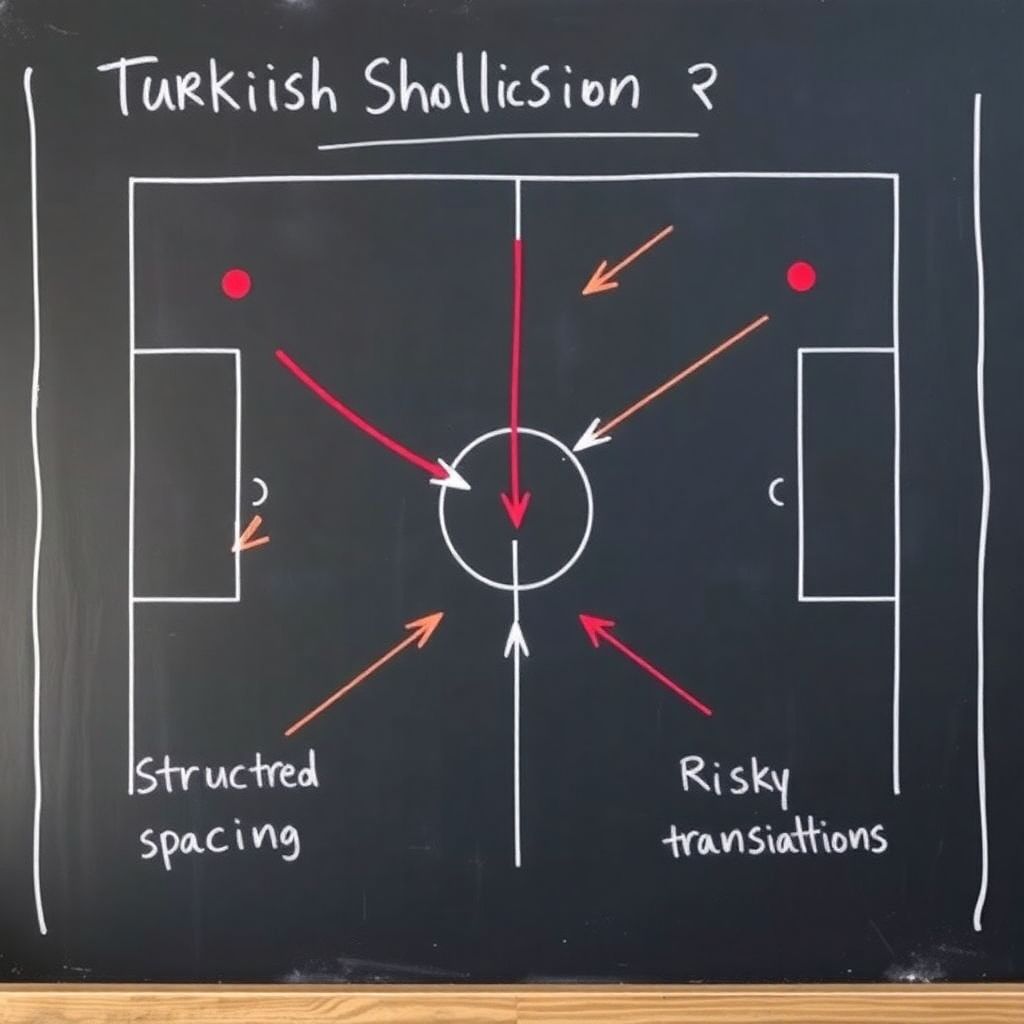
Positional play (Juego de Posición) is a structured way of organizing your team around space, not just the ball. For Turkish clubs in European competitions it offers cleaner build-up, better pressing and more control, but also higher implementation demands, stricter player profiles and clear risks in transition if coordination is poor.
Core Principles of Juego de Posición for Clubs
- Organises the team by zones, lines and roles rather than fixed positions on paper.
- Prioritises stable numerical, positional and qualitative superiorities around the ball.
- Demands strict spacing rules: width, depth and staggering between lines.
- Links game model, weekly training and recruitment into one coherent plan.
- Requires collective discipline; one player breaking structure can expose the whole team.
- Rewards patient, well-timed risk instead of constant vertical chaos.
Origins and Evolution of Positional Play
In modern football, positional play is the family of ideas that grew from Dutch total football and was refined in Spain as Juego de Posición. The core idea is simple: use predefined zones and heights to create stable passing networks that repeatedly generate superiorities around the ball.
Unlike purely direct or reactive styles, Juego de Posición treats each phase (build-up, consolidation, final third, pressing, rest defence) as part of one positional map. Players learn where to be in relation to team-mates, opponents and the ball, not only where to run. This makes it attractive for Turkish clubs trying to survive European away games with hostile atmospheres and high pressing opponents.
For Turkish teams, the evolution has been partial. Many clubs already use positional concepts (for example, full-backs inside, wingers wide, No. 6 dropping in) without a full Juego de Posición framework. True adoption means aligning academy, first team and recruitment around one positional language rather than treating it as a set of patterns for big European nights only.
Compared with more direct or transition-focused approaches, positional play is harder to start but easier to scale: once the structure and language are in place, new players integrate faster and match plans become clearer. The main risk is that a half-implemented model creates confusion, slow ball circulation and soft transitions that opponents in Europe punish immediately.
- Clarify in your staff meetings what you mean by positional play and what you do not mean.
- Map your current game model on paper: phases, zones, typical roles in each line.
- Decide if you commit to a club-wide Juego de Posición language or keep it as a first-team-only tool.
Space Management: Lines, Angles and Positional Triangles
Space management is where Juego de Posición becomes visible. The ball is used to move opponents out of key zones; players adjust lines and angles to open new passing lanes. Turkish clubs in Europe often struggle here: they lose compactness when chasing the ball or collapse into a flat shape under pressure.
Key mechanisms of space management in positional play:
- Vertical staggering of lines – Never have more than two players on the same horizontal line without purpose. This creates diagonal lanes through the block and supports quick third-man combinations.
- Fixed width and dynamic half-spaces – Wingers or full-backs hold the touchline, while advanced midfielders control half-spaces. This stretches back-fours and isolates weak defenders.
- Positional triangles and diamonds – Around the ball you always aim to create at least a triangle (three players) or diamond (four) with different heights and angles, ensuring at least two passing options.
- Rest defence structure – While attacking, at least two or three players position themselves to stop counters immediately, typically controlling central lanes and wide transition channels.
- Guided pressing traps – In pressing, space is deliberately left open to lure the opponent into predictable passes that trigger collective jumps.
For comparison of implementation effort and risk for Turkish clubs:
| Approach | Implementation difficulty | Main risks in Europe | Typical use-case |
|---|---|---|---|
| Positional play | High (requires coaching time and player understanding) | Exposed in transition if spacing breaks; slow circulation if players lack courage | Clubs aiming to control games, even away, and develop exportable players |
| Direct/transition game | Medium (easier to explain, heavy on athleticism) | Struggles against deep blocks; chaotic phases against top pressing teams | Underdogs looking for quick vertical attacks and set-piece focus |
| Reactive low block | Low (compactness and clear roles, fewer complex patterns) | Continuous defending; difficult to progress young creative players | Short-term survival against much stronger opponents |
Space management drills can be demanding, so a structured plan is necessary. When you search for a positional play coaching course for football clubs, check whether it teaches clear rules for line staggering, half-space occupation and rest defence, not only set passing patterns.
- Define 3-5 non-negotiable spacing rules (for example, width, minimum distances, rest defence positions).
- Design or adopt Juego de Posición training drills for professional teams that repeat these rules under pressure.
- Use video from your European games to show players good and bad examples of line staggering and triangles.
Tactical Structures: From 4-3-3 to Hybrid Systems
Positional play is not married to 4-3-3, but 4-3-3 and 4-1-4-1 are the clearest structures for teaching its principles. Many Turkish teams in Europe start from 4-2-3-1 or 4-4-2; these can be reorganised into positional structures in possession without changing the official line-up.
Typical application scenarios:
- 4-3-3 build-up, 2-3-5 in attack – Full-back inside, opposite full-back deeper, wingers wide, No. 8s in half-spaces. Easier to implement if you already have technical full-backs and a No. 6 comfortable under pressure.
- 4-2-3-1 morphing into 3-2-5 – One pivot drops into the back line, the 10 steps into the half-space, the weak-side winger tucks inside. Useful for clubs that want positional play without giving up a double pivot defensively.
- Back three systems (3-4-3 or 3-2-4-1) – Offer natural width and layered half-space occupation. The risk for many Turkish squads is finding enough centre-backs who are secure on the ball.
- Hybrid pressing shapes – In Europe, you may press in a 4-4-2 but attack in a 2-3-5. The key is to define role transitions so players do not get lost between phases.
- Game-state adaptations – With positional play you can drop from a high 4-3-3 to a mid-block 4-5-1 while keeping the same build-up principles once you win the ball back.
In implementation terms, keeping the defensive structure familiar (for example, 4-2-3-1) and layering a clearer positional structure only for your own build-up is often the most realistic entry path for Turkish clubs. The risk of forcing a trendy 3-2-5 or 2-3-5 shape without the right players is far higher than refining your current base system.
- Choose one primary attacking structure (for example, 2-3-5) and draw role maps for each player.
- Introduce hybrid roles gradually (such as full-back inverting) in domestic league games before key European ties.
- Use a football tactics analysis service for Turkish clubs in Europe to verify whether your intended structures appear on the pitch.
Physical Profiles and Skillsets Required in Turkish Squads
Juego de Posición places specific demands on players. They need the technical quality to operate in small spaces and the physical capacity to maintain high-intensity pressing and repeated accelerations after structured possession. Many Turkish squads are built for emotional, end-to-end football, which creates both opportunities and risks when shifting to positional play.
Key profiles and skillsets that benefit positional play:
- Centre-backs – Comfortable breaking lines with passes, able to defend wide in transitions.
- Full-backs – Capable of playing inside as extra midfielders and outside to provide width.
- Holding midfielder – Press-resistant, with strong scanning and body orientation.
- Advanced midfielders – Good timing for half-space runs, able to turn under pressure.
- Wingers – Threat in 1v1s wide, but disciplined to hold position to stretch the block.
- Centre-forward – Links play, pins centre-backs, presses intelligently.
Main advantages of aligning profiles to positional play:
- Clearer recruitment: you know exactly which technical and cognitive traits you need in each line.
- Higher resale value for players trained in a structured, modern system.
- Better energy management; the ball does more work, allowing aggressive pressing in key moments.
Main limitations and risks for Turkish clubs:
- Existing stars may lack the discipline or mobility for strict positional roles.
- Short-term performance dips as players adjust to new distances and demands.
- Over-investment in technical profiles without enough speed or duel strength for European transitions.
As you design physical and technical development plans, connecting them with an online football coaching license Europe tactical periodization module can help staff integrate conditioning into the positional game model instead of treating it separately.
- Audit your squad by line: identify which players fit a positional model and who may struggle.
- Adjust conditioning work to repeated high-intensity efforts from structured possession and counter-pressing.
- Adapt your recruitment brief to emphasise scanning, decision-making and versatility, not only physical metrics.
Organizational Change: Coaching, Recruitment and Youth Integration
Implementing positional play is an organisational decision, not just a tactical tweak. For Turkish clubs, the biggest mistake is hiring a positional coach for the first team while the academy, scouting and board still think in old-school positional labels and short-term results.
Common mistakes and myths:
- Myth: Juego de Posición is only for big-budget clubs – In reality, clear structure can help smaller Turkish teams compete against richer European opponents by reducing chaos and maximising each action.
- Mistake: Copying shapes without context – Copying a famous 2-3-5 structure without your own principles leads to confusion and soft defending, especially in away games.
- Mistake: Ignoring academy alignment – If youth teams play direct, chaotic football, new players need years to adapt, wasting the benefits of a club game model.
- Myth: Positional play kills individuality – Properly coached, structure frees creative Turkish attackers to receive in better zones with clearer support.
- Mistake: Underinvesting in coach development – Staff need continuous education: for example, a positional play coaching course for football clubs or targeted workshops on build-up and pressing.
Mitigation lies in coordinated change. Recruitment must understand the player profiles the head coach wants; academy coaches must teach the same positional language; the board must accept a medium-term horizon, especially in the first season of implementation.
- Create a written game model document that connects first team, academy and scouting language.
- Budget for coach education and shared resources such as best books on positional play for modern football coaches for your technical staff.
- Phase in positional principles at U17-U19 level to create a pipeline of adapted players for the first team.
Match Preparation: Scouting, Training Plans and In-game Triggers
Positional play really shows its value in match preparation. Because roles and zones are defined, you can tailor small adjustments to exploit an opponent without changing the whole model. For Turkish clubs in Europe this means going from reactive planning to proactive, opponent-specific control.
Consider a simplified mini-case from a hypothetical Istanbul club away in Europe:
- Scouting – Analysis reveals the opponent's right-back steps too high in build-up, leaving space behind, and their 6 drops between centre-backs, leaving a gap in front of the defence.
- Training plan – Two days are dedicated to positional rondos and possession games that target pressing triggers on the opponent's right side, plus patterns to exploit the space behind that full-back through the left winger and left No. 8.
- In-game triggers – The team agrees that when the opponent's right-back receives facing his own goal, the left winger presses inside-out, the striker cuts the pass to the 6, and the left 8 jumps on the near centre-back, with the rest of the team squeezing up in pre-agreed zones.
With a clear positional framework, these triggers become executable commands rather than abstract ideas. For implementation support, some clubs combine internal analysis with an external football tactics analysis service for Turkish clubs in Europe to validate their plan and post-match learnings.
- Define 3-4 simple pressing and attacking triggers linked to specific zones and opponents.
- Structure your MD-3 to MD-1 sessions so each day repeats your positional principles under different game situations.
- After each European match, review clips with players focusing on whether triggers and zones were respected, not just the scoreline.
Self-Assessment Checklist for Turkish Clubs Considering Positional Play
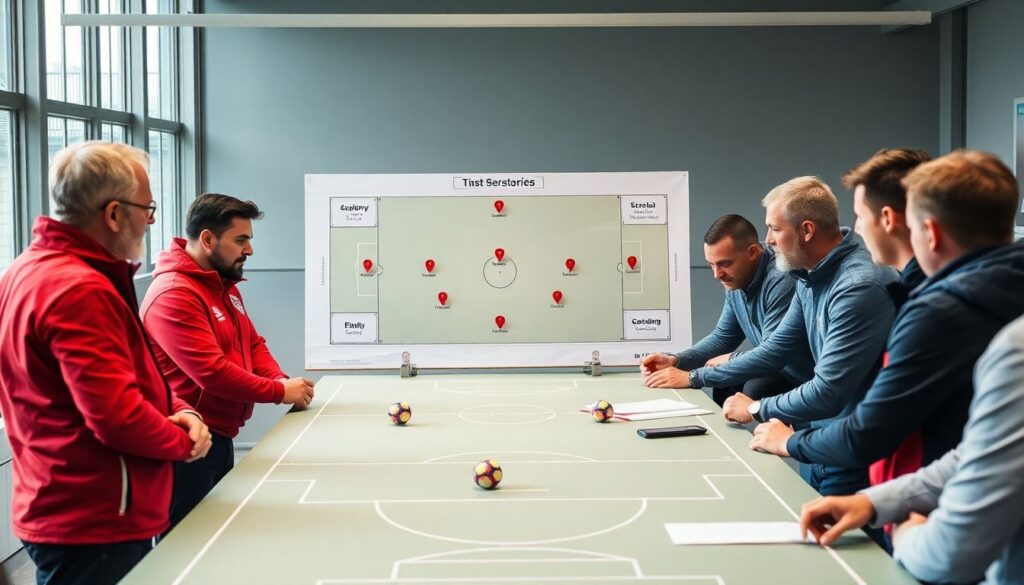
- Have we clearly defined our game model and how positional play fits domestic league and European demands?
- Do our current player profiles realistically support a positional structure, or do we need targeted recruitment?
- Are academy, first team and scouting aligned around the same positional concepts and terminology?
- Do our staff have an education plan (courses, books, analysis support) to sustain the model long term?
- Can we accept a transition period where performance may fluctuate while principles take root?
Practical Questions Coaches Ask About Implementation
How long does it usually take to implement positional play in a Turkish club?
Expect at least one full pre-season plus several competitive months before the model feels natural. If you change many players and staff at once, the adaptation can take longer. Starting with clear non-negotiable principles and a stable core of players speeds up the process.
Is Juego de Posición suitable for underdog Turkish teams in Europe?
Yes, if you focus on compactness, rest defence and clear pressing triggers rather than trying to dominate the ball at any cost. You can use positional play to structure counter-attacks and pressing while still accepting lower possession against stronger opponents.
Which training priorities should I set in the first eight weeks?
Prioritise spacing rules, build-up under pressure and immediate counter-pressing. Limit your game model to a few clear attacking patterns and two or three pressing triggers. Introduce more complex rotations only after players execute basic structures under match tempo.
Do I need a full staff overhaul to move towards positional play?
No, but at least one assistant should be responsible for positional details in training and analysis. Upskilling existing staff with targeted education, such as a positional play coaching course for football clubs or workshops on tactical periodization, is often more realistic than replacing everyone.
How can I reduce the risk of being exposed in transition?
Invest heavily in rest-defence organisation: define who stays behind the ball, which zones they protect and how they react to lost possession. Use small-sided games and positional drills that always include a transition element so players learn habits, not only shapes.
What learning resources work best for coaches new to positional play?
Combine video analysis of top teams with structured reading and formal education. Best books on positional play for modern football coaches, high-quality match breakdowns and an online football coaching license Europe tactical periodization module can together build both theory and practical planning skills.
Can positional play work in youth teams with limited training time?
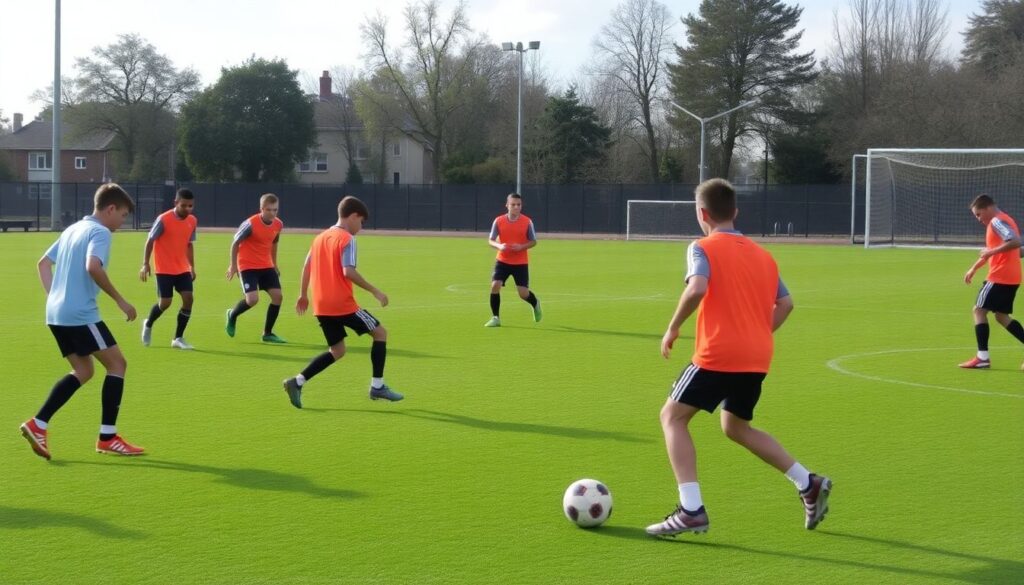
Yes, if you focus on a few simple rules: width, depth, support behind the ball and quick reaction to loss. Short but frequent Juego de Posición training drills for professional teams can be adapted for youth levels with reduced tactical detail but the same basic principles.