To press like Europe’s elite while coaching or analysing in Turkey, choose a clear reference model (City, Bayern, Barça), then adapt it to local tempo, squad profile and fixture load. Use data (PPDA, regain zones) plus targeted football pressing tactics training to decide how aggressive your high press should be in the Turkish Super Lig context.
Executive Summary: High-Press Patterns and Practical Implications
- European giants build the high press on strict spacing rules, synchronised triggers and constant support behind the ball, not just running intensity.
- Manchester City represent the most extreme height and control, Bayern Munich the most vertical and direct, Barcelona the most positional and circulation-led.
- Typical Turkish Super Lig teams face bigger gaps between lines, more transitions and diverse pitch conditions, so copying elite models 1:1 usually fails.
- Intermediate coaches should blend a clear model with realistic constraints: fitness, age profile, foreigners quota and limited preparation time.
- Analysts should track PPDA, opposition pass length and turnover zones weekly, or use a european football tactical analysis subscription to speed up work.
- Technical directors must align recruitment, professional football scouting and analytics service usage, and academy work with the chosen pressing identity.
- The most sustainable option for many Turkish clubs is a hybrid mid-to-high press with targeted game plans for Istanbul giants and relegation rivals.
Tactical Foundations of the High Press in Europe’s Top Clubs
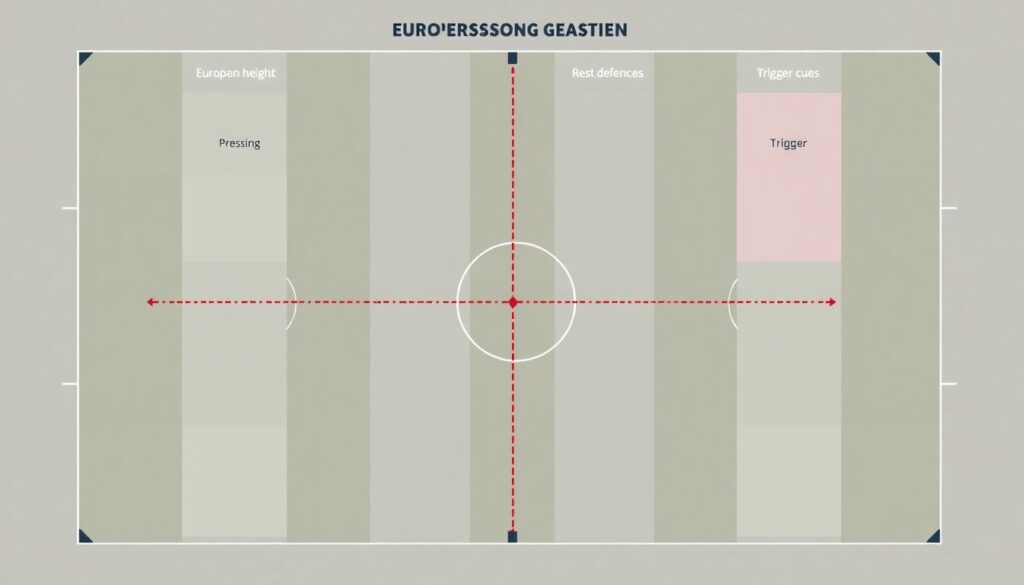
European giants converge on similar principles but express them differently. When choosing your reference model, use these criteria to compare:
- Pressing height and rest defence: How high is the first line? How many defenders stay behind the ball to stop counters?
- Trigger definition: Are the main cues pass-back, lateral pass, bad touch, weak foot, or a specific opponent?
- Coverage and compactness: Distance between lines horizontally and vertically; how tightly do they protect the centre?
- Role of the goalkeeper: Sweeper-keeper involved in build-up and covering depth vs more conservative keeper positioning.
- Ball-oriented vs man-oriented focus: Do they shift as a block to the ball or track opponents more strictly?
- Use of touchline traps: How often the press aims to guide play wide and lock on along the sidelines.
- Counter-press intensity after loss: Immediate 5-8 second hunt vs dropping quickly into a mid-block.
- Risk tolerance in the back line: Aggressive high defensive line vs deeper starting position to protect space behind.
- Adaptability by game state: Do they maintain the high press when leading, or switch to a more conservative block?
For a head coach in Turkey, these criteria should directly inform your football pressing tactics training menu and your high press football coaching course curriculum inside the club.
Statistical Footprint: Intensity, Triggers and Measurable Outcomes
Below is a comparison of four practical variants of the high press you can model on European clubs, tailored to different Turkish Super Lig realities.
| Variant | Best suited for | Advantages | Drawbacks | When to choose this approach |
|---|---|---|---|---|
| Extreme High Press (City-style) | Title-chasing clubs with dominant squads and deep benches | Territorial dominance, constant ball in opposition half, many high turnovers and shots after regains | Physically demanding, exposed to balls in behind, requires press-resistant defenders and keeper | When you can control 60-70% of possession and face opponents comfortable playing long under pressure |
| Vertical Aggressive Press (Bayern-style) | Teams with fast forwards and box-to-box midfielders | Creates quick attacks after regains, suits direct play, fits high-tempo leagues and emotional home crowds | Games become stretched, higher transition risk, can be punished by technically strong counters | When your best players are in transition and you want to raise tempo, especially at home |
| Positional Hybrid Press (Barcelona-style) | Technically strong teams that prefer short passing and patient build-up | Better control of rhythm, less chaotic, supports youth development and clear positional roles | Needs high game intelligence, slower to implement, less direct pressure on some centre-backs | When you build a long-term identity and can keep a stable core of intelligent players |
| Pragmatic Mid-to-High Press (Typical Turkish adaptation) | Mid-table or budget-conscious clubs balancing safety and ambition | Easier to coach quickly, manageable physical load, flexible vs strong and weak opponents | Less ball dominance, more time spent in mid-block, fewer ultra-high regains | When you fight for Europe or survival and face big style variety week to week |
| Game-Selective High Press (Cup & Big-Game Model) | Clubs that must prioritise certain matches (derbies, relegation rivals, Europe) | Concentrates physical peak for key fixtures, limits injury risk, clear emotional peaks for fans | Identity can look inconsistent, players may struggle with constant change of heights | When fixture congestion and squad depth force you to choose only 10-15 high-intensity games per season |
To link tactical choices with data, track the pressing metrics in a simple weekly report. A dedicated analyst or an external european football tactical analysis subscription can automate much of this work.
| Variant | Typical PPDA profile | Opposition pass length trend | Main turnover zones |
|---|---|---|---|
| Extreme High Press (City-style) | Consistently low PPDA, reflecting intense pressure on first and second line | Opponents forced into longer passes from deep areas | Wide areas near opposition box and half-spaces just outside their area |
| Vertical Aggressive Press (Bayern-style) | Low PPDA but with spikes when team resets between vertical waves | Many clipped balls into channels and space behind full-backs | Central zones around halfway line and channels behind pushing full-backs |
| Positional Hybrid Press (Barcelona-style) | Moderately low PPDA, more stable, with fewer extreme peaks | Opponents mix short and medium passes, struggling to play through central zones | Half-spaces and just inside opposition half, not always right near the box |
| Pragmatic Mid-to-High Press (Typical Turkish adaptation) | Medium PPDA with situational drops when team protects result | Opponents often forced wide, crossing from deep or from half-spaces | Flanks in middle third and second balls near central midfield |
| Game-Selective High Press (Cup & Big-Game Model) | Highly variable PPDA depending on opponent and game plan | Data shows mixed pattern; useful for tailoring per-opponent traps | Changes per match; requires custom heatmaps in your pre-match briefings |
Player Profiles and Training Practices That Enable Elite Pressing
Personas matter: the head coach, the analyst and the technical director all see pressing through different lenses, but they must converge on profiles and football pressing tactics training content.
- If your centre-backs are slow but strong in duels, then avoid an extreme high defensive line; choose a pragmatic mid-to-high press and train clear drop triggers for them.
- If your forwards are hard-working but not ultra-creative, then use a Bayern-style vertical aggressive press, with simple runs and clear cues: back-pass to CB, weak-foot trap, touchline press.
- If your midfielders are technically gifted but lack running power, then build a Barcelona-style hybrid press with shorter pressing windows and strong positional structure behind the ball.
- If your goalkeeper is excellent with feet and sweeping, then you can safely push the line higher and borrow more from Manchester City’s rest-defence structure.
- If your squad depth is thin and fixtures are congested, then rotate pressing intensity by competition; train 2-3 pressing schemes you can switch between weekly.
For the head coach persona, build a simple high press football coaching course internally:
- Start with 5v3 and 6v4 rondos that condition pressing angles and cover shadows.
- Add half-pitch games with clear pressing triggers and scoring bonuses for high regains.
- Finish with 11v11 where you freeze play after key triggers to correct distances.
For the analyst persona, design dashboards showing PPDA, regain heatmaps and pass length trends per opponent. For the technical director persona, align these profiles with recruitment, and consider outsourcing deeper reports to a professional football scouting and analytics service when internal resources are limited.
Three Club Case Studies: Manchester City, Bayern Munich, Barcelona
Use these three giants as templates, but translate them into clear selection rules. Each mini case includes a simple verbal tactical diagram or heatmap you can reproduce on a tactics board.
Manchester City: Extreme Territorial Control
Diagram idea: Draw a high defensive line near halfway, with full-backs inside, pivots staggered, and front three curved around opposition build-up. Colour a dense heatmap patch in the opposition half, especially half-spaces.
- Check if your centre-backs and keeper can defend 40-50 metres of space behind them reliably.
- Ensure at least one midfielder can jump to press the pivot yet recover to protect counters.
- Build automatisms: winger presses centre-back, striker blocks pass to pivot, near-side 8 jumps to full-back.
- Demand strict spacing: 10-15 metres between lines, no lone pressing actions.
- Plan for fatigue: late in games, drop into a mid-block to protect leads in intense Turkish atmospheres.
Bayern Munich: Vertical Aggression and Directness
Diagram idea: Show full-backs high and wide, wingers inside, a high line, and arrows forward after regains. Heatmap focuses on central midfield and just beyond halfway line.
- Identify your fastest 3-4 players and design the press to create open-field situations for them.
- Use man-oriented pressure in central zones to force predictable long balls you can win.
- Train pressing-to-finish patterns: win, two passes, shot; avoid overplaying after regains.
- Rotate heavily after European trips or long away journeys inside Turkey to avoid overload.
- Accept some chaos; focus video work on improving rest defence after your first wave fails.
Barcelona: Positional Hybrid Press
Diagram idea: Illustrate a 4-3-3 with clear triangles, full-backs not as high as Bayern, and pressure directed towards one side before trapping. Heatmap shows high densities in central and half-space zones, not only near the box.
- Select midfielders with scanning habits and passing angles, even if they are not sprinters.
- Define your pressing side: for example, show arrows guiding play to your stronger defensive full-back.
- Use ball-oriented shifts rather than pure man-marking; keep compactness as your first priority.
- Connect academy and first team with the same positional rules to raise tactical IQ over time.
- Protect older players by shortening pressing windows and designing rest phases in possession.
How Turkish Super Lig Teams Differ: Constraints, Strengths and Style
When you benchmark against Europe’s giants, be realistic about local context. These are common selection and implementation mistakes in Turkey’s environment, visible when doing turkish super lig match analysis and predictions.
- Copying the headline shape of a big club’s press without reproducing their rest-defence structure.
- Expecting older stars returning to Turkey to press like they did in Europe’s peak years.
- Ignoring travel, climate and pitch quality when planning intensity waves across the season.
- Underestimating the long-ball comfort of many opponents who are happy to bypass your press.
- Failing to coordinate high press work with set-piece defending, leaving counters open after your own corners.
- Changing pressing style every new coach, leading to confused players and mismatched recruitment.
- Overloading players with theory while not investing enough time in simple, repeatable drills.
- Not involving analysts early, so your PPDA and regain maps arrive too late to influence training.
- Underusing local data sources and external support; even a basic european football tactical analysis subscription can raise decision quality.
- Focusing on big matches only; neglecting to define a default pressing identity versus bottom-half teams.
Practical Roadmap: Translating Elite High-Press Methods for Turkish Teams
The extreme high press (City-style) is best for well-resourced title contenders seeking territorial dominance; the vertical aggressive press (Bayern-style) is best for transition-oriented sides with fast attackers; the positional hybrid press (Barcelona-style) is best for technically strong, patient projects; the pragmatic mid-to-high press is best for most Turkish Super Lig clubs balancing ambition and survival, while game-selective pressing suits squads with limited depth and heavy schedules.
Practical Clarifications and Typical Implementation Concerns
How many weeks does it take to install a basic high press model?
With clear principles, you can install a basic structure in 4-6 weeks of consistent work, but refinement continues all season. Focus on 2-3 main triggers and distances first, then layer more complex rotations later.
What should a Turkish head coach prioritise first: fitness or tactical detail?
Prioritise simple, repeatable tactical rules combined with ball-based fitness work. Endless running without the ball rarely transfers to pressing quality; use game-like drills that improve both intensity and decision-making.
How can an analyst support pressing decisions with limited tools?

Start with manual tagging of regains and basic PPDA calculations from match video. Over time, add heatmaps of turnover zones and opposition pass length charts, or plug into a european football tactical analysis subscription for automation.
Which variant is safest for a relegation-threatened team?
A pragmatic mid-to-high press with clear fallback into a compact mid-block is usually safest. It allows you to be aggressive in selected moments without exposing slow defenders or tired midfielders constantly.
How do I integrate pressing ideas into youth development?
Teach scanning, body shape and basic pressing angles from early ages, not complex rotations. Align academy principles with first-team style so players can step up without relearning everything under pressure.
Can a club change pressing strategy mid-season without chaos?
Yes, if you communicate the reasons clearly and change in phases: first adjust height, then triggers, then roles. Use the international break or winter break to rehearse new patterns intensively.
How do external courses and services fit into our plan?
Use a high press football coaching course to upskill staff, and complement in-house work with a professional football scouting and analytics service when internal manpower is short. Integrate outputs into weekly meetings, not as isolated documents.