
Turkish players who reach foreign leagues usually follow a clear path: street football, local club, pro academy, first-team minutes in Turkey, then a move abroad. This article explains how that journey works in practice, what challenges appear at each step, and what concrete actions players and families can take.
Snapshot: Turkish Journeys from Street Football to Top Leagues
- Most stories start with unstructured street or school football, not polished academies.
- Early contact with a disciplined youth academy turns raw talent into a real pathway.
- Agents, scouts and smart club choices shape the first move abroad.
- Language, tactics and everyday life abroad decide who adapts and who returns early.
- Famous Turkish football players international clubs inspire the next generation and change local training standards.
Early Roots: Street Football Culture in Turkish Neighborhoods
In many Turkish cities, the real foundation for professional careers is informal street football. Small-sided games in tight spaces force quick decisions, close control and creativity. Children play on concrete, between parked cars, or in school yards with improvised goals, often for hours without formal coaching.
This type of football teaches resilience and competitiveness. Players face older kids, rough conditions and constant challenges. It also builds social skills: leadership, negotiation over rules, and dealing with conflict. For many Turkish football players abroad, these memories remain the emotional core of their game.
Example: A young boy in Izmir, let us call him Emre, spends most evenings in a narrow alley playing 3v3. A local amateur coach notices his first touch and acceleration, invites him to weekend training, and that simple street game becomes his first step toward professional football.
- For players: play varied small-sided games, not just full-size matches.
- For parents: allow free play time; avoid over-controlling every session.
- For coaches: scout schoolyards and streets, not only organized tournaments.
First Breakthroughs: Youth Academies, Local Scouts and Talent Pipelines
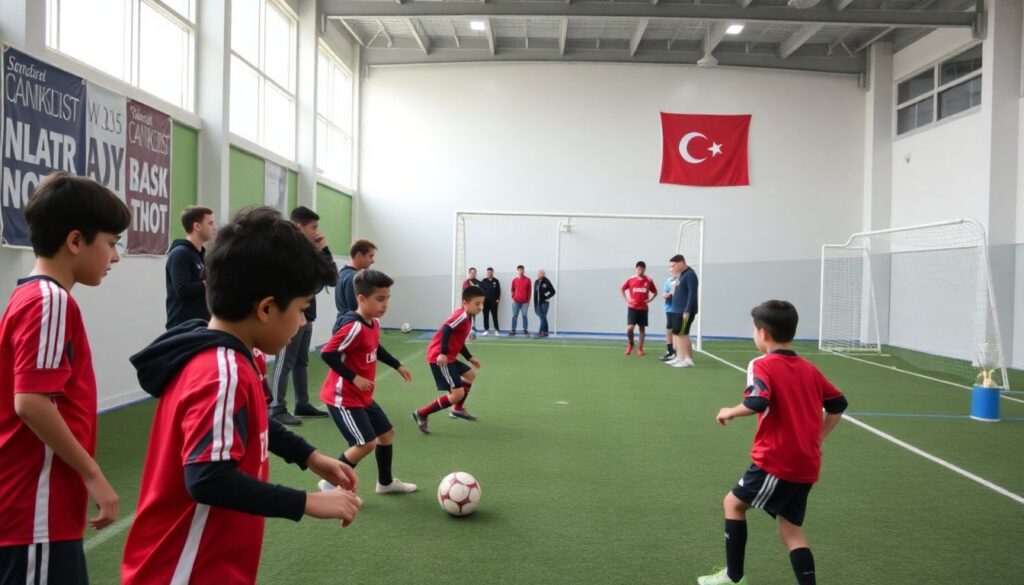
The next critical step is entering a structured environment: a club or academy that offers regular training, competition and progression. Talent pipelines in Turkey usually connect school tournaments, local amateur teams and professional club academies in big cities.
- School and local tournaments: Physical education teachers and volunteer coaches identify standout players and invite them to local clubs.
- Amateur club registration: Players join small clubs, train several times a week, and get official matches that scouts can watch.
- Regional scouting networks: Big clubs send scouts to regional leagues and organized trials, looking for technical level and mentality.
- Pro academy selection: Selected players move to professional academies with stricter schedules, fitness work and tactical training.
- Education balance: Families and clubs try to balance school commitments with increasing football demands to avoid burnout.
Example: A teenager from Trabzon impresses at a regional youth tournament. A scout from a Super Lig club offers a trial, he passes, joins the academy, and within a few seasons trains with the first team. This structured path puts him on the radar of Turkish soccer stars playing overseas.
- For players: treat every local match like a showcase; scouts can appear anywhere.
- For families: check training quality, education support and travel demands before choosing an academy.
- For coaches: give clear, honest feedback about what a player must improve to reach the next level.
Crossing Borders: Transfer Pathways from Turkey to European Clubs
Once a player proves himself in Turkey, attention from foreign clubs starts. The move abroad can follow several typical scenarios, each with its own risks and opportunities. Understanding these patterns helps avoid rushed or poorly planned decisions.
- Direct move to a mid-table European club: A player transfers from a Turkish team to a stable European side that offers realistic playing time and development, rather than only prestige.
- Stepping-stone league: Some players first join smaller European leagues to adapt to the game abroad, then aim for the best Turkish footballers in Europe status later through consistent performances.
- Loan deals with option to buy: Clubs reduce risk by taking Turkish talent on loan; if adaptation goes well, they negotiate a permanent transfer.
- Dual-nationality routes: Players raised abroad with Turkish roots may develop in European academies first, then choose to represent Turkey internationally, effectively reversing the usual path.
- Free transfers after contract expiry: Strategic contract management allows some players to choose foreign clubs freely without transfer fees, increasing their bargaining power.
Example: A young winger from Ankara chooses a modest European club known for developing wide players instead of a bigger name. Within a couple of seasons he becomes one of the successful Turkish football exports to European leagues and later earns a move to a top side.
- For players: prioritize clubs that guarantee minutes and development over brand name.
- For agents: research coaching style, squad depth and club stability before recommending a move.
- For families: ask clear questions about playing time plans, not just contract length and salary.
Adaptation Abroad: Tactical, Cultural and Linguistic Challenges

Moving abroad creates a second, hidden competition: adaptation. Tactical demands, training intensity and off-pitch life can change completely. Many Turkish football players abroad fail not because of lack of talent, but because they cannot adjust quickly enough to the new environment.
- Benefits of adapting well:
- Faster integration into the starting eleven and trust from coaches.
- Improved tactical understanding from exposure to different systems and roles.
- Personal growth, independence and confidence from managing daily life in a new country.
- Common limitations and difficulties:
- Language barriers that block communication with staff and teammates.
- Different training loads and tactical instructions that feel unfamiliar.
- Homesickness, isolation and cultural shocks that lower motivation.
Example: A defender moving from Istanbul to a club in Central Europe struggles with language and strict defensive organization. After investing time in language lessons and video analysis, he becomes more reliable, gains a starting spot and turns into one of the Turkish soccer stars playing overseas in that league.
- For players: start learning the new language and league style before arriving.
- For clubs: assign mentors or experienced teammates to help new arrivals settle.
- For families: support emotional stability with regular but not over-controlling contact.
Profiles of Success: Turkish Players Who Established Themselves Overseas
Stories of the best Turkish footballers in Europe highlight not only talent, but also smart decisions and consistent habits. At the same time, myths around these careers can mislead young players who copy the wrong patterns or underestimate the effort involved.
- Myth: A single great season guarantees a big transfer. Reality: clubs look for consistency, professionalism and mentality over multiple campaigns.
- Myth: Talent alone is enough abroad. Reality: tactical discipline, physical preparation and lifestyle choices often decide who lasts.
- Myth: Famous Turkish football players international clubs always had easy paths. Reality: many spent long periods on the bench, went on loans or dropped a level before rising again.
- Mistake: Ignoring off-field support. Players who reject nutrition, language or psychology help often struggle more than they expect.
- Mistake: Choosing the biggest club instead of the right project. Sitting on the bench in a top team can slow development much more than playing regularly in a smaller side.
Example: A creative midfielder leaves a comfortable position in a top Turkish club to join a mid-ranking European team that promises him a central role. With regular matches and trust, he grows into one of the most successful Turkish football exports to European leagues.
- For players: research the real career paths of your role models, not only their highlights.
- For agents: push for supportive environments, not just the highest-paying offers.
- For coaches: use success stories to teach patience, work ethic and intelligent career planning.
Ripple Effects: How International Careers Influence Turkish Football
When Turkish players succeed abroad, the impact goes beyond their personal careers. Training methods, tactical ideas and professional standards return home through national team camps, media coverage and social networks. Young players copy habits they see from stars playing in top leagues.
One simple way to imagine this influence is as a loop: Turkish clubs develop talent, foreign leagues refine and test that talent, then improved knowledge and standards flow back into Turkey. Over time, this loop raises expectations for coaching quality, scouting and youth development in local clubs.
Example: A full-back who made his name in Europe returns to the national team with different pressing and positioning habits. Teammates and coaches notice the effectiveness, local clubs start copying similar drills, and a new generation of wide defenders grows up with more modern profiles.
- For academies: track how leading European clubs train and adapt suitable elements locally.
- For players: bring back good habits and routines whenever you return for national duty or off-season.
- For federations: create programs that connect Turkish football players abroad with domestic coaches and youth teams.
Self-Check: Are You Building a Realistic Path Abroad?
- Are you getting regular, challenging matches that scouts may actually watch?
- Do you understand at least one foreign language of a league you aim to play in?
- Have you researched clubs that fit your playing style, not just their reputation?
- Is your family or support team aligned on a long-term plan, not just a quick move?
- Do you constantly work on mentality, discipline and lifestyle, not only technical skills?
Practical Questions About Turkish Players’ Transitions to Foreign Clubs
At what age should a Turkish player start thinking seriously about moving abroad?
The right timing depends on maturity, not just age. A player should first secure regular minutes in a competitive Turkish league, show consistent performances, and demonstrate emotional readiness to live independently before considering foreign opportunities.
Do Turkish players need an agent to reach European clubs?
An agent is not legally required but is practically very helpful. A good agent understands international markets, contract details and club needs, and can protect the player from unrealistic promises or unfair agreements.
Which positions from Turkey are most attractive to European teams?
Positions change with trends, but European teams often look for technically strong playmakers, dynamic wingers and aggressive full-backs. However, a reliable, tactically disciplined player in any position can attract attention if he solves a specific problem for a club.
How can a young player in Turkey get noticed by foreign scouts?
The first step is to stand out in domestic competitions and national youth teams. High-quality match video, participation in international tournaments and being in clubs that regularly sell players abroad also increase visibility significantly.
What is the biggest off-field challenge for Turkish players abroad?
Language and isolation are usually the hardest. Players who quickly learn the local language, create daily routines and build relationships in the dressing room tend to adapt faster and perform better on the pitch.
Is it better to move directly to a big European club or use a smaller stepping-stone team?
For most, a smaller club with guaranteed minutes is safer than a big club with limited chances. A steady record of playing time in a smaller league often opens doors later to higher levels without stalling development.
How can families support a player who has just moved abroad?
Families help most by giving emotional stability without controlling every decision. Regular calls, visits when possible, and trust in the player’s professional environment create a healthy balance between support and independence.