Changing Perceptions: From “Exotics” to Tactical Heavyweights
For a long time, turkish football coaches in europe were seen as rare curiosities rather than serious trend‑setters. That’s shifting fast. By the mid‑2020s, Turkish managers are no longer just short‑term “firefighters” or national‑team specialists; they’re building complex game models, speaking multiple languages, and handling European dressing rooms with real authority. Scouts, directors of football and data analysts now talk about Turkish coaches in the same breath as rising tacticians from Germany, Spain or Portugal, which simply did not happen ten years ago.
Today’s new wave looks very different from the old stereotype of the emotional, touchline‑explosive coach. The new generation turkish football managers blend that emotional energy with structure: they obsess over data, adapt to different leagues, and design training exercises that mirror match situations almost frame by frame. Their profile fits what European clubs want in 2026: flexible minds, clear communication, and the ability to increase the value of players as assets, not just win the next game.
—
Roots of the Revolution
From Domestic Chaos to a Tactical Laboratory
The Turkish Süper Lig has long been chaotic: intense fan pressure, rapid coaching changes, and wild tactical swings between games. Paradoxically, that chaos became a training ground. Coaches had to learn to fix problems in weeks, not months, and to adjust from direct, physical football against a smaller side on Sunday to slow, positional attacks versus a deep block on Thursday in Europe. This accelerated learning curve prepared them for the tactical variety of European football more than it might seem.
By the early 2020s, several Süper Lig clubs invested in performance analysis departments, GPS tracking and video‑based scouting. Turkish coaches who embraced these tools started to treat the league as a living lab. They tested pressing schemes, hybrid back‑three structures and rotation patterns usually associated with the Bundesliga or La Liga. When European sporting directors later sat down with them in interviews, they found coaches who already spoke the language of PPDA, expected threat (xT) and rest‑defence rather than vague ideas about “fighting spirit”.
—
The Influence of European Education
Another driver: education. Many of the top turkish managers in european football either studied or worked abroad at some point. They took UEFA Pro Licence courses in Switzerland, Germany or the UK, interned at academies, or shadowed technical directors in mid‑table European clubs. That exposure changed how they think about squad building and long‑term planning. Instead of demanding ten transfers every window, they talk about two‑year development cycles and age curves for key positions.
This educational shift explains why the best turkish football managers 2024 lists in international media suddenly stopped being only about big, charismatic names and started featuring younger specialists in pressing, set‑pieces or youth development. For agents and club executives, a major green flag is a coach who can reference both Turkish grassroots realities and the methods used in German second‑tier clubs or Dutch academies. That dual perspective has become a Turkish advantage.
—
Tactical Trends Defining the New Generation
High Press, Smart Rest-Defence
Most modern Turkish managers emerging in Europe share one common theme: they want to control territory, not just possession. That means high or at least aggressive mid‑block pressing, with very specific triggers. Instead of shouting “Press!” from the bench, they design automations: the team knows to jump when the opposition plays a backwards pass, receive facing their own goal, or bring the full‑back inside.
Tactical detail: pressing metrics
– Many leading Turkish coaches target a PPDA (Passes Allowed Per Defensive Action) between 7 and 10, comparable to high‑energy Bundesliga sides.
– They use GPS data to cap sprint distances per session, so pressing remains intense but sustainable across a 50–60 game season.
– Video review focuses on team distances: usually trying to keep defensive and midfield lines within 20–25 meters vertically when pressing.
This isn’t chaos pressing; it’s choreographed aggression. Players talk about repetitive drills where they defend in small groups of three or four, always with clear reference points: ball, teammate, opponent. The result is that Turkish‑coached teams in Europe often look surprisingly “German” in their defensive behaviour, even though the cultural roots are different.
—
Hybrid Structures and Positional Versatility
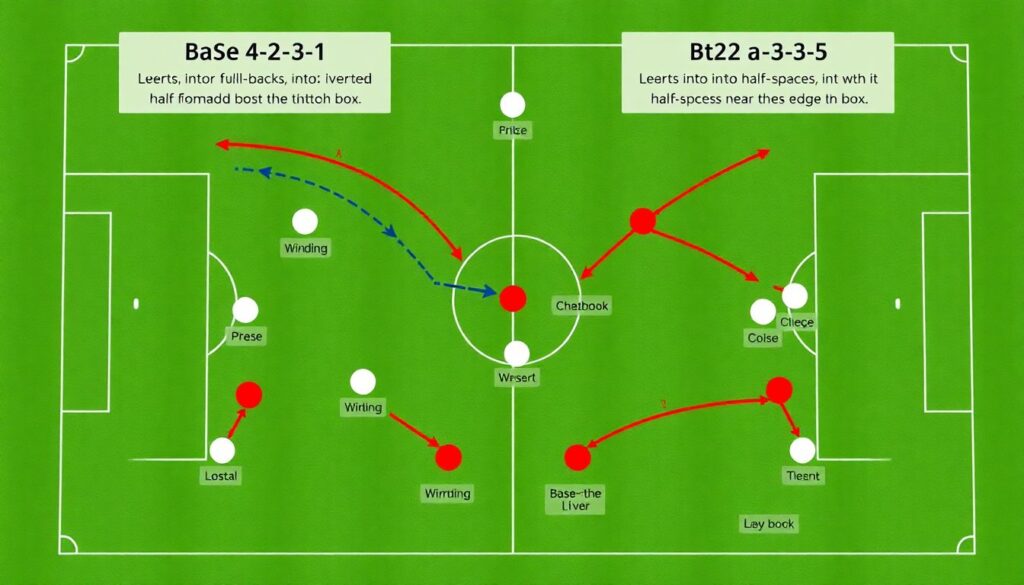
The new generation also loves hybrid shapes. On paper you might see a 4‑2‑3‑1, but in possession it becomes a 2‑3‑5 or 3‑2‑5 with full‑backs inverting and wingers attacking the half‑spaces. Many Turkish coaches explicitly copy and adapt ideas from Pep Guardiola, Roberto De Zerbi or Julian Nagelsmann, but they tune the model to the physical and technical profile of their squads.
Tactical detail: build-up patterns
– In the first phase, centre‑backs split wide while one full‑back tucks in to form a 3‑2 structure with the pivot.
– The “8s” are instructed to receive between the lines with their body already half‑turned upfield, a detail repeatedly coached in rondo‑type drills.
– Long diagonal switches are pre‑planned: analysts identify weak aerial full‑backs, and the team targets those zones 8–10 times per half.
This flexibility is crucial because Turkish coaches rarely walk into perfect squads abroad. Instead, they adapt: if the team lacks a tempo‑setting playmaker, they might build more down the wings; if the striker can’t press for 90 minutes, they design pressing traps to minimise his running. Such practical creativity is one reason turkish coach european clubs news stories increasingly describe them as “problem‑solvers” rather than “motivators”.
—
Man-Management: Bridging Cultures, Managing Egos
Emotional Intelligence as a Competitive Edge
Turkish football culture is emotionally intense. Coaches grow up dealing with volcanic media environments, fan protests at airports and presidents who call at midnight. While that sounds unhealthy, it forges resilience and social intelligence. When these coaches work in Europe, they often find pressure levels relatively manageable by comparison.
Players frequently describe Turkish managers as “close, but clear”. That means:
– They are available for one‑to‑one talks, especially with young or foreign players.
– They set non‑negotiable standards around fitness, time‑keeping and defensive work.
– They use humour and direct conversations rather than only formal team meetings.
This mix hits a sweet spot in modern dressing rooms, which are younger, more international and more media‑exposed than ever. A coach who can explain tactics in English, switch to Turkish or German for a side comment, and still maintain authority tends to win respect quickly. New‑generation Turkish managers deliberately work on these skills; some even hire communication coaches to refine how they speak in press conferences and with owners.
—
Data, Psychology and the Modern Staff
Another major shift is how Turkish coaches build their staff. Instead of surrounding themselves only with familiar ex‑players, they include data analysts, set‑piece specialists and sports psychologists. Several Turkish‑led staffs in European leagues now have three or more full‑time analysts, something rare in Turkey even five years earlier.
Technical detail: integrating analytics
– Pre‑match reports routinely include xG (expected goals), xThreat maps and pressing resistance stats of the opponent.
– Coaches define 3–4 key metrics per player (e.g., progressive passes, high‑intensity runs, counter‑press recoveries) and track them across 5‑game blocks.
– Set‑piece routines are A/B tested in training: analysts code which versions lead to clean shots or second‑ball wins, then the staff keeps only the best‑performing variants.
This scientific approach connects directly with club owners who think in numbers. When a coach can argue, “Our pressing has raised opponent xG from 1.4 to 0.9 per match over eight games,” their job security grows. That ability to speak the language of data is a key reason the label top turkish managers in european football increasingly shows up in analytics‑driven reports, not only in fan discussions.
—
Real-World Examples and Patterns
Case Studies: What European Clubs Actually Value
You don’t need to name a single superstar coach to see the pattern; the profiles themselves tell the story. European clubs hiring Turkish managers in recent seasons tend to look for a few repeated features: proven over‑performance with smaller budgets, clear identity on the pitch, and track records of improving young players.
Typical CVs of these new‑generation coaches include:
– Promotion or European qualification with a mid‑budget Süper Lig club.
– Strong cup runs, often beating richer domestic rivals through intelligent game plans.
– Documented improvements in under‑23 players who later moved abroad for significant fees.
When directors compare candidates, this combination stands out. A coach who can win, raise player values, and articulate his game model in a one‑hour PowerPoint has a major advantage. That’s exactly the profile many Turkish managers now present. It’s no coincidence that turkish coach european clubs news pieces often highlight how club net spend improved under their watch, not just results.
—
Best Turkish Football Managers 2024: A Turning Point List
The media compilation of the best turkish football managers 2024 became a kind of symbolic milestone. For the first time, international outlets didn’t just name legendary figures from Istanbul giants; they included younger coaches in Belgium, Germany, the Balkans or lower‑tier English leagues. The shared theme was innovation: aggressive pressing, fast vertical transitions, and willingness to trust academy graduates in pressure games.
Many of these coaches had quietly built reputations among scouts long before fans noticed. Analysts at European clubs track managerial performance the same way they track players, using expected points, wage‑bill efficiency and age‑profile metrics. Turkish managers who consistently over‑delivered in those numbers, season after season, suddenly moved from “interesting outsider” to “serious candidate” whenever a job came up.
—
Why European Clubs Love Them in 2026
Perfect Fit for the Mid-Table Ambition
The majority of European clubs are not title contenders; they’re mid‑table sides trying to survive, stay stable financially, and maybe grab a European slot. Turkish managers are well‑suited to that reality because they’re used to unstable environments and limited resources. When they arrive at a mid‑table club, the situation often feels almost comfortable compared to the week‑to‑week drama of some Süper Lig institutions.
From a board’s point of view, the ideal coach in 2026 is:
– Tactically modern and flexible.
– Comfortable working with data and specialist staff.
– Able to upgrade young players and sell them on.
– Strong in media handling and multilingual communication.
New generation turkish football managers increasingly tick all four boxes. They can build compact 4‑4‑2 blocks against bigger sides, switch to proactive 3‑2‑5 build‑up against direct rivals, and still keep dressing rooms unified across multiple nationalities. That versatility shortens adaptation periods and lowers the risk of a disastrous hire, which is why more owners are ready to take the “Turkish option”.
—
Market Inefficiency: Quality at a Discount
There’s also a simple economic angle. Salaries for established Western European coaches have exploded. By contrast, Turkish coaches coming abroad often accept lower initial wages, seeing the first foreign job as an investment in visibility. For data‑savvy sporting directors, this is a market inefficiency: you can hire a tactically advanced, hungry manager for a fraction of the price of a big‑name veteran.
As these coaches prove themselves and climb the ladder, that price gap will close. But for now, the combination of tactical quality and relative affordability makes them attractive to clubs in Belgium, Netherlands, Austria, Scandinavia and even the Championship level in England. That’s exactly the tier where “top turkish managers in european football” is becoming a recurring phrase, as more examples accumulate and the stereotype of “high‑risk hire” slowly disappears.
—
Modern Training Ground: How They Work Day to Day
Session Design and Micro-Cycles
On the training pitch, Turkish coaches now plan everything around game‑like situations. Gone are the endless, isolated running drills. Instead, a typical weekly micro‑cycle might look like this (with a Saturday match):
– Monday: Recovery + small‑space rondos focused on first touch under pressure.
– Tuesday: High‑intensity pressing games in 7v7 or 8v8, limited touches, directional play.
– Wednesday: Tactical day with 11v11 patterns, especially build‑up and pressing triggers.
– Thursday: Set‑pieces and specific scenarios (defending a lead, chasing a goal).
– Friday: Short, sharp session, rehearsing key cues and rest‑defence structures.
Each exercise is tagged to specific metrics—distance covered at high intensity, number of accelerations, heart‑rate zones—so staff can balance fatigue and freshness. This is where their blend of old‑school intensity and new‑school science becomes obvious: players are pushed hard, but within planned physical limits.
—
Youth Integration and Player Development
A key selling point for clubs is player development. Turkish coaches with European ambitions have realised that their career growth depends on turning raw talent into profitable assets. They collaborate closely with academy heads, often pulling two or three teenagers into first‑team training each week. The message is clear: young players are not ornaments; they are central to the project.
Development is tracked with simple but powerful tools:
– Regular individual video sessions focusing on two or three habits at a time.
– Clear positional “checklists” (e.g., for full‑backs: timing of overlaps, body orientation when defending the far post, decision‑making in zone 14).
– Periodic testing in cup matches or late substitutions with defined tasks rather than generic “go and enjoy yourself”.
As those youngsters improve and attract bids, club boards directly associate that value creation with the coach. In a football economy obsessed with sustainability, this is another reason turkish football coaches in europe have become highly bankable assets themselves.
—
What Comes Next?
As of 2026, the trend looks self‑reinforcing. Every successful stint by a Turkish manager abroad lowers the barrier for the next one. Agents become more proactive in pitching them; directors feel safer recommending them; fans are less sceptical. At the same time, domestic Turkish football is slowly upgrading its own infrastructure—better data departments, more professional academies—which will only improve the next waves of coaches.
The key challenge will be avoiding stagnation. If these managers simply copy current trends—high pressing, inverted full‑backs—without innovating further, the advantage will fade. But the signs are encouraging: many already experiment with back‑three morphing systems, heavy use of half‑space overloads and creative rest‑defence structures against fast‑breaking opponents. Their curiosity hasn’t peaked yet.
In other words, new generation turkish football managers are not a temporary curiosity; they’re becoming a stable part of the European coaching ecosystem. As European football keeps searching for fresh ideas at sustainable prices, expect more Turkish voices in technical areas, more complex accents in post‑match interviews, and more clubs quietly building success stories around coaches who cut their teeth in the intense, unpredictable world of Turkish football.
Комментарии