Foreign players in the Süper Lig are a bit like a double‑edged sword: they make the league sharper, but they can also cut into the minutes local kids get on the pitch. To understand whether this is mainly a quality boost or a blocked path for youth, we need to unpack the rules, the data, and how other leagues deal with the same problem.
—
Regulatory context and key definitions
In technical terms, a “foreign player” is any footballer who does not hold Turkish nationality under TFF registration rules. The “foreign player rule in Turkish Super Lig” is the regulatory framework that caps how many such players can be registered in a squad and in the match‑day XI. Over the last decade, Turkey has zig‑zagged between more liberal and more restrictive versions of this rule, shifting from strict on‑field limits (like 6+2+2 formats) to broader squad‑based ceilings that allow coaches more tactical flexibility but still try to protect domestic talent. This constant recalibration is exactly why any serious analysis of foreign player rule in Turkish Super Lig has to look not just at one season but at the longer regulatory cycle.
Clarifying “quality”, “development” and “pathways”
When we talk about “league quality”, we are really referring to a bundle of metrics: UEFA coefficients, xG and xGA values in European games, the average transfer value of squads and the tactical complexity visible in match data (pressing intensity, verticality, possession structures). “Youth development” means the progression of locally trained players through a pipeline: academy → reserve or U19 league → fringe first‑team minutes → stable role in the starting XI → international call‑ups. A “blocked pathway” exists when the transition time between these phases becomes abnormally long because match‑day slots are occupied by older or imported players, usually with higher wages and more transfer amortisation pressure behind them.
Text‑based diagram: squad composition under different rules
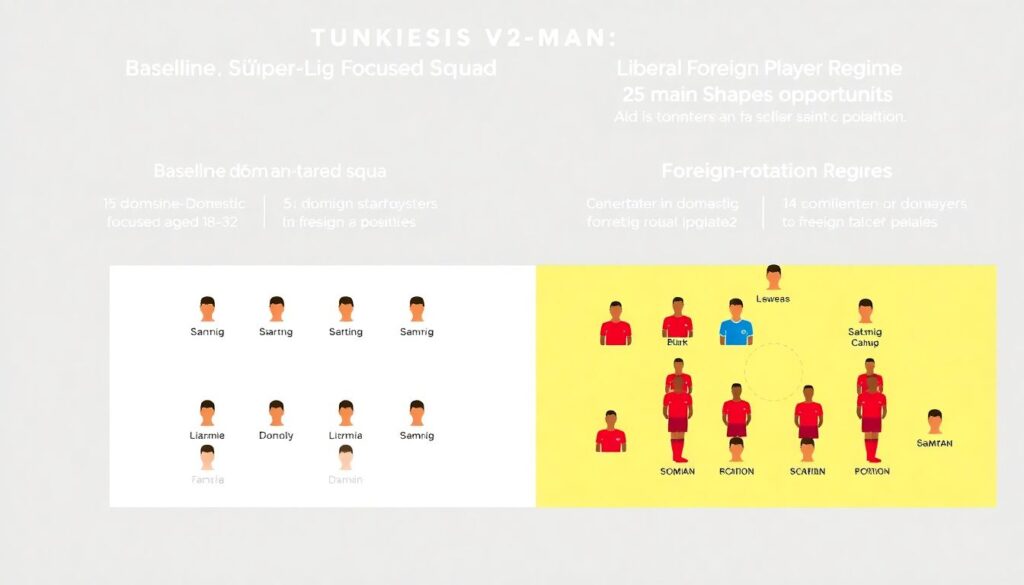
To visualise how regulation shapes opportunity, imagine a simplified 25‑man Süper Lig squad:
[Diagram: Baseline domestic‑focused squad]
– 15 domestic players (ages 18–32)
– 5 foreign starters (core positions)
– 5 foreign rotation players
[Diagram: Liberal foreign‑player regime]
– 9 domestic squad players (mainly backups)
– 10 foreign starters
– 6 foreign rotation players
[Diagram: Strict foreign‑player regime]
– 18 domestic players (many U21)
– 4 foreign starters
– 3 foreign rotation players
As the allowed foreign quota increases, the share of domestically trained players with realistic access to minutes shrinks, especially in high‑leverage positions such as central midfield, centre‑forward and goalkeeper. This structure sets up the central dilemma of the Süper Lig: do you maximise present performance, or do you force clubs to absorb the “learning cost” of playing young Turks?
—
How foreign players upgrade Süper Lig quality
From a performance‑analytics perspective, importing talent is the fastest way to raise a league’s level. A club can bypass the 5–7 year development window and buy ready‑made outputs: progressive passes, high‑value shot creation, aerial dominance. The best foreign players in Turkish Super Lig 2024, whether they are veteran playmakers or dynamic wingers in their mid‑20s, come with proven data profiles from other competitions. They lift the tactical ceiling by enabling systems that would be hard to implement with only local players, particularly in pressing intensity and build‑up under pressure, where experience in more structured leagues is a huge asset.
Tactical and technical spillover effects
The positive impact of imported players is not just about their individual metrics; it also appears in the learning environment they create. When a foreign centre‑back accustomed to high defensive lines arrives from, say, Ligue 1, he brings ingrained habits: compact spacing, line timing, communication structure. Domestic defenders training next to him are forced to adapt their body shape, pressing triggers and passing decisions. In this sense, the impact of foreign players on Turkish football youth development can be partly positive: they serve as live templates of European match tempo and decision‑making. Where clubs build structured mixed‑age training with clear tactical periodisation, these spillovers can be substantial.
Economic and branding dimension
There is also a financial layer. Foreign signings are central to Turkish Super Lig scouting and transfers foreign players strategies because they can be flipped for capital gains. Identify a 23‑year‑old from South America or Africa, give him 18 good months, showcase him in European qualifiers, and then sell him to a top‑5 league for a multiple of the initial fee. This trade model helps clubs navigate currency volatility and debt. At the same time, recognisable international names increase broadcast appeal and sponsorship value. A higher UEFA coefficient, driven in part by these players, loops back into larger TV contracts, which theoretically can be reinvested into domestic academies—if governance and incentives are properly aligned.
—
Where youth pathways get squeezed
The downside is more visible when we zoom in on actual playing time. In many Süper Lig squads, foreign players dominate the “central spine”: goalkeeper, centre‑backs, defensive midfielder, attacking midfielder, striker. These five slots concentrate both minutes and game influence. When four or five of them are imported, a 19‑year‑old Turkish midfielder is realistically competing for only a couple of low‑leverage positions: wide rotation or late‑game substitute. Over multiple seasons, Turkish Super Lig foreign players statistics often show that the median minutes for U21 domestic players remain low outside a few clubs explicitly focused on development. Even if academies produce good prospects, the lack of clear progression to the first team increases the risk of stagnation or exits to lower leagues.
Psychological and contractual barriers
There is also a softer but important dimension: perception. Coaches under pressure to deliver short‑term results may view foreign arrivals—often with higher wages and transfer fees—as “must‑play” assets. Young locals are then treated as optional or “risk” choices, especially in key matches. From a contractual point of view, agents know that a 28‑year‑old experienced import with stabilised metrics is easier to market than a 19‑year‑old whose data sample is tiny. This set of incentives drives line‑up conservatism and makes the blocked path for youth not only a regulatory issue but also a behavioural one. Unless clubs commit strategically to give young Turks defined minute targets, the default will be to overplay foreigners in decisive roles.
Systemic effect on national team quality
At the macro level, national‑team selectors end up with a smaller pool of domestic players who accumulate meaningful minutes in high‑pressure situations. If most Süper Lig clubs externalise quality by importing experience instead of developing it, the national team’s bench depth suffers, particularly in specialised roles like ball‑playing centre‑backs or modern “6+8” hybrids. Over time, the country may show decent club coefficients but inconsistent international results because the learning curve for local players has been flattened at club level. In that sense, the impact of foreign players on Turkish football youth development is ambiguous: club performance may rise, but the structural learning environment for local prospects may not improve in proportion.
—
Comparing different regulatory approaches
The core question—quality boost versus blocked pathway—is not unique to Turkey. Other leagues have tried different mixes of quotas, homegrown rules and economic incentives to balance these forces. Comparing with analogues helps clarify what is specific to the Süper Lig and what is a general pattern. It also reveals that there is no single “correct” model: each league has to match its labour market, economic context and talent base with an appropriate regulatory framework.
Premier League: few formal limits, strong academies
The English Premier League has almost no strict numerical cap on foreigners, yet its clubs produce a constant stream of local talent. The key difference is the “homegrown player” rule and massive investment into youth infrastructure. Top academies operate with elite coaching, analytics, and multi‑year planning, so that by the time a youngster debuts, he has already accumulated high‑quality training loads and competitive minutes in U18, U21 and loan spells. The absence of formal quotas is balanced by a market reality: homegrown players carry premium transfer value, which turns youth development into a profitable asset class. In such a system, foreign players elevate standards without fully suppressing domestic progression.
Bundesliga: moderate limits, development identity
The Bundesliga takes a more development‑centric path. While there is significant foreign representation, German clubs structurally integrate young locals into their rotation. Tactical models are often designed with the expectation that 1–3 starting spots are reserved for U23 players. There is less short‑term panic around youth errors, supported by stronger governance and more patient ownership structures. The Süper Lig operates in a more volatile financial environment, which pushes clubs to choose quick foreign fixes over slower domestic development. This contrast illustrates that quota design alone is not enough: the underlying competitive culture and financial stability determine how foreign players are used.
Leagues with strict quotas: K League and J1 as references
East Asian leagues like the K League or J1 League typically enforce tight foreign limits and additional “Asian player” slots. The result is a very high domestic participation rate but sometimes lower tactical diversity and reduced international visibility. Clubs have strong incentives to develop locals because they simply cannot import a whole spine. The trade‑off is clear: more predictable youth pathways, but slower elevation of overall league quality. The Süper Lig, with more liberal access to talent and significant pressure to perform in European competitions, has chosen a different balance, prioritising competitive relevance even at the risk of constraining local minutes.
—
Approaches to balancing foreign quality and youth opportunity
There is no magic switch that resolves the tension between attracting strong foreigners and nurturing Turkish prospects. Instead, leagues combine several regulatory, economic and developmental tools. For Turkey, three broad approaches can be sketched, each with its own pros and cons.
1. Strict quota‑driven model
1. Cap the number of foreign players per match‑day XI at a low level and fix this cap for at least a five‑year cycle to provide regulatory certainty.
2. Require a minimum number of U23 Turkish players in the squad and mandate a baseline number of minutes per season across the league.
3. Introduce sanctions for non‑compliance, such as fines or competitive penalties, to ensure rules are not treated as symbolic.
In this scenario, youth pathways are structurally protected. Coaches are forced to give minutes to local prospects, and clubs are incentivised to invest more heavily into academies. The downside is obvious: the immediate quality of the league may drop, particularly in European competitions, because coaches have less flexibility to field experienced imports in every key position. There is also the risk of inflating salaries for mediocre local players simply because they are “quota‑relevant”.
2. Liberal quality‑first model with economic incentives
Under this strategy, the Süper Lig would relax or even remove strict on‑field quotas, focusing instead on financial and developmental incentives:
1. No or very high cap on foreigners, but
2. Bonus distributions from central revenue tied to minutes played by domestically trained U23 players, and
3. Additional solidarity payments for clubs whose academy graduates accumulate minutes at other Süper Lig teams.
This approach treats youth development as an economic game: clubs that successfully train and export local players are rewarded; those that ignore it can still compete but may receive less central revenue. The league quality remains high because teams can sign as many strong foreigners as they can afford, while the financial structure nudges them to integrate young Turks within that mix.
3. Hybrid structural model (probably the most realistic)
A more balanced route, which many analysts see as suitable for Turkey, mixes quotas with incentives:
1. Maintain a moderate numerical limit on foreigners in the match‑day squad (for instance, ensuring at least four Turkish players start each game).
2. Combine this with a mandatory registration of a defined number of club‑trained or locally trained U23 players.
3. Add performance‑based bonuses for clubs that exceed benchmark thresholds of domestic U23 minutes.
This hybrid model aims to keep the Süper Lig competitive in Europe while making sure the blocked path for youth is gradually opened. Clubs still use foreigners to stabilise their tactical structures, but they cannot completely externalise talent, because regulations require them to carry and play a critical mass of Turkish youngsters. Over several seasons, this should increase the sample of locals with high‑level experience, feeding both the national team and the transfer market.
—
Putting it all together: what do the numbers suggest?
Even though exact figures change year by year, Turkish Super Lig foreign players statistics consistently show three broad trends: foreign players occupy a disproportionate share of minutes in central positions; a small cluster of clubs lead in integrating domestic youth; and the gap between clubs using foreigners as mentors versus as pure short‑term solutions is widening. Where clubs have strong scouting departments and long‑term plans, they use imports as “structural pieces” around which young Turks can grow. Where governance is weaker, foreigners become emergency fixes that crowd out local development.
Conclusion: complement, not replacement
Foreign players are neither villains nor saviours. Used well, they are a catalyst: they raise the competitive baseline, import tactical know‑how and create reference points for domestic prospects. Used poorly, they become a crutch that delays investment in academies and traps local talent on the bench. The real question is not whether Turkey should have many or few foreigners, but whether the league can design a coherent framework in which imported quality and domestic development are structurally aligned. If regulatory stability, smart incentives and serious academy work come together, the presence of foreigners in the Süper Lig will look less like a blocked path for youth and more like a fast lane that Turkish players are actually trained and trusted to use.