Historical context: why derbies rewrite the tactical script
The Galatasaray–Fenerbahçe rivalry is not just a calendar highlight; it is a stress test for any tactical model a coach believes in. For more than a century this derby has functioned as a laboratory where standard league-game principles collapse under emotional load, crowd pressure and political subtext. Coaches preparing for a Galatasaray vs Fenerbahce derby often admit that their usual match plans survive maybe 10–15 minutes before the game turns chaotic. That is why analysts treat these clashes almost as a separate discipline: pressing triggers behave differently, build-up risk tolerance changes, and even set-piece routines are redesigned specifically for this context. In other words, the derby environment itself becomes an active tactical factor, not just a backdrop.
From street football to high-level structures
Early Istanbul derbies resembled structured street football: lots of man-orientations, improvised pressing, and minimal concern for compactness between lines. Over time, as sports science and video analysis entered Turkish football, the rivalry transitioned into a more strategy-heavy contest. Yet some “street DNA” remains: individual duels still override system logic more often than in regular Super Lig fixtures. When you rewatch old games chronologically, you clearly see the evolution from pure emotion to controlled aggression with defined rest-defense structures, asymmetric full-back roles and specific plans for second-ball control. This historical layering explains why modern coaches have to calibrate their approach: ignore the emotional chaos and your structure collapses; lean only on emotion and you get tactically outplayed.
Core tactical principles of high-pressure derbies
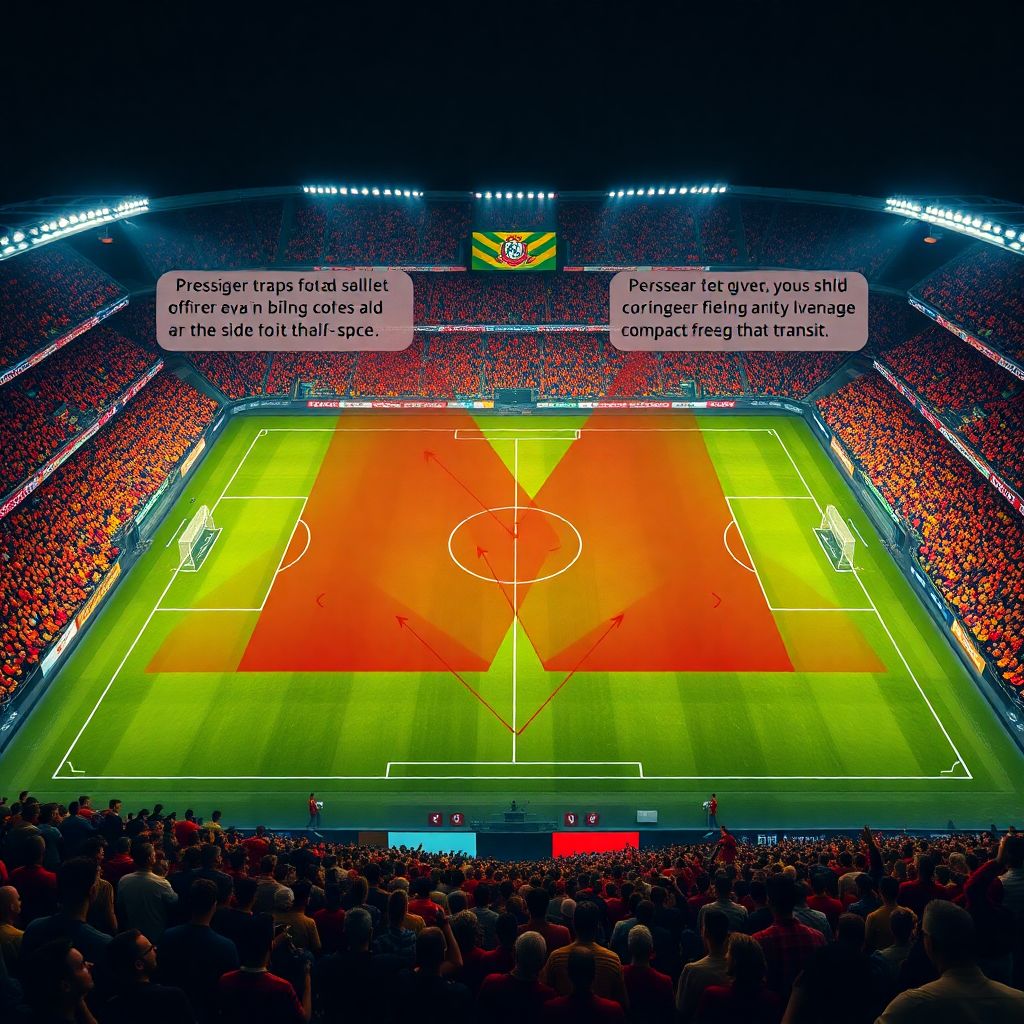
The first core principle in such derbies is emotional load management through structure. Coaches must assume that decision-making speed will increase while quality will drop in the first 20 minutes. To compensate, they simplify build-up schemes: fewer rotations, clearer passing lanes, more direct verticality. The second principle is “field control through aggression zones”: instead of generic high press or mid block, teams define precise areas where they are willing to overcommit players even at the cost of leaving the weak side exposed. In the Galatasaray–Fenerbahçe clash these zones often sit near the touchline on the side of the most emotionally volatile winger, trying to channel chaos into predictable patterns. Third, substitution strategy becomes pre-planned rather than reactive; fresh players are injected at pre-agreed timestamps, independent of the scoreline, to maintain intensity curves.
Micro-tactics: tempo, risk and information overload
At a micro level, derbies distort players’ perception of time and space. Tempo spikes lead to rushed choices, so top coaches deliberately insert slow-possession phases as “cooling pockets” where centre-backs hold the ball longer, moving the opponent without immediate penetration attempts. These segments are not signs of fear but of cognitive load control. Risk management also shifts: instead of avoiding central turnovers at all costs, some teams accept controlled risk in zone 14 to break compact low blocks that naturally form under pressure. Another underused micro-tool is “information diet”: game plans are trimmed to two or three simple cues per line (for example, full-backs only track the winger’s body orientation and the ball carrier’s hip angle) to prevent overload. That is why the best football tactics books for analysing derbies now devote entire chapters to cognitive constraints, not just formations.
Practical implementations in Galatasaray–Fenerbahçe and beyond
Look at recent Galatasaray–Fenerbahçe games and you will see repeated experiments with asymmetry. One common pattern: one full-back stays conservative to lock transitions, while the other becomes an auxiliary midfielder, overloading the half-space to bypass man-oriented pressing. The double pivot is often “staggered” vertically so that one player screens behind the ball as permanent rest-defense, while the partner participates in combinations between lines. Coaches also use tailored pressing traps: inviting the centre-back on the weaker foot to progress, then jumping from the blind side with a forward while cutting the pivot’s lane. This works especially well when crowd noise masks communication, making simple “man on” shouts less effective. Outside Turkey, similar concepts appear in the Old Firm and Superclásico, where managers weaponise stadium acoustics against the opponent’s build-up coordination.
Unconventional solutions: hacking the derby environment
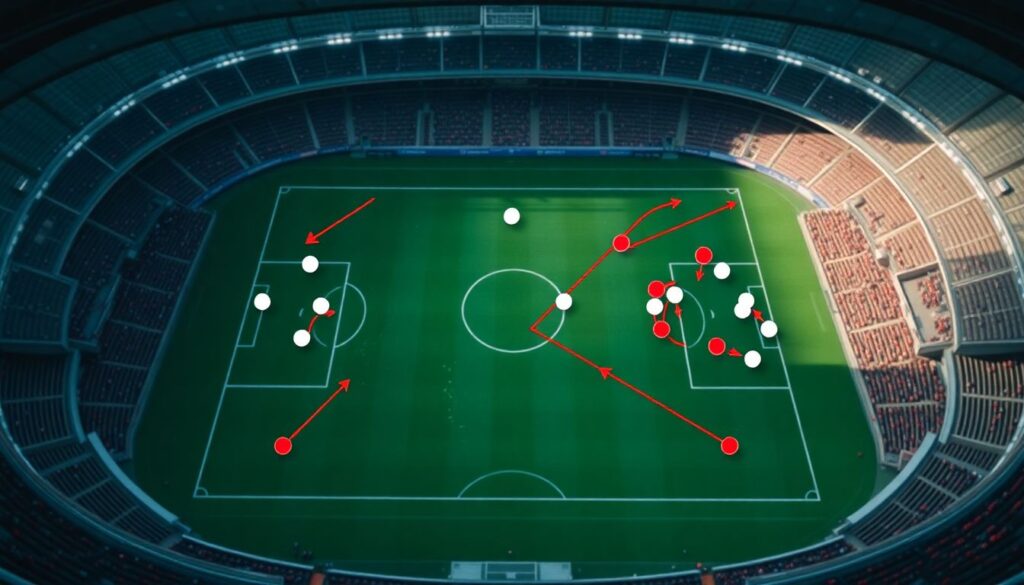
There are several creative approaches that remain underused. One is “pre-planned chaos possession”: instead of insisting on stable 4-3-3 structures, teams can intentionally rotate into something like a 3-1-3-3 only in 10-minute “storm phases”, aiming to overwhelm the rival both visually and numerically; once superiority is established, they deliberately drop to a calmer 4-4-2 block. Another non-standard idea is structured time-wasting as a tactical reset, not just to run the clock, but to break the emotional momentum after conceding chances. Teams can also micro-target set pieces to exploit specific emotional tendencies: for instance, designing corners that provoke an aggressive but mis-timed near-post charge from a hot-headed centre-back. Analysts who follow Galatasaray Fenerbahce live stream feeds in detail already annotate these patterns frame by frame, but clubs still underexploit this fine-grained emotional scouting.
Derby-specific analysis, betting markets and learning tools
From an analytical perspective, derbies demand bespoke models. Standard expected goals frameworks undervalue psychological swings and referee-induced state changes like early bookings. People looking for Galatasaray vs Fenerbahce betting tips often focus only on form tables and injury lists, but sharp bettors increasingly include metrics such as “early foul density” and “first 15 minutes field tilt” to anticipate momentum. Video analysts, in turn, code not only tactical events but also behavioural cues: players arguing, waving to the crowd, neglecting rest-defense positions right after big chances. For coaches, the most actionable edge is in scenario training: preparing mini-game blocks that simulate going a goal down amid hostile noise, with time constraints and biased refereeing. This builds what might be called “derby resilience” into your tactical identity rather than treating each big game as a one-off emotional incident.
Building expertise: from online courses to matchday habits
For those wanting to learn how to decode such clashes, it helps to treat every major rivalry as a case study. Many modern analysts start with a how to analyze football matches tactically online course and then apply frameworks to the Galatasaray–Fenerbahçe rivalry: defining reference lines, cataloguing pressing triggers, mapping substitution patterns against fatigue data. A practical habit is to rewatch the game twice: first with full emotional sound to feel the rhythm, second in near-silence to focus purely on structure. Even searching for Galatasaray vs Fenerbahce derby tickets can be an analytical exercise: thinking about stand locations, noise pockets and how proximity to ultras affects players’ perception and body language. Over time you start to see derbies not as irrational anomalies but as stress scenarios that reveal which tactical concepts are truly robust and which only work in low-pressure environments.
Common misconceptions about tactics in derbies

One widespread misconception is that structure “doesn’t matter” in derbies and that players’ passion alone dictates outcomes. In reality, the higher the emotional temperature, the more valuable clean, robust structures become; they act like guardrails, preventing the game from turning into pure randomness. Another myth holds that conservative tactics are automatically cowardly in rivalry games. In fact, adopting a compact mid-block with a lethal transition plan may be the bravest choice if your squad lacks technical security under relentless pressing. A third misunderstanding concerns in-game flexibility: many assume constant formation changes equal adaptability, but in derbies every structural shift increases communication demands precisely when verbal coordination is hardest. Smarter coaches limit themselves to one or two clearly drilled alternative shapes and switch only at specific stoppages pre-identified in the game model.
Emotion, fans and the illusion of control
Fans often overestimate the impact of their visible rituals on tactics, while underrating their invisible effects. Choreography and chants do not directly change formations, but they alter risk perception for players: some become over-motivated, attempting low-percentage dribbles or shots from poor zones. Another misconception is that tactical quality is easy to judge live from the stands or a broadcast camera. In truth, without replays it is hard to see how well rest-defense is positioned or how synchronised pressing lines are. That is why serious analysts rewatch even games they attended live, treating the stadium experience as emotional context rather than primary data. Observers who want to go beyond surface impressions should resist snap narratives and focus instead on repeatable patterns that survive across multiple derbies, regardless of refereeing errors, lucky deflections or singular moments of brilliance.
Комментарии