
How Turkish Clubs Quietly Became a European Factor
Over the last three seasons, Turkish clubs have gone from being Europa League extras to credible disruptors in European competitions, and the shift hasn’t been accidental. Between 2021/22 and 2023/24, Türkiye’s UEFA country coefficient jumped from outside the top 15 to flirting with the top 9, largely thanks to deep runs by Galatasaray, Fenerbahçe, Başakşehir and Trabzonspor across the Champions League, Europa League and Conference League. That rise in coefficient ranking directly affects seeding, qualification rounds and revenue distribution, which in turn reinforces the strategic cycle: more money, better squads, higher ambitions. In other words, this is not just a feel‑good story, it’s a structural reconfiguration of where Turkish football sits in the European hierarchy.
Historical Background: From Emotional Football to Data‑Driven Projects
To understand what is happening now, you have to contrast it with the old paradigm. For years, the best Turkish football clubs in Europe were known more for atmosphere than for long‑term planning. Galatasaray’s UEFA Cup and Super Cup wins in 2000 were followed by two decades of intermittent success, while Fenerbahçe’s 2007/08 Champions League quarter‑final and 2012/13 Europa League semi‑final stayed isolated peaks rather than part of a sustained project. Financial mismanagement, short coaching cycles and impulsive transfer policies meant squads were frequently unbalanced and aging. Around 2018–2020, under the pressure of UEFA’s Financial Fair Play and growing domestic debt, the big Istanbul clubs started to professionalise their structures: hiring sporting directors with European profiles, building analytics departments and integrating academy pipelines more systematically instead of treating them as emergency backup.
Core Principles Behind the New Turkish Approach
This “new wave” is built on three connected principles: smarter squad construction, flexible tactical identities and monetisation of global attention. In recruitment, clubs have shifted from collecting star names to building positionally coherent squads, where age profiles, contract lengths and resale potential are tracked through proper databases rather than gut feeling. Tactically, there is a clear pivot from pure emotion‑driven pressing and wide attacking to more controlled possession structures, layered pressing triggers and better rest‑defence (how the team is organised when it loses the ball). Commercially, executives are treating the Süper Lig as a content product: streaming, dynamic ticket pricing and international partnerships are no longer afterthoughts but core revenue drivers that help fund ambitious European campaigns.
Transfers: From Retirement League Stereotype to Market Arbitrage
Look at the transfer windows from 2021 to the summer of 2024 and you see the pattern. In 2023/24, Galatasaray combined marquee signings like Mauro Icardi (made permanent), Wilfried Zaha and Hakim Ziyech with undervalued profiles such as Sacha Boey and Victor Nelsson, then flipped Boey to Bayern in early 2024 for a substantial profit while remaining competitive domestically and in Europe. Fenerbahçe followed a similar model with Edin Džeko, Dusan Tadić and a group of younger, more athletic recruits. The phrase Turkish football transfers 2024 became shorthand among analysts for an aggressive but surprisingly coherent window, where top‑five league experience was mixed with high‑upside players from secondary markets. Over the last three seasons, Turkish clubs have consistently ranked among the top 10 in UEFA for net transfer activity, but the crucial difference is the increasing share of outgoing fees, which signals genuine integration into the wider European transfer economy.
Tactical Evolution: Hybrid Pressing and European‑Grade Structures
On the pitch, the change is just as visible. In 2023/24, Galatasaray’s Champions League group with Bayern, Manchester United and FC Copenhagen became a tactical laboratory. Okan Buruk used asymmetric 4‑2‑3‑1 and 4‑3‑3 shapes that morphed into a 2‑3‑5 in possession, with full‑backs inverting to create central overloads and protect against transitions. The non‑penalty xG differential in that group stage hovered around break‑even despite the elite opposition, a sharp contrast to older Turkish campaigns where teams were out‑shot and out‑chanced heavily away from home. Fenerbahçe’s 2022/23 Europa League run under Jorge Jesus showcased a different template: ultra‑aggressive high press, rotation‑heavy line‑ups and a vertical 3‑4‑3/4‑2‑3‑1 hybrid. Across 2021/22–2023/24, Turkish sides in UEFA competitions improved their average possession and pass completion while simultaneously lowering shots conceded per game, evidence that tactical structures are no longer collapsing under pressure against stronger European opponents.
Concrete Results: What the Last Three Seasons Actually Show
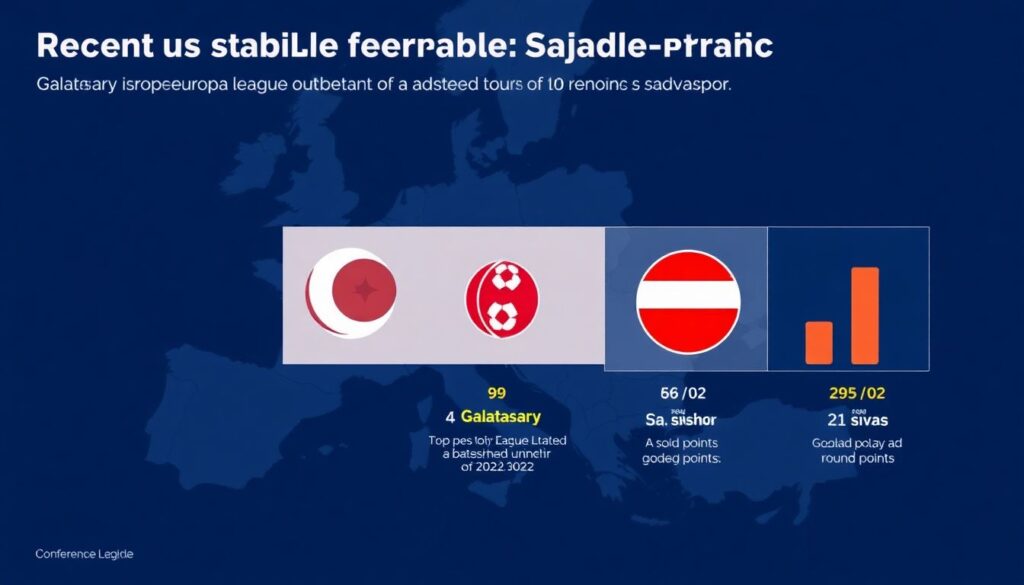
From a statistical standpoint, the recent period is the most stable European stretch Turkish football has had in years. In 2021/22, Galatasaray topped a Europa League group unbeaten and reached the round of 16, while Başakşehir and Sivasspor collected solid points in the Conference League. In 2022/23, Fenerbahçe won their Europa League group and only went out to Sevilla in the round of 16, and Başakşehir reached the same stage in the Conference League, contributing heavily to the coefficient. The 2023/24 season brought Galatasaray back to the Champions League proper, where they finished third in a very tough group but posted competitive underlying metrics and crowds consistently over 45,000. Combined, Turkish teams averaged more than one point per game in European group and knockout fixtures across those three seasons, a meaningful improvement over the late 2010s, when they frequently finished bottom of their groups with negative goal differences and low xG figures.
Commercial Layer: Tickets, Streaming and Global Attention
The on‑field progress is tied to a more modern commercial mindset. Demand from foreign fans means that Turkish Super Lig tickets online are now bundled with hospitality and travel packages, targeting tourists who want to experience a “big night” at Rams Park, Şükrü Saracoğlu or Vodafone Park. Simultaneously, clubs and broadcasters have leaned into live streaming Turkish Super Lig matches for international audiences, experimenting with multilingual commentary and second‑screen analytics content. This digital reach feeds back into sponsorship contracts, making it easier to justify higher wage bills and appearance bonuses for players with global marketing appeal. The betting market has followed, with increasingly sophisticated betting odds Turkish Super Lig and European cups being integrated into global platforms that once focused almost exclusively on the top five leagues, reinforcing the perception of Turkish football as part of the mainstream European ecosystem rather than its periphery.
Ambitions: From Surviving Europe to Targeting Knockout Runs
Targets have shifted accordingly. Where clubs once talked about “representing the country” and “not embarrassing ourselves,” the internal KPIs are now much sharper: consistent group‑stage qualification, knockout‑stage appearances, and coefficient points that keep at least one Champions League group‑stage spot accessible each season. Club presidents speak openly about leveraging Istanbul’s infrastructure and fan base to compete financially with mid‑tier Premier League and Bundesliga sides, not just with regional rivals. Medium‑term planning documents include stadium upgrades, training‑ground analytics hubs and academy integration ratios. While exact projections for the 2024/25 and 2025/26 campaigns are speculative from today’s vantage point, the pattern of the last three years—better squads, better structures, better results—suggests that Turkish clubs see themselves as permanent stakeholders in UEFA competitions, not as occasional guests dependent on one golden generation.
Common Misconceptions About Turkish Clubs in Europe
Several clichés still cloud the analysis. One is that Turkish teams are only dangerous at home and collapse away; recent data contradicts this, with away win and draw percentages in Europe rising in each of the last three seasons. Another misconception is that the league remains a “retirement home” for aging stars. While big names still arrive in their late twenties or early thirties, the average age of starting XIs in European fixtures has trended downward, and the resale of players like Eljif Elmas, Kim Min‑jae and Sacha Boey demonstrates a functioning talent‑development and export pipeline. It is also outdated to view the Süper Lig as tactically naive: coaching staffs increasingly feature assistants with Bundesliga, Serie A or Premier League backgrounds, and match models now incorporate detailed opposition analysis, set‑piece micro‑plans and load management. Put simply, Turkish clubs are no longer reshaping European football through noise and passion alone; they are doing it with structures, data and intentionally designed ambitions.