
Historical context of Turkish defensive talent
For a long time, when people talked about Turkey’s football identity, they meant passionate forwards and volatile playmakers, not defenders. Yet if you look closely, there’s a steady lineage that explains why we’re now talking about the best young Turkish defenders in a more serious way. From Alpay Özalan and Bülent Korkmaz, through Servet Çetin and Gökhan Gönül, to the more modern profiles of Çağlar Söyüncü and Merih Demiral, Turkish academies have gradually shifted from pure “warrior” centre backs to players who can manage space, press triggers and build from the back with real composure.
The modern wave really accelerated once the Turkish Super Lig opened up tactically, copying European trends in pressing and positional play. Clubs started exporting defenders at younger ages, which forced them to upgrade scouting, data usage and position-specific training. That’s the context in which today’s turkey football young talents defenders are emerging: they grow up seeing ball‑playing centre backs and attacking full‑backs as normal, not as risky experiments. As a result, the domestic market now consistently produces top U21 defenders in Turkey who can adapt quickly to different tactical systems and higher tempo leagues abroad.
Core scouting principles for young Turkish defenders

When you scout in this market, the first trap is to focus only on highlight tackles. A serious report on the next generation Turkish centre backs starts with game intelligence. You want to know how early a defender reads the cue for a through ball, how he adjusts his body shape while the ball is travelling, and whether he scans behind his shoulder before stepping out. This isn’t glamorous, but it separates long‑term prospects from short‑term social media clips. Physicality still matters, yet it has to be evaluated relative to role: covering full‑backs need repeat sprint capacity, while central stoppers need acceleration over the first 5–10 metres and the balance to defend 1v1.
Technical execution is the second pillar. For young Turkish defenders, many academies still undertrain weak‑foot passing and press‑resistant receiving, so you must track progression over time. Can the player break lines under pressure, or does he default to lofted clearances whenever the press comes? Does he control the tempo with simple wall passes, or panic when the team is forced to build from deep? When judging turkish super lig young defenders to watch, video alone isn’t enough; in‑stadium scouting reveals first touch quality, voice usage in the line, and micro‑adjustments in positioning that cameras often miss, especially in lower‑angle broadcasts.
Practical examples: profiles of emerging defenders

To ground this in reality, look at someone like Ahmetcan Kaplan, developed at Trabzonspor and signed by Ajax. His profile shows why many analysts list him among the best young turkish defenders despite injury interruptions. He combines aggressive front‑foot defending with a calm passing game, comfortable stepping into midfield lines to create an overload. His aerial timing and cover shadow use are above average for his age group, and he has the frame to add muscle without losing mobility. For a scout, the interesting part is how he adapted from a more direct Turkish environment to Ajax’s strict positional play, revealing high tactical plasticity.
Another case is Ravil Tagir, who came through Altınordu’s famously structured academy. He doesn’t jump off the screen with spectacular sliding tackles, but his anticipation, weak‑side coverage and line‑breaking passes make him a textbook example of where turkey football young talents defenders are heading. Similarly, Yasin Özcan at Kasımpaşa and Emin Bayram at Galatasaray illustrate different development paths: Özcan offers hybrid full‑back/centre‑back versatility with strong 1v1 metrics out wide, while Bayram profiles as a more classic stopper who has been steadily improving his build‑up play. All of them show why analysts keep a separate watchlist of turkish super lig young defenders to watch for medium‑term recruitment.
Common mistakes by novice scouts and coaches
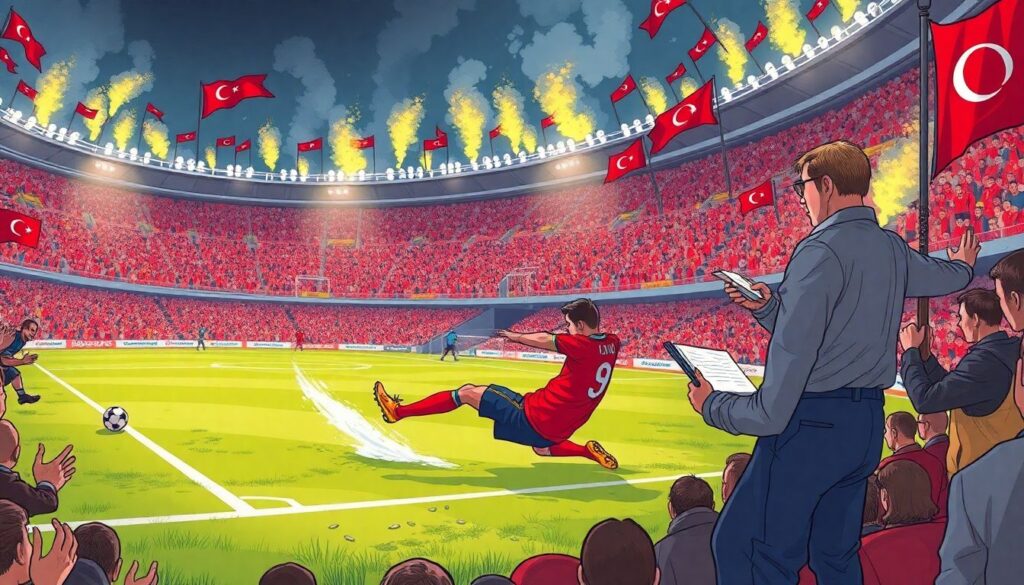
Newcomers in scouting this market repeat the same errors. First, they overrate raw aggression. Because Turkish stadiums reward big tackles with noise, rookie scouts often tag any fearless sliding defender as elite. The problem is that at higher levels, late challenges become yellow cards and cheap set pieces. Instead of asking “does he tackle hard?”, you should ask “does he delay, channel and time interventions to reduce xG against?”. Another frequent mistake is judging top U21 defenders in Turkey on small European samples, like a single youth international tournament, while ignoring 90‑minute consistency in domestic fixtures where they face deep blocks and chaotic transitions every week.
Coaches and agents also misjudge development curves. One classic error is pushing a young centre back into a big‑club first team as a backup full‑back, thinking any minutes are good minutes. This often corrupts their positioning habits, as they stop defending the box and start defending the touchline, which can stall growth for the next generation Turkish centre backs. Novice analysts may also rely too much on basic defensive stats—clearances, tackles, interceptions—without context. In a low block side, those numbers will inflate; the real question is whether the player can survive in a higher defensive line with more space behind. Failing to separate system effects from individual quality is probably the costliest beginner mistake when assessing best young Turkish defenders.