
Why the Turkish path to pro football is its own beast
If you grow up in Turkey, your journey from dusty street pitches to stadium lights looks very different from what you see in glossy documentaries about Premier League academies. Here, most kids start with improvised goals made of school bags, concrete surfaces that eat through your knees, and evening games under weak street lamps. That chaotic environment actually builds toughness, but without structure it rarely turns into a professional career. Understanding how to become a professional footballer in Turkey means accepting this paradox: the street gives you instincts and courage, but only a clear development path, plus ruthless discipline, can take you from local pitch legend to paid professional.
From street games to your first organized team
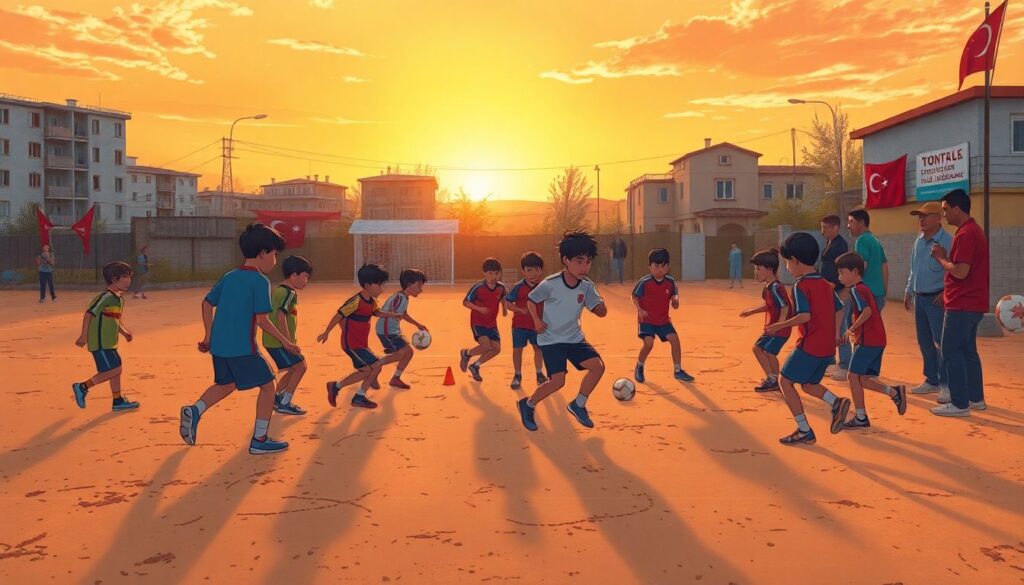
For most Turkish players, the first serious step is not a big club academy but a neighborhood or municipal team. Parents usually wait too long, expecting a miracle scout to appear at a random school tournament. In reality, you should aim to join an organized team between 9 and 12 years old, when basic coordination, decision‑making and social habits are forming. That doesn’t mean you are finished if you start at 13 or 14, but the later you enter structured competition, the more you’ll have to catch up in tactical understanding, positional play and physical preparation. The early goal is simple: regular training, official matches, and a coach who does more than just shout “press” and “pass faster”.
– Find a local club with U10–U12 teams and weekly league matches
– Check whether training includes ball work, decision‑making and not just endless running
– Talk to older players and parents about how often the coach actually promotes kids to higher age groups
Choosing the right academy instead of chasing the “big badge”
The biggest trap for ambitious families is falling in love with the logo on the shirt. Parents proudly post photos from weekend sessions in famous colors, while the child trains once a week with 40 kids on a half pitch. That is not development, it is merchandising. When people talk about turkish football academy programs, they often mix up marketing schools with real performance pathways linked to club scouting and youth leagues. Your priority is not the name of the club, but the ratio of players to coaches, the number of competitive games per season, and the feedback system used to track progress across months, not just days.
– Ask: “Who was the last player promoted from this academy to a pro contract?” and listen for real names
– Check average group size; over 16 kids per coach usually means babysitting, not coaching
– Make sure your age category plays an official league with at least 20–25 matches per year
Technical detail – evaluating an academy session:
During one training, count how many ball contacts your child has in 10 minutes of a drill. If it’s under 20 touches, the exercise is probably too static or overcrowded. In top environments, U12 players often reach 500–800 ball touches per full session through rondos, small‑sided games and position‑specific drills. This kind of data tells you far more about quality than promo videos on social media.
Why Istanbul isn’t the only answer, but matters a lot
Many families believe the best football academies in Istanbul are the only doorway to a contract, and yes, the city dominates the talent pyramid due to clubs like Galatasaray, Fenerbahçe, Beşiktaş and Başakşehir. But this obsession causes two mistakes: first, parents move too early, putting kids into social and academic chaos; second, they ignore strong regional clubs in Izmir, Bursa, Trabzon, Antalya or Konya, where competition is slightly less brutal and coaches may have more time for each player. A realistic strategy is to grow in a good local academy until about 14–15, build a match record in regional leagues, then target Istanbul or other big‑city clubs when you have something solid to show: video, stats and references from serious coaches.
Technical detail – when to move to a bigger club:
Scouts usually start to follow players intensively around U14–U15. For wide players and forwards, they look for sprint speed (30 m in around 4.3–4.5 seconds at 15–16 years), repeated accelerations, and 1v1 success rate above 50% in match footage. For central midfielders and defenders, key indicators include pass completion above 80% under pressure, defensive duels won, and positional awareness when the ball is on the opposite side. If your numbers are far below this level, another year in a smaller club with lots of minutes is often more valuable than sitting on the bench for a big team in Istanbul.
Understanding the real cost of going all‑in
Turning the dream into a plan also means counting money, not just goals. Parents often underestimate the cost of professional football training camps in Turkey, especially when they target high‑profile environments in Antalya or Alanya. A serious 7‑day residential camp with qualified UEFA‑licensed coaches, full board, GPS vests and video analysis might cost anywhere from 600 to 1,200 euros per player, depending on the season and hotel standard. On top of that, there are boots, travel, medical check‑ups and sometimes private fitness sessions. Before committing, the family should discuss a simple budget and a time frame: how much can you invest over the next 2–3 years, and what concrete milestones justify continuing at that intensity?
Common beginner mistakes that quietly kill careers
Most players don’t fail because they “don’t have talent”; they fail because they repeat the same basic errors for years. The first frequent mistake is confusing playing with training. Weekly five‑a‑side with friends is fun, but it doesn’t replace structured work on weak foot, body orientation, first touch and tactical tasks. The second error is living in a bubble: only watching highlight reels of superstars, ignoring your own match footage and refusing to confront weaknesses. The third is chaotic scheduling: three different teams, futsal on Fridays, gym on Saturdays, matches on Sundays, and zero planned recovery. Over time, this approach leads to burnout, overuse injuries and academic disaster.
– No clear playing position and role, changing places every week “just to play”
– Skipping proper warm‑ups and cool‑downs, then wondering about groin and knee pain
– Ignoring sleep and nutrition, especially during growth spurts between 13 and 16
Technical detail – typical physical errors in 12–16 age group:
Coaches in Turkey often report three patterns: players who train only with the ball and have no strength base (risk of knee and ankle problems); others who suddenly start heavy gym routines copied from pros on social media, loading barbells with poor technique; and a third group that grows 8–10 cm in a single year yet keeps the same training intensity, leading to Osgood‑Schlatter, back pain and recurring muscle strains. A basic rule: during rapid growth, volume stays similar or drops slightly, but you increase emphasis on mobility, core strength and technique, not maximum load.
The role of trials and how to navigate them without panic
Every ambitious youngster dreams of that one magical trial. In Turkey, these are often linked to regional scouting days, private showcases, or official turkish super lig trials for young players when clubs search for late developers or overlooked talents. The biggest error at trials is trying to do everything at once: dribble every opponent, shoot from impossible positions, and show “hustle” by chasing the ball without tactical logic. Scouts are not impressed by chaos; they look for players who understand their role, make fast but simple decisions, and show consistency over 30–60 minutes, not just one flashy action.
Technical detail – what scouts actually write in their notes:
Contrary to popular belief, scouts rarely write “amazing step‑over” or “nice nutmeg”. Their sheets usually include headings like “first touch direction”, “scans before receiving”, “reaction after losing the ball”, “body language under pressure”. They give simple grades, often 1–5, across categories such as technique, game intelligence, physicality and mentality. A winger who tracks back, covers his full‑back and still has energy to attack will often outscore a purely spectacular dribbler who walks when the team loses the ball.
Building a weekly routine that looks like a pro’s — scaled to your age
If you want a professional outcome, your habits need to resemble professional patterns early on, even if you train fewer hours. The question is not just how many times you touch the ball, but how intelligently you distribute effort and recovery alongside school. A solid U14–U17 schedule in Turkey often includes three to four team sessions per week, one extra technical session alone or with a private coach, one strength‑and‑mobility block, and at least one full day completely off. That off day is not a sign of laziness; it’s when your body adapts and your brain resets from constant demands.
Technical detail – sample micro‑cycle for a 16‑year‑old midfielder:
Monday: recovery run (20–25 min at low intensity), mobility and stretching (25–30 min).
Tuesday: team training with focus on possession games and pressing triggers (75–90 min).
Wednesday: individual technical work (40–50 min) – weak‑foot passing, first touch under pressure, wall passes, scanning before receiving.
Thursday: gym (45–60 min) with emphasis on compound movements (split squats, hip hinges, core stability) at moderate load and meticulous technique.
Friday: tactical session, set pieces and small‑sided games (60–75 min), lower total volume before match day.
Saturday: match.
Sunday: complete rest or light walk, no intense football.
Mentality: the underestimated difference‑maker in Turkey
Turkey has no shortage of technical players; the streets and cages produce tons of them. The bottleneck is mentality. The environment is emotional, coaches can be volatile, and external pressure from family and local fans is intense. Young players often internalize that tension, reacting to every refereeing decision, arguing with teammates and losing focus after mistakes. A more professional mindset means treating each training as data collection: what worked, what failed, what needs adjustment. Instead of blaming the pitch, coach or teammate, the serious player asks: “What is still under my control today?” Sleep, effort, attitude, preparation and body language are always controllable, even in chaotic leagues.
Turning knowledge into a real plan

Everything above only matters if you translate it into concrete steps rather than vague wishes. Sit down with your family or mentor and outline a 12‑month plan. Which league will you play in this season? What position are you focusing on? How many minutes of match footage will you collect? Which turkish football academy programs or camps can you realistically afford this year, and what is the single main objective of attending each one (exposure, specific skills, or fitness)? Treat your path not as a lottery ticket but as a project, with check‑points and honest reviews. That’s how street passion can realistically lead you all the way to stadium lights, instead of ending as just another story about “the talent who almost made it.”