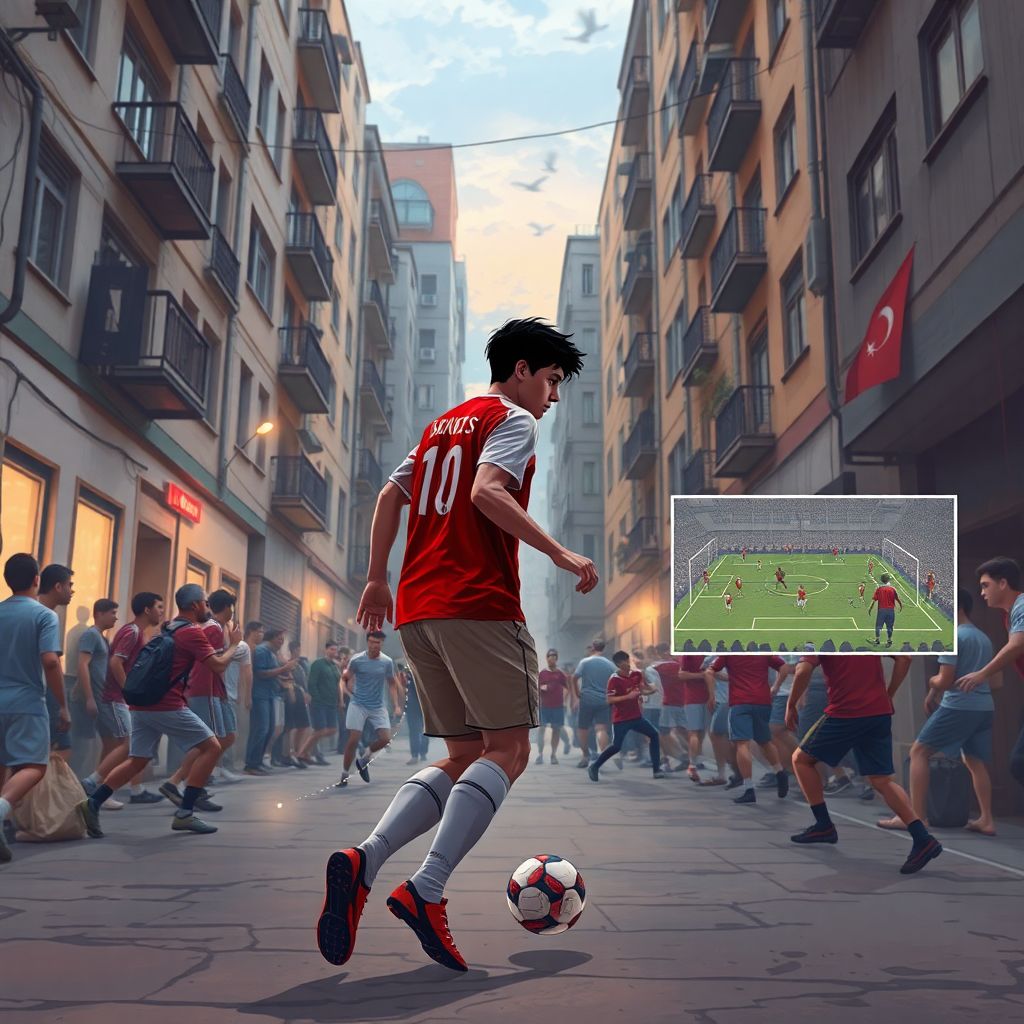
When people talk about Turkish football, they usually mention loud stadiums, crazy fans and big derbies. But if you look a bit closer, there’s another pattern: this country keeps producing imaginative No.10s who can flip a match with one pass. From dusty street pitches in Anatolian towns to the floodlights of Istanbul and Europe, there’s a clear path — and, importantly, parts of that path you can copy no matter where you live.
From backstreet cages to big arenas: why Turkey breeds playmakers
If you walk through almost any Turkish city in the evening, you’ll see a familiar scene: tight concrete cages, small-sided games, too many players for one ball, and a constant stream of risky passes and nutmegs. This is the informal laboratory of turkey football talent development. In these cramped spaces, kids learn to receive the ball under pressure, hide it with their body, scan for options and improvise when the planned pass closes. There’s no coach pausing the game every two minutes, so decisions have to be instant and often bold. That’s exactly the environment that shapes a No.10: restricted space, aggressive opponents, and social pressure to do something special that makes everyone shout.
Inspiring examples: what Turkish No.10s actually do differently
Look at the best turkish number 10 footballers of the last two decades and you’ll see a shared trait: they’re all comfortable being the “problem-solver” when the game gets ugly. Mesut Özil, though he played for Germany, grew up in a Turkish community environment in Gelsenkirchen, constantly playing in cages and futsal halls; his trademark disguised passes come from that crowded football culture. Emre Belözoğlu, pulling strings for Fenerbahçe and the national team, relied more on angles and rhythm than on pure speed. Today, players like Hakan Çalhanoğlu and Arda Güler show the updated version of the same profile: street-born creativity, polished by structured training. The lesson is simple: they’re not just technically gifted; they’re obsessed with reading the game a split-second faster than everyone else and taking responsibility for the final decision.
How to become a playmaker in football, Turkish-style
If you’re wondering how to become a playmaker in football and you like the Turkish model, start by copying the mix of chaos and structure they live in. You need “messy” games where rules are flexible and touches are plenty, and then you need focused sessions where you slow everything down and analyse. In practice, that can mean two or three evenings of small-sided street games — five-a-side in a tight space, no restrictions on touches — where your only personal rule is: turn forward whenever possible, look between defenders instead of at their feet, and try at least three risky passes per match. Then, on another day, you replay those moments in your head or on video, asking yourself: could I have received with the other foot, could I have faked the pass first, did I notice the weak-side runner early enough? This combination of intuitive play and conscious review is precisely what sharpens vision.
Training habits that build a Turkish-style No.10 toolbox
Behind the street flavour, there is a lot of boring repetition that people don’t see. Most creative Turkish midfielders spend extra time on first touch, scanning and body orientation. You can build the same habits alone or with one partner. Before every session, decide that for the next 15 minutes you will scan deliberately before receiving: look over your shoulder twice, identify the closest defender in your mental map, then receive half-open to the field so you can pass or dribble without a second touch. Add a simple constraint: you’re not allowed to control the ball back towards where it came from unless you’re under heavy pressure; instead, you must open up and face forward. This kind of micro-rule turns regular drills into football training programs for creative midfielders, because you’re not just passing; you’re training your brain to see forward solutions by default.
What turkey youth football academies actually do right
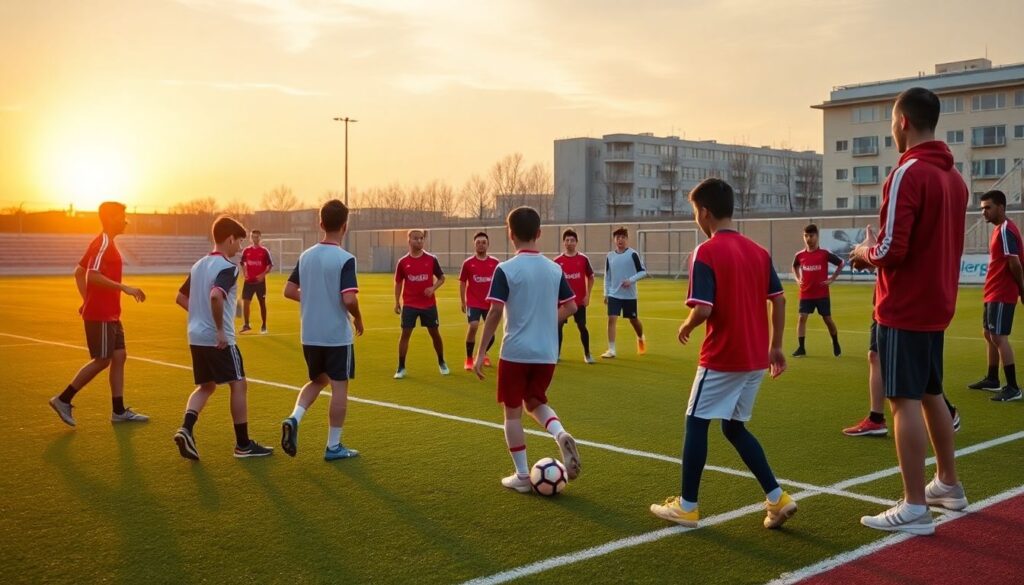
Modern turkey youth football academies have started to formalise what the streets already teach. Clubs like Galatasaray, Fenerbahçe, Beşiktaş and Trabzonspor now introduce positional rondos, zone games and video analysis at fairly young ages, but they rarely kill the player’s natural style. A typical session for an attacking midfielder will include tight-possession games in a 10×10 grid, where the No.10 must constantly receive on the half-turn, play one-touch layoffs and then immediately sprint into a new passing lane. Coaches stop the drill not to shout, but to ask: “Where was the third-man option? Why did you stay on the same line as the striker?” If you train outside Turkey, you can borrow this logic. Design your drills around three questions: can I receive between the lines; can I connect two teammates who don’t see each other; and can I move into space that creates a new passing angle the moment I release the ball?
Cases of successful projects: when structure meets street
You can see the results of this blended approach in several recent careers. Take Arda Güler, who moved from Gençlerbirliği’s local environment to Fenerbahçe’s system and then to Real Madrid. As a young playmaker, he spent hours in tight rondos and game-situational drills, but never stopped playing informal games with friends. Coaches noticed that he was not afraid to lose the ball with an ambitious pass, which is typical of kids raised on cage football where reputation matters more than coach approval. Another case is Yusuf Yazıcı, polished at Trabzonspor, where the club deliberately gave technically gifted kids game minutes in senior football instead of forcing them into rigid roles. These successful projects show that the best investment isn’t just more running or bigger gyms; it’s giving creative No.10s the ball in decision-heavy situations again and again, even if that means accepting a few turnovers while they learn the limits of their imagination.
Street drills you can steal, even if you don’t live in Turkey
You don’t need Istanbul’s backstreets to train like a Turkish No.10; you just need to recreate the constraints. Find a small area — maybe half a basketball court or a parking space — and pack it with as many players as you can safely fit. Use small goals or even bags as targets. Play games where goals only count if they come from a through ball or a one-touch assist. This pushes you to search for vertical passes through crowded legs instead of taking the easy safe option sideways. If numbers are low, play two-versus-two with neutral “jokers” who always support the team in possession. As a playmaker, focus on constant communication: point where you want teammates to run, shout early for the ball, and after every attack ask yourself which defender you unbalanced with your movement. Over time, you’ll notice that your instinct is to open your body towards the most dangerous space before the ball even arrives.
Turning analysis into a weapon: the overlooked side of creativity

There’s a myth that No.10s are just born talented and play off instinct. In reality, many Turkish playmakers are quiet students of the game. They spend hours watching clips of their own matches and of other creators. To apply this, start recording your games and training whenever possible. After each session, pick three moments: one where you made a good final pass, one where you chose the safe option, and one where you lost the ball. Freeze the frame one second before you received the ball and ask: what were the other options; was my body shape signalling my real intention; and could I have manipulated the defender with a fake, a look-away or a delay? This kind of self-review mirrors what top academies do in turkey football talent development and turns vague “creativity” into something you can deliberately improve.
Blending physical work with smart energy use
Street football builds toughness and agility, but professional No.10s in Turkey also need the engine to press, drop and then immediately join attacks again. That doesn’t mean endless distance running. It means conditioning that respects how a playmaker moves: short accelerations into pockets, quick changes of direction, and repeated sprints after losing the ball. When you design your own sessions, attach fitness to decision-making. For example, after every failed pass in a small-sided game, the passer must sprint five metres and back before rejoining play. This adds a “cost” to poor choices and teaches you to protect the ball without becoming conservative. The goal is to play at a high tempo while staying mentally clear enough to see the disguised pass when it appears.
Using modern resources without losing the street mindset
Today, anyone with a phone and internet can access the same resources as pros. If you want to follow the path of top Turkish creators, don’t just watch highlight reels; study full games where they struggle as well as shine. Look up tactical breakdowns of Çalhanoğlu’s role at Inter, or deep dives into how Arda Güler finds pockets between the lines. Combine that with online masterclasses on vision, passing angles and body orientation. Many clubs, including some turkey youth football academies, now release training clips and coaching webinars explaining how they structure possession drills. Use those videos as templates and then adapt them to your environment, always bringing back the core philosophy: tight spaces, quick decisions, forward-thinking passes. That way, modern learning tools don’t replace the street mentality; they refine it.
Building your own mini-project: a personal academy in your neighbourhood
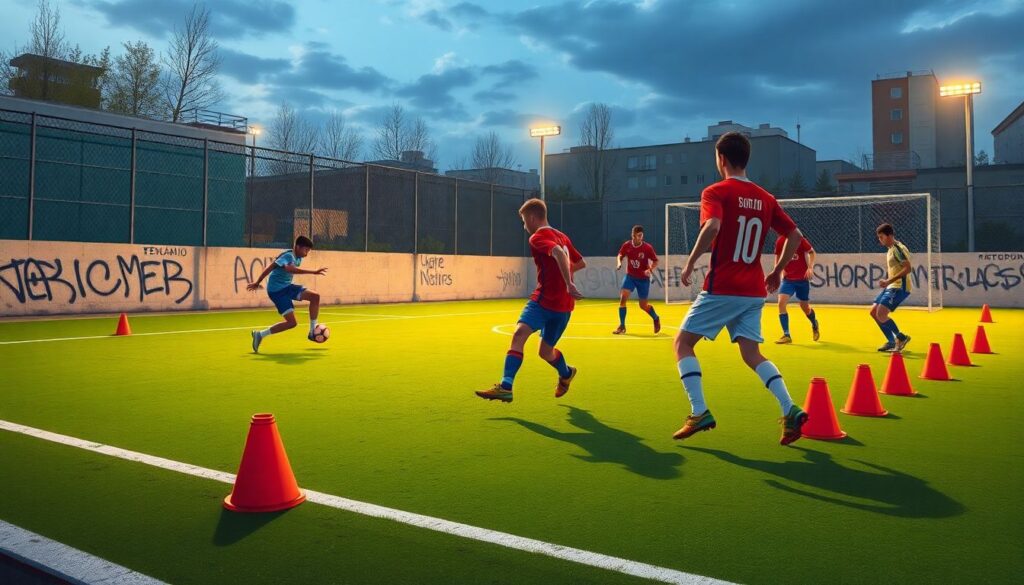
If you don’t have access to a big club, think like a developer, not a victim. Gather a small group of motivated players and agree on a weekly routine inspired by successful Turkish pathways. Dedicate one session to pure street-style games, one to structured positional play focused on your role as a No.10, and one to mixed work with fitness, video and technical drills. Over a few months, this turns your local pitch into a miniature version of the environments that shaped current stars. The real magic is consistency: Turkey’s best playmakers didn’t become special by trying a new trick every week; they became special by repeating simple, game-real situations — receiving between the lines, playing the third-man pass, arriving late in the box — thousands of times under slightly different kinds of pressure.
Turning inspiration into daily actions
From back alleys to Champions League nights, the journey of Turkish No.10s looks romantic, but underneath it’s very practical. They combine chaotic games that force creativity with targeted training that sharpens specific skills. They study the game off the pitch, treat mistakes as useful data and keep asking for the ball in difficult moments. You can take the same approach starting tomorrow: find or create tight-space games, set small tactical rules that push you to think forward, review your decisions with brutal honesty, and use modern resources to understand why top playmakers choose the options they do. Do that consistently, and you’re no longer just dreaming about Turkish-style creativity; you’re actively building it into your game, one risky pass at a time.