
From Local Pitches to Global Arenas
If you grew up in Türkiye, you know the script: dusty Anadolu pitches, heavy balls, uneven grass, and one big dream — Europe’s top 5 leagues. In 2026 that dream is no longer abstract. It’s a proven, repeatable pathway, backed by data, scouting networks, and academy structures that didn’t exist 25 years ago.
Back in the 1990s, Turkish football was still mostly inward‑looking. The 2000 UEFA Cup win of Galatasaray and the 2002 World Cup bronze cracked the door open, but only a handful of players really crossed over. Today, the dynamic has flipped: scouts from Premier League, La Liga, Serie A, Bundesliga and Ligue 1 track U15 and U17 fixtures in Türkiye with the same rigor they use in France or Brazil. The pipeline from Anadolu to Europe has become a defined “development architecture”, not just a lucky break for a few wonderkids.
Trailblazers: The First Big Waves of Turkish Stars
To understand how Turkish players conquered the top 5 leagues, you have to look at the early benchmarks. Nihat Kahveci exploding in La Liga with Real Sociedad in the early 2000s wasn’t just a feel‑good story; it showed that a Turkish forward could be a high‑efficiency asset in one of the world’s most tactical leagues. Around the same time, players of Turkish origin born in Europe, like Yıldıray Baştürk in the Bundesliga, proved that Turkish talent could adapt to high pressing, positional play, and intense physical metrics.
The second wave came with names like Nuri Şahin, who broke records as the youngest scorer in Bundesliga history, and later Arda Turan, who turned his Galatasaray pedigree into key roles at Atlético Madrid and Barcelona. At that point, the market perception started to shift: Turkish players were no longer “exotic gambles” but legitimate options for clubs optimizing their squads under Financial Fair Play constraints.
Even the fan culture adapted. As merchandising grew, you suddenly saw Turkish football players in Premier League jerseys for sale in Istanbul shopping malls and on European club webshops, signaling that Turkish stars weren’t just squad members — they were commercial assets with global appeal, influencing shirt sales and digital engagement.
Modern Heroes: The 2010s and 2020s Generation
The current generation amplified everything. Players like Hakan Çalhanoğlu in Serie A, Çağlar Söyüncü in the Premier League, and Burak Yılmaz’s late‑career reinvention at Lille in Ligue 1 turned Turkish athletes into key nodes in elite tactical systems. They were no longer just “hard‑working fighters”; they became playmakers, ball‑progressing defenders, high‑volume chance creators, and leaders in dressing rooms filled with world stars.
What changed was not only raw talent, but the “player development stack” behind them. Many came through more structured academies, had exposure to GPS‑tracked workloads, individualized strength programs, and video‑based tactical education from adolescence. When they landed in Europe, the adaptation curve shortened. Clubs realized that signing a Turkish player meant getting someone already familiar with pressing triggers, rest-defense principles, and structured build‑up patterns.
For fans, this evolution created new rituals. People started planning trips to buy tickets for matches with Turkish players in top European leagues, turning away days in London, Milan or Dortmund into personal pilgrimages. Following Turkish players became a lifestyle, not just a casual hobby.
Inspirational Examples: Different Pathways, Same Destination
Let’s break down the main archetypes you can actually model your own journey on.
Some players followed the “domestic elite → European jump” route. They dominated Süper Lig at a young age, outperformed league averages on key metrics like expected goals (xG), key passes, and defensive actions, then transferred as nearly finished products. Think of attackers who moved after proving they could carry high usage in pressure games — they showed resilience in hostile atmospheres like Kadıköy or Ali Sami Yen before facing Camp Nou or Anfield.
Others took the “early export → gradual integration” path. They left Türkiye as teenagers, integrated into European academies, and progressed through U19 and reserve teams. Their performance indicators were tracked for years: sprint volume, pressing intensity, progressive passes, and chance‑creation zones. By the time they hit the first team, they spoke the language, understood the league’s tactical grammar, and were embedded in local culture.
Finally, there are dual‑identity players who grew up in Germany, the Netherlands or France, but chose Türkiye at international level. Their stories matter because they show that “Turkish footballer” is no longer a geographic label; it’s a cultural and footballing identity that can be developed inside or outside Türkiye’s borders. Their careers underline that adaptability, multilingual communication, and tactical literacy are as important as first touch and finishing.
Short version: there is no single correct route from Anadolu to Europe — but every successful example shares systematic work, smart career decisions, and long‑term planning.
Practical Recommendations: How to Build a Europe‑Ready Profile
If you’re a young player, coach, or parent, you don’t need vague slogans. You need a development blueprint. Here are concrete, actionable levers you can pull.
• Technical skillset (micro‑level):
– Master first touch under pressure (tight‑space rondos, 3v1, 4v2 drills daily).
– Train weak foot repetition until your passing map is symmetrical.
– Focus on position‑specific tools: full‑backs need crossing and one‑on‑one defending in large spaces; central midfielders must scan constantly and pass under pressure; forwards must finish in multiple body positions.
• Tactical intelligence (meso‑level):
– Study game models: gegenpressing, low block, positional play, direct transition.
– Learn to interpret triggers: when to press, when to drop, when to cut passing lanes instead of chasing the ball.
– Watch full 90‑minute games, pausing to predict next actions; this trains your “football IQ” and anticipatory skills.
• Physical and mental robustness (macro‑level):
– Use structured strength and conditioning, not just running laps. Monitor load, recovery, and sleep.
– Develop stress management routines: breathing, visualization, match‑day rituals. Playing in Europe means constant scrutiny from media and fans.
– Build resilience to role changes — from star at home to rotation player abroad, then back to starter. This psychological transition kills many promising careers.
On top of that, think like a long‑term project manager. Every season should have a development roadmap: specific metrics you want to improve, leagues you aim to reach, and competitions (U19, reserve, cup games) that will showcase you to the right scouts.
Case Studies: Successful Projects, Not Just Talents
When you analyze players who made it, patterns emerge. Behind almost every success story is a sequence of rational decisions: right club fit, correct league selection, and timing of moves that supports growth instead of just chasing salary.
Some attackers, for example, chose mid‑table clubs in top 5 leagues instead of jumping directly to a superclub. That gave them higher expected minutes, more touches per 90, and chances to become tactical focal points rather than bench options. Their entourage treated the transfer like a start‑up scaling project, not a lottery win.
Other players embraced loans strategically. Being loaned to a Bundesliga or Serie A team with a compatible game model allowed them to accumulate high‑intensity minutes, diversify their positional roles, and build a highlight reel that matched what bigger clubs wanted: pressing efficiency, ball recoveries in the opposition half, and progressive ball carries.
Even the commercial ecosystem around them has matured. Fans now routinely look up where to watch Turkish players in top 5 European leagues live stream, aligning their weekend schedules with specific players’ fixtures. Clubs and agents watch those numbers closely, because digital engagement and global audience size matter in contract negotiations and sponsorship deals.
Beyond the Pitch: Branding, Memorabilia, and Fan Engagement
In 2026, being a successful Turkish player in Europe is not only about performance metrics; it’s also about personal brand architecture. Social media strategy, public image, and fan engagement all feed into a player’s market value.
Supporters feel this directly. You can now easily buy signed memorabilia of Turkish football stars in Europe through official club stores or verified online platforms. That signed shirt or match‑worn boot is more than a decoration — it’s a physical token of a pathway that once seemed unreachable for Anadolu kids. It tells you: “Someone from here made it; so can you.”
The merchandising boom goes even further. Limited drops, collaboration lines, and special edition shirts are common, and among them you’ll see items clearly marketed to Turkish fans abroad. Between that and growing demand for tickets for matches with Turkish players in top European leagues, clubs are very aware of the diaspora effect. They know a Turkish player can activate entire new fan segments across Germany, the UK, Italy, France, and beyond.
Learning from Data, Video, and Modern Analytics
Today’s edge is built on information. If you want to reach Europe, you need to think like an analyst as well as an athlete. Clubs use expected goals models, tracking data, and heatmaps to analyze both their own squads and potential signings; there’s no reason players shouldn’t use similar tools to self‑evaluate.
For example, you can track:
– Your xG and xA (expected goals and assists) over a season.
– The zones where you receive the ball most frequently.
– Number of pressures, interceptions, or progressive passes per 90.
This transforms training from vague “work harder” into targeted optimization: you start asking, “What can I change in my movements, positioning, or decision‑making to improve these metrics?”
Meanwhile, video platforms give you an on‑demand library of your own matches and those of players in your position. You can benchmark your actions against established Turkish stars abroad, breaking down how they move in build‑up, how they react to pressing cues, how they manage transitions. Over time this raises your tactical ceiling and game speed.
Resources for Continuous Learning and Inspiration
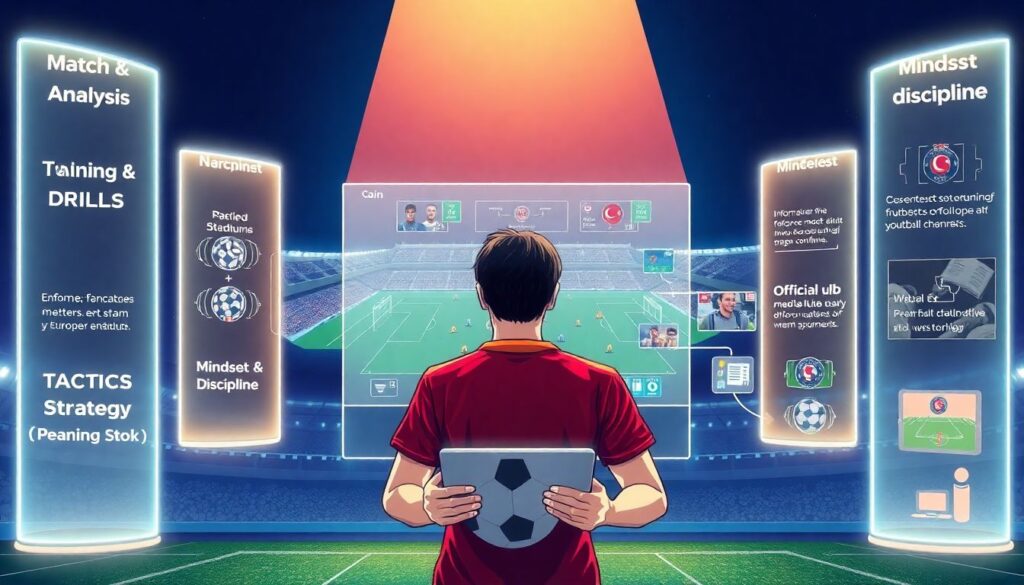
Information is no longer a bottleneck. What matters is how methodically you use it. If you’re serious about following in the footsteps of those Turkish players in Europe, build a personal “learning stack” around four pillars:
• Match content and analysis
– Use legal platforms and club channels to follow full games, not just highlights. This is where knowing where to watch Turkish players in top 5 European leagues live stream becomes a practical tool: you can track your role models weekly, observe their form cycles, and build your own analysis notes.
– Watch with a notebook: record patterns, positions, pressing triggers, and off‑ball movement.
• Educational media
– Seek out the best books and documentaries about Turkish footballers in Europe; those long‑form stories reveal decisions, setbacks, and career inflection points that short clips never show.
– Combine these with coaching books on tactics, sports psychology, and strength & conditioning to create a structured reading plan across the season.
• Digital training solutions
– Use verified online drills, remote coaching platforms, and performance‑tracking apps to systematize your growth.
– Analyze your own clips, overlaying them with principles learned from elite games, and adjust training micro‑cycles based on objective weaknesses.
• Networking and mentorship
– Connect with coaches, analysts, and scouts through clinics and online seminars.
– If possible, get feedback from professionals who understand both Turkish football culture and European tactical demands.
From Anadolu to Europe: Your Turn

The story of Turkish players in Europe is no longer a fairy tale — it’s a mature ecosystem with proven pathways, measurable benchmarks, and clear role models. In 2026, the question isn’t whether Turkish footballers can succeed in the top 5 leagues; it’s who will design their career with enough clarity, discipline, and patience to be next.
Your environment might be a small club in Central Anatolia or a youth team in Istanbul, but the global feedback loop is already connected to you: scouts’ databases, live streams, analytics platforms, and fan communities are just a few clicks away. Use them. Treat your career as a long‑term project with phases, milestones, and constant learning.
Someone has to write the next chapter of “From Anadolu to Europe.” There’s no reason that can’t be you — if you build the right skills, make smart decisions, and stay committed when the path gets steep.