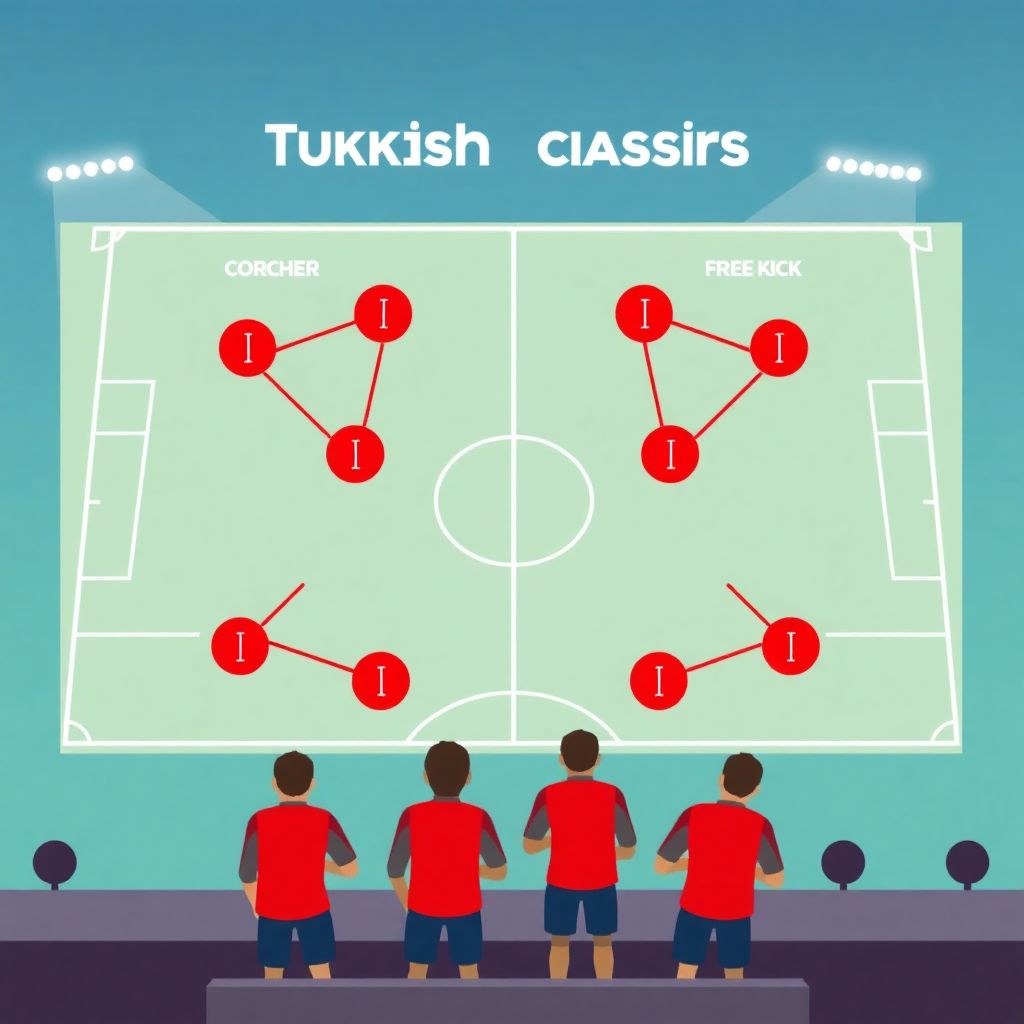
Use corners and free kicks as repeatable, trained situations: collect Turkish Super Lig corners statistics, design 3-5 simple routines for corners and free kicks, assign clear roles, and rehearse them under pressure. Then track Super Lig goals from corners and free kicks weekly, adjust details, and lock in the 2-3 highest‑return patterns.
Essential Set-Piece Principles for Süper Lig Matches
- Focus on a small, reliable playbook: 3-5 corner routines and 2-3 free‑kick patterns that players can execute even under fatigue.
- Base routines on Super Lig set piece analysis instead of copying foreign teams; adjust for local refereeing and physical profiles.
- Define roles by strengths: screeners, blockers, first headers, second‑ball hunters, and delivery specialists.
- Plan for second phases on every dead ball instead of hoping the first contact scores.
- Use data, including Turkish Super Lig corners statistics, to decide when to overload near post, far post, or edge of the box.
- Review video quickly on matchday to spot opponent adjustments and change your routines live.
Analyzing Opponent Tendencies from Corner Statistics
This approach fits analysts, head coaches, and assistants who already capture event data or video from Süper Lig games. It is less useful at amateur level without stable video coverage or when frequent coach changes prevent consistent set‑piece work.
Start by structuring your Super Lig tactical analysis set pieces work into three questions: how does the opponent defend, where do they concede, and which matchups you can exploit. Use at least the last 4-6 league games as your sample.
| Corner Scouting Item | What to Look For | Typical Süper Lig Example | Decision for Your Plan |
|---|---|---|---|
| Defensive scheme | Pure zonal, pure man, or mixed; number on posts; line height | Team A keeps 2 on posts, mixed marking, deep line | Use crowd at goalkeeper and near‑post runs to attack deep line |
| Targeted zones conceded | Where first contact is lost or shots are allowed | Team B concedes many flicks at front post | Add 1-2 front‑post overload routines |
| Key duel weaknesses | Shortest markers, poor timing, players who ball‑watch | Full‑back on tallest striker at back post | Design a screen to free your striker vs that full‑back |
| Transition behavior | How quickly they counter from clearances | Team C leaves 2 high and counters wide | Assign 2-3 rest‑defence players to control counters |
| Attacking corners pattern | For defensive planning against them | Short‑corner preference from left side | Prepare compact 2v2 structure vs short options |
Example: A mid‑table İstanbul side facing Trabzonspor might see that Trabzon struggle with flat deliveries to the six‑yard line when zonal; the next step is to design one routine that attacks that line with two aggressive runs and a blocker on their key header.
Next step: build a one‑page report template and fill it every week with opponent corner tendencies, keeping language and diagrams identical so players learn to read it fast.
Designing Corner Routines: Roles, Zones, and Timing
To turn analysis into goals, you need clear tools and a shared vocabulary. Start simple: one pattern per major zone (near, central, far) plus at least one short‑corner option and one low‑risk routine to protect a lead late in games.
| Resource / Tool | Purpose in Corner Design | Practical Notes for Süper Lig Staff |
|---|---|---|
| Video clips (own & opponent) | Show players exact timing, runs, and screens | Use 10-20 second clips on tablets in the dressing room pre‑match |
| Pitch diagram sheets | Draw roles, code names, and starting spots | Laminate and reuse weekly; one sheet per routine |
| Role profiles | Define who is the primary header, screener, blocker | Update each window when players transfer in/out |
| Signal system list | Link hand/ball positions to each routine | Keep 3-4 simple signals, practised every session |
| Data snapshot | Connect routines to evidence of success | Track which routines generate shots, not only goals |
In practice, a team like Galatasaray might use one near‑post crowd routine, one back‑post isolation for a tall centre‑back, and one short option that ends with a cut‑back to the edge. Each routine has a short code name players can recall in noise.
- Define fixed roles for starters and backups so changes during substitutions do not break the structure.
- Limit complex choreography; prioritize two strong runs plus one screen over five moving parts.
- End each design meeting by deciding which 2-3 routines are first‑choice for this specific opponent.
Next step: build a small corner playbook document and review it with leaders (captain, set‑piece takers, centre‑backs) before team meetings.
Free-Kick Models: Direct Threats and Second-Phase Plans
Free kicks require a structured approach around your delivery quality, your aerial strength, and which zones the opponent protects poorly. Start with a short prep checklist to ensure every routine stays realistic for your squad and your league context.
| Pre‑Free‑Kick Planning Item | Key Question | Example Adjustment |
|---|---|---|
| Main taker selection | Who among the best free kick takers in Super Lig suits this angle? | Switch from right‑footer to left‑footer for better outswing |
| Wall and goalkeeper tendencies | Do they jump, move early, or overprotect one side? | If wall jumps, use low driven shot under or around it |
| Scoreline and match minute | Do we need a direct shot or controlled second phase? | Winning late: prefer chipped ball plus strong counter protection |
| Distance and angle | Is direct shot realistic for your taker power and accuracy? | Far distance: design deep cross towards far‑post runner |
Mini preparation checklist before designing or calling a free‑kick routine:
- Identify 1-2 trusted direct takers and 1-2 cross‑delivery specialists.
- Mark preferred shooting zones on your training pitch with cones.
- Analyze at least 5-10 opponent free‑kick defensive clips.
- Agree on simple verbal or hand signals for each routine.
- Decide who commands the wall‑distraction and who attacks rebounds.
-
Map your free-kick zones on the pitch
Divide the attacking half into zones: close central (direct shot), wide crossing areas, and long‑range. In training, label them so players can quickly recognize which model applies in each match situation.
-
Assign primary and secondary takers by zone
Choose your primary shooter and crosser for each zone, considering the best free kick takers in Super Lig as benchmarks for technique types. Ensure players know who steps up if the first option is substituted or injured.
-
Design 2-3 direct-shot routines
For central and near‑central areas, create patterns for direct strikes with simple variations.
- Standard curl over the wall into far corner.
- Low driven shot under a jumping wall.
- Disguised lay‑off to a runner from the side of the wall.
-
Create 2-3 delivery-based free-kick models
For wider or deeper zones, prioritize crosses with coordinated runs, blocks, and second‑ball positions. Link at least one model to a routine already used from corners to reduce learning load.
-
Define second-phase responsibilities
On every free kick, assign at least one player for edge‑of‑box shots and one for covering the opponent’s counter. Make this a habit so the team reacts automatically after the initial header or clearance.
-
Practice with match-realistic pressure
Simulate limited time, referee whistle cadence, and crowd noise. Rotate defenders to mimic different Süper Lig opponents and demand quick decisions from takers and runners.
-
Review and refine using match clips
After each game, cut every free kick into a short clip, review if the model chosen matched the zone and scoreline, and adjust details at the next session.
Example: A team in Ankara may use a right‑footed specialist for direct shots from the D, but when the ball is wider left at 30 meters, they switch to a left‑footer who can whip an outswinging cross towards the far‑post center‑back.
Next step: create a zone map graphic for your stadium and attach one preferred routine to each zone so players link space to solution quickly.
Training Drills and Periodization for Match-Ready Execution
Set‑piece training must respect player load and weekly rhythm. Integrate small, frequent blocks into existing sessions rather than one long, low‑intensity block that players mentally switch off from.
| Training Focus | When in Week | Typical Drill Example | Goal of the Block |
|---|---|---|---|
| Technique and delivery | MD-3 or MD-4 | 10-15 repeated corners and free kicks per taker | Stabilize cross height, speed, and spin |
| Timing and runs | MD-2 | 11v0 walk‑through, then 11v8 live corners | Coordinate starting positions and movement cues |
| Defensive organization | MD-2 | Rehearse marking assignments vs next opponent’s patterns | Limit free headers against your team |
| Pressure simulation | MD-1 short block | 5-10 quick‑restart corners or free kicks | Recreate match tempo and focus |
Use simple Süper Lig‑style examples: if Fenerbahçe are strong at attacking near‑post corners, spend extra MD‑2 minutes drilling that scenario so defenders feel the speed and chaos before the match.
- Include at least one attacking and one defensive set‑piece block in every full session.
- Limit total dead‑ball repetitions per player to avoid over‑fatigue.
- Rotate takers under mild fatigue, not only fresh, to reflect match reality.
- Evaluate every drill by whether it clearly connects to your next opponent’s patterns.
- End set‑piece blocks with quick recap: what worked, what must be repeated next day.
Next step: build a weekly calendar template (MD‑4 to MD‑1) and plug in short set‑piece slots with specified objectives instead of generic “set pieces” notes.
In-Game Adjustments: Substitutions, Signals, and Risk Management
Even well‑prepared routines can fail if they are not adjusted during the match. Clarify in advance who makes decisions, how changes are communicated, and how your risk level shifts with the scoreline and substitutions.
| Match Scenario | Adjustment Focus | Example Reaction in Süper Lig Game |
|---|---|---|
| Main aerial threat substituted | Switch to low‑cross or short options | After centre‑back exit, use quick short corner for cut‑backs |
| Opponent changes to zonal defending | Modify screens and attack gaps between zones | Shift to crowding goalkeeper and attacking six‑yard line |
| Protecting a narrow lead late | Reduce risk on rest defence | Keep extra player back instead of overloading box |
| Chasing goal in stoppage time | Maximize box presence, include goalkeeper | Send keeper forward for last corner with pre‑agreed role |
- Do not overload players with too many in‑game signal changes; keep 3-4 key options.
- Avoid calling complex routines after long injury breaks when focus has dropped.
- Do not forget to reassign set‑piece roles after substitutions or red cards.
- Avoid taking unnecessary risks with many players ahead of the ball when already leading.
- Do not ignore clear patterns: if an opponent struggles with one type of delivery, repeat it.
- Resist the urge to improvise completely new routines mid‑match; tweak existing ones instead.
Next step: create a short touchline card for staff with default routines by game state (drawing, leading, losing) to guide quick decisions.
Using Data and Video: Scouting, Analytics, and Implementation Checklists
Data and video make your decisions objective and help you communicate ideas clearly. You do not need a full analytics department; even basic tagging of clips and simple spreadsheets can transform your Super Lig set piece analysis work.
| Approach | When to Use | Pros for Süper Lig Environment | Limitations |
|---|---|---|---|
| Manual video tagging | Clubs without dedicated analysts | Low cost, immediate insight from match footage | Time‑consuming, depends on staff discipline |
| Spreadsheet corner database | Tracking Super Lig goals from corners and free kicks | Simple way to detect trends versus rivals | Limited visual context, needs regular updates |
| Specialized set-piece software | Clubs with analyst staff and budget | Fast filtering of Turkish Super Lig corners statistics | Cost and learning curve |
| External consultancy | Short‑term projects or European competition prep | Expertise and benchmarks from broader Super Lig tactical analysis set pieces data | Less day‑to‑day integration with internal culture |
Alternative paths for implementing set‑piece improvements:
- Analyst‑led model: one staff member owns data, video, and weekly reports, feeding clear conclusions to coaches.
- Coach‑driven model: assistant coach handles basic tagging and design, using only simple tools like shared folders and whiteboards.
- Player‑involved model: senior players review clips with staff and help choose routines they trust most under pressure.
- Hybrid with external support: club uses external reports for benchmarking but adapts details locally in training.
Example: a club from Izmir might start with simple Excel logs of every corner (for and against), then upgrade to a software solution once trends clearly show extra points won through set‑piece focus.
Next step: choose one data approach that fits your budget, then standardize how every match is coded so comparisons across the full season stay consistent.
Common Execution Concerns and Tactical Clarifications
How many different corner routines should a Süper Lig team use?
Most intermediate‑level teams should actively train 3-5 attacking corner routines plus 1-2 low‑risk options for protecting a lead. More patterns often create confusion and reduce precision under pressure.
How do we balance attacking corners with protecting against counters?
Always assign 2-3 players to rest defence depending on opponent speed and scoreline. Adjust the number forward in the box but never sacrifice basic coverage of central spaces and wide counter channels.
What if we do not have tall players for aerial dominance?
Emphasize short corners, low cut‑backs, and movements that target the edge of the box rather than aerial duels. Use blocks and screens to free your best shooters instead of fighting in the air.
How often should we change our set-piece routines during the season?
Keep a stable base package but refresh details every few weeks: starting positions, screens, or decoy movements. Make bigger changes only in international breaks or pre‑season so players have time to adapt.
Who should lead set-piece organization on the pitch?
Ideally a centre‑back or defensive midfielder, supported by the main taker. Assign that leader explicitly so there is no doubt about who calls routines and checks matchups before the ball is delivered.
How quickly can we expect an impact from focused set-piece work?
With structured training and clear roles, many teams see better chances created within a few league matches. Consistent gains across a full Süper Lig season, however, depend on maintaining the process every week.