Set-piece science means turning corners and free-kicks into repeatable, low-risk routines. Turkish and European teams use rehearsed patterns, role clarity, and video-led adjustments to exploit space or protect it. This guide gives you ready-to-train schemes, defensive organization steps, and a compact matchday checklist you can plug into your next session.
Set-piece playbook overview
- Use a small core of repeatable routines instead of inventing new ideas every week.
- Give every player a simple role, reference point, and timing cue for each set piece.
- Build sessions that mix football set piece training with live, game-speed rehearsals.
- Base tweaks on corner kick tactics analysis and opposition video, not on improvisation.
- Track outcomes with simple tags: delivery zone, first contact, second ball, and shot.
- Align staff: one coach owns attack, one defense, one handles data and video cut-ups.
Corner routines: anatomy and match-ready options
Corners are ideal when your squad has at least two strong aerial targets and a reliable dead-ball taker. Turkish Super Lig clubs often mix short and inswinging corners, while many European teams favor crowding the goalkeeper or isolating a back-post runner.
Who this approach suits:
- Teams with well-conditioned center-backs comfortable attacking the ball aggressively.
- Squads that can spare one or two players for rehearsed blocking and decoy runs.
- Clubs already investing in professional football analysis Turkish Super Lig or European databases.
When you should avoid over-complicated corners:
- If your league pitches are poor and make short patterns risky near your own transition cover.
- If your taker changes frequently and you cannot maintain delivery consistency.
- If fitness levels are low and complex movements break down under fatigue.
Sample routine: Near-post crowd, far-post arrival
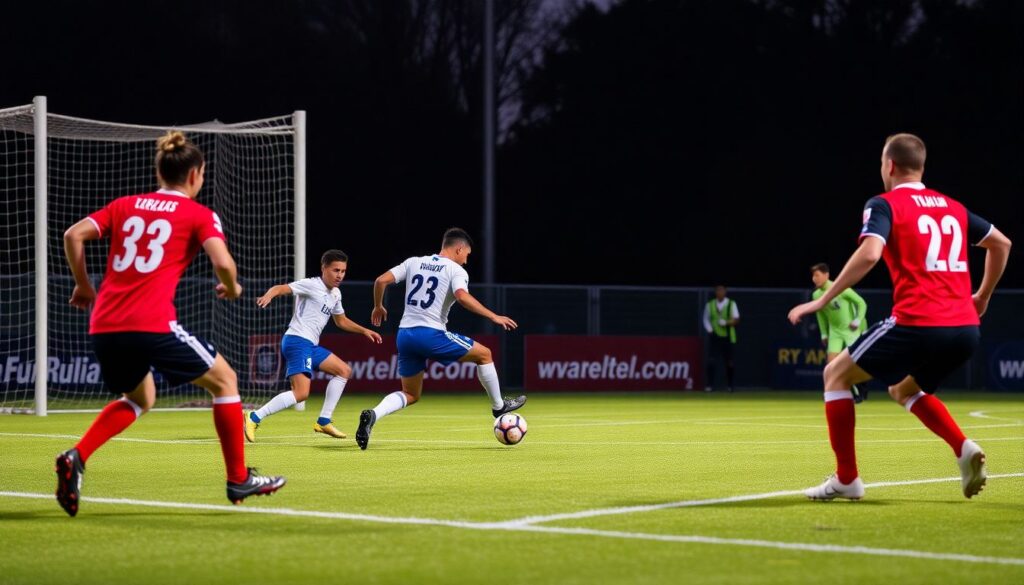
Text position map (viewed from attacking perspective):
- Zone A – near-post 6-yard line: Target 1 starts central, sprints to meet the cross.
- Zone B – penalty spot: Target 2 curves run to block marker and screen keeper.
- Zone C – far-post 6-yard line: Late runner arrives for flick-ons or rebounds.
- Zone D – edge of box: One player for cut-backs and second balls.
- Zone E – halfway line: Two covering players for counter-press and rest defense.
Timing notes:
- T-3 seconds: Signal (hand up) from taker, near-post runner starts slow movement.
- T-1 second: Blocker and decoy cross paths; far-post runner starts late sprint.
- T=0: Delivery hits near-post target; far-post arrival is timed for flick-on.
Free-kick frameworks: direct, indirect and hybrid setups
Free-kick routines football coaching works best when you standardize what you need for each type: direct shots, crossing deliveries, and quick hybrids. Before adding complex ideas, ensure you have the following basic tools and resources.
Core requirements
- Reliable dead-ball takers: At least one right-footed and one left-footed option.
- Clear distance map: Predefined zones where you always shoot vs always cross vs run a rehearsed play.
- Wall management: One player briefed to adjust the opposition wall by feints or positions.
- Trigger signals: Non-verbal cues agreed for shot, cross, and short play (e.g., number of steps, arm positions).
- Video library: Short clips from training and matches for quick review and learning.
Direct free-kicks: simple framework
- Distance and angle decision: Use your map to decide shot vs cross; avoid debating on the pitch.
- Wall and keeper scan: Taker checks gap, wall height, and starting position of the goalkeeper.
- Run-up routine: Fixed starting spot and number of steps to make contact repeatable.
- Rebound coverage: Two players attack any spill; one protects the counter-attack zone.
Indirect and hybrid free-kicks
- Lay-off and strike: One player rolls the ball; second hits first time through or around the wall.
- Wide overload: Quick pass outside the wall to a full-back for a driven cross.
- Floor pattern: One-touch third-man run behind the line, especially effective when the defense expects a cross.
A structured approach similar to a soccer set piece coaching course will help your staff teach these patterns consistently and safely.
Defensive counters: organizing to limit set-piece threats
Mini preparation checklist before you install defensive routines:
- Confirm who leads set-piece defensive calls on the pitch (usually a center-back or goalkeeper).
- Define your default shape for corners and wide free-kicks (zonal, mixed, or man-oriented).
- Agree rest-defense numbers and positions to control the opponent’s counter-attack.
- Print or share simple role diagrams with players by unit (back line, midfield, forwards).
- Choose your defensive structure
Decide whether you will defend mainly zonal, man-oriented, or with a mixed system. Keep it consistent across corners and wide free-kicks to reduce confusion. - Assign zones and match-ups
Give each player one job: protect a specific zone or mark a specific opponent. Communicate this repeatedly during football set piece training so it becomes automatic.- Strong headers: central zones and key aerial threats.
- Quicker players: edge of box and short-corner options.
- Forwards: stay higher for counter-threat but close enough to help if the ball drops.
- Coordinate goalkeeper commands
Agree simple words for line height, wall shifts, and defenders leaving the post. The goalkeeper should trigger the final three-second countdown before the kick. - Secure first and second contacts
Train reactions for both winning and losing the first header. Your line must push out together once the ball is cleared to compress space.- First action: attack the ball; no waiting for someone else.
- Second action: nearest players attack the second ball; others squeeze out.
- Build rest-defense and counter-attack rules
Define who stays up and who holds the line at the edge of the box. This balance should reflect match context: protecting a lead vs needing a goal. - Rehearse under pressure
Finish sessions with repeated live corners and free-kicks. Vary opposition strategies you face, based on corner kick tactics analysis of upcoming opponents.
Training progressions: drills, reps and session templates
Use this checklist to confirm your set-piece blocks are working and safe for your players:
- Players can describe their role in each main routine in one clear sentence.
- Delivery (pace, height, and zone) is consistent enough to trigger rehearsed movements.
- Runs and blocks are performed at match speed without collisions or risky contacts.
- Defensive line holds shape and reacts together to clearances and second balls.
- Transition rules after set pieces (press, delay, or regroup) are understood and followed.
- At least one routine is practiced for attacking and defending from both left and right sides.
- Video clips from training are reviewed briefly with units (defenders, midfielders, forwards).
- Staff can run the block without the head coach, using a shared session template.
Data-driven edge: analytics, video cues and opponent profiling
Common mistakes when working with data and video around set-pieces:
- Collecting too many clips instead of a focused professional football analysis Turkish Super Lig or league-specific playlist.
- Copying elite European routines without adapting to your own players’ physical profile.
- Changing routines every week so players never reach true automaticity.
- Ignoring where the first contact actually happens and only tracking shots or goals.
- Failing to tag who is responsible for each conceded chance on a set piece.
- Overloading meetings with numbers instead of 3-4 clear coaching points per block.
- Not linking video feedback to the next football set piece training session’s design.
- Skipping goalkeeper-specific analysis on walls, starting positions, and decision speed.
Implementation checklist: matchday roles and contingency plans
Use this compact coach prep table to fix roles, timings, and communication before kick-off:
| Area | Primary role | Timing focus | Main signal or cue |
|---|---|---|---|
| Attacking corners | Assistant coach A | Pre-match and half-time adjustments | Hand signals from taker; verbal cue from leader |
| Defensive corners | Defensive leader + goalkeeper | Final three seconds before delivery | Keeper shout for line, leader calls marks |
| Free-kicks attacking | Set-piece specialist coach | Quick decision within a few seconds of foul | Pre-agreed arm position or ball placement |
| Rest defense | Holding midfielder | While taker is preparing ball | Pointing to positions, short verbal reminders |
| Video tagging | Analyst or intern | Live during match and within one day after | Simple tag categories for each set piece |
Alternative implementation paths depending on your environment:
- Lean staff model
If you lack specialist coaches, combine roles: one assistant owns all set pieces, while the analyst focuses only on simple tags and quick clips. - Academy-focused model
Use routines that copy your first team but reduce complexity, turning each game into a live soccer set piece coaching course for young players. - Data-led partnership model
Work with an external provider for deeper reports and then translate insights into two or three simple, safe routines your squad can actually execute.
Typical obstacles and practical fixes
How many attacking corner routines should one team use?
Most intermediate teams function best with a small menu of repeatable ideas: one near-post, one far-post, one short option. Add or remove variants only when players can already execute existing ones consistently.
What if my squad is weak in the air?
Shift focus from aerial dominance to fast, low deliveries and short patterns. Use movements to create cut-back chances instead of relying on winning headers against taller opponents.
How can I keep routines safe and avoid collisions?
Mark starting spots clearly in training and rehearse runs at half speed before going full pace. Remove any pattern where crossing paths are too tight or players cannot see each other’s movement.
Do I need advanced software for set-piece analysis?
No. Start with simple tagging: type of set piece, delivery zone, first contact, and outcome. As your workflow grows, then consider adding professional tools to deepen your analysis.
How often should we refresh our set-piece playbook?
Review routines each international or mid-season break. Keep the core ideas, but adjust details like starting positions, screens, and rest-defense according to the players you currently have.
What is the best way to show routines to players?
Use short clips plus one clean diagram per routine. Present to units rather than the whole squad to keep explanations faster and more directly relevant to each role group.
How can I link first-team and academy set-piece work?
Build a shared framework: same naming, similar basic shapes, and scaled-down complexity. This lets younger players step into higher levels already understanding the language and structure.