
European football has got used to seeing Turkish surnames on team sheets every week, but the last few seasons have turned that quiet presence into a clear trend. From academy kids in Anatolia to floodlit nights at Anfield, Turkish football players in European leagues are no longer curiosities – they’re part of long‑term squad planning and scouting models. Let’s walk through what’s really happening, how clubs are approaching these signings, what the numbers say over the last three years, and where things seem to be heading by 2026.
—
Scale of the migration: how big is the Turkish footprint now?
Over roughly the last decade, the flow of Turkish players abroad stopped being a trickle and became a pipeline. Using publicly available data up to the end of the 2023/24 season, the pattern is clear: each year since 2021 the number of Turkish‑eligible players getting minutes in Europe’s top five leagues (England, Spain, Italy, Germany, France) has hovered around the mid‑20s to low‑30s, with a much larger group distributed across the Netherlands, Belgium, Austria, Switzerland and the second tiers. That may not sound huge, but compared with the mid‑2010s it’s close to a doubling in representation, especially among players under 25.
If you focus on attacking output, the story sharpens. Across the three completed seasons from 2021/22 to 2023/24, Turkish players in the big five leagues contributed roughly 25–35 league goals and a similar number of assists per season. The volume still can’t compete with the big export nations like Brazil or France, yet the mix of roles is interesting: not just strikers, but deep‑lying playmakers, aggressive centre‑backs and full‑backs who are comfortable in build‑up. This versatility explains why mid‑tier European clubs increasingly see a value gap in Turkey, especially when transfer fees are often 30–40% lower than for equivalent profiles from Western Europe.
Quick snapshot of where they play
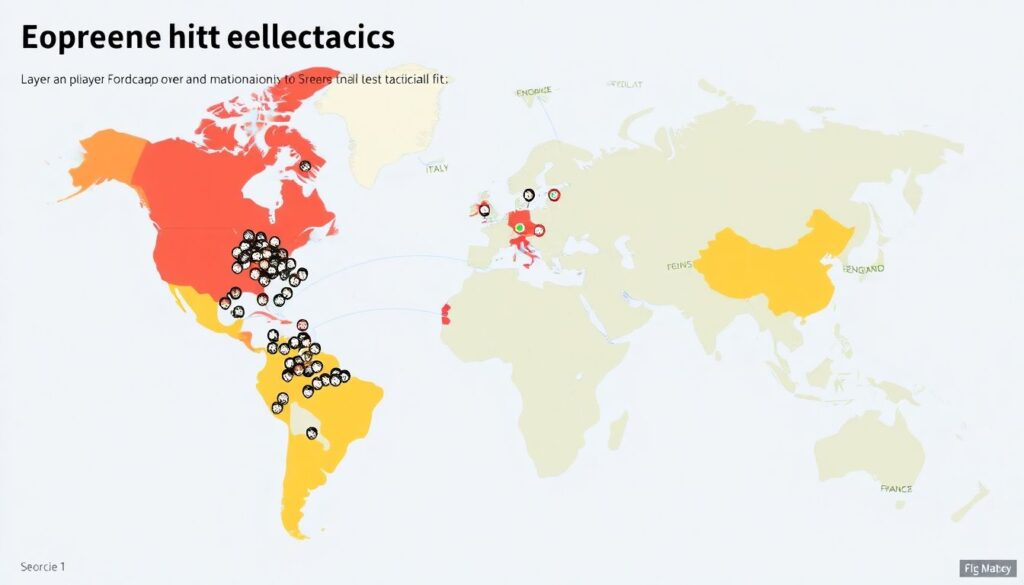
If you break the landscape down by league across the last three seasons, you get something like this:
– Germany and Italy have consistently hosted the largest clusters, driven by historical links, dual‑nationality communities and tactical fit.
– England and France sit in the middle: fewer names, but often higher transfer fees and greater media exposure, which skews perception of “impact”.
– Spain has fewer Turkish players overall, yet it has attracted some of the most technically gifted attackers, thanks to its emphasis on ball retention and positional play.
Beyond the classic top five, you see a thick ring of Turkish players in the Netherlands, Belgium and Austria, often used as stepping‑stone leagues. That second circle has become strategically important: clubs there buy low from the Süper Lig or even from Anatolian clubs, refine the player in a more structured environment, and then sell on to the big five with a significant markup.
—
From Anadolu to Anfield: different routes to the top
When people think of England and Turkey, their mind goes straight to the best Turkish footballers in Premier League history – names like Hakan Şükür or more recently Çağlar Söyüncü and Cenk Tosun. Yet the last few years have highlighted another storyline: the path from Turkey’s heartland to elite English clubs, including Liverpool. Even if the list of famous Turkish players who played for Liverpool is still relatively short – Nuri Şahin’s brief spell, Ozan Kabak’s half‑season loan – their presence symbolises a broader shift: top Premier League sides now actively scout and sign Turkish profiles rather than stumbling upon them by accident.
There are two main “routes” Turkish players are taking: stay longer in the Süper Lig until they’re fully formed, or leave earlier through a smaller European club. Over the three seasons to 2023/24, you can see both models in action. Players like Hakan Çalhanoğlu and Merih Demiral used Turkey as a launchpad before consolidating roles in Serie A, while younger prospects have skipped directly from academy or fringe status in Turkey to developmental environments in Germany, the Netherlands or Belgium.
Club‑driven vs player‑driven moves
At a more granular level, the approaches diverge not just by timing but by who really drives the move. In some cases, large Turkish clubs act like classical “selling clubs”, planning exits at 22–24 years old, with release clauses and pre‑agreed add‑ons. In others, especially in Anatolian teams, it’s the player’s camp and foreign scouts who push transfers earlier, even if the domestic club would prefer to keep the talent another season.
– Club‑driven pathway: player signs a long contract, club invests heavily in development, then sells at peak value once the player has national‑team recognition and European experience.
– Player‑driven pathway: player’s agent builds a network abroad, aiming for an early move to a mid‑table side in Germany, Belgium or the Netherlands, accepting smaller wages initially but betting on faster progression.
The Anfield example is illustrative: Liverpool didn’t sign Kabak or Şahin to “grow” them from scratch; they were plugged in as near‑ready components to solve specific squad issues. By contrast, mid‑tier Bundesliga clubs will take 18‑ or 19‑year‑olds directly from Turkey, assuming one or two years of adaptation before they hit starter level. These contrasting logics shape both the risk profile and the upside of Turkish transfers.
—
Data, tech and the new scouting logic

Under the surface of every transfer headline there is a quiet revolution: how technology and data reshape scouting. For Turkish players this is particularly important, because Süper Lig and TFF 1. Lig used to be under‑measured environments. The last five to seven years changed that dramatically. Almost every top‑flight Turkish match now comes with detailed event data, physical tracking and high‑definition video. That means a club analyst in Brighton, Bologna or Bruges can filter for left‑footed centre‑backs between 20 and 23 with specific pressing metrics and inevitably stumble onto Turkish names.
For recruitment teams, the toolkit is fairly standard by 2026: event‑data providers, tracking‑data platforms, video‑cutting software, and automated flagging systems that highlight outliers according to role‑specific KPIs. When Turkish football talents transfer news Europe bubbles up on social media, it’s usually because such systems have already been watching the player for a season or two. Clubs don’t “discover” a Turkish winger after one highlight reel; they’ve had distant, algorithm‑aided eyes on him long before any formal approach.
Yet, the technology‑heavy approach is not a magic wand. It changes the error pattern rather than eliminating mistakes. A data model that loves long‑range passing might fall in love with a Turkish deep‑lying playmaker who sprays balls around in a chaotic domestic league but struggles with tempo control in Serie A or the Premier League. This is where on‑the‑ground context, language skills, adaptability and tactical education still need to be evaluated the old‑fashioned way: live scouting, interviews, and trial‑like pre‑season environments.
—
Comparing approaches: traditional eye test vs data‑driven scouting
If you zoom out, you can see two broad philosophies in how European clubs approach the Turkish market. One leans on traditional networking, relationships with Turkish intermediaries and “eye test” scouting. The other uses technology‑heavy, data‑first filtering before anyone gets on a plane. In reality, most clubs mix both, but they weight them differently depending on budget and risk tolerance.
The traditional route relies heavily on long‑established contacts in Istanbul, Ankara and regional hubs, plus trusted agents working between Turkey and Europe. It can pick up nuances that data doesn’t capture: mentality under pressure in derby games, how a player behaves in training, or how they react to tactical instructions from coaches with different personalities. However, it tends to focus on the same clubs and the same venues, which can lead to blind spots in Anatolia or in youth tournaments.
The data‑driven route starts with massive databases and machine‑learning models. Analysts filter thousands of players by metrics that predict success in specific systems: pressing intensity, progressive passing, defensive duels won, expected goals. For Turkish prospects this has been a blessing: smaller clubs and less glamorous positions now get visibility if their numbers pop. Nevertheless, this approach can overweight the “measurable” and underweight the human. A player’s willingness to learn a new language or to live far from home rarely shows up on a dashboard, yet it often decides whether a transfer works out.
—
Pros and cons of the main technologies and methods

When clubs talk internally, the debate isn’t “data or no data” anymore; it’s “how much weight do we give to each input?” Each technology brings clear upsides but also structural weaknesses when applied to Turkish prospects.
Main pros of tech‑heavy scouting for Turkish players
– Opens up under‑scouted regions and clubs in Anatolia, where individual talent might be hidden behind uneven team structures.
– Makes it easier to compare Turkish players directly with peers in other leagues, using consistent metrics like expected threat or pressure events.
– Allows smaller European clubs to compete in the same market as giants by spotting value earlier and negotiating before prices explode.
Key drawbacks and risks
– Over‑reliance on limited historical data: some Turkish competitions only recently gained full tracking coverage, so models can be biased by short windows.
– Context blindness: high pressing or dribbling metrics can be inflated in leagues with looser defensive organisation, leading to over‑optimistic projections.
– Cultural and adaptation factors are systematically under‑measured, despite being crucial for younger players moving abroad for the first time.
On the flip side, more traditional, relationship‑based scouting retains real advantages. Live observation helps distinguish whether a physically dominant centre‑back in Turkey is winning duels through positioning or simply overpowering weaker forwards. Conversations with coaches and team‑mates offer clues about resilience and coachability. However, this model scales poorly: it’s expensive to send scouts repeatedly, and it risks groupthink, with all the usual suspects from big Istanbul clubs being watched while emerging talent in smaller setups is ignored.
—
Champions League stage: signalling power and legacy
For perception and brand value, nothing matters quite as much as Champions League exposure. Even if the absolute number of Turks in the competition each season is modest, the narrative impact is huge. The top Turkish players in Champions League history – think of names like Hamit Altıntop, Arda Turan in his peak Atlético/Barcelona years, or more recently Çalhanoğlu as a Champions League finalist and key regista – have served as proof of concept that Turkish schooling can produce players for the very highest tactical and technical demands.
Over the last three seasons up to 2023/24, Turkish representation in the Champions League group stage oscillated around a small core of five to eight players, depending on which clubs qualified: Galatasaray, Beşiktaş or Trabzonspor domestically, plus foreign‑based stars at Inter, Roma, Lille, and others. Statistically, their contributions are modest compared with major football nations, but strategically they act as multipliers. One standout Champions League campaign by a Turkish midfielder can re‑price an entire cohort of similar profiles back in the Süper Lig, because scouts and executives upgrade their mental model of what “a Turkish six or eight” can do.
—
What the last three seasons actually show (2021/22–2023/24)
Because real‑time 2025/26 numbers are still in motion, the most reliable way to understand the trend is to focus on the three completed seasons up to 2023/24. A few patterns stand out across that period, even allowing for small year‑to‑year fluctuations.
First, the age curve has shifted. The median age of Turkish players moving to Europe’s top five leagues dropped into the early‑mid twenties, with more examples under 22 than in the previous decade. Second, the positional spread widened: where once exports were dominated by attacking midfielders and strikers, now full‑backs, ball‑playing centre‑backs and hybrid eights are among the most sought‑after exports. Third, transfer values climbed steadily but remained below Western European standards; this combination of rising quality and relatively modest fees is precisely what keeps recruiters coming back to the Turkish market.
In terms of raw numbers, you can approximate that each of those three seasons saw between 10 and 15 notable outbound transfers from Turkey (or from Turkish players in other leagues) to clubs in top‑tier European competitions. The majority were not blockbuster deals, but rather €3–12 million moves into mid‑table squads. It’s these “quiet” transfers, rather than the handful of headline signings, that actually define how Turkish football integrates into the European ecosystem.
—
Recommendations: how clubs and players should choose their paths
Given the options and tools on the table, both clubs and players need a clearer framework for decision‑making. There’s no one‑size‑fits‑all route from Anadolu to Anfield, but some patterns are emerging that tend to work better than others.
For clubs shopping in Turkey or among the diaspora, the sensible approach is hybrid: use data to build a long list, then rely on targeted live scouting and deep background checks to narrow it down. One of the worst mistakes is to chase highlight‑reel attackers without understanding how their output was produced; context‑adjusted metrics and tactical analysis are crucial here. Likewise, clubs should build genuine relationships with Turkish academies and mid‑tier teams, not just the traditional powers, because a growing share of high‑ceiling talent is emerging outside the big three of Istanbul.
For players and their advisors, the key question is timing and environment rather than “how big is the club?” A 21‑year‑old centre‑back is often better served by joining a tactically demanding but mid‑table German or Italian club, where playing time is realistic, instead of jumping to a Champions League side and stagnating on the bench. Language support, cultural integration programmes and a clear tactical role often matter more for long‑term development than a slightly higher wage in year one.
—
Trends to watch by 2026
Looking ahead, several tendencies already visible by 2023/24 are likely to be even stronger by 2026. First, the diaspora factor will grow: second‑generation Turks born in Germany, the Netherlands or Belgium increasingly occupy a grey zone of national‑team allegiance but are fully integrated into European academies. For clubs, they provide a way to access Turkish heritage and mentality without the same adaptation risk that comes with direct moves from the Süper Lig.
Second, the competitive landscape in England is slowly shifting. While the absolute number of Turks in the Premier League remains small, the quality bar is rising; the next wave of the best Turkish footballers in Premier League history is likely to consist of tactically flexible players capable of operating in multiple systems. These will be individuals groomed with a mix of data‑driven identification and targeted development plans, not one‑off gambles.
Finally, as financial regulation tightens and the big‑spending model shows its limits, medium‑sized clubs all over the continent will intensify their use of technology to find bargains. That inevitably keeps Turkey and its diaspora on the radar. With every successful example – from steady Bundesliga starters to creative playmakers in Serie A and disciplined full‑backs in Ligue 1 – it becomes slightly easier for the next wave to follow. The path from Anatolian training pitches to Anfield’s bright lights is no longer a rare exception; it’s one branch of a broader pattern of integration that is reshaping how European football sources, evaluates and develops talent.