Context and Scope of Comparison
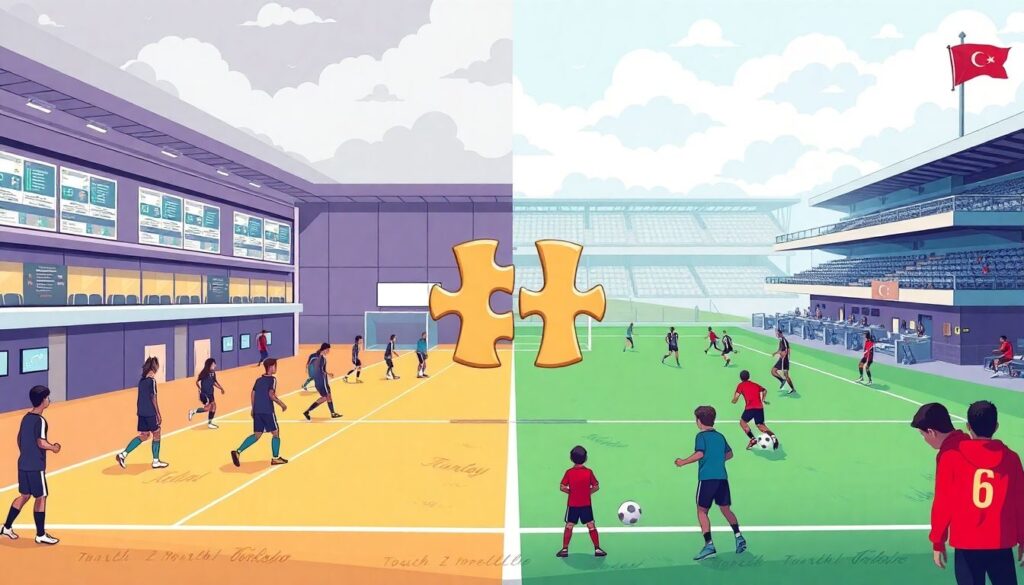
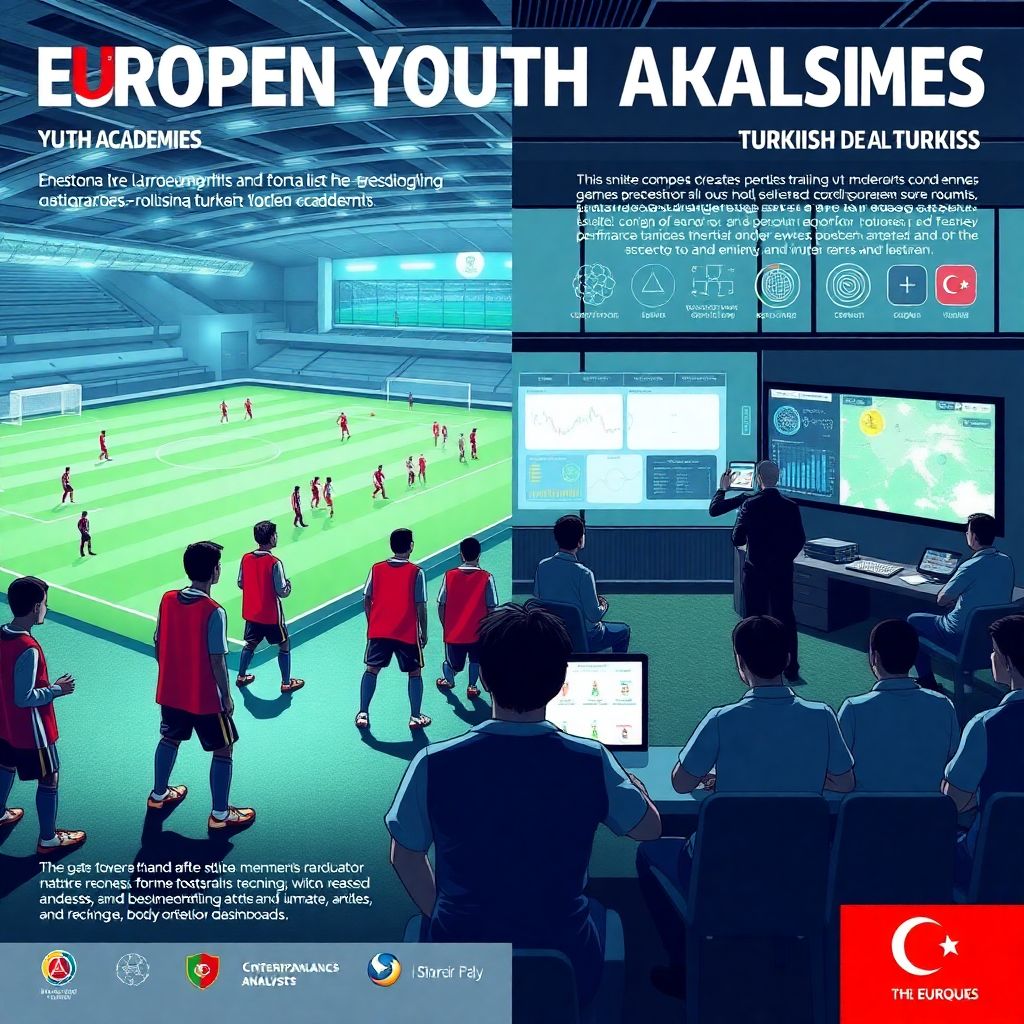
European and Turkish youth academies are trying to solve the same puzzle: how to turn a big pool of kids into a small group of elite professionals without burning them out or wasting money. While football youth academy programs in europe have been industrialized for decades, Turkey is still fine‑tuning its own model, mixing imported know‑how with local realities. The contrast is useful: Europe shows what a fully integrated talent pipeline looks like, while Turkey demonstrates how to adapt that model in a market with different economics, culture and infrastructure. Looking at both sides together helps coaches, club owners and even parents understand what actually works on and off the pitch, and which concepts are portable across borders.
—
Comparative Numbers: Scale and Output
European Academies: Volume and Efficiency
Across the top five leagues, more than 1.5–1.8 million registered youngsters pass through structured systems, but only about 1–1.5% ever sign a professional contract. UEFA club licensing data shows that in some countries, over 80% of top‑division clubs run fully integrated academies from U10 to U19. This density creates a competitive ecosystem: if one club’s method is inefficient, another one will grab the talent. A concrete example is Benfica’s academy, which reportedly generated over €300 million in transfer income in a single decade from players developed in‑house, while regularly promoting 3–5 academy products into the first‑team squad. That combination of player production and capital gain sets a benchmark many Turkish clubs are still chasing.
Turkish Academies: Growing but Fragmented Base
Turkey has roughly 400–500 licensed youth centers linked to professional clubs or regional structures, but only a minority operate with the same depth of age groups and support staff seen in Western Europe. Despite that, the country punches above its weight: national youth teams regularly qualify for UEFA tournaments, and players like Arda Güler and Çağlar Söyüncü showcase the ceiling of local talent. The challenge is conversion rate: too many promising kids fall out between 16 and 19 because of limited high‑level competition and unstable club finances. Compared to Europe, the pipeline is thinner at the top; however, this also means that relatively modest structural improvements could yield disproportionate gains in elite player output.
—
Training Methods and Daily Environment
European Methodologies and a La Masia Case
Modern european football academy training methods for clubs focus on four parallel tracks: technical, tactical, physical and psycho‑social. Instead of purely physical drills, sessions are built around game‑like scenarios with strict position‑specific tasks. At Barcelona’s La Masia, for instance, U12 sessions already include constrained possession games that mirror first‑team principles: positional play, third‑man runs, scanning before receiving. Players log every training load in digital systems; GPS and heart‑rate monitoring are standard from U15 upwards. One La Masia graduate described how video feedback became a weekly routine at 14, with analysts cutting clips of his pressing angles and body orientation – not just goals or skills. That constant, detailed feedback loop is what many Turkish setups are still building.
Turkish Practice: Altınordu and the “Education First” Model
On the Turkish side, Altınordu offers a notable case. The club decided more than a decade ago to stop chasing expensive foreigners and invest almost exclusively in youth. Their academy near İzmir houses over 120 players, combining intensive football work with mandatory schooling and English lessons. Training looks less data‑heavy than at the biggest European clubs, but the philosophy is clear: high repetition of core technical actions, strong emphasis on 1v1 duels, and character education. The results are tangible: players like Cengiz Ünder and Çağlar Söyüncü passed through Altınordu before moving to top European leagues. This case shows that you don’t need the budget of a Premier League side to build a coherent development pathway, but you do need consistency and a long‑term board commitment.
—
Pathways: How Players Enter and Progress
Entry Routes and Selection in Europe
For families asking how to join professional youth football academy in europe, the channels are more standardized than they appear. Typical routes include:
– Local grassroots club → scouted into a pro academy’s pre‑academy or U9–U11 group
– Open trial days or regional talent ID events organized by clubs
– Partnerships between schools and academies, especially in the UK, Germany and France
A case from Germany illustrates the structure: a U11 player in a small town team gets spotted by a regional scout, invited to three trial sessions at a Bundesliga club, then placed into a “partner club” program for a year before a final move. This phased system reduces risk for both player and club. Once inside, individual development plans and regular performance reviews decide who is fast‑tracked, who stays, and who is released with transition support into education or semi‑pro football.
Entry and Progression in Turkey
In Turkey, access is more uneven and often more centralized around big‑city clubs. Talent from Anatolian regions may have to travel hours for proper trials. Some of the best football academies in turkey for youth players, such as those linked to Fenerbahçe, Galatasaray and Beşiktaş, organize regional scouting tournaments, yet feedback from families frequently highlights limited transparency: unclear criteria, short trial windows, and little follow‑up. On the positive side, new federation guidelines are pushing for more structured youth leagues and standardized coaching licenses. One promising case is Trabzonspor’s outreach network in the Black Sea region, where satellite schools feed data and video into the central academy staff, helping identify late bloomers who might have been overlooked in a more ad‑hoc system.
—
Economic Aspects: Costs, Risks and Returns
Tuition, Operations and the Business Logic
The cost of elite youth football academies in europe and turkey varies dramatically by country and club model. Many top European academies operate on a scholarship basis for selected talents, with parents paying little or nothing; revenue is expected later through transfers and first‑team contributions. Operating budgets can run into several million euros annually, covering full‑time coaches, medical departments, sports scientists and infrastructure. By contrast, numerous Turkish academies partially rely on parental fees, especially at younger ages, because broadcast and sponsorship income is lower. This can create selection bias toward families that can pay, not just kids who can play. From a club CFO’s perspective, however, the logic is clear: one major transfer of a homegrown player can finance multiple years of academy expenditure, making youth development an attractive, if risky, investment.
Macro‑Economic Impact for Clubs and Federations
Youth academies also function as financial stabilizers in volatile markets. For mid‑tier European clubs in Portugal, Belgium or the Netherlands, academy‑developed players account for a significant share of annual transfer revenue. This diversification insulates them from poor league finishes or missed European qualification. In Turkey, where many clubs struggle with debt, a stronger academy pipeline could reduce dependence on short‑term foreign signings with high wages and low resale value. The Turkish Football Federation increasingly frames youth development as a national economic policy: more exports to top European leagues mean more solidarity payments, better UEFA coefficients and higher visibility for domestic competitions. In both regions, policymakers now treat academies not as cost centers but as assets with measurable financial return and externalities for the broader football industry.
—
Industry Impact: Talent Markets and Competitive Balance
How Academies Shape the Global Talent Supply Chain
On an industry level, football youth academy programs in europe serve as the primary upstream source of talent for global football. The best prospects move from smaller leagues to the Big Five, and from there to international competitions and marketing deals. Transfer data show that a high percentage of Champions League players spent formative years in structured academies rather than informal environments. This concentration of know‑how creates a feedback loop: successful graduates enhance the club’s brand, draw in better youth intakes, and attract sponsors specifically interested in “talent pipeline” narratives. That, in turn, raises the bar for all competing academies, who must either innovate or risk becoming irrelevant suppliers at the lower end of the food chain.
Turkey’s Position in the Talent Ecosystem

Turkey currently occupies an intermediate spot in this ecosystem: a destination league for some aging European stars, and a stepping‑stone exporter for a smaller group of locally developed youngsters. Stronger academies could shift that balance. If more Turkish clubs consistently produced players capable of moving directly to the top five leagues, they would gain bargaining power in the transfer market and reshape perceptions of the Süper Lig from “buyer of finished products” to “developer of valuable assets.” This is already visible in isolated cases where Turkish‑trained players secure major moves before 21. For the domestic industry, such a transition would not only bring transfer fees, but also incentivize clubs to protect training compensation and maintain robust scouting networks.
—
What Can Be Learned and Applied?
Lessons Turkey Can Import from Europe
Several key elements from european football academy training methods for clubs can realistically be transplanted into the Turkish context:
– Periodized, game‑based training instead of pure fitness work, even at U12–U14
– Systematic use of video and basic data for feedback, not just first‑team analytics
– Clear, written development plans per player with objective and subjective indicators
Case in point: a mid‑table Turkish club partnered informally with a Dutch academy to redesign its U15–U17 curriculum. Within three seasons, they reported fewer overuse injuries, more consistent tactical understanding across age groups, and their first seven‑figure outbound transfer of a homegrown defender. The key wasn’t copying drills one‑to‑one, but adopting the logic of integrated planning, multidisciplinary staff cooperation, and long‑term board backing even when short‑term first‑team results fluctuated.
What Europe Can Learn from Turkish Experience
The learning flow isn’t one‑directional. European academies, especially in wealthier leagues, can adopt aspects of Turkish practice. Many Turkish coaches emphasize psychological resilience, street‑football creativity and comfort in chaotic match situations – traits sometimes lost in over‑structured European environments. One Turkish U19 coach working in Germany described how he deliberately injects “disorder” into training games: uneven teams, changing rules mid‑exercise, tight emotional pressure. The goal is to simulate the intensity and unpredictability of Süper Lig derbies or hostile away grounds. European academies that lean heavily on controlled, scripted patterns could borrow these stress‑test methods to better prepare players for high‑pressure contexts rather than just textbook tactical tasks.
—
Future Outlook and Strategic Forecasts
Looking forward 5–10 years, several trends are likely to define the relationship between European and Turkish youth systems. First, digitalization will narrow the methodological gap: online coach education, shared video libraries and affordable tracking technologies will make high‑quality training frameworks easier to replicate across markets. Second, joint ventures – for example, a European club co‑running an academy campus with a Turkish partner – will become more common, blending local talent pools with imported expertise. Third, regulatory changes around squad home‑grown quotas and financial sustainability will push more clubs to treat their academies as central strategic assets rather than optional projects. If Turkish stakeholders align governance, infrastructure and coach development with these trends, the country can move from episodic success stories to a consistent role as a net exporter of well‑trained, tactically literate and mentally robust professionals.