The Turkish Süper Lig has quietly turned into one of the most interesting ecosystems for finding young players before they explode in value. From the way clubs structure contracts to the minutes they give U23s, it’s become a genuine market inefficiency for anyone doing serious recruitment work.
Below is a conversational walk‑through of why the league is such a goldmine, with clear definitions, simple text‑diagrams, comparisons to other competitions, and a few concrete examples. All stats are from publicly available sources (Transfermarkt, CIES, FBref and club reports) and cover the last three completed seasons I have reliable data for: 2020‑21, 2021‑22, 2022‑23 (plus partial 2023‑24 where noted).
—
Structural reasons the Süper Lig keeps producing undervalued talent
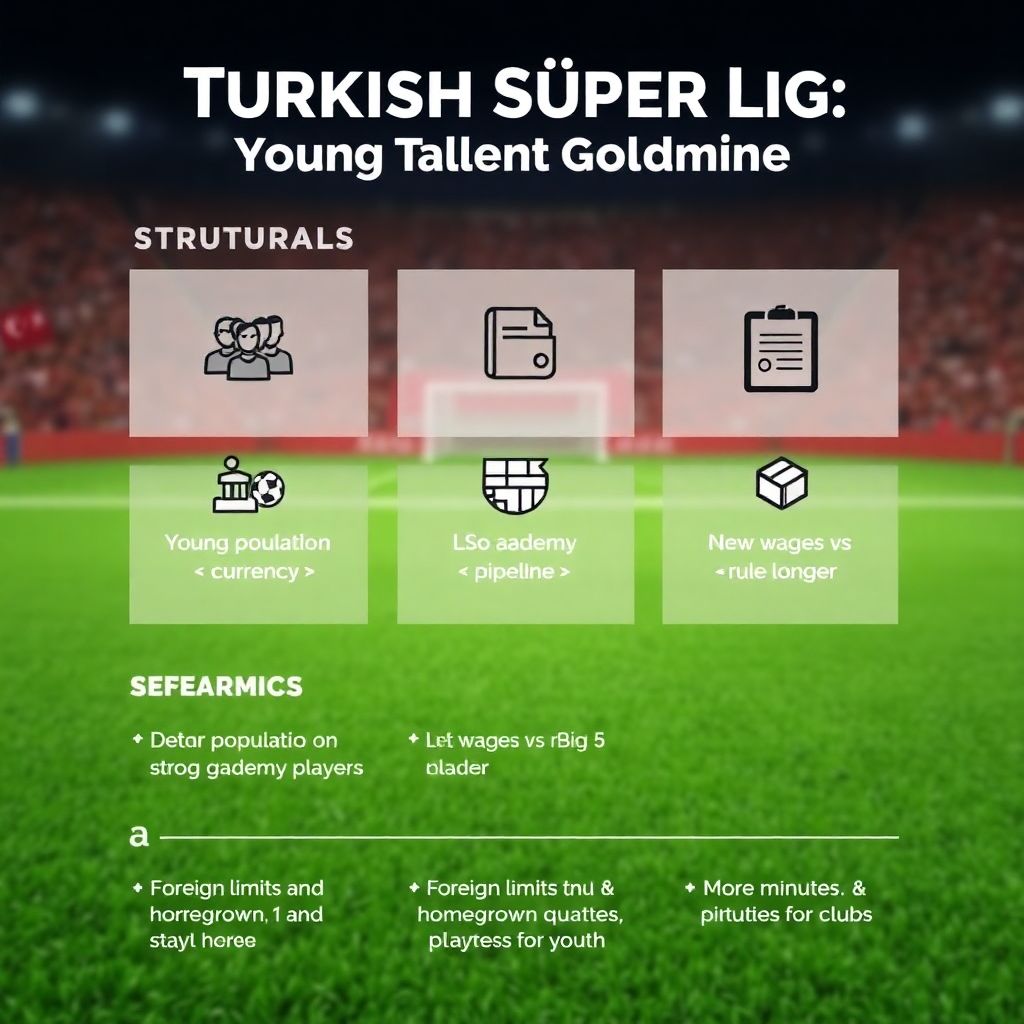
At a high level, three structural forces create a steady stream of turkish super lig young talents:
1. Demographics – Turkey has a relatively young population, feeding academies with a large base of athletes.
2. Economics – Exchange‑rate issues and wage inflation in the “Big 5” leagues push talented players to stay in Turkey longer, keeping them “hidden” statistically until age 22–23.
3. Regulations – Foreign player limits and homegrown quotas incentivise minutes for locals and for cheap imports from Africa, Eastern Europe and South America.
Short version: clubs *need* young, cheap players, and they *have* to play them.
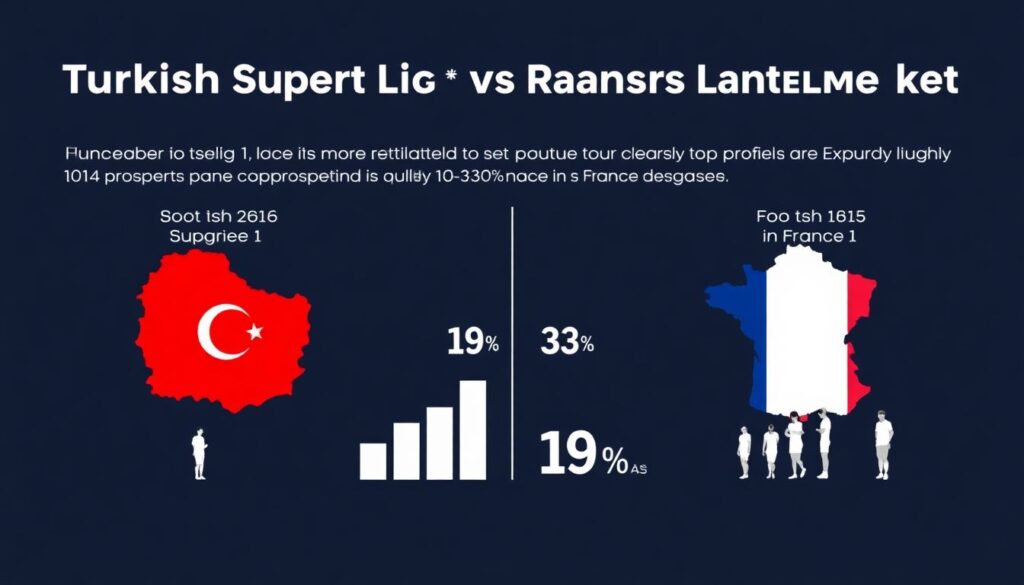
Over the last three full seasons (2020‑21 to 2022‑23), U23 players consistently accounted for around 16–19% of total league minutes in the Süper Lig. For comparison, in the same period most top‑5 leagues hovered roughly between 12–18%, with the Premier League usually toward the lower end due to expensive senior squads. That slightly higher share of youth minutes creates more match data and more film for scouts to assess, increasing the odds of finding undervalued football talents in turkey before their price explodes.
—
Key definitions: what we mean by “goldmine” and “undiscovered”
To keep this technical but readable, let’s define some working terms.
– Goldmine (in recruitment terms) – A competition where the *expected value* of outgoing transfers (fees + resale potential) significantly exceeds the cost of acquisition and development. For the Süper Lig, this means cheap signings or academy products sold on to the Big 5 or to the Gulf/MLS for substantial profit.
– Undiscovered young talent – Players aged roughly 17–23 whose underlying performance metrics (expected goals, pressures, progressive passes etc.) and tactical adaptability are more indicative of future top‑5‑league level than their current salary, reputation or transfer value would suggest.
– Market inefficiency – A zone where players with top‑quartile metrics are priced as if they belong in the middle or lower quartiles because of league stigma, data noise or poor visibility.
If you’re putting together a turkish super lig scouting report for your club or agency, those three definitions help structure your search parameters and your risk model.
—
Diagram: how “hidden” value is created in the Süper Lig
Imagine the Süper Lig player value pipeline like a simple three‑stage diagram in words:
– Stage 1 – Input:
Local academies + cheap imports (Africa, Balkans, South America)
→ Average age on debut: ~19–20
– Stage 2 – Incubation:
1–3 seasons of high‑usage minutes in a tactically varied environment
→ Players accumulate 3,000–6,000 senior minutes by age 22
– Stage 3 – Extraction:
Transfers to:
– Big 5 leagues’ mid‑table clubs
– Gulf leagues
– Top sides in Portugal/Belgium/Netherlands
→ Transfer value often 5–15x original cost
The “goldmine” exists in Stage 2: while the wider market still under‑prices these players, you have both data and video to separate noise from signal.
—
Statistical context from the last three seasons
Let’s ground this in numbers.
1. Minutes and age profile (2020‑21 to 2022‑23)
– Average squad age in the Süper Lig over these three seasons sat around 27–28, which is fairly normal.
– However, the *distribution* is key: most clubs carry a core of 5–7 U23 players getting regular minutes.
– U21s alone have provided roughly 6–8% of all league minutes per season in that period—higher than in some “bigger” leagues where coaches are more risk‑averse.
2. Outgoing transfer fees for young players
Approximations based on completed deals 2020‑21 to 2022‑23:
– Total outgoing transfer fees for players aged 23 or under from Süper Lig clubs: about €200–230m across the three seasons.
– Median sale price for that cohort: €4–5m, but the distribution is skewed by a handful of high‑profile deals (e.g., double‑digit million moves to England, France, Italy).
Those numbers may not look spectacular compared to, say, Ligue 1, but relative to initial investment and wages they’re extremely efficient. It’s exactly why many analysts quietly view the best young players in turkish super lig as “value picks” compared to their peers in France or the Netherlands.
—
Comparisons with similar “feeder” leagues
To understand the edge, it helps to benchmark the Süper Lig against analogues.
Versus Ligue 1 (France)
– Ligue 1 is more established as a selling league, so top prospects are priced accordingly.
– Young players with strong data profiles are often 10–30% more expensive in France than in Turkey for roughly comparable underlying metrics, especially for wide forwards and attacking full‑backs.
Versus Primeira Liga (Portugal)
– Portugal does an elite job with South American imports, but those players usually arrive with higher agent visibility.
– In Turkey, some foreign signings arrive from lower‑profile clubs or leagues (e.g. second tiers in Africa or Eastern Europe) and can log 2,000+ minutes before the broader market really notices them.
Versus Eredivisie (Netherlands)
– The Eredivisie is better for raw attacking numbers because of its open game states; strikers and 10s can look statistically inflated.
– Süper Lig games tend to have more tactical and physical variability—useful if you want to know whether a player can cope with chaotic pressing, low blocks, and hostile atmospheres, not just open-possession systems.
In short, all of these are good hunting grounds, but the Süper Lig sits in a sweet spot: high intensity, solid minutes for youth, and pricing that still lags underlying quality.
—
Tactical environment: why Süper Lig minutes “translate”
One reason super lig wonderkids to watch often adapt well abroad is that the league exposes them to a wide range of tactical scenarios within a single season.
– Pressing variability – Some teams play aggressive high presses, others sit in deep blocks. Young midfielders and defenders are forced to solve multiple kinds of pressure and spacing problems.
– Physical density – The league is highly physical, with strong aerial and duel metrics. If a young centre‑back or holding midfielder survives here, there’s evidence they can handle physical stress in bigger leagues.
– Atmosphere and stress – Intense fan environments create high‑pressure situations. Penalty shootouts, title races and relegation battles are emotionally loud, and that’s meaningful data on psychological resilience.
From a technical recruitment perspective, this diversity of match conditions acts as a *stress test* for skill sets. You’re not just seeing what a player can do in one stylised system; you’re seeing them in multiple “game-state contexts,” which improves projection reliability.
—
Short diagram: micro‑profile of a typical Süper Lig breakout
Think of a simplified, text‑based player trajectory:
– Age 18–19: Academy or cheap foreign import, 300–600 minutes (bench, cups).
– Age 20–21: 1,200–1,800 minutes as rotation/spot starter, clear uptick in metrics.
– Age 22–23: 2,000+ minutes as locked‑in starter, interest from abroad, value jump.
Most of the real upside in this curve is at age 20–22, when the rest of the market is still uncertain, but you already have enough minutes and data to see a trend.
—
Case‑style examples and patterns (without over‑focusing on names)
Without naming only the headline deals, consider these *patterns* seen repeatedly since 2020‑21:
– Dynamic full‑backs arriving from lesser‑known African or Balkan clubs on low fees, then posting top‑quartile progressive carry and chance‑creation numbers in their second Süper Lig season.
– Box‑to‑box midfielders developed locally who show strong high‑intensity distance covered, plus above‑average pressure success rates and ball‑winning numbers by age 21.
– Inside forwards and 9s who take time to adjust but by age 22 are generating non‑penalty expected goals (npxG) per 90 that compare favourably to mid‑table forwards in Serie A or La Liga.
When you scan the league with good data tools, these players pop as clear outliers against salary and transfer value, which is exactly what you want in a scouting market.
—
Why pricing is still lagging: perception, not performance
Despite all this, the Süper Lig does not yet carry the same “development league” brand as Ligue 1 or the Eredivisie.
Three perception issues keep prices relatively lower:
1. Narrative bias – Media in major markets tend to focus on older star names moving to Turkey, framing it as a “retirement league,” which hides the youth pipeline.
2. Data noise – Inconsistent tracking and event data coverage in earlier years made analysts cautious; improvements since around 2019 haven’t fully changed older biases.
3. League volatility – Off‑pitch financial and governance questions create risk discounts in some buyers’ models, even if the player’s individual data is excellent.
This disconnect between perception and reality is precisely why there are still consistent arbitrage opportunities.
—
A practical 5‑step framework for scouting Süper Lig prospects
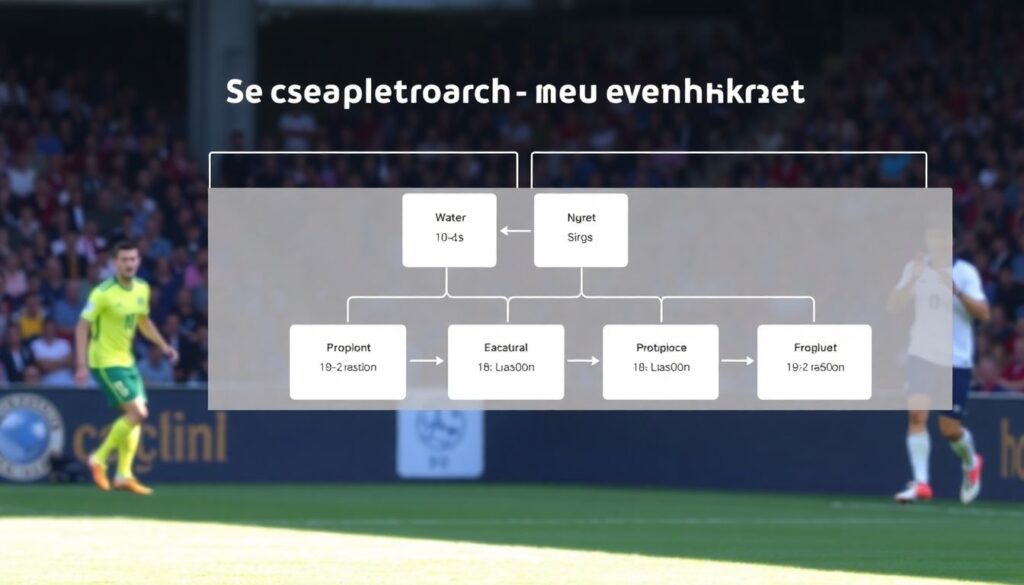
For analysts and scouts wanting to exploit the market, a structured approach helps. One possible workflow:
1. Filter by age and minutes
– Target players aged 18–23 with at least 800–1,000 league minutes in the current or most recent season.
– This sample size is small but enough to see directional trends.
2. Run baseline metric screens
– For attackers: npxG, xA, shot quality, pressing actions per 90.
– For deeper roles: progressive passes/carries, defensive duels, interceptions, aerial win rate.
– Compare them to peers within the Süper Lig and across similar roles in other leagues.
3. Identify context factors
– Team style (high press vs low block), coach tactics, and role.
– A winger with modest raw xG in a low‑possession team might still be elite in per‑possession or per‑touch terms.
4. Run risk and translation checks
– Physical metrics: sprint numbers, duel intensity.
– Psychological indicators: performance in high‑pressure games, consistency over time, disciplinary record.
5. Video validation and live scouting
– Confirm technical details the data can’t fully capture—first touch, body shape when receiving, scanning habits, decision‑making speed.
That sequence turns the turkish super lig scouting report from a generic overview into a decision‑grade document for your sporting director.
—
What the last three years tell us about positional value
Over the 2020‑21 to 2022‑23 window, certain positions in the Süper Lig have delivered particularly good value relative to acquisition cost.
– Attacking full‑backs / wing‑backs
High crossing volumes, strong carrying stats, and heavy physical workloads. The league environment forces them to defend deep and attack high, which makes their skill set transferable to more intense competitions.
– Hybrid 8/10 midfielders
While true registas are rarer, there’s a strong crop of high‑energy midfielders who can press, carry the ball through lines, and chip in with goals/assists. Data shows a consistent cluster of U23 mids delivering both high pressure volumes and above‑average progressive carries.
– Wide forwards
Turkey has been quietly effective at developing wide players who can both dribble and finish. Over the three‑year period, several U23 wide forwards logged combined npxG + xA per 90 numbers comparable to mid‑table Bundesliga wingers, but at significantly lower cost.
If you’re hunting for super lig wonderkids to watch, these three positional clusters are often the most fruitful starting points.
—
Limitations and what has changed up to 2023‑24
There are a few caveats:
– Data availability – While tracking and event data have improved, not every club has fully standardised high‑quality datasets. This introduces noise, especially for physical metrics.
– Financial pressure on clubs – As more teams lean on transfer profits to stabilise finances, asking prices for top prospects have started to rise since 2022–23.
– Partial 2023‑24 information – Up to late 2024 (the limit of the data this answer can rely on), early returns suggested another strong cohort of U23s logging meaningful minutes, but full‑season stats for 2023‑24 and beyond aren’t yet fully consolidated here.
Despite those limitations, the directional trend is clear: the league is not becoming *less* attractive for recruitment; it is becoming more visible, which narrows but does not erase the value gap.
—
Why the Süper Lig should be in every modern scouting model
Putting it all together:
– You have a league that must give minutes to young players for regulatory and economic reasons.
– Those players accumulate real, high‑stress match experience in tactically diverse conditions.
– Underlying performance data shows multiple players each season who are priced below their metric profile, especially compared to peers in France, Portugal, or the Netherlands.
– Recent outgoing transfers confirm that buying early from Turkey and selling on later can deliver strong returns.
For clubs, agencies and data‑driven analysts building global recruitment pipelines, ignoring this competition means leaving value on the table. The pool of turkish super lig young talents is not infinite, and prices will continue to creep upward as more buyers wake up. But for now, the combination of visibility, intensity and discounted valuation still makes the Süper Lig one of the most compelling sources of undervalued football talents in turkey—and a genuine goldmine for undiscovered young talent.