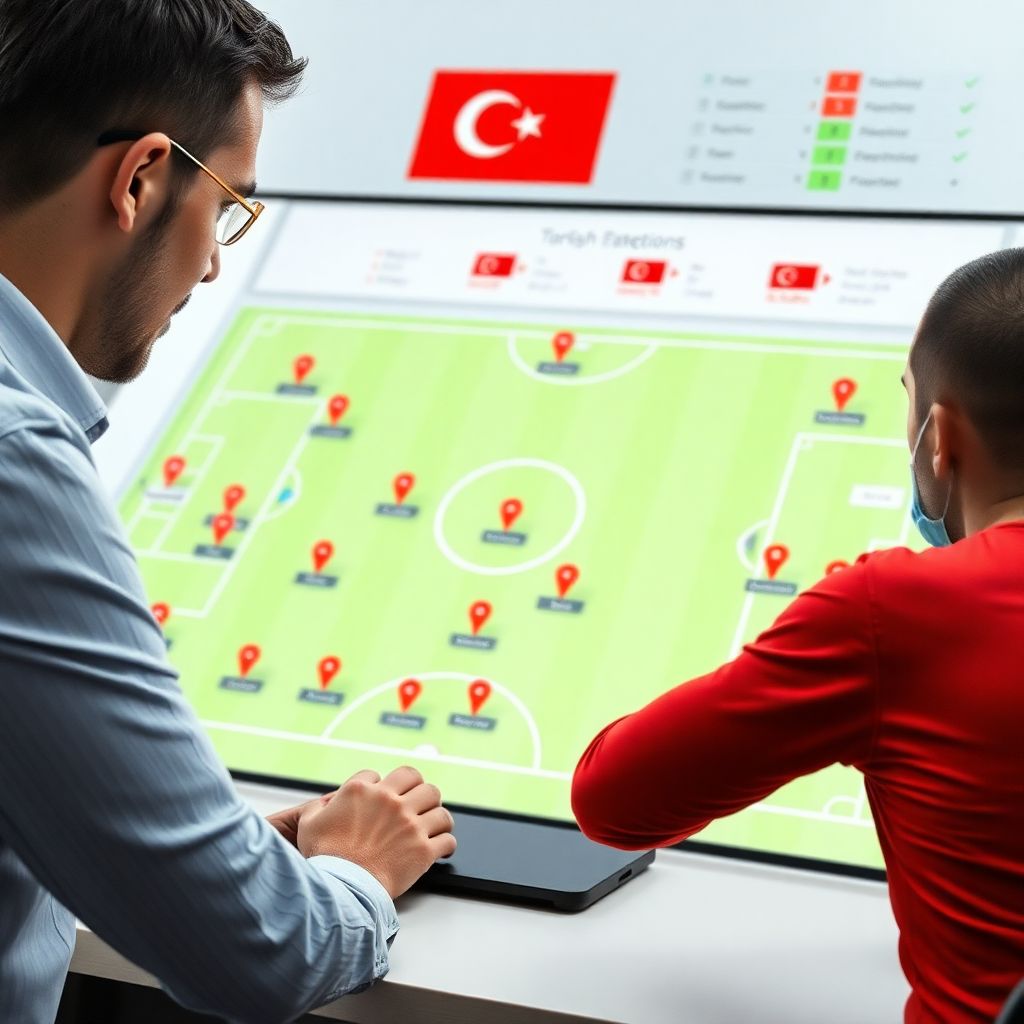
The tactical evolution of the Turkish national team across the last three major tournaments can be understood as a gradual shift from reactive, medium-block stability towards more proactive pressing, flexible midfield structures and more varied attacking patterns. Safe, incremental tweaks in block height, roles and rest-defence reduced risk, but structural and personnel limits still capped consistency.
Concise tactical snapshot
- Across the last three tournaments, Turkey moved from conservative, medium-block defending toward more frequent high pressing in selected phases and match states.
- Midfield structures evolved from rigid double pivots to more fluid, hybrid interiors, increasing passing options but also exposure in transition.
- Wing usage shifted from pure crossing zones to more half-space overloads and underlapping runs, especially visible in Turkey national team tactics analysis Euro 2024 coverage.
- Personnel changes enabled more technical buildup but reduced aerial dominance and long-ball security, demanding safer rest-defence planning.
- Managerial in-game tweaks became more opponent-specific, yet late-game game-management and control phases remained a recurring limitation.
Foundational game model at the first tournament
At the first of the three tournaments, the foundational game model of the Turkish national team leaned on a compact medium block, cautious buildup and clear role separation between lines. The priority was defensive solidity and avoiding chaotic transitions, even at the cost of sustained possession or high pressing intensity.
A typical pattern involved a back four staying relatively narrow, protected by a double pivot screening central spaces. Full-backs advanced selectively, rarely both at once, to ensure numerical security behind the ball. This created a stable platform but limited opportunities for overloads and dynamic third-man combinations in the final third.
In possession, the team relied heavily on vertical passes into target forwards and wide channels rather than systematic progression through midfield. This was a safe approach for a squad still developing its collective automatisms, but it made Turkey predictable against well-organised opponents. The baseline idea: protect the box first, then attack.
- Clarify the primary defensive block (usually medium) and avoid frequent, uncontrolled jumps into high pressing early in cycles.
- Use a conservative full-back advance pattern (one goes, one stays) until central protection principles are fully internalised.
- Accept lower possession as a trade-off for compactness while collective technical level and automatisms are still maturing.
Evolution of defensive compactness and transitional duties
Across the next two tournaments, the most visible change was how compactness was managed horizontally and vertically, and how transitional duties were assigned. This is where Turkish national football team tactical evolution last tournaments becomes clear when you compare footage and basic positional maps.
- Block height variation
Initially, the team defended almost exclusively in a medium block. Later tournaments introduced situational high pressing after backward passes or sideline traps, and deeper blocks when protecting a lead. This safe, context-based variation added tools without discarding the original compactness-first identity. - Rest-defence structure
Early versions often left just two players behind the ball in possession, vulnerable to counter-attacks. Over time, an extra midfielder or full-back remained connected to the centre-backs, creating a more robust 2+1 or 3+2 rest-defence. This reduced transition risk while allowing an extra player to join buildup. - Wide lane responsibilities
At first, wingers tracked full-backs all the way to the defensive line, creating a flat back five in long phases. Later tournaments preferred defending the half-spaces, using the near-side midfielder to cover full-back overlaps. This kept the block more compact, though it demanded higher tactical discipline. - Counter-pressing triggers
Originally, Turkey dropped off after losing the ball, prioritising shape recovery. With time, controlled counter-pressing was used in central and half-space zones, especially when numbers around the ball were favourable. The safe rule: press immediately only when outnumbering or equal, otherwise drop into the block. - Goalkeeper involvement
The goalkeeper gradually became more proactive in sweeping behind a higher line and in starting counters with quick throws. This added vertical threat but introduced reliance on the keeper’s decision-making; a clear communication framework with centre-backs was crucial to avoid large gaps.
- Define clear rules for shifting between high, medium and low blocks based on scoreline and opponent build-up patterns.
- Maintain at least a 2+1 or 3+1 structure behind the ball whenever full-backs and midfielders advance.
- Use counter-pressing only when local numerical parity or superiority is clear; otherwise, prioritise fast recovery into the block.
Shifts in midfield structure and pressing philosophy
The midfield is where the team’s identity changed most. The first tournament’s double pivot, often flat and conservative, evolved into more dynamic shapes: a single pivot with two advanced interiors, or an asymmetrical 2-3 structure in buildup. Each shift altered how, where and when the team pressed.
Scenario 1: Conservative 4-2-3-1, medium block
Two holding midfielders screened the defence, with the “10” pressing the opposition pivot. Pressing triggers were limited to backward passes and heavy touches. This was structurally safe but allowed opponents time to circulate the ball and pick passes around the block.
Scenario 2: 4-3-3 with one pivot, higher press
Later, Turkey sometimes used a lone pivot, with the two interiors jumping aggressively to opposition full-backs and central midfielders. This supported more proactive pressing but exposed the pivot if the first line was bypassed. The safe compromise was staggering one interior slightly deeper to form situational double pivots.
Scenario 3: Asymmetrical 3-2 buildup
By the latest tournament, particularly visible in best tactical analysis of Turkey national team online breakdowns, full-back inversion or a dropping midfielder created a 3-2 platform. This allowed central overloads in buildup and better press-resistance, though it demanded very clear role communication to avoid leaving wings unprotected on turnovers.
Scenario 4: Targeted high pressing against specific opponents
Pressing philosophy shifted from “avoid risk” to “press when opponent structure allows”. Against teams with risky short buildup, Turkey used high pressing with curved runs from wingers to block centre-back-full-back lanes. Against direct teams, the press line dropped to preserve compactness, saving energy and protecting the space behind.
- Ensure at least one midfielder remains connected to the pivot when the other jumps into pressing or attacks the box.
- Define clear pressing triggers (backward pass, heavy touch, sideline trap) rather than pressing spontaneously.
- Match pressing height to opponent buildup style; do not insist on high pressing against long-ball, second-ball teams.
Attacking patterns, wing usage and set-piece schemes
Attacking ideas progressed from cross-heavy, flank-oriented play to more layered patterns involving half-space combinations, cut-backs and structured set-pieces. For fans following Turkey national team tactics analysis Euro 2024, this evolution is visible in the balance between classic wing play and central overloads.
Using wide players more intelligently helped unlock low blocks, but it also required safer rest-defence and clearer positional discipline to avoid being exposed on counters, particularly when both full-backs advanced simultaneously.
Advantages of the newer attacking patterns
- Half-space overloads allowed Turkey to create 3v2 situations using full-back, winger and interior, opening diagonal passes and cut-backs instead of predictable long crosses.
- Underlapping runs from full-backs or interiors created confusion in opposition marking schemes, especially when wingers stayed wide to pin defenders.
- Short, rehearsed set-piece routines (blocks, decoy runs, second-ball focus) increased the threat from corners and wide free-kicks without relying purely on height or aerial dominance.
- Combination play with the centre-forward (lay-offs, third-man runs) improved link-up phases and helped sustain attacks in the final third.
Limitations and structural risks in attack
- Overcommitting both full-backs in the same attack often left only two defenders and one midfielder behind the ball, a dangerous pattern against fast counter-attacking sides.
- When the ball-side interior and winger both checked to feet, depth was lost, making it easy for opponents to hold a high line and compress play.
- Reliance on rehearsed wide overloads occasionally made attacks predictable; opponents could pre-empt shifts into the half-space and overload the far side.
- Set-piece focus on complex routines sometimes reduced basic delivery quality; over-engineering corners is a common, avoidable limitation.
- Balance wing and half-space usage so at least one player in every attack threatens depth behind the defensive line.
- Link advanced full-back positioning to clear rest-defence rules; never advance both full-backs without extra cover behind.
- Keep set-piece menus simple enough that execution quality stays high under tournament pressure.
Personnel-driven role changes and position hybridization
As personnel changed between tournaments, roles were adapted to suit the technical and physical strengths of new core players. Hybrid roles became more common: full-backs stepping into midfield, wingers acting as inside forwards, and midfielders moving into wide pockets in possession while recovering centrally out of possession.
The professional football analytics service Turkey national team community often highlights how these hybrid roles boosted flexibility but also introduced complexity. Without clear, rehearsed reference points, players could be caught between tasks, generating gaps in the block or disconnects in pressing chains.
Common mistakes and myths around hybrid roles
- Myth: More hybrid roles always mean more tactical sophistication.
In reality, too many hybrids without simple base rules create confusion. For national teams with limited training time, clarity usually beats complexity. - Mistake: Forcing players into club-style roles without context.
Replicating a player’s club role can be unsafe if national-team partners and automatisms differ. Roles must be adapted to the collective, not copy-pasted. - Myth: Inverting full-backs automatically improves buildup.
Inversion helps only if centre-backs are comfortable on the ball and if wingers understand their lane responsibilities. Otherwise, central congestion reduces passing clarity. - Mistake: Ignoring off-ball workload balance.
Piling creative tasks on one or two players, while also expecting them to lead pressing and transitions, is a frequent cause of late-game drop-offs. - Myth: Hybrid forwards solve all chance-creation problems.
Dropping forwards into midfield can help link play but may empty the box if wide players do not attack depth on time.
- Limit the number of hybrid roles on the pitch at once; focus on two or three clearly defined flexible players.
- Align national-team roles with players’ club habits but adjust for different partners and tactical environment.
- Check that every attacking movement has a corresponding rest-defence safeguard and realistic off-ball workload.
Managerial adjustments: in-game tweaks and tournament planning
Managerial evolution over the three tournaments is visible in substitution patterns, formation tweaks and game-plan specificity. Early on, changes were often like-for-like and reactive after conceding. Later, adjustments became more proactive: altering pressing heights, switching overload sides, and changing midfield shapes to protect leads or chase goals.
For analysts following a Turkey national team statistics and tactical data subscription, these changes show up in time-stamped heat maps and pass networks. Below is a simplified pseudo-“plan” demonstrating safer in-game tweaking logic used more frequently in the latest tournament:
Example in-game adjustment logic (pseudo-code style)
IF leading after 60' AND opponent adds a second striker:
    - Drop block from high/medium to clearly medium.
    - Switch midfield from 4-3-3 to 4-2-3-1 (add second pivot).
    - Instruct wingers to track full-backs halfway, not to back line.
    - Keep one full-back deep to maintain 3+2 rest-defence.

IF trailing after 60' AND opponent defends low:
    - Push one full-back higher, invert the other into midfield.
    - Move from double pivot to single pivot, add an interior runner.
    - Instruct far-side winger to attack back post on crosses.
    - Use short, quick corners to disrupt set defensive shape.
Across the three tournaments, the safe evolution was from rigid pre-planned approaches to scenario-based adjustments with clear triggers. Risks emerged mostly when emotional decisions (chasing equalizers too early, overloading flanks) overrode this framework.
- Define pre-tournament adjustment rules for different scorelines and opponent changes to avoid emotional, ad-hoc decisions.
- Ensure every attacking substitution is paired with a compensating structural adjustment in rest-defence.
- Review match data post-game to connect subjective impressions with objective patterns before the next tactical plan.
End-of-section self-assessment checklist for analysts and coaches
- Can you clearly describe the progression in block height, rest-defence and pressing triggers across the three tournaments?
- Have you identified how midfield shape changes impacted both chance creation and transition protection?
- Can you map the main attacking patterns (wing focus, half-space overloads, set-plays) and their inherent risks?
- Do you understand which hybrid roles were stabilising versus over-complicating for this specific player group?
- Are your future recommendations grounded in realistic training time and tournament constraints for a national team?
Common tactical clarifications and misconceptions
Does a higher pressing game automatically mean Turkey became more attacking?
No. Higher pressing mainly changes where the team tries to regain the ball. Actual attacking intent depends on how many players are committed beyond the ball after regain and how safely rest-defence is structured.
Why does Turkey sometimes look more solid in qualifiers than in tournaments?
Qualifiers allow more varied opponents and time to adjust between games. Tournament schedules compress preparation and recovery, so small structural weaknesses or role misunderstandings are punished more consistently by higher-level opposition.
Is shifting from 4-2-3-1 to 4-3-3 a major tactical overhaul?
Not necessarily. The real change lies in responsibilities: who presses which lane, who protects which zone, and who supports the striker. Formations are reference frames; behaviour within them defines the tactical identity.
Can data services fully explain the tactical evolution of the team?
Statistics from any professional football analytics service Turkey national team package give valuable context on zones, passes and pressures, but they must be combined with video to understand spacing, communication and decision-making behind raw numbers.
How many hybrid roles can a national team safely use?
There is no fixed number, but with limited training time it is safer to keep hybrids to a small, clearly defined group. Clarity of tasks usually beats maximal flexibility at international level.
Are wide overloads always the best option against low blocks?
No. Overloading the wings without central support and depth can lead to sterile crossing. Effective low-block breaking combines width, half-space presence and at least one runner attacking behind the line.
Is the recent evolution complete, or should we expect further change?
Tactical evolution is continuous. As new players emerge and opponents adapt, Turkey will likely keep refining pressing triggers, midfield structures and attacking patterns, always balancing ambition with the structural safety needed in tournaments.