
Set-piece mastery in the Süper Lig: why it matters more than ever
Set pieces decide titles in Turkey. In a league where many matches are played on tight, intense margins and where mid‑block defending is common, one corner or one direct free kick can be the whole difference between 3 points and a crisis week in the media.
Analysts looking at Süper Lig set piece statistics corners and free kicks consistently see the same pattern: teams that are top‑4 in set‑piece xG over a season almost always end up in the European spots, even if their open‑play metrics are less dominant. That’s why clubs have started treating corners and free kicks as a standalone phase of play, with their own micro‑tactics, data pipelines and specialized coaching.
—
Comparing different approaches: chaos vs structure
Direct “deliver and fight” model

Many Süper Lig teams outside the traditional big four still lean on a classic approach: whip the ball into the danger area and send the big guys in.
This model relies on:
– Outswinging corners from the strong side
– Targeting the near‑post flick or the penalty spot
– Overloading with center‑backs plus a strong No. 9
It’s simple, quick to coach and fits squads that change a lot every window. But it generates a lot of *low‑quality* headed chances rather than a few *high‑quality* tap‑ins.
Case from practice – mid‑table survival mode
A mid‑table club like Çaykur Rizespor in recent years often adopted this approach: two tall center‑backs, a target man, and a fast winger hanging on the edge for second balls. Video analysis showed that while they were near the top for shots per corner, their set‑piece xG per corner was middling. Volume over precision kept them up, but did not push them into European contention.
—
Structured, playbook‑driven routines
Top clubs – Galatasaray, Fenerbahçe, Trabzonspor – have increasingly moved to highly scripted routines.
Key traits:
– Strict zoning in the box (front zone, central lane, far‑post, rebound zone)
– Pre‑planned movements: blockers, screeners, decoy runs
– Short‑corner patterns that force defensive line shifts
– Clearly defined first and second contacts
Here, analysts plug Süper Lig analytics set piece xG data directly into the coaching process: routines that don’t generate consistent high xG are dropped quickly, no matter how “nice” they look.
Case from practice – Galatasaray’s short corner evolution
In the 2022–24 period, Galatasaray increasingly used Kerem Aktürkoğlu and Dries Mertens/Ziyech in 2v1 short‑corner scenarios. Initial data showed fewer shots from corners, but higher xG per shot. Defenders were dragged out to the touchline, creating space for late arriving midfielders like Torreira at the edge. Internally, staff accepted a smaller number of set‑piece attempts because the quality jump was so clear.
—
Hybrid strategy: opponent‑specific routines
The third model is hybrid: clubs maintain 3–4 “base” routines and 3–5 “opponent‑specific” ones every week.
Coaches analyze:
– Marking scheme: zonal, mixed, or pure man‑marking
– Keeper starting position and aggressiveness
– Dominant aerial defenders and weak links
Then they tailor triggers: blockers positioned on the weakest aerial defender, or a screen on a passive goalkeeper.
Case from practice – Trabzonspor targeting near‑post gaps
Against certain rivals using a loose zonal system, Trabzonspor’s staff designed a specific corner: Edin Višća starts wide, then cuts inside as a late runner while two teammates initiate a near‑post clash. The ball is drilled to the corridor between six‑yard box and penalty spot, forcing the weakest defender to make first contact. On video, this looked like chaos; on data, these patterns delivered one of the highest xG per corner figures in the league for a short time span.
—
Technology in set‑piece work: pros and cons
Tracking, video and data platforms
Clubs now integrate:
– Optical or GPS tracking to quantify runs and separation
– Multi‑angle video breakdown of every corner and free kick
– xG models specifically tuned for dead‑ball situations
– Opposition scouting databases for set‑piece tendencies
This ecosystem powers a more objective reading of Turkish Süper Lig free kick goals stats 2024 and beyond: analysts don’t just count goals; they assess expected goals per routine, delivery height, speed, and defensive disruption.
Pros
– Objective comparison between routines (not bias toward “memorable” goals)
– Quick iteration: ineffective patterns are removed after 4–5 match samples
– Personalized roles: matching best headers with ideal zones and runs
– Better Süper Lig betting tips corners and free kicks for clubs’ internal risk modeling (e.g., planning how many set‑piece goals they need across a season to hit points targets)
Cons
– Implementation costs: hardware, software, analyst salaries
– Data noise: small sample sizes for specific routines can mislead
– Overfitting: routines may work against one defensive scheme but fail against another
– Risk of “paralysis by analysis” for players if staff overload them with details
—
On‑field tablets and VR rehearsal
Some clubs experiment with:
– Tablets on the bench to show fresh corner patterns in‑game
– VR or AR environments to let players rehearse triggers and timing
This is still new in Turkey and not uniformly adopted.
Upside
Very fast feedback loops. A center‑back can watch his mistimed run on a corner during half‑time and adjust immediately. Or a young full‑back can “experience” his marking assignments in VR sessions without the physical load of extra training.
Downside
– Tech anxiety: older players often prefer magnetic boards and simple instructions
– Risk of overcomplication mid‑match when players are already under stress
– Dependence on staff who can translate raw visualizations into *simple cues* (“you start half a step deeper, you go earlier on the trigger word”)
—
Choosing the right approach: practical recommendations for clubs
1. Diagnose your squad profile first
Before copying routines from top European sides, Süper Lig coaches need to ask: what are my actual weapons?
– Do I have two or three dominant aerial players?
– Who are my technically clean crossers?
– Is there a left‑footer/right‑footer combination for outswingers and inswingers?
– Do I possess a genuine direct free‑kick specialist?
The best corner takers in Turkish Süper Lig are not always the biggest stars; they’re the players with optimal combinations of trajectory, pace and decision‑making. Sometimes a deep‑lying midfielder or a full‑back is the more efficient taker than the marquee winger.
—
2. Start with a minimal, high‑impact playbook
A concise structure often outperforms a full “NBA‑style” book.
Recommended baseline:
1. One primary inswinging corner routine with near‑post overload
2. One outswinging corner aimed at penalty‑spot screens
3. One short‑corner scheme to pull markers out
4. Two direct free‑kick patterns (direct shot vs disguised cutback)
5. Two indirect free‑kick patterns (far‑post peel‑off vs second‑line shooter)
This 1–4–2 package is easy to remember for players and covers most in‑game contexts. Once it’s stable, coaches can build opponent‑specific variants.
—
3. Align coaching language and analytical language
Analysts talk in terms like “set‑piece xG per attempt” and “zone 2–3 density.” Players don’t. The bridge between them is crucial.
A practical solution: staff map complex analytical findings into 2–3 game cues:
– “When we face full zonal, we attack the second post late.”
– “Your run starts only when the blocker touches the six‑yard line.”
– “On outswingers, your job is not to score, it’s just to clear the near zone.”
Here, Süper Lig analytics set piece xG data is the engine; the output must be very accessible, or the edge disappears in the noise.
—
4. Integrate betting‑style probability thinking (internally)
While clubs obviously don’t bet, the mindset behind Süper Lig betting tips corners and free kicks is useful: thinking in probabilities and value.
Coaches can frame it as:
– “We expect 5–6 corners per match; our current routine creates 0.05 xG per corner; that’s 0.25–0.30 xG per game. If we raise that to 0.08, we gain the equivalent of 8–10 extra goals a season.”
This “expected value” mindset helps boards understand why hiring a specialized set‑piece coach or investing in tracking tech is not a luxury but a rational performance bet.
—
Real‑world cases: corners and free kicks that changed seasons
Beşiktaş and the “double screen” free kick
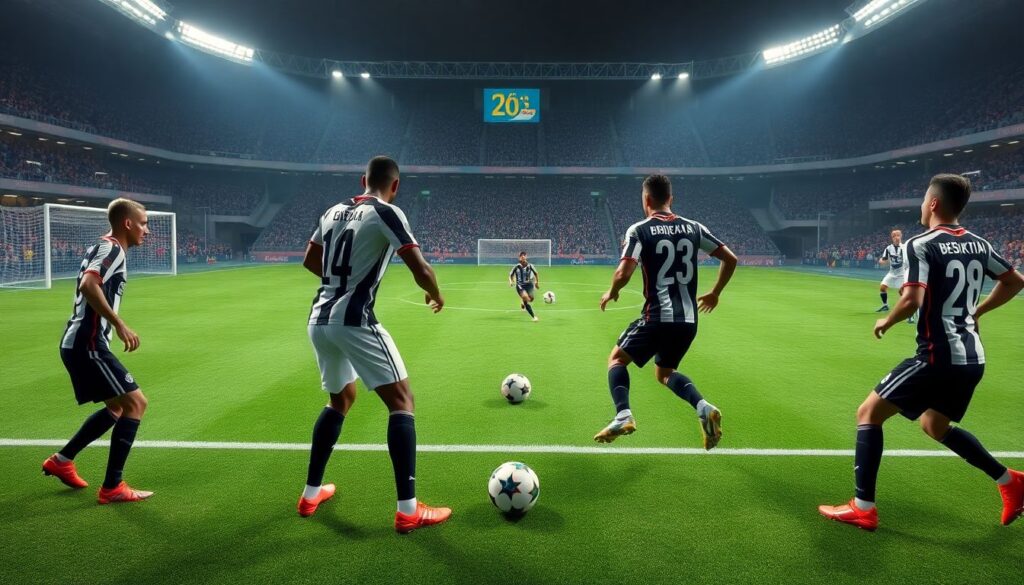
During the 2021–22 era, Beşiktaş experimented with a double‑screen indirect free kick: two players stand in the wall, pretending to argue about who takes the shot. At the last second, one peels wide, dragging a defender, while the other cushions the ball centrally for a late runner.
On raw Turkish Süper Lig free kick goals stats 2024 you won’t see a massive explosion of direct goals from this type. But if you dig into the deeper metrics, Beşiktaş generated several high‑xG cutback chances out of this pattern across two seasons, some of which led to tap‑ins or rebounds. The routine’s true value was not the shot itself but the structured chaos it created.
—
Fenerbahçe’s mixed delivery arsenal
Fenerbahçe in recent seasons had a luxury problem: multiple capable deliverers from wide areas – Dusan Tadić, Sebastian Szymański, later others. Instead of assigning a single primary taker, they rotated duties based on:
– Side of the pitch
– Game state (lead vs chasing)
– Aerial matchup vs the opposition’s best headers
Data analysis showed that inswinging corners from Tadić on the left produced more flick‑ons at the near post, while Szymański’s outswingers from the right were better at generating second‑ball chaos beyond the far post. The coaching staff didn’t fix a rigid hierarchy; they built a decision tree that players learned over time.
—
Anatolian clubs and “long free‑kick counters”
Several Anatolian sides have specialized in using defensive set pieces as offensive launchpads. On deep defensive free kicks, instead of simply clearing the ball, they plan:
– Pre‑positioned runners on the flanks
– A target zone near the halfway line for second balls
– Coordinated pressing on the opponent’s first touch
From a traditional stats view, this doesn’t show up in set‑piece goals. But when analysts include transition chains starting from free kicks, some of these teams gain ~4–6 extra goals per season. It’s still a form of set‑piece mastery; it just treats the dead ball as the *start* of a transition instead of an immediate chance to shoot.
—
Current trends and projections toward 2026
Tactical convergence with top European leagues
By 2026, the Süper Lig is very likely to show:
– More zonal‑hybrid defending on corners (fewer pure man‑marking teams)
– Increased use of blocking and NBA‑style screening in attacking routines
– Systematic use of second‑phase structures: planned behaviour after partial clearances
As more Turkish clubs work with foreign set‑piece specialists, patterns already common in the Premier League and Bundesliga will become standard in Istanbul and Anatolia.
—
Growth of specialized staff and “data‑first” routines
Clubs are gradually moving from “assistant who also does set pieces” to “dedicated set‑piece coach working with a data analyst.” This duo typically owns:
– Design and evolution of the playbook
– KPI tracking (xG per routine, shots allowed from defensive set pieces)
– Continuous updating of Süper Lig set piece statistics corners and free kicks for internal dashboards
By 2026, it’s reasonable to project that most top‑8 clubs will have at least part‑time staff in this role, and some will extend it to academy levels to standardize terminology and patterns.
—
Player profiles and transfer market implications
Another expected shift: more attention to “hidden” set‑piece value in transfers.
Clubs will look for:
– Center‑backs with high aerial win % on both boxes
– Forwards who are elite blockers and screeners, not only finishers
– Wingers and full‑backs with repeatable delivery metrics (height, speed, spin)
That “average” left‑back who takes a wicked inswinger might be worth more than his base salary suggests when you price in 3–4 extra goals from corners per season.
—
Final thoughts: how to build sustainable set‑piece dominance
Sustainable superiority in corners and free kicks in the Süper Lig doesn’t come from one “magic” routine or a single world‑class taker. It comes from a repeatable process:
– Clear understanding of your squad’s strengths and weaknesses
– A lean, well‑drilled set of core routines, not a bloated manual
– Smart use of technology without drowning players in information
– Continuous, data‑driven refinement anchored in xG, not just highlight reels
Teams that treat set pieces as a dedicated tactical phase – with structure, creativity and good analytics – are already gaining an edge. By 2026, that edge will no longer be optional; it will be a baseline requirement for any club aiming at the top half of the Süper Lig.