
Scouting the New Turkish Wave
If you feel like every Champions League night now features at least one sharp‑haired kid with a Turkish surname dropping a killer first touch, you’re not imagining it. There’s a genuine wave of young turkish football talents in europe, shaped both by strong academies in Turkey and by migrant communities in Germany, Italy, the Netherlands and beyond. Instead of just listing names, let’s walk through a simple “how to” guide: what to use, how to watch them properly, what can go wrong, and then dig into real case studies that show why this generation is different from the ones before it.
Why This Generation Is Different
The short version: better coaching, earlier exports and clubs finally trusting teenagers in big games. That’s why phrases like next generation turkish football stars stopped being marketing talk and started describing actual squad players at Real Madrid, Juventus and Benfica, not just prospects in youth leagues.
—
Necessary Tools: How to Track Turkish Wonderkids Like a Pro
H2H with the Data: What You Actually Need
To follow top young turkish players in european leagues in a smart way, you don’t need a professional scouting badge, but you do need a toolkit. First comes data: free platforms like FBref, SofaScore and WhoScored let you track minutes, positions, progressive passes, expected goals, even pressing actions. Pair that with YouTube and club highlight channels for the eye test. If you’re obsessive, Wyscout or InStat give you near‑professional access to every touch. Add social tools: Turkish‑language Twitter, fan forums, and local journalists often spot a kid months before he hits mainstream English media. Finally, build a simple notes document where you log impressions: position, strengths, weaknesses, and how they cope in different game states.
Minimalist Setup for Casual Fans

If that sounds like too much, you can still stay ahead of the curve with just two tabs: a stats site plus a video source. Watch 15–20 touches rather than 2‑minute highlight reels, and suddenly the best turkish wonderkids 2024 look a lot more real and less like edited superheroes.
—
Step‑by‑Step: From “Who Is This Kid?” to “I Was Early on Him”
The Basic Scouting Workflow
Let’s build a simple, repeatable process you can use for all turkish football prospects to watch in europe. Step one: identify names. Look at U21 minutes in the Bundesliga, Serie A, La Liga, Ligue 1 and Primeira Liga, filter by Turkish nationality or dual nationals eligible for Turkey. Step two: context. Check the club’s situation—are they mid‑table risk‑takers or a title contender? Game model matters; a technical midfielder at Benfica faces different demands than one at a relegation‑battling side. Step three: the eye test. Watch at least one full match, not just a compilation, and track simple events: first touches under pressure, decisions in transition, defensive work off the ball. Step four: compare. Don’t label anyone a star until you’ve watched at least three games across different opponents and match scenarios.
A Quick Shortcut
No time for three full matches? Focus on how they play without the ball for 10 minutes. With youngsters, work rate and positioning often say more than a flashy dribble.
—
Troubleshooting Your Own “Scouting”
Common Mistakes When Judging Young Players
Even professionals struggle here, so don’t be shocked if your early takes age badly. The biggest trap is highlight bias: if you only see long shots and dribbles, you’ll assume constant brilliance. Another issue is sample size; Arda Güler hitting a wondergoal for Real Madrid doesn’t automatically mean he’s ready to dictate every Champions League night. Injuries and growth spurts make 17‑ to 20‑year‑olds wildly inconsistent. Also, be careful with league translation: a forward bullying weaker defenses in the Dutch second division won’t instantly repeat those numbers in the Premier League. Finally, cultural adaptation matters for many young turkish football talents in europe: moving from Ankara or Stuttgart to Madrid or Turin at 18 means new language, food, media pressure and tactical instructions, all at once.
How to Stay Sane
When in doubt, slow down your conclusions: track a kid over a season, not a weekend. Ups and downs are normal, panic or hype are not.
—
Case Study 1: Arda Güler – From Fenerbahçe Prodigy to Madrid Puzzle
What the Tools Say
Arda Güler is the cleanest example of how to combine data, video and patience. At Fenerbahçe, his numbers showed an odd profile for a teenager: high progressive passing, strong expected assists per 90, and excellent ball retention under pressure. Once he moved to Real Madrid, minutes became scarce due to injuries and competition, but the micro‑data stayed impressive: high shot quality, low turnovers, smart movement between lines. Watching full games, not just compilations, makes it obvious why so many scouts labeled him one of the top young turkish players in european leagues: he scans constantly, receives on the half‑turn, and plays like someone who’s been in elite academies for a decade. The real question isn’t talent; it’s opportunity and health over the next two seasons.
Real‑World Coaching View
One La Liga assistant described him privately as “already a Champions League brain, with a Europa League body that’s still catching up.” That’s a neat way to remember: reading the game and surviving the schedule are two separate skills.
—
Case Study 2: Kenan Yıldız – The Juventus Hybrid Forward
From Youth Ranks to Allegri’s Trust
Kenan Yıldız is a very different type of prospect. Developed at Bayern before moving to Juventus, he grew up steeped in German structure and Italian tactical demands. Data first: his raw goal‑contribution numbers aren’t explosive yet, but look deeper—high shot volume from decent locations, lots of carries into the box, and above‑average defensive actions for a nominal attacker. Video fills the gaps: he drifts between the lines, presses with intent, and isn’t afraid to take responsibility in tight games. That blend of versatility and off‑ball intelligence is exactly what Serie A coaches love. It’s why many analysts list him among the most promising turkish football prospects to watch in europe, despite his highlight reels not being as viral as others. His case shows that “boring” traits like pressing and tactical discipline often secure minutes faster than tricks.
The Allegri Effect
There’s also the “coach filter”: if a conservative manager like Allegri keeps using a teenager, you can assume the kid is tactically trustworthy, not just flashy.
—
Case Study 3: Can Uzun – The Bundesliga‑Bred Finisher
Reading the Numbers Behind the Hype
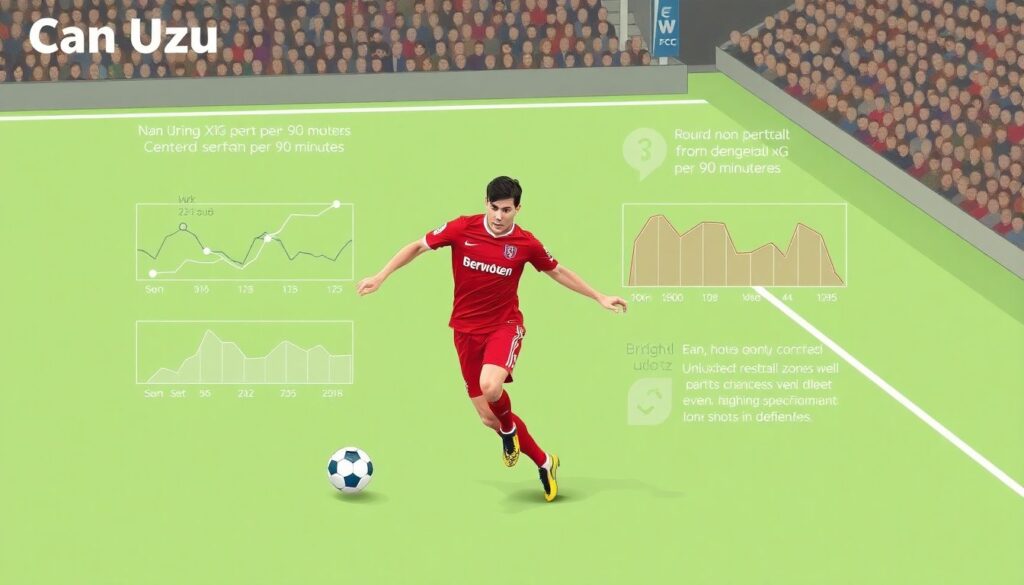
Can Uzun at Nürnberg offers another useful template. Look at his stats: strong non‑penalty xG per 90, regular shots from central zones, good conversion even under pressure. Unlike many young forwards, he doesn’t live off low‑percentage long shots. Watch him over 90 minutes and you’ll see a striker who times runs well, attacks the box late and finds space between center‑backs. That’s why German and Turkish media both flagged him early as one of the next generation turkish football stars, even before he’d played a top‑flight minute. There’s a classic “Bundesliga production line” feel here: disciplined off‑ball work, clear role understanding, and a style that can scale up a division. The main variable is how he adapts once defenders are faster and space is tighter, but the base toolkit is unusually mature for his age.
What a Youth Coach Noticed
A youth coach who faced him in German academies summed it up: “He was never the flashiest, but he always arrived in the right place.” That’s often the real separator for professional forwards.
—
Case Study 4: Orkun Kökçü – Blueprint for the Modern Turkish Midfielder
From Feyenoord Engine Room to Benfica
Orkun Kökçü is already more established, but he’s a crucial blueprint for younger kids. At Feyenoord, his metrics—progressive passes, deep completions, shot‑creating actions—put him in elite company for his age. The Benfica move tested whether those skills would travel to a different league and system. Watching him closely shows why he belongs in any conversation about young turkish football talents in europe, even if he’s already beyond the “wonderkid” label: he receives under pressure, breaks lines with both passing and dribbling, and directs pressing triggers. Younger Turkish midfielders now get compared to him in academies, which is new; a decade ago the typical role model was a pure destroyer or a deep playmaker. Kökçü’s two‑way game signals a broader evolution in Turkish player development, with more emphasis on adaptable, press‑resistant profiles.
The Hidden Lesson
If you want to spot the “next Kökçü,” look for teenagers who demand the ball in tight spaces rather than hiding behind defenders. That mentality is often visible before the stats explode.
—
How to Judge if a Prospect Is Real or Just Social‑Media Hype
A Simple Three‑Question Filter
When you bump into a big claim about some “new Arda” or “future Kenan,” run three quick checks. First: does he play real minutes in a respectable league or just youth tournaments? Second: do any underlying numbers (progressive passes, xG, pressures) look strong relative to age? Third: in the clips you watch, does he affect the game in multiple phases—build‑up, transition, and defense—or only show one trick repeatedly? If the answer to all three is yes, you’re probably looking at someone who at least belongs in a broader list of top young turkish players in european leagues. If not, you might be watching a six‑month social‑media bubble. This method won’t make you infallible, but it will save you from overreacting to every viral dribble in an U19 match or summer friendly.
Remember the Late Bloomers
Also keep room in your mind for slower, late developers. Not every international star was a headline‑making teenager; some just kept improving quietly.
—
Troubleshooting: When Your Predictions Go Wrong
Why Your “Future Star” Stalled
Let’s say you were convinced a specific winger would own 2024 and instead he’s stuck on the bench. What happened? Injuries, coaching changes and tactical shifts are the usual suspects; a new manager might favor experience over youth. Sometimes the league’s physicality exposes weaknesses you didn’t see in youth football. Or the player simply struggles off the pitch: homesickness, language barriers, chaotic agents. Many of the best turkish wonderkids 2024 will have at least one “lost season” before stabilising. That doesn’t always mean you misjudged talent; it often means you underestimated how fragile development pathways are. Your fix is to re‑evaluate with fresh data and video: what’s changed in role, confidence and usage, not just raw minutes.
Own Your Misses
The healthiest approach is to treat every wrong prediction as another data point. That’s exactly how professional scouts refine their models too.
—
Putting It All Together
Becoming an Informed Fan, Not Just a Hype Echo
If you combine basic tools, a simple process and a bit of patience, you can follow this wave more intelligently than most timelines do. Keep a running list of names—Arda Güler, Kenan Yıldız, Can Uzun, Orkun Kökçü and the next batch coming out of Germany and the Süper Lig—and revisit them a few times each season. Watch full matches when you can, use numbers as guardrails, and stay skeptical of overnight narratives. The result is that you’ll spot genuine young turkish football talents in europe earlier, understand their strengths and flaws more clearly, and enjoy their rise with a sense of “I’ve really seen this coming,” not just “I saw a cool clip last week.” In the end, that mix of curiosity and critical thinking is what turns watching football into something closer to a live‑action research project—only with louder stadiums and better goals.