The future of football in Turkey will be defined by smarter VAR usage, wider matchday technology, and clearer tactical ideas. Turkish Super Lig VAR technology must become faster and more transparent, while clubs invest in data, modern coaching and academies. Success will come from small, concrete workflow changes, not abstract theory.
Essentials of Turkey’s Football Evolution
- VAR in Turkey is stable in infrastructure but inconsistent in communication, speed and trust.
- Wearables, tracking systems and improved broadcasting will shape how clubs prepare and how fans watch.
- Turkey football analytics and data technology is moving from basic reports to integrated decision-making.
- Modern tactics demand coordinated pressing, structured build-up and flexible formations.
- Refereeing quality depends on continuous education, governance transparency and clear post-match feedback.
- New Turkish Super Lig live streaming rights models will influence club revenues and fan engagement strategies.
VAR Implementation: Current State and Pain Points
In Turkey, VAR implementation is already a fixed part of professional competitions, especially in the top division. The core idea is simple: a team of video officials supports the on-field referee on clear and obvious errors in four areas: goals, penalties, direct red cards and mistaken identity.
The infrastructure of Turkish Super Lig VAR technology is broadly aligned with international standards, yet the operational reality still shows gaps. The biggest pain points are decision speed, consistency across different matches, and how clearly the reasoning is explained to coaches, players and fans after incidents.
Clubs also struggle to adapt their match preparation to VAR behaviour. For example, defensive lines must respect that every offside will be checked visually and with lines, while coaching staffs should analyse past VAR decisions to understand how specific types of contacts or handballs are usually interpreted in Turkey.
For the federation and refereeing body, the challenge is to standardise protocols, track key performance indicators like review time and error rate, and communicate guidelines more openly. Public education about VAR boundaries and limitations can reduce unrealistic expectations and pressure.
- Review your last 5-10 matches and tag all VAR interventions: type, timing, impact, and communication clarity.
- Train defenders and forwards with video examples of Turkish VAR handball and offside interpretations.
- Develop a simple internal protocol for how staff and players react during and after a VAR review.
Emerging Matchday Technologies Beyond VAR
Matchday technology in Turkey is expanding beyond VAR towards tools that assist performance, broadcasting and fan experience. The focus for practitioners should be on integrating a few reliable solutions instead of chasing every new gadget.
- Player tracking and GPS wearables
Many clubs now use wearables to track distance, high-speed runs and load. The value comes when analysts connect these metrics with tactical roles and match context, not just present raw numbers. - Optical tracking and positional data systems
Optical systems track every player and the ball, creating a full positional dataset. This enables analysis of pressing distances, compactness and line height. It is a key pillar of advanced turkey football analytics and data technology. - Enhanced replay and tactical camera angles
High behind-goal and wide tactical cameras help both analysts and coaching staff review pressing triggers, rest defence and build-up patterns, far beyond standard TV angles. - Stadium connectivity and second-screen experiences
Better connectivity allows real-time stats and replays in stadium apps. As Turkish Super Lig live streaming rights evolve, clubs can link in-stadium and home experiences with unified digital memberships. - Communication tools for coaching staff
Licensed tablets and intercom systems support faster information flow between analysts in the stands and the bench, provided competition rules are respected.
- Prioritise 1-2 technologies you can maintain well (for example, GPS plus one tactical camera) instead of many fragile tools.
- Define how each technology will influence at least one weekly process: training design, opponent analysis or player feedback.
- Assign a single staff member as owner of all matchday technology workflows and data quality.
Data-Driven Player Development in Turkish Academies
Data-driven development is now essential for the best football academies and training camps in Turkey. The goal is not to replace coaches but to give them clearer evidence about each player’s progress and profile over time.
First, academies increasingly track physical development through periodic testing and match data. This includes sprint performance, repeated high-intensity efforts and recovery indicators. Coaches can then personalise conditioning loads and identify late developers who need more patience instead of early deselection.
Second, technical and tactical profiles are built from tagged match video. For example, wingers are evaluated on type, location and outcome of 1v1 attempts, crosses and pressing actions. Central midfielders can be assessed on progressive passes, body orientation and scanning frequency before receiving the ball.
Third, psychological and behavioural data can be coded qualitatively: training attendance, response to feedback, resilience after mistakes, and leadership signals. When combined with objective performance data, this helps academies decide who to promote, loan or reposition tactically.
Finally, academies that connect their databases to first-team analysts create a smoother pathway. Coaches of senior squads receive an already-structured history for each promoted player, making integration faster and less risky.
- Build a simple player report template that mixes physical, technical, tactical and behavioural indicators across the season.
- Film all academy matches from a consistent tactical angle and tag 3-5 key actions per player role.
- Review academy data jointly with first-team staff at fixed intervals to align profiles and promotion decisions.
Tactical Shifts: Pressing, Build-up and Formation Trends
Tactical evolution in Turkey is moving toward more coordinated pressing, structured build-up and flexible systems that shift within the match. The future will reward teams that coach simple, repeatable principles instead of memorising complex patterns that players cannot execute under pressure.
Pressing trends include higher lines, clearer triggers and more compact distances between units. Build-up shifts focus on creating numerical advantages around the ball with full-backs inverting or pivot players dropping between centre-backs. Flexible formations, such as changing from 4-2-3-1 to a 3-2-5 in possession, are now more common in top clubs.
However, every innovation has trade-offs. Aggressive pressing increases physical demands and risk of being exposed by one well-timed long ball. Over-complicated build-up can slow the tempo and disconnect the front line. Coaches need to choose ideas that realistically match their squad profile and league schedule.
Benefits of modern pressing and build-up
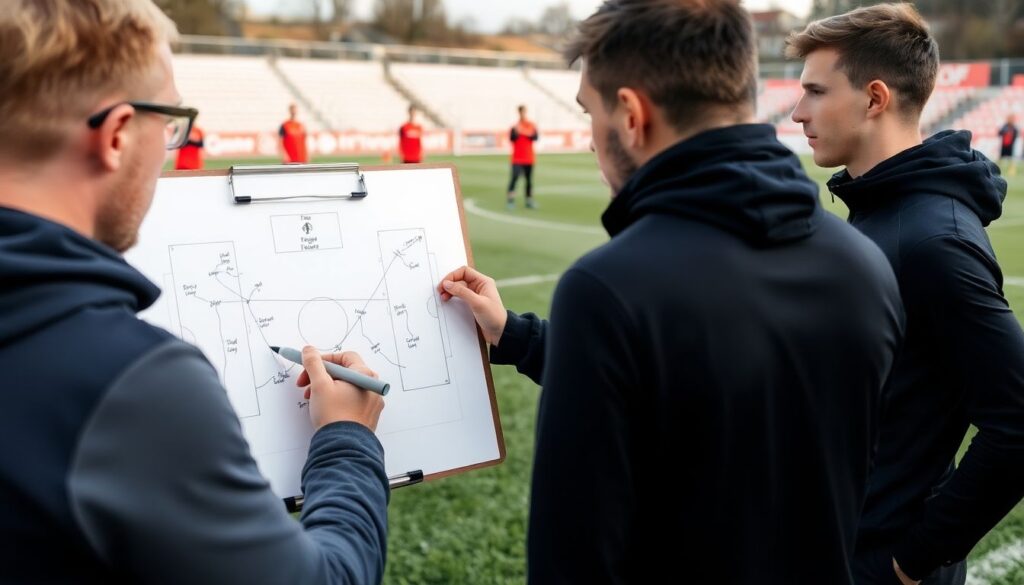
- Better control of territory and second balls in the opponent’s half.
- More structured options for playing out under pressure, reducing random clearances.
- Improved player understanding of roles and reference points in each phase.
Constraints and risks to manage
- Higher physical load and potential fatigue in congested Turkish calendars.
- Need for defenders and goalkeeper comfortable under pressure and in large spaces.
- Longer teaching time and more detailed video work, especially with frequent squad turnover.
- Choose 2-3 core pressing triggers (for example, backward pass, poor first touch) and coach them repeatedly with video.
- Design build-up patterns around your goalkeeper’s and centre-backs’ real passing strengths, not idealised schemes.
- Test new formations first in controlled phases of friendly games before full-season adoption.
Referee Training, Governance and Regulatory Challenges
Refereeing in Turkey faces technical, educational and governance challenges. Improvement demands more structured referee training, transparent evaluation and closer cooperation between officials, clubs and the federation.
One frequent mistake is assuming VAR will automatically fix poor on-field positioning and decision-making. In reality, VAR can only review specific incidents and is not a substitute for fundamental skills like angle selection, anticipation, and managing player emotions effectively.
Another myth is that more public punishment of referees will improve standards. Often it has the opposite effect, increasing fear, reducing confident decision-making and making it harder to attract new officials from football coaching and tactical courses in Turkey into the refereeing pathway.
Regulatory complexity is also a barrier. Continuous law amendments and local interpretations can make it hard for players and coaches to fully understand expectations, fuelling frustration and conspiracy theories instead of constructive feedback loops.
- Invest in joint workshops where referees, coaches and analysts review the same match clips and discuss interpretations calmly.
- Encourage young referees to combine officiating with coaching education, improving their game understanding.
- Document and share consistent internal guidelines on grey-area decisions instead of changing tone week by week.
Commercial Dynamics: Broadcasting, Sponsorship and Fan Engagement
Technology and tactics also reshape the business side of Turkish football. Broadcasting formats, sponsorship packages and fan interactions are increasingly data-driven, which affects both big clubs and smaller regional teams.
As Turkish Super Lig live streaming rights become more flexible across platforms, clubs can package behind-the-scenes content, tactical breakdowns and youth matches into premium digital products. Simple analytics on viewing times, device types and geographic location help refine content schedules and sponsorship offers.
A basic pseudo-workflow for a club’s weekly content cycle might look like this:
collect_match_data()
segment_fans_by_engagement()
publish_highlights_for_mass_audience()
publish_tactical_clip_for_advanced_fans()
measure_watch_time_and_clicks()
adjust_next_week_content_plan()
Brands increasingly expect clear evidence of fan engagement: click-through rates, attendance patterns and social media interactions. Clubs that link their on-pitch identity (pressing style, academy promotion, local heroes) with a coherent digital story will attract stronger, longer-term partners.
- Audit all digital channels and map each to a clear purpose: reach, depth, or conversion.
- Integrate basic performance data into content (heatmaps, sprint maps) to differentiate from generic highlight clips.
- Offer sponsors packages that combine physical assets (LED, shirts) with measurable digital inventory.
Quick Self-Check for Clubs and Practitioners
- Can you describe in one page how VAR, data and tactics are integrated into your weekly workflow today?
- Do your staff know exactly which technologies they own, maintain and translate into football language?
- Are youth development reports evidence-based, mixing video, data and coach observations consistently?
- Do your tactical ideas match the real technical level and conditioning of your squad?
- Is your digital content strategy clearly linked to your on-pitch identity and key revenue streams?
Common Practitioner Concerns and Quick Clarifications
How can a smaller Turkish club start with technology without overspending?
Begin with essentials: one good tactical camera, basic video tagging software and simple GPS units if budget allows. Focus on using these consistently in analysis meetings instead of buying many tools that you cannot maintain.
What is the most impactful change to improve VAR relations for a coaching staff?
Educate players and coaches on VAR protocols and typical interpretations in your league, then set clear internal rules for behaviour during reviews. Calmer reactions reduce cards and help staff see patterns in decisions more objectively.
Do we need a full-time data analyst to benefit from analytics?
Not necessarily. Start with a part-time role or a coach with analytical interest, and define a narrow scope: post-match reports and 2-3 key metrics per position. Expand only when processes are stable and useful for the head coach.
How can academies in Turkey compete with bigger European setups?
Use clarity and focus as advantages: define a clear playing identity, track a few meaningful metrics, and ensure every academy session links directly to first-team tactical principles. Strong alignment often beats larger but unfocused structures.
Are complex positional play systems realistic in the Turkish calendar?
They are possible but must be simplified. Prioritise a small set of automatisms in key zones, considering travel, weather and match congestion. Overloaded concepts quickly break down during intense away fixtures.
What should referees and coaches do to reduce conflict in high-pressure matches?
Agree pre-match on communication channels, especially with captains and technical staff. After the match, use short, structured debriefs with video rather than emotional public statements that damage long-term relationships.
How do Turkish clubs keep fans engaged when performance is inconsistent?
Share transparent development stories: youth promotions, tactical adjustments, and training focus areas. Fans respond better when they see a plan, even if short-term results fluctuate.