Turkish coaches have quietly gone from “interesting outsiders” to regular faces on European benches. You see their teams pressing higher, counter‑attacking smarter and developing technically polished young players who don’t panic under pressure. To unpack why this is happening, it helps to treat the topic almost like a mini research project: define what we mean by success, look at tactical patterns, compare them with other coaching schools and finish with a realistic forecast for the next decade of European football.
Key Terms: What We’re Really Talking About
Before diving into details, let’s pin down a few terms that often get thrown around. When people say turkish football coaches in europe, they usually mean head coaches and key assistants working in the top two tiers of the big five leagues plus major UEFA competitions. “Tactical model” is the repeatable pattern of how a team behaves in the four phases: attack, defence, offensive transition and defensive transition. A “coaching microcycle” is the weekly training plan from matchday to matchday, where workload, intensity and tactical focus are calibrated. Keeping these concepts clear makes it easier to compare Turkish coaches with their Spanish, German or Italian counterparts without slipping into clichés.
Why Europe Started Paying Attention
For a long time, Turkish coaches were seen as “domestic specialists”: great with local clubs, but supposedly too emotional or tactically rigid for European leagues. That reputation began to crack as more Turkish managers studied abroad, learned foreign languages and completed UEFA Pro coaching education alongside German and Italian peers. At the same time, European clubs started scouting not just players but also coaching staff from Turkey’s big academies. The result is a generation that blends local street‑football instincts with formal tactical schooling. When directors search for the best turkish football managers in european leagues, they now find CVs with data‑analysis skills, B‑team development experience and decent European cup runs, not just emotional team talks.
Core Features of the Modern Turkish Coaching Philosophy
When you zoom in on turkish football coaching philosophy and training methods, a few recurring traits stand out. First, sessions are usually built around game‑like drills with direct decision‑making: small‑sided games, positional rondos and constrained 11v11. Second, there’s a heavy emphasis on competitive intensity; even finishing exercises are often scored and ranked to simulate pressure. Third, coaches pay particular attention to “transition literacy” – how quickly players switch mindset after losing or gaining the ball. This fits well with the tempo of modern European football. Compared with the more pattern‑oriented Italian school or the control‑obsessed Spanish approach, Turkish coaches tend to accept chaos, but try to organize the first two or three seconds after each turnover.
Tactical Trends: What Their Teams Actually Do
A turkish coach tactics analysis european football watchers like to run often highlights three main ideas: adjustable pressing, vertical attacks and half‑space overloads. “Adjustable pressing” means they rarely press high for 90 minutes; lines step up or drop back based on game state and opponent build‑up shape. Vertical attacks are about gaining meters fast after winning the ball, but not just by “kicking it long”: passing lanes through central channels are rehearsed during the week. Half‑space overloads describe how wingers drift inside, full‑backs push wide and a central midfielder joins to form diamonds near the opponent’s box, allowing quick one‑touch combinations. It’s not pure chaos; it’s controlled risk designed to make matches uncomfortable for more rigid, possession‑heavy teams.
Text Diagram: Typical 4‑2‑3‑1 in Attack
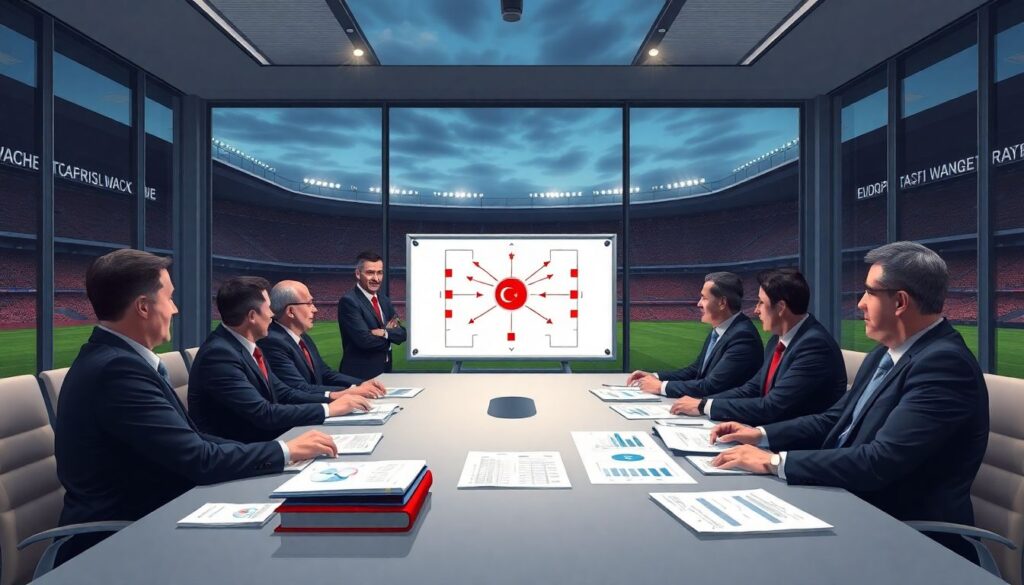
Imagine a simple pitch drawn on paper, split into three vertical lanes (left, center, right) and three horizontal zones (build‑up, midfield, final third). The back four spread across the build‑up zone. Two deep midfielders sit in the central lane of the midfield zone, one slightly left, one right. The “10” moves into the right half‑space of the final third, while the right winger tucks inside into the left half‑space, almost forming a box with the striker and “10”. Full‑backs push into the wide channels in the midfield zone. Arrows point diagonally from deep midfielders into both half‑spaces, showing preferred passing angles: win the ball, play forward or diagonal within 2‑3 touches, then combine inside the box.
Case Studies: Individual Paths and Shared Patterns
Look at a few recent examples and a pattern emerges. Nuri Şahin moved from being a Bundesliga playmaker to a modern coach shaped by German periodisation and data‑driven scouting, then took that toolkit back into European club roles. Tayfun Korkut has bounced around the Bundesliga, often called in as a “firefighter” for teams in trouble, proving Turkish coaches can operate inside highly structured German club cultures. Others have built reputations as elite assistants in Spain and Italy, responsible for set‑pieces or out‑of‑possession phases. While each biography is unique, their teams tend to share: compact mid‑blocks, sharp transitional play, and a willingness to rotate young players into high‑pressure matches instead of hiding them on the bench.
How They Compare with Other Coaching Schools
Compared with German coaches, whose identity is rooted in systematic pressing and high physical output, Turkish coaches borrow those elements but accept more improvisation in the final third. Versus Spanish managers, who generally prioritize possession and positional play, Turkish coaches are less obsessed with 60–65% possession and more concerned with chance quality and momentum swings. Italian coaches often foreground defensive structures and risk management; Turkish managers align with them on compactness but are quicker to “open the game” after the first pressing trap is broken. In short, they sit in a hybrid space: structured enough for modern analytics‑driven clubs, yet still comfortable with matches that turn into emotional, high‑variance battles.
Diagram in Words: Decision Tree After Ball Recovery
Picture a vertical flowchart. At the top box: “Win ball in own half.” Two arrows go down. Left arrow: “Opponent disorganized?” If yes, it leads to “3‑pass vertical attack” – midfielder receives, plays into a dropping striker, then into a runner in behind. Right arrow: “Opponent in shape?” If yes, it branches to “Secure first pass wide,” then “Advance in numbers,” then “Prepare crossing or cut‑back pattern.” This simple logic tree is drilled in training. The key is that the first decision – attack immediately or stabilize possession – is pre‑coached, so players react fast instead of hesitating, which is vital against the pace of European football.
Training Ground Details That Matter
On the training pitch, you’ll often see three layers built into a single drill. Forwards work on finishing, midfielders rehearse pressure triggers, and defenders practice line coordination, all within the same small‑sided game. Load is controlled using time rather than distance: short, intense blocks with clear tactical tasks followed by feedback. Many Turkish staff also integrate video breakdowns directly into the microcycle: a 10‑minute clip session before training, then the exact situations are recreated on the field. Compared with some older European setups, the hierarchy is flatter: analysts, fitness coaches and goalkeeping coaches have more say, making the overall process more adaptable and attractive to modern clubs.
European Cups and the Champions League Factor
The success of turkish managers in champions league isn’t about lifting the trophy every year; it’s about repeatedly punching above budget. Think of clubs that qualify less regularly still managing respectable group‑stage performances, surprise wins at home and competitive away legs. These runs show that Turkish coaches can design match‑specific plans: narrower blocks against elite possession teams, then explosive counter‑attacks targeting weak full‑backs or slow center‑backs. That kind of adaptability is exactly what directors of football value: someone who won’t freeze when the fixture list suddenly says “away to Manchester, Munich or Madrid,” yet keeps long‑term player development on track.
Why Clubs Keep Hiring Them
When boards look at turkish football coaches in europe today, three selling points keep coming up: value, versatility and player management. Salary expectations are often lower than for big‑name Western European managers, which matters for mid‑table clubs. Versatility shows up in willingness to tweak formation, from 4‑2‑3‑1 to 3‑4‑2‑1, without needing an entire new squad. Player management is the underrated edge: many Turkish coaches grew up in emotionally intense football cultures, so they’re used to handling volatile dressing rooms, high‑pressure fanbases and demanding presidents. That experience translates surprisingly well to clubs where media pressure and social‑media storms can destabilize a season in a single week.
Common Strengths of Turkish Coaches
– Strong communication with multicultural squads and foreign stars
– High tolerance for pressure and unstable club politics
– Readiness to integrate academy talents and cheap signings quickly
Typical Areas They Still Work On
– More refined build‑up schemes against elite presses
– Language skills to deal with media and boardrooms in multiple countries
– Long‑term squad planning aligned with data‑driven recruitment
Data, Analytics and the New Generation

The younger wave of Turkish coaches is much more fluent in analytics than the stereotype suggests. Many now have dedicated staff for set‑piece modelling, expected‑goals tracking and physical load monitoring. Rather than drowning players in numbers, they translate data into simple rules: “If opponent full‑back tucks in 5 meters, we trigger wide overload,” or “From minutes 60–75, we rotate pressing roles to keep intensity.” Compared with some traditional coaches who still rely heavily on intuition, this data‑informed but not data‑obsessed style fits perfectly with mid‑tier European clubs trying to squeeze every marginal gain out of limited budgets.
2026–2035: Where This Trend Is Heading
Looking ahead from 2026, the most likely scenario is not one superstar Turkish manager dominating, but a steady increase in representation across top‑20 European clubs. Expect more Turkish assistants in Premier League and Serie A sides, gradually stepping up to head‑coach roles once they’ve proved themselves internally. Academies in Turkey are also improving coach education, which should produce tactically literate, multilingual staff by the early 2030s. If this pipeline holds, we’ll probably see at least a couple of Turkish‑led clubs regularly reaching Champions League knockout rounds, not as fairy‑tale stories, but as a normal part of the European football landscape. The ceiling is no longer “exotic choice”; it’s “serious candidate for any ambitious project.”