The big picture: why Turkey’s last decade matters
Over the last ten years the Turkish national team has gone from chaotic, talent‑driven football to a much more structured, flexible model. If you’re interested in turkey national football team tactics analysis, this decade is almost a textbook on how a national side can modernise under pressure. Between Euro 2016 frustration, the disastrous Euro 2020 campaign and the revival towards Euro 2024, Turkey repeatedly rebuilt their identity, balancing emotional, aggressive play with data‑driven decision making and clearer positional roles on the pitch.
Phase 1 – Terim 3.0: romantic chaos with a 4‑2‑3‑1 base
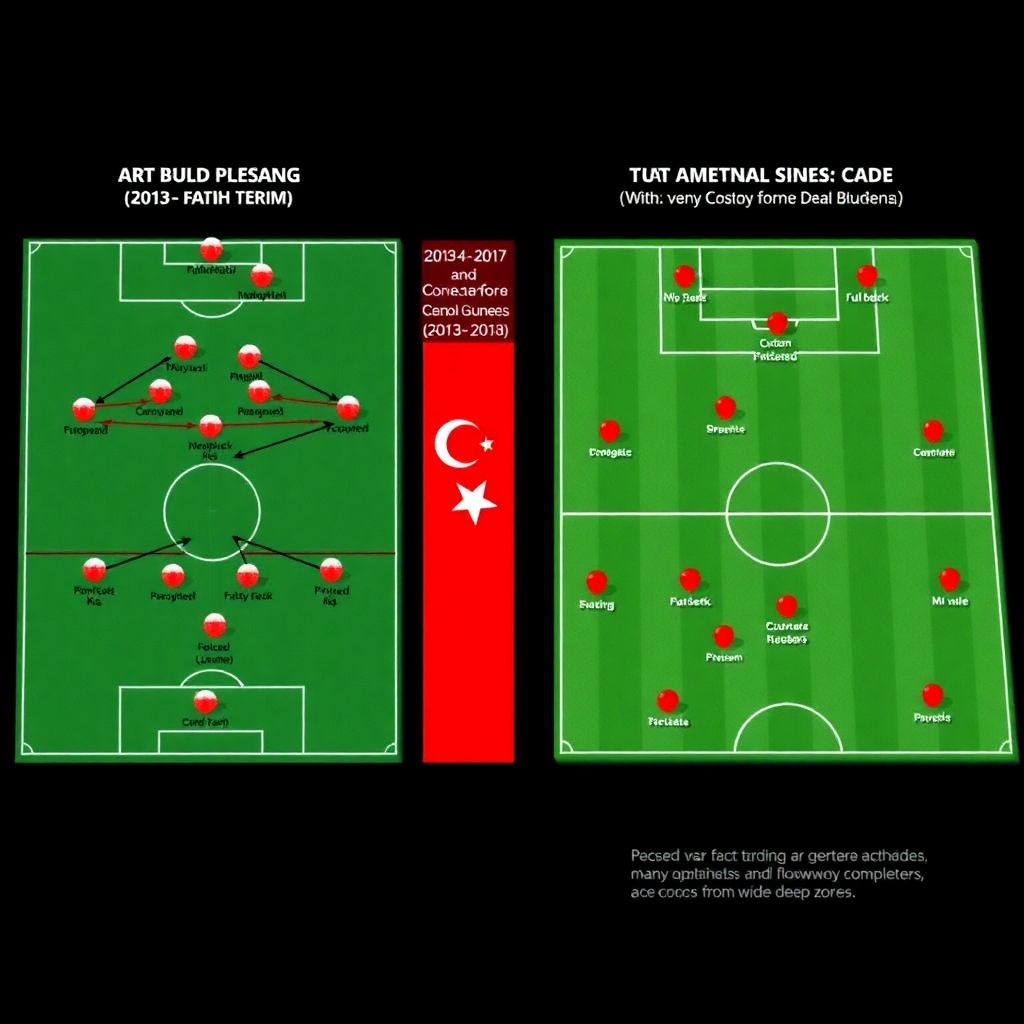
Under Fatih Terim’s third spell (2013–2017), Turkey mostly lined up in a 4‑2‑3‑1 with heavy freedom for the front four. On paper it looked modern, but in reality the double pivot often broke apart, leaving huge distances between lines. Pressing intensity was inconsistent: the team could chase wildly for 15 minutes, then drop into a passive mid‑block. This made Turkey dangerous in transitions, yet very fragile against any opponent capable of calmly playing through the first pressing wave.
Technical detail: spacing and pressing metrics
If we look at turkey national football team statistics last 10 years, early in this period their PPDA (passes allowed per defensive action) frequently floated around 11–13 against strong rivals, meaning they pressed, but not in a synchronised, suffocating way. The distances between defenders and midfielders often exceeded 20–25 meters, which is huge at international level. That gap meant the No.10 was isolated both in pressing and build‑up, forcing long balls and low‑percentage dribbles instead of controlled progression through zones two and three.
Case study: Euro 2016 – talented, but structurally exposed
Euro 2016 is the clearest real‑life example of this first phase. Turkey used a 4‑2‑3‑1 with Hakan Çalhanoğlu as the main creative reference, but the team struggled to advance the ball under pressure. Croatia repeatedly targeted the Turkish double pivot, pressing aggressively with Modrić and Rakitić stepping high. Because Turkey lacked automatisms for third‑man runs and rotations on the flanks, the full‑backs often received with no safe passing angle, leading to rushed clearances, lost second balls and long defensive sequences in their own half.
Technical detail: build‑up issues vs Croatia
In that Croatia match, Turkey completed fewer than 70% of passes in the middle third, a very low number for a team trying to keep possession. Goal kicks were a key indicator: instead of building short, the goalkeeper frequently went long toward the right flank, where Turkey lost more than half of aerial duels. This pattern shows a team without stable build‑up triggers: centre‑backs rarely split wide, the pivot didn’t drop between them, and the No.10 didn’t come close enough to offer a bounce pass option to break the press efficiently.
Phase 2 – Lucescu and early Güneş: from chaos to cautious control
Mircea Lucescu (2017–2019) tried to sober Turkey up. His approach was more conservative: lower defensive blocks, more compact 4‑2‑3‑1 or 4‑1‑4‑1, and priority on defensive stability. The trade‑off was clear: less flair, more structure. This paved the way for Şenol Güneş, who combined that compactness with a smarter use of the emerging generation: Söyüncü, Demiral, Yazıcı, Çelik, and later Burak Yılmaz in a renewed role. The team became harder to break down, especially in Euro 2020 qualifying, where they conceded just three goals in ten games.
Technical detail: compact mid‑block and narrow wingers
Defensively, Turkey shifted to a narrow 4‑1‑4‑1 or 4‑4‑2 without the ball, steering opponents wide. The wide midfielders tucked inside, compressing central spaces to around 25–30 meters width. The holding midfielder screened the zone between lines, making it difficult for rivals to find pockets in front of the centre‑backs. This compact block reduced shots from central areas; opponents were frequently forced to cross from deeper, wider positions, which favoured Turkey’s physically dominant centre‑backs in aerial duels.
Case study: France 0–2 Turkey (2019) – a blueprint of control
The 2–0 win over France in Konya during Euro 2020 qualifying is a classic coaching clip. Turkey were not just lucky; the plan was crystal‑clear. They defended in a compact 4‑1‑4‑1, killing passing lanes into Griezmann between the lines and accepting that the French full‑backs would have the ball. When they recovered, they didn’t try to dominate possession. Instead, they attacked fast down the right with Cengiz Ünder and advanced full‑backs, using early crosses and cutbacks while the French defence was still re‑organising.
Technical detail: transition patterns vs France
In transition, the first pass was almost always vertical: either into Burak Yılmaz’s feet or into the right half‑space for Ünder. A common pattern looked like this: regain → quick vertical to striker → lay‑off to incoming No.8 → wide release to winger. This simple sequence allowed Turkey to bypass France’s rest‑defence in two or three passes. Expected goals models showed Turkey creating higher‑quality chances despite less overall possession, a reminder that efficient transitions can outperform sterile circulation around the block.
Phase 3 – Euro 2020: misalignment between style and tournament demands
Then came Euro 2020, and the script fell apart. Güneş tried to replicate the successful qualifying blueprint, but the strategic context changed. Rivals treated Turkey as a dangerous dark horse and decided to control transitions more carefully. Turkey kept the same conservative 4‑1‑4‑1 ideas, yet lacked on‑ball solutions when forced to take the initiative. The block was set deeper, distances in counter‑attacks grew, and Burak Yılmaz was often isolated. The result: three defeats, one goal scored, eight conceded, and a serious identity crisis.
Technical detail: attacking structure problems at Euro 2020
In possession, Turkey often built in a flat 4‑1‑4‑1 with the No.6 too close to the centre‑backs and both No.8s stuck on the same horizontal line. That killed verticality. Because full‑backs advanced simultaneously and wingers came inside, rest‑defence behind the ball was fragile. Every lost pass led to a dangerous counter. Statistically, Turkey’s xG per shot was low, showing that they shot from poor locations, while opponents consistently entered the box with numbers. The balance between defensive security and attacking ambition was simply not there.
Phase 4 – Kuntz and Montella: modernising through flexibility
Stefan Kuntz (2021–2023) didn’t fully solve the puzzle but set the tone for a more flexible, principle‑based game. He experimented with 3‑4‑3 and 4‑4‑2, trying to integrate a younger, more technical generation: Orkun Kökçü, Kerem Aktürkoğlu, and later Arda Güler. Vincenzo Montella then refined this, stabilising a hybrid system that can look like 4‑2‑3‑1 in possession and 4‑4‑2 out of possession. Under Montella, how does turkey national team play tactical formation is less about a fixed shape and more about zones: who occupies half‑spaces, who provides width, and who pins the back line.
Technical detail: asymmetry and role of half‑spaces
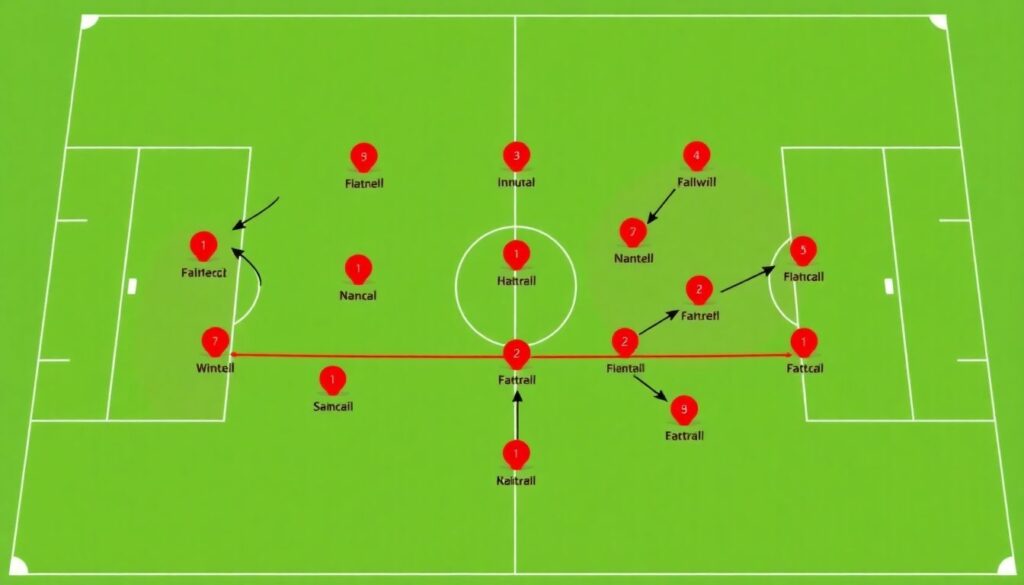
Montella frequently uses asymmetry: one full‑back (often on the left) pushes high to provide width, while the opposite full‑back stays deeper, forming a back three in build‑up. This allows the near‑side winger to come inside and operate between opposition full‑back and centre‑back. The double pivot is staggered: one midfielder drops to help circulation, the other pushes into the right half‑space to connect with the No.10. This structure creates triangles on the wings and diamonds in the centre, improving support angles for progressive passing.
Case study: Euro 2024 run – maturity under pressure
At Euro 2024, Turkey showed how far they’d come tactically, especially in the 2–1 win over Austria in the round of 16. Instead of an emotional high press for 90 minutes, Montella chose selective, well‑timed pressure. The team shifted between a mid‑block 4‑4‑2 and aggressive pressing triggers when the ball went to Austria’s full‑backs. On the ball, Arda Güler’s positioning between lines and his coordination with advancing full‑backs created repeated overloads, especially on the right, without losing defensive control behind the ball.
Technical detail: set‑pieces and game management vs Austria
Turkey’s first goal came from a corner, underlining improved set‑piece work: clever blocking movements freed defenders to attack the near post. Defensively, they used a mix of zonal and man‑oriented marking, with one player on the posts against Austria’s strong aerial presence. In open play, Turkey’s PPDA numbers stayed moderate, showing deliberate alternation between calm phases and targeted pressing. The ability to “switch modes” during the match—a hallmark of mature teams—was a central factor in surviving Austria’s late pressure and protecting the lead.
Key tactical shifts you can actually learn from
If you’re studying football or designing your own game model, Turkey’s last decade offers clear lessons. Let’s narrow them down to practical takeaways you can apply in coaching, scouting, or your own turkey national football team tactics analysis: the shift from romantic chaos to structure, from fixed formations to flexible principles, and from purely emotional pressing to data‑informed intensity management. These are not abstract trends; you can see them in specific match plans, positional tweaks, and the way new talents are integrated into the team.
3 practical lessons from Turkey’s evolution
1. Structure beats raw emotion – Intensity without coordinated spacing leads to holes between lines and easy progression for opponents.
2. Versatility within principles matters – Changing between 4‑2‑3‑1, 4‑1‑4‑1 and 3‑4‑3 works only if core rules about width, depth and compactness stay consistent.
3. Youth needs tactical scaffolding – Giving freedom to talents like Arda Güler is effective only when the rest of the team provides stable reference points and reliable rest‑defence behind the ball.
Using data: reading the last decade like an analyst
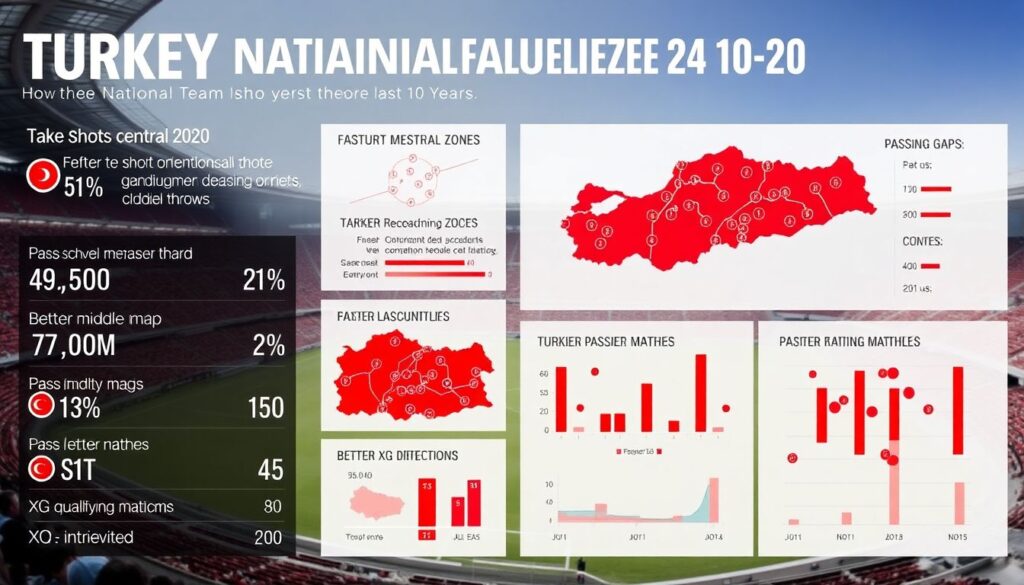
To understand how Turkey changed in practice, you need more than final scores. Detailed turkey national football team statistics last 10 years show a slow but steady shift: fewer shots conceded from central zones, improved pass completion in the middle third, and better xG differential in qualifying cycles. Analysts inside the federation reportedly emphasised video‑based pattern recognition: not just “we conceded a goal”, but “we conceded after losing the ball with both full‑backs high and no cover in the six‑space”. That level of granularity changed daily training priorities.
Technical detail: what to track if you analyse Turkey
If you want to go deeper, focus on a few key metrics: PPDA to measure how consistently they press; zone‑based xG to see where chances are created and conceded; and field tilt (share of final‑third passes) to understand territorial control. Add event‑based notes: how often the double pivot receives facing forward, how many times Arda Güler or Çalhanoğlu get the ball between lines, and how often Turkey win second balls after long clearances. Combined, these indicators paint a far more accurate picture than simple possession percentages.
How to keep learning from Turkey’s tactical journey
If this decade of evolution makes you want to go further, you’ll need both theory and practice. Some of the best books on modern football tactics and analysis break down concepts like rest‑defence, positional play and pressing traps that you can then map onto Turkey’s matches. To turn theory into skills, an online course football tactics and match analysis can help you practise drawing passing networks, identifying pressing triggers and coding chances in software. Use Turkey as your case study team, re‑watching key games with your new analytical toolkit.
Technical detail: building your own “Turkey file”
A practical exercise is to create a personal database: store screenshots of Turkey’s structures in each coaching era, annotate with arrows for runs and passing lanes, and add short notes on roles for every line. Over time, you’ll start seeing recurring patterns: for example, how the No.6’s position changed from Terim to Montella, or how full‑back height evolved. This type of structured observation sharpens your tactical eye and makes watching international football a far richer, more instructive experience than simply following results or highlights.