
Why foreign player limits suddenly matter more than ever
In 2026, Turkish football is standing at a real crossroads. Money is tighter, UEFA competition is harsher, and fans are less patient than ever. In this context, the foreign player quota is no longer just a boring regulation from the federation – it’s a lever that shapes transfer strategy, academy planning and even the style of football we see every weekend. When people ask to have the turkish super lig foreign player rule explained, what they really want to know is not just “how many foreigners can we use?”, but “how do these limits help or hurt our chances of building competitive clubs that can survive financially and perform in Europe over the next five to ten years?”
Right now, every top‑flight sporting director in Turkey makes their first decision with the quota in mind, not with the tactics board.
Quick recap: what are we actually talking about?
Put simply, a foreign player limit is a cap on how many non‑Turkish players you can register or put on the pitch. That sounds straightforward, but in practice the rules are layered, full of exceptions and subject to almost yearly tweaks. Over the last decade, Turkey has bounced between more open models (effectively allowing a full foreign XI) and more protectionist formats that force coaches to keep at least three Turkish players on the pitch. This constant back‑and‑forth explains why many clubs now hire staff whose job is partly legal and partly sporting: to keep up with the rules and turn the constraints into a competitive advantage instead of a headache.
How quotas quietly shape the way clubs are built
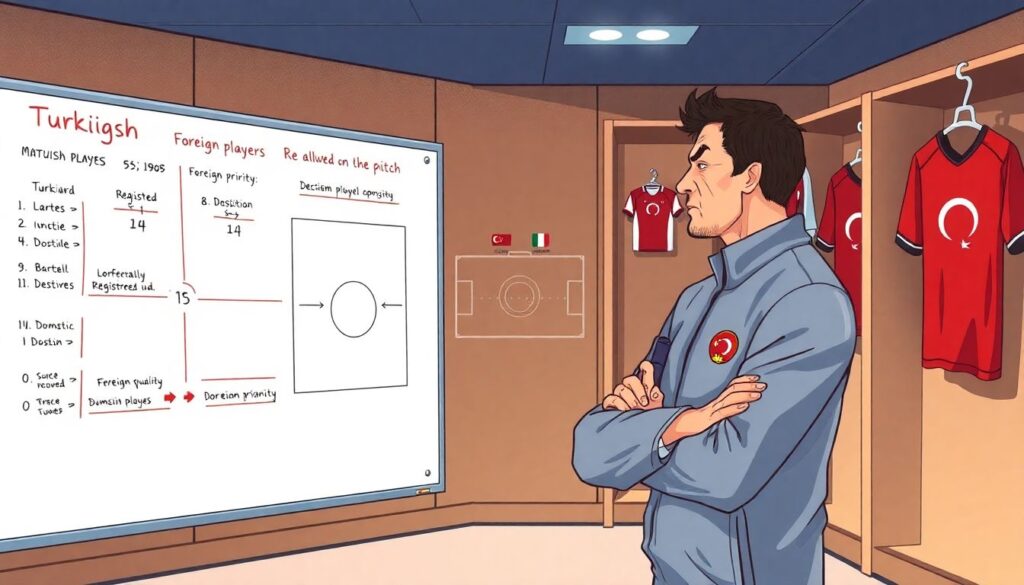
The impact of foreign player limit on turkish football clubs starts with simple math. If a club can register, say, 14 foreign players but only field 8 at any given time, the coach must decide which positions are “foreign priority” and which must be filled by domestic players almost regardless of quality or form. That decision then reshapes the academy: if you know your Turkish goalkeeper will always be in the XI, you suddenly care a lot about the U17 and U19 keepers; if full‑backs must often be domestic to save foreign slots for creative players, you structure your youth training to produce modern, athletic Turkish full‑backs. None of this is written in a regulation, but it’s the hidden architecture of every medium‑term squad plan in the country.
In short, the rulebook decides which Turkish kids get a real pathway and which foreign profiles are worth top wages.
Money, risk and the transfer market
From the finance side, quotas create scarcity and scarcity creates inflation. A decent Turkish centre‑back who could be a rotation player in a mid‑table team suddenly becomes premium because he “frees” a foreign slot. This is why you routinely see local players earning wages that would shock clubs of similar sporting level in Belgium or the Netherlands. At the same time, foreign signings become high‑risk, high‑stakes bets: every foreign player who flops isn’t just a lost salary, he is also occupying one of a limited number of strategic roster spots, which pushes clubs toward more data‑driven scouting and more careful contract structures in the last few years.
Real‑world examples from recent seasons
Look at Galatasaray’s title‑contending squads of the mid‑2020s. The spine often leaned on foreigners in “decisive” roles – striker, creative midfield, sometimes centre‑back – while Turkish players were concentrated in the positions where the club could realistically compete domestically for talent, such as goalkeeper or wide defensive roles. This is not just taste; it’s a rational response to the rules. Trabzonspor, on the other hand, tried to merge a strong domestic core with targeted foreign upgrades. When those foreign signings hit (think efficient forwards and ball‑playing defenders), the team could compete with Istanbul giants; when they missed, the quota magnified every mistake and the squad suddenly looked unbalanced and short of quality in key areas.
Even Başakşehir’s run of success earlier in the decade owed a lot to careful use of quotas, squeezing value out of experienced foreigners alongside selectively chosen Turkish role‑players.
How quotas feed – or starve – youth development

For academies, the relationship is complicated. On paper, limits should protect opportunities for young Turkish players. In reality, coaches under pressure often choose safe, experienced locals rather than giving minutes to a teenager, just to satisfy the domestic requirement. The result can be a stagnant domestic pool: plenty of Turkish names in line‑ups, but not enough of them young, dynamic and ready for international football. The clubs that have started to break this pattern since around 2022 do one thing differently – they decide three or four positions that will be “academy priority” and commit to them over several seasons, instead of improvising based on short‑term quota needs. That kind of planning is what turns regulation into a talent pipeline.
Technical framework: what the rules actually say
By the time you get to turkish super lig squad rules for foreign players 2024, the structure looks roughly like this: a club can register a limited number of foreign players in its league squad, with a smaller number allowed on the pitch at any given time, and with the implicit expectation that at least three Turkish players will start most matches. Matchday squads are therefore puzzles: a coach must balance tactical needs, injuries, form and the foreigners–locals mix. Registration windows add another layer; a foreign player stuck on the bench still occupies a precious spot until the next window, which incentivises short contracts, loan deals and mid‑season surgery to fix mistakes that were often caused by rushing transfers in the first place.
Technical note – how clubs operationalise the rule
Sporting departments now use roster matrices: Excel‑style depth charts where each position is tagged as “foreign‑eligible” or “domestic‑priority”. They simulate different XI combinations to make sure that injuries don’t force them to field a tactically unbalanced team just to remain inside the rules. This is also why versatile Turkish players – who can cover two or three positions – are gold; they give coaches freedom to put more quality foreigners into high‑impact roles.
Turkey vs Europe: different philosophies
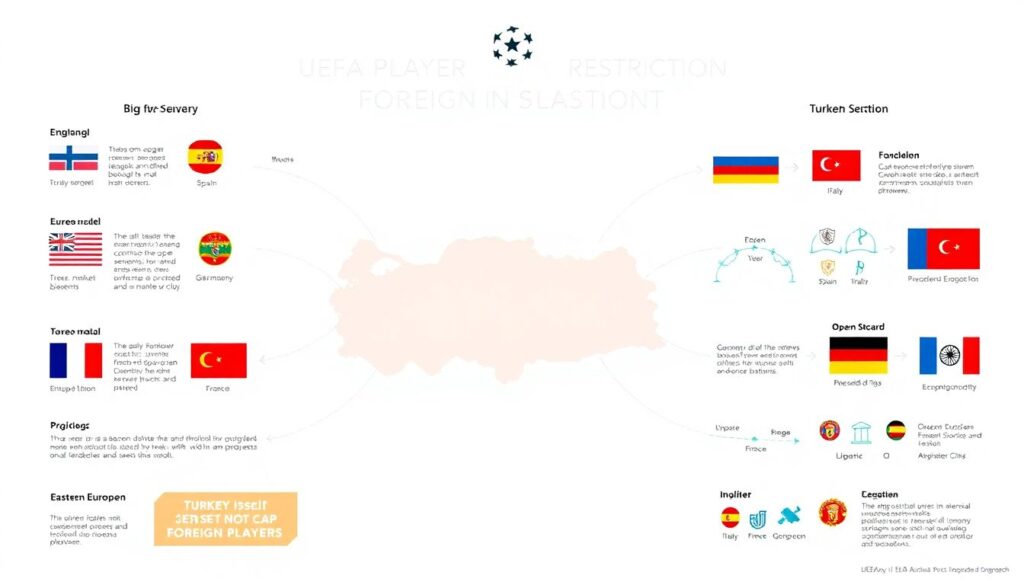
When you dive into a deeper analysis of foreign player restrictions in turkish football, you quickly see that Turkey sits somewhere between the open, market‑driven models of the big five leagues and the more restrictive approaches in certain Eastern European countries. UEFA itself does not cap foreigners; instead, it uses homegrown player rules, which are softer and more flexible. This mismatch creates a strategic dilemma: a Turkish club built for domestic quotas may not be optimised for European competition, especially if key Turkish players are slightly below continental level. It’s no coincidence that clubs doing best in Europe tend to be those that, within the local rules, still think in European terms: they seek quality first, then reverse‑engineer compliance rather than the other way around.
Modern trends reshaping the debate in 2026
Three trends have pushed the quota issue back to centre stage in 2026. First, global data‑driven scouting means Turkish clubs can now find undervalued foreigners in secondary markets much more easily, making every extra foreign slot economically attractive. Second, the explosion of player salaries in Western Europe has turned Turkey into a “bridge” league: attractive to players priced out of top‑five leagues but not yet willing to move to the Gulf or MLS. Third, fan expectations have shifted: younger supporters, used to streaming European football all weekend, want dynamic, technical, high‑tempo games. They care less about the passport and more about the product, which puts political pressure on any move to tighten quotas too aggressively.
At the same time, politicians and federation officials see the national team as a shop window, and still view protection of domestic minutes as a legitimate goal.
What 2026‑era clubs are doing differently
The smartest sporting directors now assume that the rules will keep changing and build flexibility in from day one. Instead of filling every available foreign slot immediately, some clubs deliberately leave one or two spaces open for the winter window, when prices drop and opportunities appear. Others negotiate contract clauses that allow easy exits if the quota is suddenly reduced, so they’re not stuck with surplus foreigners they can’t register. On the domestic side, they identify a few Turkish players with genuine European upside and lock them in early, accepting a higher initial salary in exchange for long‑term cost control and future resale value.
Looking ahead: what quotas could look like by 2030
When we talk about the future of foreign player quotas in turkish super league, we’re really guessing how the Turkish Football Federation, government and clubs will balance three competing goals: a stronger national team, financially stable clubs and better European results. The most likely scenario is not a dramatic swing to either extreme but a gradual softening toward a UEFA‑style “homegrown” logic – still protecting locally trained players, but with fewer rigid caps based solely on nationality. By 2030, it would not be surprising to see a system where clubs must register a minimum number of academy‑trained players, while the nationality of the rest becomes less important than their training background.
If that happens, the clubs that invested early in serious academies and regional scouting networks will immediately pull ahead.
Practical advice for clubs, coaches and policymakers
For clubs, the key is to treat the quota as a design constraint, not an excuse. That means defining three things clearly: which positions must be filled by top‑level foreigners, which must reliably be covered by Turkish players, and how the academy will produce those locals. For coaches, it’s about tactical adaptability: being able to switch systems without breaking the foreign–domestic balance. For policymakers, the lesson of the last decade is simple: stability matters. Constantly changing the rules every season forces short‑termism. A clear, long‑term framework announced well in advance would let everyone plan properly and might finally align domestic competition with the level Turkey wants to reach in Europe.
If that alignment happens, the phrase “turkish super lig foreign player rule explained” will stop sounding like a bureaucratic headache, and start sounding like a competitive blueprint.