From Flow to Stop-Start Drama: How VAR Rewired the Süper Lig
If you talk to players who debuted before 2017 and still play in 2026, they’ll tell you the Süper Lig now feels like a different sport in terms of rhythm. The game used to be an almost uninterrupted emotional wave; now it’s a sequence of short acts, each potentially followed by a freeze-frame while everyone glances at the fourth official. The impact of VAR on Turkish Süper Lig matches is most visible in those 30–90 second lulls where nobody knows whether to celebrate, complain or conserve energy. Coaches report that the hardest part isn’t the technology itself, but that emotional “limbo time” where the stadium noise drops and tension silently multiplies.
Psychology Under Review: Players, Coaches, Fans
On the pitch, the psychological pattern has flipped. Before VAR, a striker missing a clear chance carried that frustration for minutes; now, the bigger emotional swings come after goals that might be cancelled. Players talk about a new skill: “emotional buffering” — celebrating at 70%, keeping 30% in reserve until the VAR check ends. That half-celebration culture has diluted spontaneous joy, but it has also reduced some post-goal overreactions and brawls. Coaches in the Süper Lig quietly train leaders to control micro-groups during reviews: one player talks to the referee, one calms the bench, one keeps focus on the next phase. Teams that fail at this arrive at the restart mentally a step behind.
The crowd psychology changed just as sharply. In Istanbul derbies, noise used to spike right after a goal; now it often spikes during the VAR check itself, as fans try to “influence” the verdict with sheer volume. The phenomenon became obvious during several highly charged incidents that fuelled the Süper Lig VAR controversy 2024, when stadiums turned into pressure cookers each time the referee touched his earpiece. Ultras have even created specific chants for VAR moments, not only to support their team, but to unsettle the referee team in the booth. Instead of a single cathartic explosion, modern fans experience three waves: goal, review anxiety, then confirmation relief or collective outrage.
Rhythm Breakers: How VAR Alters Tempo and Game Plans
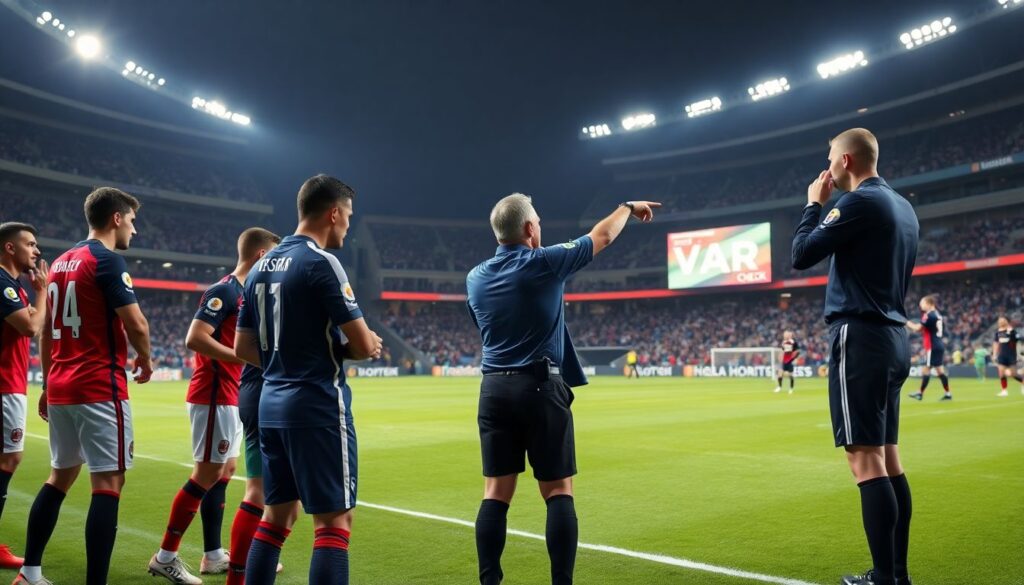
Tactically, VAR has inserted unplanned “timeouts” into a sport that traditionally resisted pauses. Long checks slow the heart rate, reset pressing intensity and, crucially, give coaches extra moments to issue instructions. Analysts have noticed that high-pressing sides in the Süper Lig often use VAR breaks to reorganise their press triggers and refresh verbal cues, almost like basketball huddles without the whiteboard. For opponents, the danger is obvious: teams that were physically under pressure get an unearned breather. That’s why some coaches now treat every potential VAR review as a “mini-interval” and prepare pre-scripted commands for those thirty surreal seconds.
Rhythm issues become most acute in the final 15 minutes, where late penalties and offside lines dominate narratives. The best analysis of VAR decisions in Süper Lig matches shows a clustering of decisive interventions after the 75th minute, when legs are heavy and reactions emotional. Teams that chase games often lose the plot during a contentious VAR check, arguing instead of organising for either scenario: penalty awarded or play resumed. More pragmatic coaches make their bench rehearse both reactions in video sessions: “If it’s given, we press here. If not, our shape is this.” In effect, they plan for parallel universes, so that whichever way the decision goes, the team restarts with an intentional rhythm rather than raw emotion.
Real Cases: From Chaos to Learned Adaptation
You can see this learning curve if you track big-club behavior across the last few seasons. Early in the VAR era, several title-deciding clashes turned into chaos after controversial calls, with benches flooding the technical zone and players allowing anger to bleed into the next five minutes. By 2024–25, the same clubs began to assign a “designated complainer”: one senior player allowed to engage the referee, while the rest were instructed to physically walk away and focus on shape. This tiny, almost bureaucratic adaptation considerably reduced yellow cards for dissent and kept teams tactically coherent after restarts, especially when a goal was overturned and emotional balance was at risk.
Another real shift appeared in how defenders use the offside trap. Knowing that semi-automated offsides and calibrated lines will be checked, some Süper Lig back lines consciously hold a higher risk line, trusting technology to rescue them on marginal calls. Yet the statistics on VAR influence in Süper Lig results reveal a sting in the tail: a meaningful portion of reviewed offsides still end up favouring attackers, either because the initial flag stayed down or because the line is tighter than defenders assume. Video analysts responded with a conceptual tweak: they now teach defenders not just to “step up”, but to step up with reference to camera angles and known calibration zones, effectively aligning tactical depth with the technological architecture of the broadcast.
Non-Obvious Solutions: Managing Emotion, Not Just Tactics
The most effective adjustments to VAR are psychological, not purely tactical. Some clubs have quietly brought in sports psychologists to build routines specifically for review moments. Instead of allowing players to gather around the referee, they practice breathing protocols and “reset” phrases: short verbal cues between teammates like “score nil-nil mindset” or “next action only”. These mental tools sound trivial, but in a stadium boiling over a penalty review, they create a sliver of cognitive distance. Over a long season, that can be the difference between controlled aggression and self-sabotage, especially in knockout races where one emotional meltdown can alter the title picture.
Another under-the-radar solution is scenario-based substitution planning. Smart benches treat VAR as a possible pretext for immediate, targeted changes. If a penalty is given against them late in the match, they’re ready with a substitution aimed at winning the second phase — for example, adding a fast winger to exploit space if the opponent retreats to protect the lead. Conversely, if a potential goal for their side is disallowed, they may insert a physically dominant forward to attack the psychological vulnerability of defenders who just “got away with one”. This use of VAR as a trigger, rather than a mere interruption, reframes the technology as a strategic resource.
Alternative Frameworks: Beyond “Right or Wrong Call”
Debates often stagnate around Süper Lig referees and VAR mistakes, as if the only metric were accuracy. A more productive framework, already used in some analytics departments, treats VAR as a “variance compressor” that reduces extreme injustices but introduces its own micro-randomness via interpretation, camera angles and protocol limits. Analysts then measure not just whether a call is correct, but how predictable the decision type is based on historical patterns. If a certain type of handball produces wildly inconsistent outcomes, coaches adjust by telling defenders to avoid that body position entirely, not because the law is clear, but because the decision space is chaotic.
Some clubs go even further and build what you might call “VAR heatmaps”. Instead of only tracking where chances originate, they log where review-prone actions occur: marginal offsides near specific camera towers, crowded penalty-area zones that historically lead to checks, or particular duels prone to slow-motion exaggeration. By overlaying these maps onto their game models, they design attacking patterns that retain threat but minimise contact in zones where VAR tends to punish even incidental fouls. It’s a subtle shift: not avoiding the box, but avoiding the messy types of contact that become incriminating when replayed frame by frame from three angles.
Pro Lifehacks: How Pros Can Live With VAR Instead of Fighting It
For players, the first practical “lifehack” is information hygiene. Veterans now insist on appointing one teammate to listen to the referee, while the rest avoid speculating about what the VAR room is seeing. The more rumours spread on the pitch — “they said it’s clear handball”, “someone saw offside” — the more cognitive load rises. Keeping the information channel narrow preserves focus. Another trick is to treat every goal as provisional in body language: celebrate with teammates, not against opponents. This reduces the emotional crash if the goal is scratched and prevents needless provocations frozen forever in highlight reels.
Coaches have their own toolbox. Some deliberately normalise VAR disappointment in training: they simulate goals, then randomly “disallow” them and demand instant tactical reaction. Over time, players learn that emotional protest is wasted energy compared with reorganising for the next phase. Analysts, for their part, can make peace with VAR by separating process from outcome in post-match reviews. Instead of obsessing over one overturned goal, they ask: “Did our structure produce enough clean chances that VAR can’t kill?” This mindset shifts the narrative from victimhood to control and, paradoxically, makes it easier to mount a calm, evidence-based complaint when a genuine injustice does occur.
Looking Ahead: VAR in the Süper Lig by 2030
Standing in 2026, we’re past the experimental phase and into the optimisation era. Future debates in Turkey will likely move from “Do we keep VAR?” to “How do we integrate it more transparently?” Expect more semi-automated offside, faster communication and, crucially, improved in-stadium explanations. If leagues publish near real-time clips and referee audio after controversial incidents, the raw anger may soften into informed critique. That, in turn, will help create the best analysis of VAR decisions in Süper Lig history, as external data scientists gain cleaner, contextualised information. The technology won’t end controversy, but it will shift it from conspiracy theories to methodological arguments.
By 2030, the clubs that thrive will be those that treat VAR as a stable environmental condition rather than a cosmic injustice. They’ll integrate VAR metrics into scouting — avoiding defenders with reckless contact profiles, valuing forwards who stay onside by instinct. Youth academies will drill “VAR-aware defending” alongside pressing and build-up. And if governance keeps pace, the old image of VAR as an alien intrusion may fade, replaced by a more humble view: football in the Süper Lig is still a human game — just one where every key emotion, and every mistake, now has a replay button.