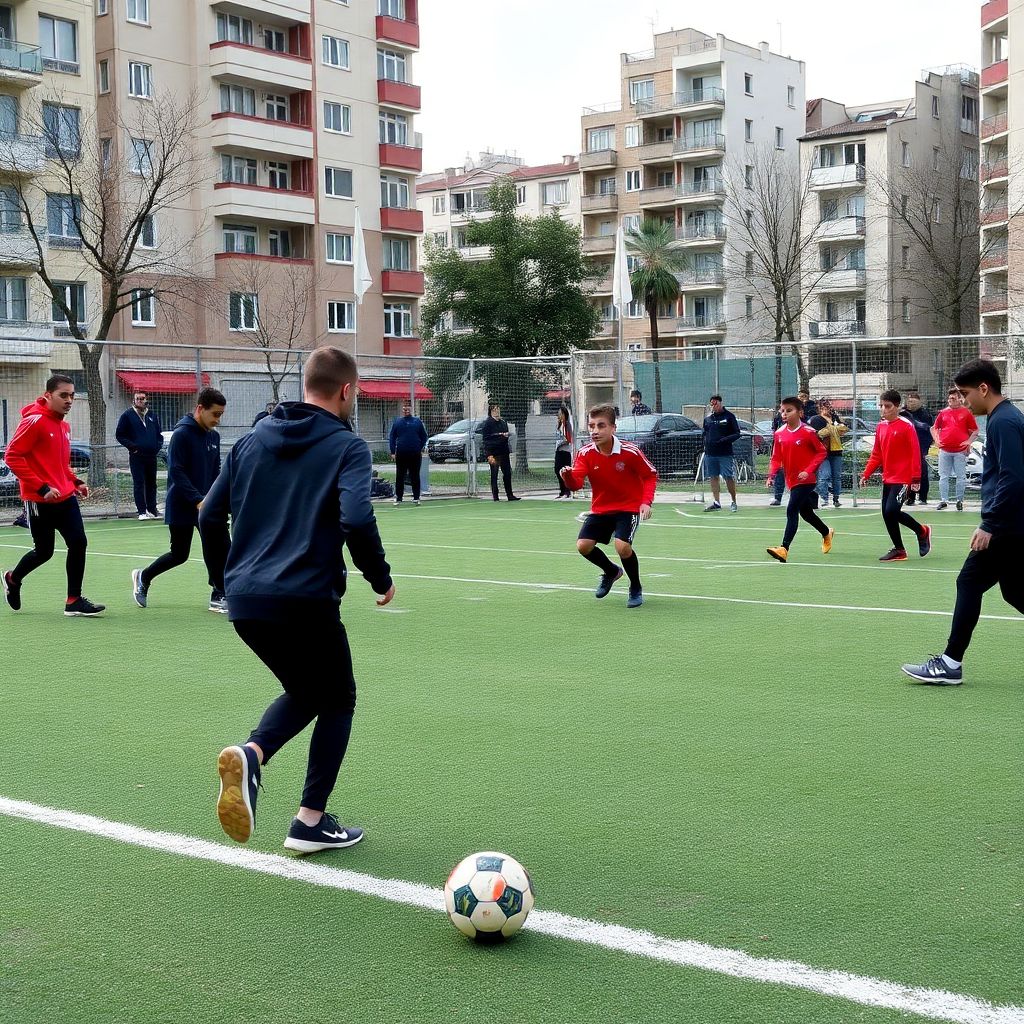
Turkish urban football culture shapes players through tight spaces, constant improvisation and strong community pressure, but it also brings safety, injury and education risks if unmanaged. Use street play as a creative base, then add structured work in clubs, Turkish football training camps for youth players and professional football coaching clinics in Turkey.
Common Myths and Central Claims
- Myth: Street football alone can turn any Istanbul kid into a professional; reality: it creates a technical base but needs structured coaching and education.
- Myth: Formal academies kill creativity; reality: good coaches protect street flair while adding tactics and physical preparation.
- Myth: More hours on asphalt always mean faster progress; reality: overuse on hard ground increases injury risk and bad movement habits.
- Myth: Scouts find every talented street player; reality: location, family support and information access strongly affect visibility.
- Myth: Urban style is only showboating; reality: it also builds first touch, scanning and 1v1 defending that top leagues value.
- Myth: Buying street football style inspired football boots for sale will make a player look and play “Turkish”; reality: style comes from training environment and decisions, not just equipment.
Istanbul’s Streets as Training Grounds: Historical and Spatial Context
Myth: Istanbul’s streets are a natural football paradise where kids safely play from morning to night. In practice, traffic, uneven ground and crowding constantly shape what is possible and what is dangerous.
In districts like Kadıköy, Beşiktaş or Fatih, many players grow up on sloped side streets, school yards and small mosque courtyards. These improvised pitches force close control and quick decisions, but also expose children to cars, concrete falls and occasional conflicts with neighbours. Safe development requires adults to define clear time slots, safer spots and simple rules.
This urban culture means that “from street to stadium” is not a romantic accident. The environment filters for kids who learn to protect the ball in chaos, anticipate rebounds from walls and adapt to different surfaces. At the same time, long evening games on hard asphalt without warm-up or hydration increase knee and ankle stress. Parents and local coaches should gradually direct players towards safer mini-pitches and club sessions once basic street skills appear.
Consider a boy from Üsküdar playing nightly 3v3 in a narrow dead-end street. His first touch becomes excellent under pressure, but he also develops a habit of bending his back over the ball to avoid bumps. A safe step is to combine these games with weekly, well-supervised sessions at one of the best Turkish football academies in Istanbul, where posture and landing mechanics get corrected.
Technical Signatures: Ball Control, Creativity and Improvisation
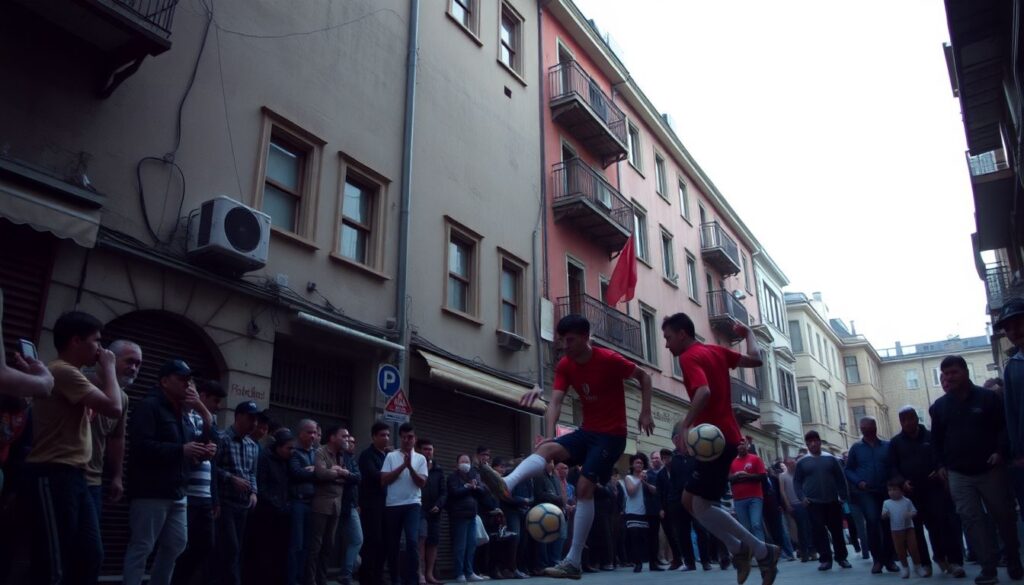
Myth: Turkish street players focus only on flashy nutmegs and tricks. In reality, the urban game engraves deeper technical habits that can help or hurt a player on professional pitches.
- First touch in traffic. Tight alleys and crowded school yards leave no time. Players learn to control the ball with any surface and instantly shield. Safe step: repeat 1-touch and 2-touch wall passes on flat surfaces to correct awkward landings learned on broken asphalt.
- Low centre of gravity and shielding. Kids automatically play semi-crouched to absorb contact and protect the ball from older or heavier opponents. Limitation: excessive leaning forwards can overload the lower back. Add simple core stability drills and upright receiving patterns in structured sessions.
- Use of walls and obstacles. In many Istanbul courtyards, walls, stairs and parked cars become partners. Players learn to predict rebounds and create passing angles. Coaches later must translate this habit into using teammates instead of physical obstacles through positional rondos.
- Unscripted 1v1 creativity. Repeated duels in narrow lanes force players to invent new feints. The problem appears when these feints are overused on big pitches. A balanced drill is 1v1 in a narrow channel with a clear rule: after beating the defender, the attacker must pass or finish within two touches.
- Weak-foot improvisation. When space closes on the strong foot, kids often use the weaker one out of necessity, not planning. To keep this advantage safely, coaches in academies and professional football coaching clinics in Turkey should formalise weak-foot passing and shooting blocks, including proper technique and warm-up.
- Surface adaptation. Shifting daily between tiles, dust and artificial turf teaches micro-adjustments in step length and contact. Limitation: some players never fully standardise a repeatable technique. Safe progress means choosing one “home surface” for core technical work and using others only for variation.
Small-Sided Logic: Tactical Patterns Born from Tight Spaces
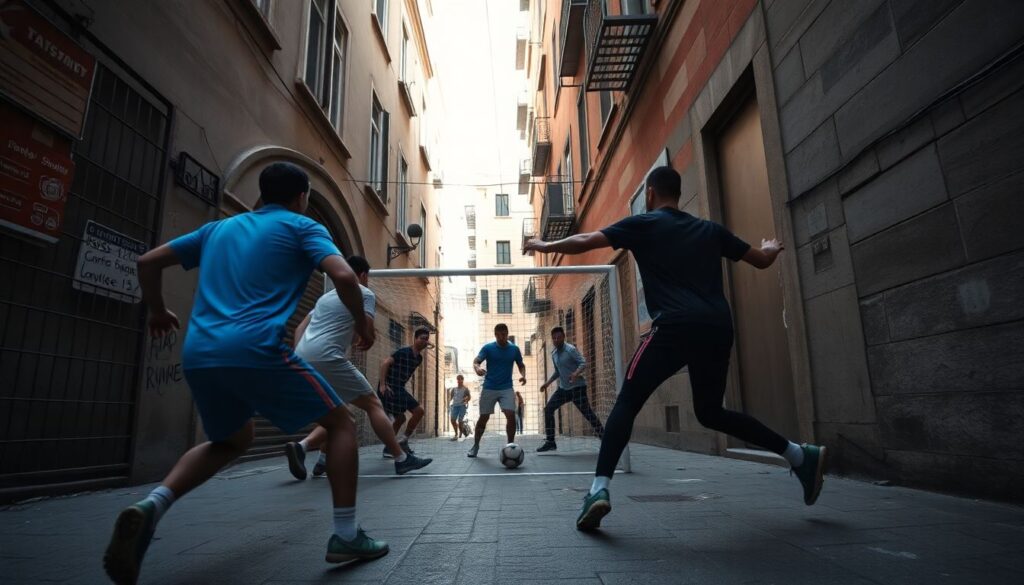
Myth: Street football has no tactics, only chaos. The reality is that repeated 3v3 or 4v4 games on Istanbul backstreets create strong tactical patterns that later appear in professional matches.
- 3v3 in a dead-end alley. One entrance, two walls, one goal: this common layout builds habits of triangle support and constant rotation. Safe step for youth coaches: recreate this as a 3v3 alley game on artificial turf, marking side lines with cones instead of parked cars.
- Cage-style school yards. Concrete yards surrounded by fences push players to press aggressively because the ball rarely leaves the field. The limitation is over-aggressive tackling. Coaches should introduce a “touch not tackle” rule in similar drills to protect ankles and encourage clean positioning.
- Multi-age pickup games. Ten-year-olds often play with teenagers. Younger players learn to find space between physically stronger opponents instead of fighting them. The risk is injury from mismatched contact. Safe adaptation: design 5v5 games where older players must play with limited touches, reducing dangerous duels.
- One-goal formats. Sometimes the neighbourhood has only one goal. Teams attack in waves and then quickly transition to defence. This builds transition awareness but can hardwire everyone to chase the ball. On bigger pitches, coaches should add clear zones and passing targets to upgrade this instinct into structured pressing.
- Winner-stays-on competitions. The losing team leaves the court, so every goal is decisive. Players learn to manage risk and tempo. Limitation: fear of mistakes may suppress creativity. Adjust by adding a simple rule: the winning team must complete a set number of passes with at least one risk pass forward.
Community Forces: Family, Neighbourhood Networks and Informal Clubs
Myth: Talent naturally rises from the streets if the community supports the kid with love. Support helps, but unstructured pressure, expectations and lack of information often limit safe progress.
Strengths of Community-Driven Development
- Constant access to games. Families and shop owners often tolerate long evening matches in side streets, giving children daily repetition without formal booking or fees.
- Role models next door. Local semi-professionals or ex-players teach tricks and stories in places like Bağcılar or Kartal, showing a visible pathway upwards.
- Emotional safety and belonging. Kids feel ownership of their pitch, which reduces fear of failure and encourages trying new moves.
- Informal mentors. A respected older player might quietly manage teams, avoid fights and guide talented kids towards local clubs and Turkish football training camps for youth players.
Limitations and Hidden Risks
- Overload without recovery. Daily, long matches with no rest schedule or stretching increase overuse injuries and burnout risk.
- Education sacrificed for training. Some families push kids to skip homework or even school for extra games or distant friendlies, which is unsafe for long-term life outcomes.
- Unequal visibility. Children in central districts meet more scouts and club coaches than those in peripheral or low-income areas, regardless of pure talent.
- Misinformation about pathways. Well-meaning neighbours sometimes give wrong advice about trials, contracts or agents, exposing families to exploitation.
- Social pressure to play through pain. Phrases like “just walk it off” can normalize playing with injuries. Safe culture means teaching kids to report pain early and rest.
Pathways Upwards: Scouting, Trials and the Shift to Club Academies
Myth: If a child is good enough, big clubs will automatically find them on the street. In reality, safe progress from urban games to elite academies requires planned steps and awareness of common errors.
- Over-chasing famous clubs only. Many families wait only for major Istanbul clubs and ignore smaller academies or regional teams. This limits playing time and increases stress. Safer approach: aim for consistent minutes and trusted coaches first, fame later.
- Ignoring physical preparation before trials. Players used to street games often arrive at trials without proper warm-up habits, nutrition or sleep. They then underperform or get injured. Simple routine: three nights of stable sleep, light ball work only, and a clear warm-up pattern rehearsed in advance.
- Paying for dubious “guaranteed” showcases. Some private events promise direct access to top clubs. Without clear club partnerships and transparent rosters, these can waste money and create disappointment. Always verify who will watch, what level attends and whether feedback is documented.
- Dropping school too early. The belief that serious football cannot coexist with education is dangerous. Safe planning keeps school as a core pillar, with training blocks arranged around it, especially when attending the best Turkish football academies in Istanbul that usually coordinate with schools.
- Switching clubs too often. Jumping every season in search of instant promotion disrupts development and social stability. A safer rule is to stay at least one full year unless there is evidence of poor safeguarding, lack of playing time or clearly unsuitable level.
- Confusing tourism with scouting. Some football tours to Turkey for youth teams offer great cultural and match experiences but are not real scouting platforms. Families should enjoy them as learning trips, not as guaranteed professional gateways.
Institutional Responses: Coaching Methods, Facilities and Policy Changes
Myth: Modern academies must erase street habits and start from zero. Many Turkish clubs now try to keep the creativity of urban play while adding safety, structure and long-term planning.
Clubs and municipalities increasingly convert unsafe asphalt yards into mini artificial-turf pitches with fences and lighting. This preserves the feel of the small-sided game while reducing falls on concrete and interactions with traffic. Academies design 3v3 and 4v4 drills that intentionally mirror neighbourhood games from places like Şişli or Gaziosmanpaşa but with controlled contact rules and clear learning objectives.
Professional football coaching clinics in Turkey often teach local coaches how to blend unscripted play with periodised workloads. A typical microcycle might include one “free street-style” session, one technical block and one tactical game day. The safe principle is simple: keep creativity, regulate volume and monitor growing joints and fatigue.
Mini-case: A 13-year-old from Beyoğlu, famous in his street for nutmegs, joined an academy that initially tried to remove his flair. His performance dropped, and he lost confidence. A new coach changed the plan: one weekly 3v3 “Beyoğlu street” game on artificial turf, one positional rondo to teach timing of risk, and one simple strength session for ankles and hips. Within months his 1v1 skills remained, but he learned when to pass, stopped playing through pain and gradually progressed to regional competition. This pattern-respect origin, add structure, control risk-is the safest way to move from street football to professional pitches.
Concise Clarifications and Persistent Misconceptions
Is street football in Istanbul enough to reach the professional level?
No. Street football can build first touch, courage and creativity, but professional clubs look for tactical understanding, physical preparation and emotional stability. Safe progress combines street games with club training, age-appropriate strength work and consistent schooling.
At what age should a talented street player join an academy?
There is no single perfect age, but once basic coordination and love for the game appear, usually in primary school, adding structured training becomes helpful. The key is to avoid sudden volume spikes: gradually replace some street sessions with academy work instead of adding everything on top.
Do academies remove the unique Turkish street style?
Poor coaching can suppress creativity, but well-run academies protect street skills while adding tactics and safety. Parents should look for training plans that include 1v1s, small-sided games and decision-based drills, not only running and rigid patterns.
Are paid trials and showcases in Turkey always scams?
Not always, but many are oversold. A safe rule is to pay only when event organisers clearly name the attending clubs, level of players and type of feedback. Families should treat such events as one opportunity among many, not as guaranteed contracts.
How can families reduce injury risk from hard street surfaces?
Limit the total duration of games on concrete, encourage proper warm-up and stretching, and use shock-absorbing footwear. When possible, move regular games to nearby artificial-turf or rubber courts and reserve asphalt play for shorter, lighter sessions.
Do special “street style” boots change how a kid plays?
Boots affect comfort and grip, not decision-making or vision. Buying street football style inspired football boots for sale may motivate a child, but development still depends on smart training design, safe workload and quality coaching.
Are international youth tournaments in Turkey real scouting opportunities?
Some high-level events attract serious scouts, while others are mainly cultural exchanges. Football tours to Turkey for youth teams are valuable for learning to travel, adapt and face new opponents, but families should confirm scout attendance before expecting professional impact.