Turkish clubs struggle in Europe because their financial models, academies, coaching structures, governance and facilities are misaligned with modern elite standards. Debt-driven squads, weak youth pathways, unstable coaching and politicised boards create fragile performance. Improving structure, not just buying star players, is essential if turkish football clubs in european competitions are to compete consistently.
Structural Barriers Summarised
- Short-term, debt-fuelled spending replaces stable revenue growth and disciplined budgeting.
- Academy systems produce too few first-team regulars, so squads depend on expensive imports.
- Coaches change frequently, with limited time to build adaptable, European-level game models.
- Club governance is often politicised, opaque and election-driven rather than performance-driven.
- Training facilities and sports science lag behind top European benchmarks, increasing injury risk.
- Domestic scheduling, travel and pressure intensify fixture congestion and reduce European freshness.
Immediate Tactical Adjustments for European Nights
Before structural reform fully lands, clubs can still make smaller changes that matter in UEFA ties.
- Standardise set-piece routines and defensive distances specifically for European opponents.
- Rotate domestically before away UEFA games instead of “must play all stars” thinking.
- Use data-driven opponent reports: press triggers, build-up patterns, transition threats.
- Prioritise continuity in back four and goalkeeper across the whole European campaign.
- Adopt stricter internal discipline on tactical roles to reduce chaotic pressing and spacing.
Financial Foundations: Revenue Streams, Debt and Spending Discipline
Financial foundations describe how a club earns money, manages debt and invests in players, staff and infrastructure. For many Turkish teams, TV income and short-term sponsorships dominate, while sustainable matchday and commercial growth remain limited. This creates a fragile base compared with top European clubs that combine diversified revenues with clear cost controls.
In this context, why turkish teams fail in champions league often starts off the pitch. Clubs chase instant European qualification by overpaying aging stars, deferring payments and accepting complex loan deals. Wage-to-income ratios become unhealthy, leaving little margin for strategic investment in academies, analytics staff or facilities that would truly improve competitiveness.
Debt structures further restrict flexibility. Refinanced stadium projects, foreign-currency loans and unpaid transfer instalments tie future income to past decisions. Instead of using unexpected European windfalls to de-leverage, boards frequently commit them to new, high-risk transfer campaigns. The cycle repeats: brief peaks, then forced squad sales and decline.
| Metric | Typical Turkish Club | Top European Benchmark Club |
|---|---|---|
| Revenue level | Moderate, volatile, TV-heavy | High, diversified (matchday, media, commercial) |
| Net transfer spend profile | Short-term net spender, little resale planning | Balanced, with regular profitable sales |
| Youth graduates in squad | Few consistent starters | Several academy regulars plus rotation players |
| Average head coach tenure | Short, frequent changes | Longer, multi-season cycles |
| Stadium capacity vs utilisation | Modern but underutilised, weak ancillary income | Optimised utilisation with strong non-match events |
| UEFA coefficient trend | Fluctuating, dependent on 1-2 clubs | Stable or improving, multi-club contribution |
Case study – successful exception: Galatasaray’s UEFA Cup and Super Cup run around 2000 combined a stable core, sensible recruitment and a strong coach. Financially, the squad was coherent, not a random collection of expensive names. This alignment shows that the gap is structural, not cultural or “genetic”.
- Reprioritise budgets: cap first-team wages as a share of income and dedicate a fixed slice to academy, analytics and medical departments.
- Use any European windfalls first to reduce debt and renegotiate loan terms, only then to strengthen key weak positions.
Academy Culture: Talent Development, Scouting and Retention
Academy culture covers how a club identifies young talent, develops it technically and mentally, and integrates graduates into the first team. For turkish football clubs in european competitions, this is the most under-utilised competitive lever compared with clubs like Ajax, Benfica or Sporting that rely on academy production as a core model, not a bonus.
- Long-term game model alignment: Youth teams train in similar structures and roles as the first team, so promotion is smoother.
- Integrated scouting network: Regional and data-informed scouting brings in diverse profiles early, not just late physical maturers.
- Individual development plans: Each prospect has targeted work on weaker skills, mentality and physical load, monitored over years.
- Clear promotion pathways: Loan strategies and rotation plans are agreed so promising players receive real minutes, not just pre-season appearances.
- Retention and contract policy: Smart timing on contracts and extensions avoids losing talent cheaply or blocking their progression.
- Coach education integration: Academy coaches share methods, language and principles with first-team staff to prevent “two different clubs” inside one badge.
Case study – foreign benchmark: Benfica repeatedly reaches latter European stages while selling academy products at high fees. Their model treats each youth player as both potential starter and financial asset. This discipline contrasts sharply with Turkish clubs, where promising players often stagnate as squad fillers or are sold without strategic timing.
Applied Academy Scenarios for Turkish Clubs
Scenario 1: A mid-table Super Lig club decides that within three seasons, at least three academy players must be regular starters. They redesign the U17-U19 training to mirror the first team, appoint a loans manager and tie coach bonuses partly to academy minutes.
Scenario 2: A bigger Istanbul club targets “one major sale every two years” from its youth system. Scouting focuses on positions with high global demand (ball-playing centre-backs, modern full-backs, creative midfielders), and contract planning ensures these players reach peak value while still under control.
- Define a measurable academy objective (percentage of minutes, number of promoted players or target sale cycle) and align all age groups around it.
- Invest in two critical roles: a head of youth development with authority and a data-literate scouting coordinator who bridges academy and first team.
Tactical Ecosystem: Coaching Quality, Match Preparation and Adaptability
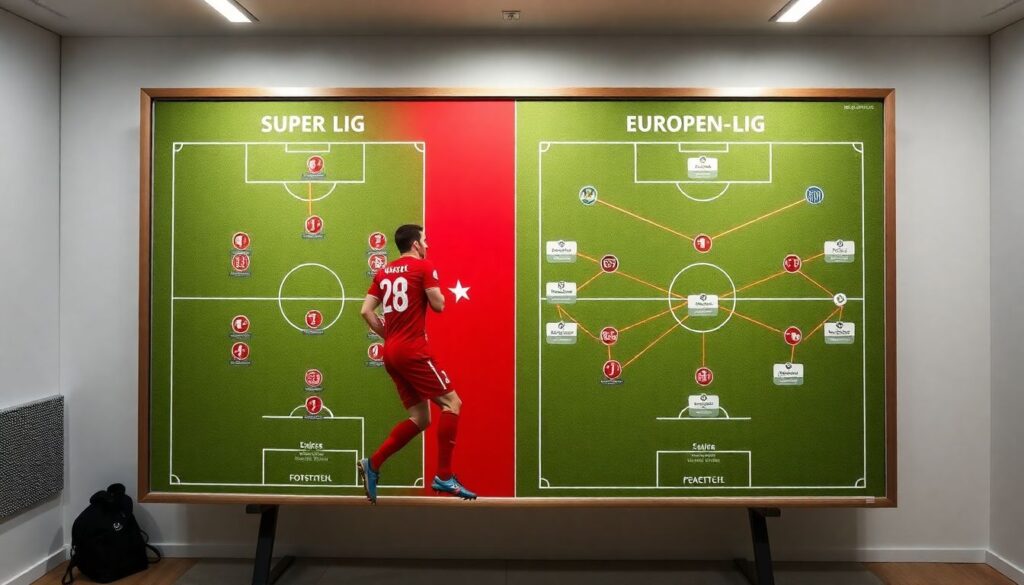
Tactical ecosystem refers to the combination of coach quality, analysis resources, training design and in-game adaptability. In a realistic turkish super lig vs european leagues analysis, one key gap is that domestic games often reward emotional intensity and individual skill, while European games punish structural weaknesses relentlessly.
Typical scenarios where this ecosystem matters include:
- Group stage away match vs possession-dominant team: Clear pressing triggers, compact block distances and transition plans are essential. Without them, the game becomes stretched and exposes slow or ill-positioned defenders.
- Home match vs deep-block opponent in qualifiers: You need rehearsed mechanisms to create overloads, rotations and third-man runs, not just hopeful crosses and long shots.
- Two-legged knockout tie: Managing scorelines, away goals (where relevant) and fatigue requires different tactical plans for each leg and scenario.
- In-game injury or red card: Coaching staffs must re-balance structure within minutes, maintaining stability instead of chaotic role changes.
- Facing high pressing sides: Building automatisms for playing out of pressure, including rehearsed long-ball patterns, protects confidence and field position.
Case study – repetitive failure: Many Turkish clubs lose control of Champions League qualifiers by chasing games emotionally after conceding. Shape collapses, lines disconnect and the opponent scores more on counter-attacks. This pattern explains part of why turkish teams fail in champions league even before facing the very biggest clubs.
- Stabilise coaching cycles: commit to multi-season tactical projects and recruit players who suit a defined game model instead of changing philosophies each year.
- Expand analysis teams and pre-match routines, including mandatory video sessions and specific training blocks for likely European tactical scenarios.
Club Governance: Ownership Models, Transparency and Political Influence
Club governance shapes who actually makes decisions, how accountable they are, and what incentives they face. In many Turkish clubs, presidents are elected on populist promises, while boards mix business interests with political networks. This structure encourages short-termism, headline transfers and risky borrowing to satisfy fan expectations quickly.
Compared with stable ownership models in Europe’s best-run clubs, Turkish governance often lacks clarity on performance targets, decision rights and risk tolerance. Transfer committees can be fragmented, with agents and intermediaries exerting outsized influence. Budget overruns or failed signings rarely lead to systematic reviews, so mistakes repeat across cycles.
Potential Advantages of Improved Governance Models
- Longer planning horizons: multi-year squad and budget strategies instead of season-to-season improvisation.
- Clear accountability: defined roles for sporting director, head coach and board reduce interference and confusion.
- Better investor confidence: transparent reporting and realistic targets make it easier to attract patient capital.
- Reduced political pressure: professional structures can buffer short-term media storms and keep projects on track.
Limitations and Risks in Current Governance Structures
- Election-driven decisions: presidents prioritise visible signings over hidden but vital spending on data, medical and academy.
- Agent dependency: clubs overpay for players because they lack internal scouting depth and negotiating leverage.
- Opaque finances: limited transparency on debt and liabilities makes long-term planning difficult and risky.
- Unstable sporting leadership: sporting directors change often or have weak mandates, leaving no coherent football philosophy.
- Separate football decisions from electoral cycles by empowering a professional sporting director with clear authority and KPIs.
- Publish simplified, regular financial and strategic updates to fans and stakeholders to build pressure for discipline and continuity.
Operational Backbone: Stadiums, Training Facilities and Sports Science
Operational backbone means the physical and human infrastructure that supports performance: stadiums, training grounds, medical rooms, gyms, analytics hubs and staff. Many Turkish clubs have impressive stadiums but outdated or under-resourced training environments, which undermines consistency, injury prevention and recovery for high-intensity European schedules.
Common mistakes and myths include:
- “New stadium equals modern club”: Matchday arenas can be elite while training pitches, gyms and recovery zones remain below European standards.
- Over-reliance on charisma: Believing motivational talks can replace structured sports science, load management and nutrition plans.
- Understaffed medical teams: Expecting a small medical staff to manage dense calendars, frequent flights and older squads without proper support.
- Inconsistent data use: Collecting GPS or wellness data but not integrating it into selection, substitution and training-volume decisions.
- Neglecting youth facilities: Investing mainly in first-team areas while academies train on poorer pitches with weaker medical coverage.
Case study – foreign operational benchmark: Clubs like Bayern, Manchester City or, at a smaller scale, RB Leipzig, design “football campuses” where first team and academy share aligned facilities, sports science and analytics. This horizontal integration is still rare among Turkish sides, who often split resources and standards across locations.
- Audit all facilities with external experts, prioritising training-ground improvements (pitches, gyms, recovery areas) over cosmetic stadium upgrades.
- Hire or empower a head of performance who coordinates medical, fitness and data teams, with a direct line to the head coach.
Competitive Context: Domestic Calendar, European Experience and Fixture Congestion
Competitive context covers how the domestic league schedule, cup commitments and travel demands interact with European matches. Turkish clubs often face emotionally intense derbies, heavy domestic pressure and long-distance trips just before or after UEFA fixtures, reducing freshness and psychological balance.
Mini-case: A Turkish club draws a technically strong but physically moderate opponent in a Europa League knockout tie. The domestic federation schedules a high-stakes derby three days before the first leg. The coach, under pressure, fields the strongest XI in both games. Tired players lose duels late in the European match, concede an away goal and face an uphill task away from home. Better rotation and communication with league organisers could have altered the outcome.
For anyone studying how to improve turkish football clubs performance in europe, this calendar management is crucial. It is not only about having good players but about ensuring they reach European games in peak physical and mental condition. Fixture congestion without smart rotation or squad planning turns even winnable ties into survival battles.
- Plan season-long rotation maps in pre-season, identifying which domestic games will feature altered line-ups around key UEFA dates.
- Work collectively through league and federation structures to lobby for small but meaningful calendar adjustments that protect European representatives.
Concise Responses to Typical Strategic Objections
Is the gap only about money, not structure?
Financial muscle matters, but poor structures waste whatever money exists. Some clubs with smaller budgets outperform Turkish sides through academy production, tactical consistency and disciplined recruitment. Structural reform ensures that any future revenue growth actually translates into European competitiveness.
Can Turkish clubs realistically copy models like Ajax or Benfica?
They cannot copy-paste, but they can adapt principles: clear game model, academy focus, and strategic trading. Local realities differ, yet the logic of using youth development as both sporting and financial engine is highly relevant for best strategies for turkish clubs in uefa competitions.
Does fan pressure make long-term planning impossible?
Fan pressure is intense, but governance design can buffer it. Transparent plans, realistic goals and consistent messaging reduce volatility. Boards that hide behind short-term promises create the very instability they blame on supporters.
Are Turkish players technically good enough for Europe?
Technical quality exists, but development environments do not always maximise it. Structured coaching, better physical preparation and earlier exposure to high-level competition would help talents convert their potential into reliable European performances.
Is the Super Lig’s overall level too low to prepare clubs for Europe?
Domestic level is part of the issue, but it is not destiny. Through targeted reforms and collaborative planning, the league can become a better preparation platform. Thoughtful turkish super lig vs european leagues analysis should guide rule changes, not fatalism.
Will more foreign stars alone solve the European problem?
Short-term, experienced foreigners can help, but without structural change they become expensive band-aids. Sustainable success requires integrating them into a coherent system with strong academies, stable coaching and clear financial discipline.
Where should clubs start if resources are limited?
Begin with governance clarity, coaching stability and academy alignment. These require more organisational courage than cash. From there, reinvest any incremental success into facilities and data capabilities, always guided by how to improve turkish football clubs performance in europe, not just domestically.