Historical context: from local idols to continental exports
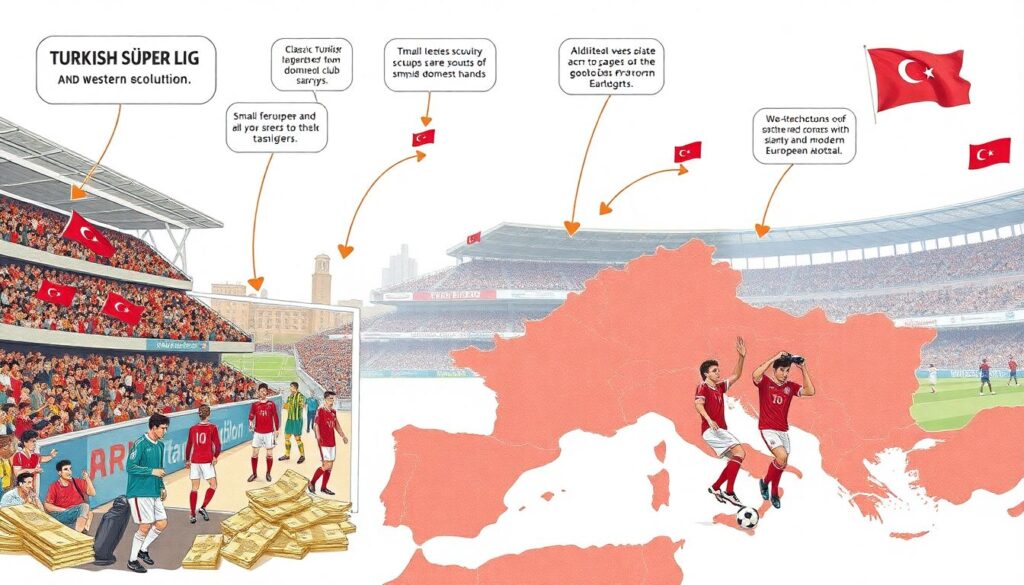
If you zoom out a bit, the story of Turkish footballers moving from Anatolia to Europe is actually pretty recent. Until the mid‑1990s, most elite Turkish players stayed in the Süper Lig because the domestic league paid well, the language barrier was serious, and scouting networks were less sophisticated. The few who did leave – like Metin Oktay in the 1960s or Rıdvan Dilmen’s brief stint – were exceptions, not a steady stream. The real structural shift came with the Bosman ruling, the growing power of European TV rights, and the increased visibility of the national team after Euro 1996 and especially the 2002 World Cup, which functioned as a global showcase for Turkish football players in Europe and changed how clubs assessed the market in Turkey.
The second major turning point came with the large Turkish diaspora in Germany, the Netherlands and France maturing into a stable talent pool. Players born or raised abroad, such as Nuri Şahin, Mesut Özil or İlkay Gündoğan, showed that Turkish‑background players could already be integrated into European academies, speaking the language and understanding tactical frameworks from day one. By the 2010s, it was no longer just about isolated stars; there was a more predictable pipeline. In the last three completed seasons before mid‑2024, there were typically 25–35 Turkey‑eligible players under contract in the top five European leagues each year, a volume that would have been unthinkable two decades earlier and that underpins the current wave of best Turkish footballers playing abroad.
Core principles behind “making it” abroad
Tactical adaptability and positional intelligence
For a long time, the stereotype about Turkish players abroad was that they were technically gifted but tactically undisciplined. Modern data paints a more nuanced picture. The guys who truly stick in Europe tend to be those who can function in multiple tactical systems and interpret space efficiently. Think of Hakan Çalhanoğlu, who reinvented himself from a half‑space playmaker into a deep‑lying regista at Inter, sharply improving his defensive duel success and progressive passing metrics. In practical terms, scouts now look at whether a player can operate within high‑pressing schemes, compact mid‑blocks and positional play – not just whether he can dribble or shoot from distance.
Over the 2021/22–2023/24 span, you see this clearly in on‑ball event data. Turkish central midfielders and centre‑backs who lasted more than one season in top European leagues typically posted above‑average pressures per 90 and were trusted in build‑up phases, not just in low‑risk roles. That’s why many top Turkish soccer talents in European leagues are either ball‑playing defenders or flexible midfielders rather than pure poachers. Versatility – the capacity to cover several roles while maintaining tactical coherence – is almost a hard requirement. When we talk about “making it” abroad in 2026, we’re really talking about internalizing this multi‑system tactical literacy.
Physical and psychological adaptation
The second big principle is adaptation, both physical and psychological. Workload data from the last three seasons shows that in the Premier League, Bundesliga and Serie A, average high‑intensity running per match is significantly higher than in the Süper Lig. Players who moved from Turkey to, say, Germany often needed at least one full pre‑season to match the intensity levels. This explains why some signings look underwhelming in year one and then suddenly “click” once their conditioning profile catches up and injury risk decreases.
Psychologically, the difference between being a local star and a squad player abroad is huge. Interviews and performance curves suggest that players who engaged early with language lessons, club sports psychologists and structured integration programs had smoother adaptation arcs. From 2021 to 2024, several Turkish players who struggled in their first season abroad later stabilized once they had family support, better housing and consistent communication with coaching staff. In other words, mental load management and cultural integration are not soft factors; they’re performance variables that can decide who joins the list of best Turkish footballers playing abroad and who quietly returns home after one difficult year.
Implementation in practice: case studies and trends
From academy to spotlight: emerging talents
At the sharp end of the pipeline, the stories of young prospects explain how the current system works. Arda Güler’s move from Fenerbahçe to Real Madrid is the obvious flagship example. Despite limited minutes due to injuries in 2023/24, his per‑90 data – chance creation, progressive carries, shot quality – indicated a player whose output strongly exceeded his age baseline. He represents a new pattern: Turkish clubs pushing for higher upfront fees and sell‑on clauses, while big European clubs accept that development minutes may initially be scarce but see the upside in securing top Turkish soccer talents in European leagues before rivals do.
Below that elite tier, there are more modest but still telling trajectories. Between 2021/22 and 2023/24, a notable portion of Turkish youngsters didn’t jump directly from Süper Lig to top‑five leagues; instead, they used stepping‑stone competitions such as the Belgian Pro League, the Austrian Bundesliga or the Dutch Eredivisie. These leagues offer a mix of tactical sophistication and lower media pressure, making them ideal laboratories for adaptation. Data from those seasons shows a clear uptick in total minutes logged abroad by Turkey‑eligible players under 23, which correlates with the growing interest in transfer news Turkish players to European clubs outside the usual Germany‑England‑Spain triangle.
Established stars and league‑specific fits
On the more established end of the spectrum, fit with league identity has been crucial. Famous Turkish players in Premier League and La Liga often thrived when their physical and technical profiles matched club playing styles. Çağlar Söyüncü’s peak years at Leicester coincided with a system that valued aggressive front‑foot defending and vertical transitions, amplifying his strengths. In contrast, Turkish attackers in La Liga tended to succeed when they combined high technical security with off‑ball intelligence, as Spanish teams generally emphasize positional play and ball retention.
Statistically, over the last three seasons up to 2023/24, Turkey‑eligible players in Serie A and the Bundesliga logged more defensive actions and aerial duels per 90 compared to their counterparts in La Liga, where passing volume and reception in tight spaces were more strongly weighted. This divergence explains why certain profiles – robust centre‑backs, high‑work‑rate box‑to‑box midfielders – migrate naturally towards Germany and Italy, while more subtle playmakers and hybrid forwards are targeted by Spanish clubs. The outcome is that when you scan lists of the best Turkish footballers playing abroad, you see an implicit segmentation by role and league that reflects underlying tactical ecologies rather than random distribution.
Common misconceptions about Turkish players abroad
“They can’t handle the top level”
One stubborn myth is that Turkish players lack the mentality or consistency for sustained success abroad. This narrative ignores both context and data. Injury histories, tactical misuse and unstable club environments often explain failed spells better than any supposed “national character.” For instance, several defenders who looked error‑prone in their first Premier League seasons improved dramatically once paired with more compatible partners or under coaches who simplified their decision‑making tree. When you control for age, minutes and team quality, performance metrics of Turkish players in major European leagues over the 2021–2024 period largely sit within the normal variance you’d expect from any mid‑tier footballing nation.
The flip side of the same misconception is the habit of overhyping every breakout season as proof that a new era has begun. In reality, the pool is still relatively small compared with traditional exporters like Brazil or France, so fluctuations are natural. A couple of high‑profile disappointments can skew public perception. However, when you aggregate contribution – goals, assists, defensive interventions, expected goals involvement – Turkish football players in Europe have gradually increased their overall impact in top‑five leagues over the last three seasons. The trend is incremental, not explosive, and that’s actually a sign of structural consolidation rather than a fragile boom that depends on one or two outliers.
“It’s all about raw talent – the rest will sort itself out”
A second misconception is that once a player is talented enough, success abroad is automatic. Modern football doesn’t work like that. Elite performance is a systems problem: coaching quality, sports science, data‑driven role allocation, and support staff all mediate how much of a player’s potential is translated into output. Several promising Turkish forwards, for example, have struggled because they were deployed as lone strikers in low‑chance teams, meaning their expected goals numbers were suppressed and their confidence eroded, leading fans to underestimate their true ability.
What actually distinguishes those who join the conversation about the best Turkish footballers playing abroad is the alignment between micro‑talent (individual qualities) and macro‑environment (club, league, coach). Between 2021/22 and 2023/24, the more successful moves tended to be those where the buying club had clearly defined tactical roles, robust performance analysis, and realistic adaptation timelines. In contrast, opportunistic transfers made for marketing reasons or short‑term depth often under‑delivered. So when you read the latest transfer news Turkish players to European clubs, the key analytical question isn’t “Is this player good?” but “Is this player’s profile congruent with the club’s game model and development ecosystem?”
Looking ahead from 2026: what the data suggests
Even though public statistics up to late 2024 only cover the 2021/22, 2022/23 and 2023/24 seasons in full detail, the direction of travel is clear. The number of Turkey‑eligible players getting minutes in top European divisions has risen steadily, and their roles are increasingly central rather than peripheral. You’re seeing more Turkish captains, more set‑piece takers, more players trusted in high‑leverage phases of play. The talent ID process in Turkey is becoming more data‑informed, and European clubs are now comfortable investing earlier in Turkish prospects, knowing that the pathway from Anatolia to Europe is well tested.
For fans and analysts following this journey in 2026, the stories to watch are less about isolated wonderkids and more about continuity: can Turkish academies consistently produce profiles tailored for specific leagues? Will collaboration between Süper Lig and European clubs deepen through loan pathways and shared analytics? And perhaps most fundamentally, will the next generation of Turkish players abroad internalize that success in Europe is not just a matter of being gifted, but of mastering the tactical, physical and psychological demands of modern football? If the last three seasons are any guide, the answer is cautiously optimistic – and the list of famous Turkish players in Premier League and La Liga is likely to keep expanding.