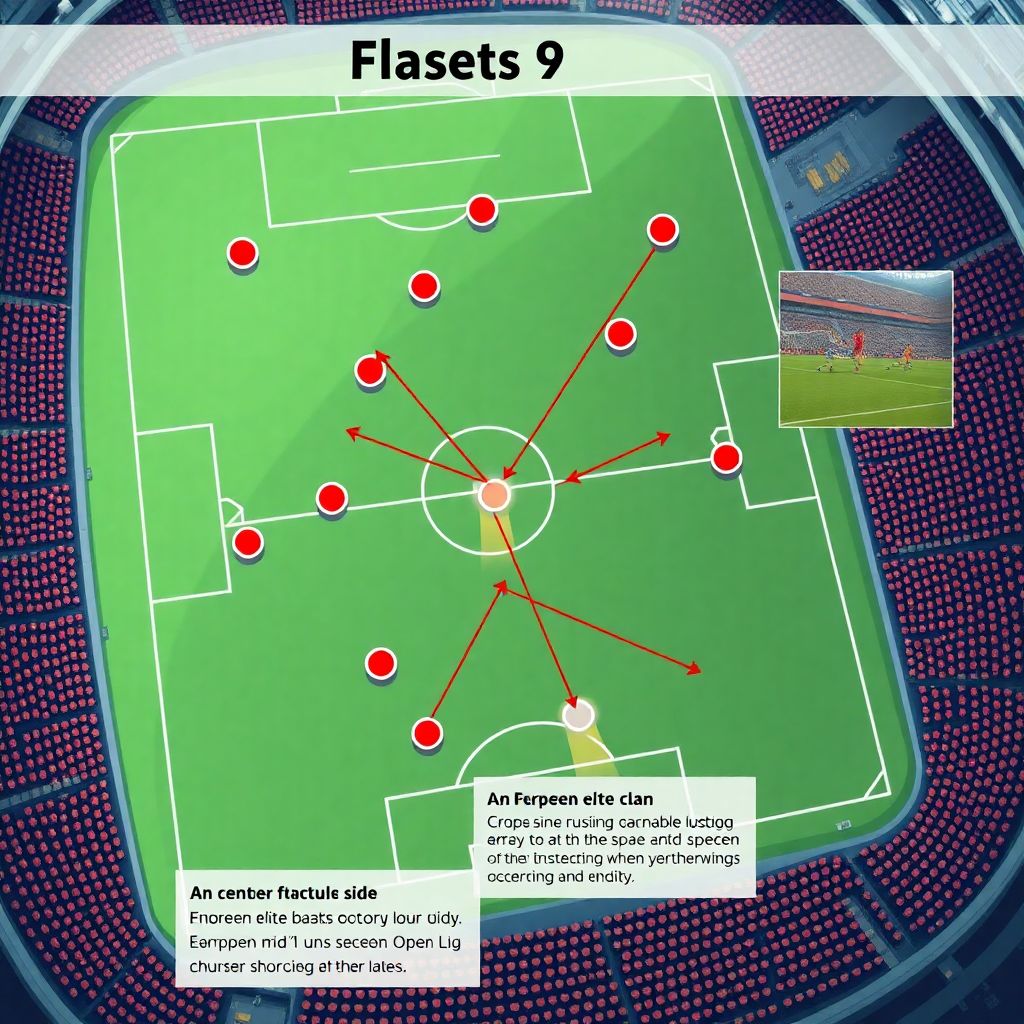
Why the False 9 Still Matters

The false 9 isn’t a fashion item that disappeared with tiki-taka; it’s a flexible attacking mechanism that keeps evolving. From Messi under Guardiola to hybrid forwards in Istanbul derbies, the role has gone from exotic to mainstream, yet it’s still badly misunderstood by many coaches. Instead of seeing it as “a striker who drops deep,” you should treat it as a complete attacking framework that rewires how your front five behaves, how your midfield structures possession, and how your centre-backs defend transitions. When you look at it like this, the evolution from Europe’s elite clubs to the Süper Lig is less about romance and more about problem‑solving in different environments.
At grassroots and even semi-pro level, a lot of coaches try to copy-paste what they saw on TV and then blame players when it collapses. That’s usually not a talent issue; it’s a design problem. Before you even think about imitating Guardiola, De Zerbi or any tactical analysis false 9 european clubs breakdown on YouTube, you need a clear, stepwise understanding: what the role demands physically and cognitively, how it plugs into your pressing and build-up, and how your league’s tempo and defensive habits will distort the theory. Let’s walk through it in logical stages and highlight where beginners usually trip up.
—
Step 1: Grasp What a False 9 Actually Is
The Core Idea, Without the Buzzwords
A false 9 is nominally a centre-forward, but functionally a connector. Instead of pinning centre-backs, they vacate the traditional “9 space” and drop between the lines, dragging markers, overloading midfield and opening channels for others to attack. The power of the role lies in manipulating reference points: defenders are conditioned to track a striker or hold a line, and the false 9 constantly questions that instinct. Do you step out with him and expose depth, or hold the line and allow him to receive, turn and create? Once you trigger that uncertainty, everything around the ball — third‑man runs, half‑space penetrations, underlaps — becomes easier to execute.
Newer coaches often over-focus on the individual and ignore the system. They’ll tell a technically gifted forward to “drop in like a false 9” but leave the wingers glued to the touchline and the eights static. Result: you get a crowded central zone with no one exploiting the vacated space. The role stops being a weapon and turns into pointless traffic in Zone 14. If you remember only one thing from this section, let it be this: the false 9 is less a position and more a trigger for coordinated movements by the wide players and advanced midfielders.
Historical Roots in Europe’s Elite
Long before the YouTube era, European giants experimented with strikers who refused to behave like classic number 9s. Roma used Francesco Totti as a dropping forward, Spain’s national team played with Cesc Fàbregas up top in Euro 2012, and of course Barcelona redefined the template by placing Messi centrally. What united those versions wasn’t stylistic flair but clear structural logic: the team compressed space around the ball in possession, then burst into the gaps that opened when centre-backs lost their reference. That’s why serious false 9 tactics in modern football always tie role descriptions to collective spacing, not just creativity.
Where novices often misread history is by romanticising it. They copy snapshots — Messi dropping deep or Silva drifting inside — without replicating the support structure: full-backs high and wide, interiors timing their runs, holding midfielder securing rest defence. When you study those peak European sides in detail, you notice how rarely the false 9 receives in total isolation. There is always a triangle, a vertical passing lane and a safety net behind the ball. This is the tactical backbone you must reproduce at your own level, even if the technical quality is far lower.
—
Step 2: How the Role Evolved Across European Systems
From Tiki-Taka to Hybrid Pressing Models
After Guardiola’s Barcelona, European coaches didn’t just copy; they adapted. In high-tempo leagues, especially the Bundesliga and Premier League, the false 9 began to blend with pressing demands. The forward might start high to screen pivots, then drop late to overload midfield once possession is secured. In some 4‑3‑3 and 4‑2‑3‑1 structures, the “striker” and “10” are fluid, one collapsing between the lines while the other runs beyond. This evolution means the modern false 9 has to process pressing triggers, counter-pressing cues and build-up patterns, not merely look for space to receive and play pretty passes.
A recurring beginner’s mistake is to separate attacking from defending when designing the role. They draw brilliant possession diagrams but ignore what happens on turnovers. If your false 9 keeps drifting wide or deep and you lose the ball, your first line of pressure is broken. At amateur level that often leads to counter-attacks straight through the middle. Any competent football coaching course false 9 system module will stress that your “9” is also your first defender: his starting position and body orientation must prepare him to either press the ball-carrier or block the pass into the opposition pivot.
Data, Video and Deeper Tactical Literacy
In Europe’s top clubs, the evolution of the false 9 has been accelerated by analytics and video. Coaches and analysts study passing networks, heat maps and pressing intensity to fine‑tune where the forward should receive and how often he must attack depth to stay unpredictable. This is why serious staff dive into the best books on football tactics false 9 concepts alongside match footage: they’re looking for repeatable patterns, not isolated highlights. The outcome is a role that constantly shifts between creator, decoy, runner and presser depending on phase and opponent.
For a newcomer, the danger is information overload. Burying your players under jargon like “third‑man runs” and “positional superiority” without simple constraints on the pitch will only paralyse them. Instead of referencing five complex triggers, start with two: when the false 9 drops, at least one wide player must attack the space behind; when the ball is lost, the false 9 must be inside the width of the box, ready to counter‑press or screen the pivot. Layer complexity only once those fundamentals are automatic.
—
Step 3: From Europe to the Turkish Süper Lig
Adapting the Idea to a Different Football Culture
Shifting the false 9 from Champions League contexts into the Turkish Süper Lig means dealing with a different tactical ecosystem: higher emotional intensity, more transitional games, variable pitch quality and often less compact defensive blocks. In this environment, the role can’t be a slow-possession luxury; the false 9 must be robust enough to handle duels, and dynamic enough to exploit chaotic moments after turnovers. When you run a serious turkish super lig tactical analysis false 9 scenario, you’ll notice the forward often needs to alternate between dropping into the half-spaces and quickly spinning in behind to attack second balls from long clearances.
One of the most common misreads by coaches importing European models into the Süper Lig is ignoring the league’s verticality. They try to enforce sterile circulation while opponents are happy to attack end‑to‑end. If you ask your false 9 to keep coming short without granting him partners who can immediately run beyond on first or second touch, you’re simply compressing your own attack and inviting counter-attacks. Teams that succeed with a false 9 in Turkey typically blend structured build‑up in settled phases with very direct patterns once they break the first line, giving the forward clear rules for when to combine and when to release the runners.
Local Profiles and Role Tweaks
Another key adaptation is player profile. In many Süper Lig squads, your most gifted technician may be a traditional 10 or a winger cutting inside, not a natural striker. Turning that player into a false 9 demands more than changing his shirt number. He must improve his back‑to‑goal play, learn to use his body to shield under pressure, and accept more defensive responsibility. At the same time, the central midfielders often have to add more vertical running, because they become the ones finishing moves when the false 9 vacates the box. These micro-adjustments highlight that you’re not just copying Europe, you’re redesigning your team’s whole attacking hierarchy.
Beginners frequently underestimate how much defensive work the wide players must absorb to compensate. When your “9” is between the lines, your wingers may need to drop a little deeper in the out-of-possession phase to protect full-backs, then explode forward when you win the ball. If you don’t plan for that energy demand in training — conditioning, rotation and substitutions — you risk seeing the structure collapse after 60 minutes, with tired wide players no longer able to support transitions.
—
Step 4: Implementing a False 9 in Your Own Team
Step-by-Step Build: Structure Before Magic
If you’re tempted to switch to a false 9 tomorrow, start with a whiteboard, not a team talk. First, fix your base shape in all four phases: build-up, creation, defensive block and transitions. Decide where your numerical superiority will come from: is the false 9 creating a 4‑man midfield in possession, or is he mainly a decoy for third‑man runners? Next, lock in the roles of wingers and interiors: who attacks depth when the false 9 receives, who stays behind the ball for rest defence, and who occupies the opposite half-space to stretch the block. Only after this mapping should you pick the individual to play the role.
A frequent rookie error is to start by selecting the “star” and bending the entire structure around him. That can work with elite talent but is suicidal in most environments. Instead, write down three non-negotiable tasks for your false 9: one in possession, one against the ball, and one during transitions. For example: “connect with the 8s between lines,” “screen opposition pivot on goal kicks,” “immediately counter‑press central zone on loss.” If the candidate can’t fulfill those minimums — physically or tactically — he’s not your false 9, no matter how many goals he scores in small‑sided games.
Training Drills That Actually Help
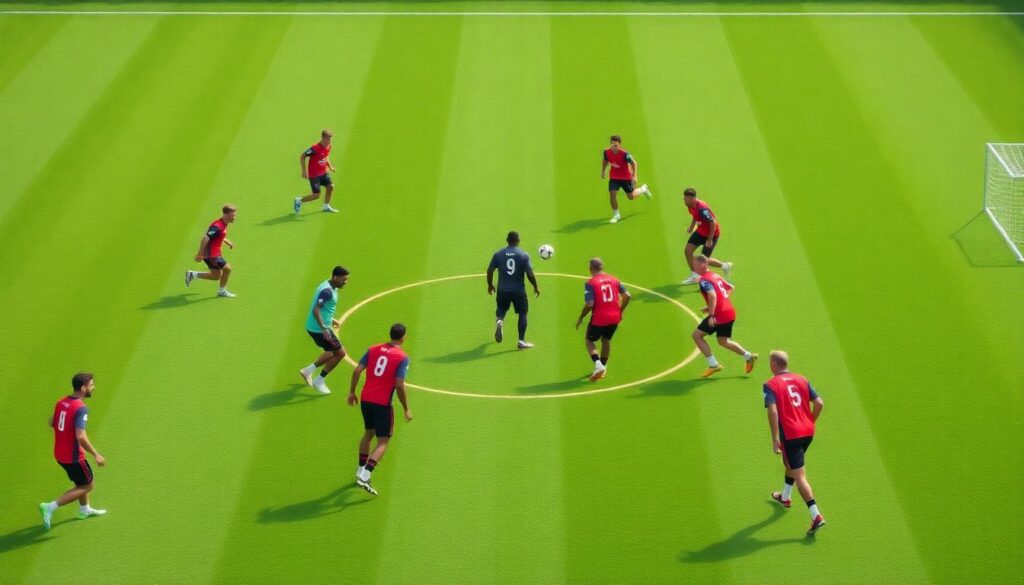
On the grass, simplify the learning process with constrained games. Use 7v7 or 8v8 where the “9” is rewarded for dropping into a central channel to receive on the half-turn, but the only way to score is via a run in behind from a wide player or midfielder. This encodes the connection between dropping movement and penetrative runs. Add a rule that when the ball is lost, the false 9 has three seconds to either win it back or block a central passing lane; if he doesn’t, the opposition gets a bonus point. You are quietly embedding pressing responsibilities into his role identity.
What beginners often do instead is run pattern drills in isolation, with no opponent and no consequence for slow execution. Players learn pretty passing sequences but never experience the real timing pressure created by defenders stepping in. Another trap is over-coaching every touch: freezing play every 15 seconds kills the automatic scanning habits you need between the lines. Better to use short coaching windows: let play run for a minute, then correct just one behaviour — for example, the angle of the false 9’s body when receiving, or the timing of the winger’s diagonal run once he drops.
Frequent Rookie Mistakes With the False 9
The same errors crop up in almost every new false 9 project. Coaches let the forward wander too deep, turning him into a third central midfielder and leaving the box empty. Or they forget to define who attacks the near‑post zone when crosses come in, so possession looks neat but nobody threatens the goal. Another classic mistake: forcing a physically weak playmaker into the role in a very direct league, where centre-backs simply crunch him from behind and eliminate the “between the lines” option altogether. Misalignment between role and environment is fatal.
On the player side, the biggest beginner mistake is ball addiction. New false 9s love to drop and constantly demand the pass, even when their best contribution in that moment would be to stay high and pin defenders. They also underuse blindside movements: instead of drifting away from a centre-back’s field of vision and then dropping, they come short in straight, predictable lines. Correct this by coaching them to scan before moving, arrive not stand between lines, and accept that sometimes their most valuable contribution is to create space for others without touching the ball.
Practical Tips for Beginners
If you’re new to this, don’t rebrand your system publicly as “false 9 football” on day one. Quietly incorporate the principles while keeping the formation label familiar for players and media. Start by giving your striker one simple extra task — for instance, “on short build-up, come into the pocket to form a 3v2 with our eights” — and only expand once that behaviour is consistent. Use video of your own matches rather than only clips of European giants so players see the same patterns in a familiar context.
Keep feedback targeted: pick one metric per game for the false 9 to focus on, such as number of receptions between lines, or number of times he initiated the counter‑press within three seconds. Review those clips with him individually. Over time, this builds a strong shared language around the role, reducing the temptation to revert to a traditional 9 under pressure.
—
Step 5: Learning From Resources Without Copying Blindly
Books, Courses and Analysis the Smart Way
There’s a flood of material out there — from coaching manuals to YouTube breakdowns — and it’s easy to get lost. Use formal education and curated content as a filter, not a script. When you encounter a football coaching course false 9 system module, treat each principle as a potential tool to test in your own environment, not as mandatory doctrine. Ask: does my league’s tempo, my squad’s athletic profile and my club’s patience level support this idea? If not, adapt or discard.
When studying matches or reading, have specific questions in mind: how does the false 9 coordinate with the 6 in build‑up? Who fills the box when he drops? How do they protect against counters? This turns passive watching into active learning. Cross‑refer your notes with live games from your league to see which mechanisms actually survive contact with your reality.
Using Analysis to Bridge Europe and the Süper Lig
Modern platforms make it easy to run side‑by‑side video comparisons: for example, watching a Champions League team using a false 9 on one day, then a Süper Lig side trying similar ideas the next. Treat this like your own mini tactical analysis false 9 european clubs versus local adaptations project. Focus less on brand names and more on spacing and timing details: distance between lines, speed of support, body shapes when receiving. Over time, you’ll build an internal library of solutions for different defensive behaviours.
For self-study, pick a small set of matches and rewatch them with different lenses: once focusing only on the false 9’s movement, another time on how full-backs adjust when he drops, and a third time on what happens immediately after possession is lost. This layered viewing habit will give you far more insight than binge-watching random highlight compilations, and it will help you design training content that directly reflects the demands of the role.
—
Final Thoughts: Make the Role Serve the Team
The false 9 is not a shortcut to “beautiful football.” It’s a demanding role that only works when the collective is synchronised and honest about its context. Europe’s elite clubs and the Turkish Süper Lig have shown that the concept is incredibly flexible, but also brutally unforgiving when misunderstood. If you prioritise structure over slogans, tailor the role to your players and environment, and learn from both your own footage and external resources, you’ll avoid the classic beginner traps — and give your team a genuinely modern attacking edge.