
The Süper Lig’s tactical revolution is a shift from rigid 4-2-3-1 blocks towards flexible hybrids that morph between 4-2-3-1, 4-3-3, 3-4-3 and 4-4-2 shapes across phases. For coaches, analysts and smart fans, the key is reading roles and rotations, not just starting formations on paper.
Tactical Snapshot: Süper Lig’s Evolution from 4-2-3-1 to Hybrids
- 4-2-3-1 remains widely used in Turkey, but mainly as a starting reference, not as a fixed shape for 90 minutes.
- Top sides increasingly build in a 3-2 or 2-3 structure, then defend in 4-4-2 or 4-1-4-1 mid-blocks.
- Fullbacks, sixes and wide forwards now decide the real system through their rotations and height.
- Match plans are opponent-specific: transitions, press triggers and rest-defense define the shape more than line-up graphics.
- For Super Lig tactical analysis, tracking lanes (half-space, wing, central) is more useful than counting defenders.
- For bettors, combining Super Lig statistics and analytics with shape trends gives sharper Super Lig predictions and odds.
Myths vs Reality: Is 4-2-3-1 Still the Default in Turkey
Myth: Turkish clubs play an old-school, static 4-2-3-1. Reality: many still list 4-2-3-1 on the teamsheet, but the in-possession and out-of-possession structures are far more fluid and situational.
In practice, the classic double pivot often splits: one six drops to form a back three in buildup, while the other steps into the half-space next to the ten. On the graphic, this is 4-2-3-1; on the pitch it often resembles 3-2-5 with the wingers pinning the last line.
Defensively, the same side might press in a 4-4-2 (ten joins the striker), then fall into a narrow 4-1-4-1 block against wide circulation. For anyone doing Super Lig tactical analysis or preparing Turkish Super Lig betting tips, fixing the team to a single label like 4-2-3-1 hides these phase-based shifts.
For coaches at intermediate level in Turkey, the practical takeaway is simple: treat 4-2-3-1 as a language for starting roles, not as a cage. You design pressing schemes, build-up patterns and rest-defense first, then allow the formation to follow those decisions.
Historical Drivers: Why Süper Lig Shifted Tactics Over a Decade
Myth: the change was purely imported “European fashion”. Reality: domestic factors in the Süper Lig forced coaches to modernise structures.
- Rise of high pressing opponents. As more clubs adopted coordinated pressing, static double pivots were too easily locked; coaches started dropping a six or fullback to escape the first line.
- Foreign coach influence and staff exchanges. Assistants and analysts brought training ideas from top European leagues, introducing rest-defense concepts and hybrid pressing schemes that didn’t fit a rigid 4-2-3-1.
- Profile shifts in local players. Turkish fullbacks grew more comfortable under pressure and inverting inside, while local tens and eights became more interchangeable between lines.
- Demand for proactive football from big-club fans. Supporters and media, who regularly watch Turkish Super Lig live and compare to European nights, pushed top clubs toward more dominant, possession-based styles.
- Data and video integration. Clubs using Super Lig statistics and analytics discovered that flexible occupation of the half-spaces and box, rather than strict positions, correlated with chance creation and control.
- Game-state awareness. The league’s swingy scorelines rewarded teams that could add a defender or striker through simple rotations instead of time-consuming substitutions.
Anatomy of the Classic 4-2-3-1: Roles, Risks, and Strengths
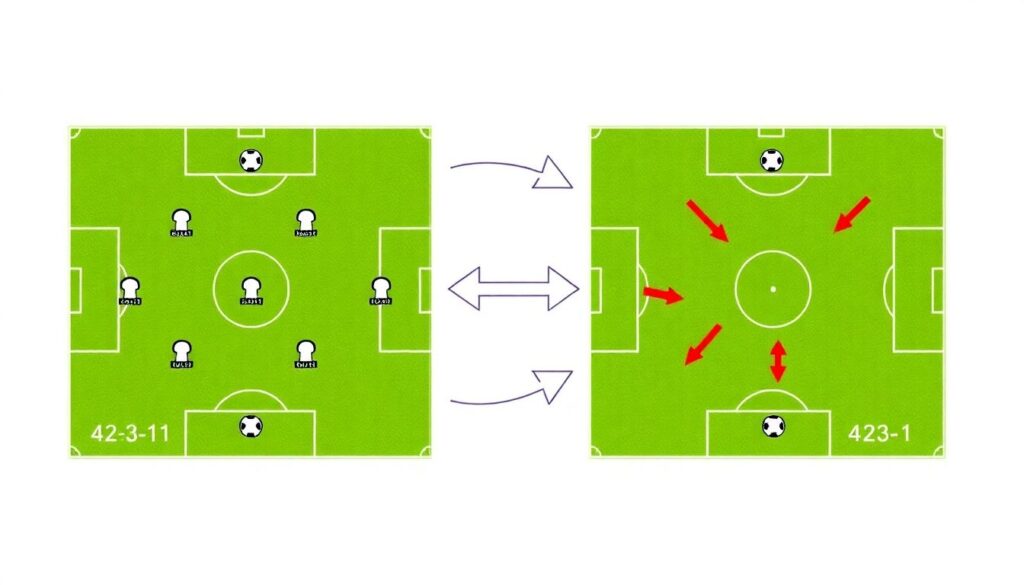
Myth: 4-2-3-1 is only defensive and cautious. Reality: in the Süper Lig, it is often an attacking, transition-friendly structure with built-in balance.
To apply it effectively, understand the roles in real match scenarios rather than as static dots:
- Standard home dominance plan. Against mid-table visitors, the double pivot controls second balls, fullbacks push high, wingers attack the far post, and the ten roams between the lines. The practical focus: win the ball back quickly after losing it around the box.
- Conservative away block. Versus stronger rivals, the ten drops to help the pivots, forming a 4-5-1 without the ball. Transition idea: recover, first pass to the ten in the half-space, then immediate vertical ball into the striker’s run.
- High press with ten as trigger. The striker presses centre-backs, the ten jumps to the pivot, and the wingers curve runs to block fullbacks. This risk-reward pattern suits coaches targeting early goals and is vital for anyone aligning game plans with Super Lig predictions and odds.
- Late-chase attacking tweak. When trailing, one pivot advances to form a line of two eights plus ten, effectively 4-1-4-1. Fullbacks overlap, and the wide players come inside. The risk is open transition lanes behind the advanced eight.
- Protecting a narrow lead. A winger is replaced by a more defensive midfielder, sliding into a 4-3-2-1. The front three stay inside to block central passes; fullbacks become more cautious, defending the back post and crosses.
Strength in all these scripts comes from clarity: players know how the shape flexes for each game state and where the spare man is supposed to appear.
Hybrid Models Emergent in the League: 3-4-3, 4-3-3 Variants and In‑game Switching
Myth: switching systems mid-game is chaotic for players. Reality: when built around clear reference points, Süper Lig teams can switch between 4-2-3-1, 4-3-3 and 3-4-3 within a few seconds and a few metres of movement.
In possession, many clubs now create a back three with either an inverting fullback or dropping six. This unlocks 3-2-5 or 3-1-6 structures in the attacking phase, while the nominal wingers and ten adjust their height to occupy the half-spaces and last line. Out of possession, the same team may collapse into a 4-4-2 or 4-1-4-1 for compactness.
Practical advantages of hybrid systems in Süper Lig context
- Flexible build-up. Easier to outnumber two-striker presses by forming temporary back three shapes.
- Better width and depth. Wingbacks or advanced fullbacks can both pin and stretch back lines, creating 1v1s for skillful wingers.
- Custom match plans. Coaches can design a different role for the same player depending on opponent, without changing the entire eleven.
- Smoother late-game risk shifts. Need a goal? Convert to a 3-2-5 by pushing fullbacks high. Need stability? Drop a winger into midfield, reverting to 4-3-3 or 4-5-1.
Structural and execution limits to keep in mind

- Cognitive overload risk. Too many shape rules can paralyse players, especially under pressure or in hostile away atmospheres.
- Profile mismatches. Not every fullback can invert, and not every ten can defend as a second striker; forcing hybrids onto the wrong squad leads to holes in transition.
- Training time cost. Each extra in-game switch demands rehearsed automatisms, which is challenging in the dense Süper Lig calendar.
- Analytical complexity. For analysts and those using Super Lig statistics and analytics, coding phases and zones accurately is harder when the shape changes every attack.
For fans, following these patterns live increases understanding; learning what to watch when you watch Turkish Super Lig live offers context beyond the TV formation graphic.
Player Profiles and Positional Rewrites: Fullbacks, 6s, and False Nines
Myth: hybrids are about fancy formations, not individuals. Reality: the revolution is driven by redefined roles for fullbacks, sixes and strikers.
- Fullbacks are not only cross machines. Common mistake: treating them purely as overlapping runners. Modern Süper Lig fullbacks must also invert, receive under pressure and connect midfield lines. If you demand only crosses, you waste build-up potential and invite counters.
- The six is more than a destroyer. Many coaches still pick a pure ball-winner at six, then complain about shaky buildup. The modern six must open passing angles, screen transitions and support the press – three jobs, not one.
- False nine misuse. Labeling any dropping striker a false nine is misleading. Without coordinated wide runs and a ten attacking depth, you simply vacate the box. The role only works if the team replaces the striker’s presence in the area.
- Wing profiles confused. Expecting a touchline winger to also be an interior playmaker creates tactical contradictions. Decide: is he a 1v1 isolation dribbler, or an inside forward attacking the box?
- Ten versus second striker. In many Süper Lig teams the ten defends as a second striker in the press, then becomes a playmaker in possession. Misunderstanding this dual role leads to spaces behind the first line or an isolated striker.
Coaching Methods and Training Adjustments That Enable Tactical Flexibility
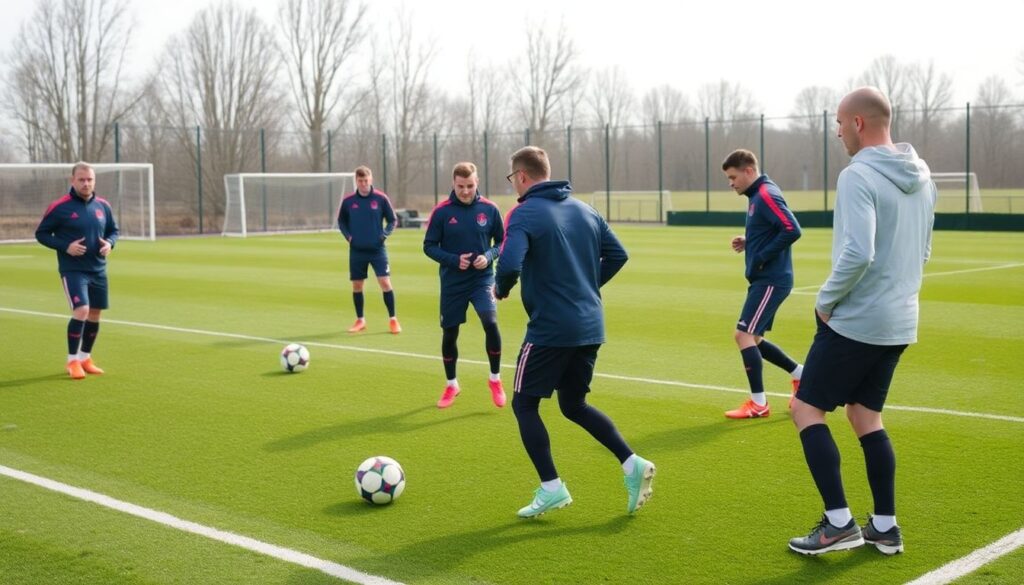
Myth: only big-budget clubs can train hybrids. Reality: with smart design, even semi-professional staffs can install flexible systems using simple, repeatable drills.
Training focus should shift from “formation” to “principles in phases”: how you build, how you press, how you protect transitions. Below is a practical micro-cycle outline that an intermediate-level staff in Turkey can adapt.
Phase-oriented weekly structure for hybrid 4-2-3-1 / 4-3-3 / 3-4-3
- Day 1 – Rest-defense and back-three building.
- Drill: 7v4+GK buildup. Back four plus pivot versus front four. Coach the pivot dropping or fullback inverting to form a 3+2.
- Coaching cue: “Choose the safest player to become the third centre-back; others adjust height accordingly.”
- Day 2 – Pressing triggers from 4-2-3-1 to 4-4-2.
- Drill: 8v8 half-pitch. Encourage ten to jump onto the opposition pivot when the centre-back’s first touch is poor.
- Output: players feel the automatic switch from 4-2-3-1 block to 4-4-2 press based on a clear visual cue.
- Day 3 – Attacking patterns into 3-2-5 or 3-1-6.
- Drill: pattern play with mannequins. Rehearse both fullbacks high and one inverted; wide players attack half-spaces, ten arrives late into the box.
- Constraint: require final-pass options from both wings and central lane to avoid overloading one side only.
- Day 4 – Game-state scenarios.
- Drill: 11v11, starting at min 70 with different scores (0-0, 1-0, 0-1). Script substitutions: add a striker → move to 3-2-5; add a midfielder → consolidate to 4-3-3.
- Goal: players recognise score, time, and rotation needed without waiting for constant sideline instructions.
Substitution templates for practical match management
- Need a goal, but keep stability. Replace a pivot with an attacking eight; instruct the remaining six to drop into the back line in buildup. Shape: 3-2-5 with clear rest-defense behind the ball.
- Protecting a lead against strong wings. Swap one winger for a third central midfielder. Instruct fullbacks to be conservative; ten stays higher for counters. Shape oscillates between 4-3-3 and 4-5-1.
- Chasing late equaliser. Introduce a second striker, push one fullback as a wingback, and keep a three-man base with the six dropping. Practical system: 3-3-4 in the final minutes while maintaining at least three players behind the ball.
Coaches, analysts and even bettors studying Turkish Super Lig betting tips should link these substitution templates to trends seen in Super Lig predictions and odds markets, understanding how tactical shifts alter game flow rather than just personnel.
Targeted Clarifications on Applying These Systems in Match Contexts
How do I decide between starting 4-2-3-1 or 4-3-3 in a Süper Lig match?
Base it on your sixes and tens. If you have a clear playmaking ten and a more defensive pivot pair, 4-2-3-1 suits you. If you have three multifunctional midfielders who can press and build, 4-3-3 offers better central stability.
When is it safe to switch into a back three during the game?
Switch when your team has stable possession and clear counter-pressing distances. The cue is usually the ball under control with your centre-backs and six; then an outside back or pivot can drop without leaving a huge gap behind the ball.
How can I prevent my false nine from leaving the box empty?
Pre-define wide and midfield runs that attack depth whenever the nine drops. At least one winger and either the ten or an eight must run beyond the ball on the weak side, so the back line still has players to mark near the box.
What should amateur analysts track when doing Super Lig tactical analysis?
Track line heights, occupation of half-spaces and how many players stay behind the ball when your team attacks. These are more telling than the nominal formation and help you interpret why certain games open up or stay tight.
How do hybrid systems affect Super Lig predictions and odds for bettors?
Teams that comfortably switch between pressing and deeper blocks tend to manage game states better. For betting, identify sides that can safely add attackers late without collapsing rest-defense; they are likelier to influence late goals markets.
Does watching only highlights help me understand these tactics?
Highlights hide build-up and defensive organisation. When you watch Turkish Super Lig live, focus on the first and second phases of possession and where the six and fullbacks stand; that is where most structural clues appear.
Can I apply these hybrid ideas with youth players?
Yes, but simplify. Teach just one in-possession switch and one out-of-possession switch, tied to clear cues like “ball with right centre-back” or “opponent plays wide”. Add complexity only when the first behaviours are automatic.