
European clubs scout in Turkey by combining structured data analysis with deep local networks: regional scouts, trusted turkey football talent scouting agencies, collaborations with clubs and academies, and targeted trials. Success depends on clear metrics, risk-aware due diligence, cultural understanding, and spotting undervalued regions and profiles before they appear on mainstream radars.
Top Scouting Insights on Turkey’s Talent Landscape
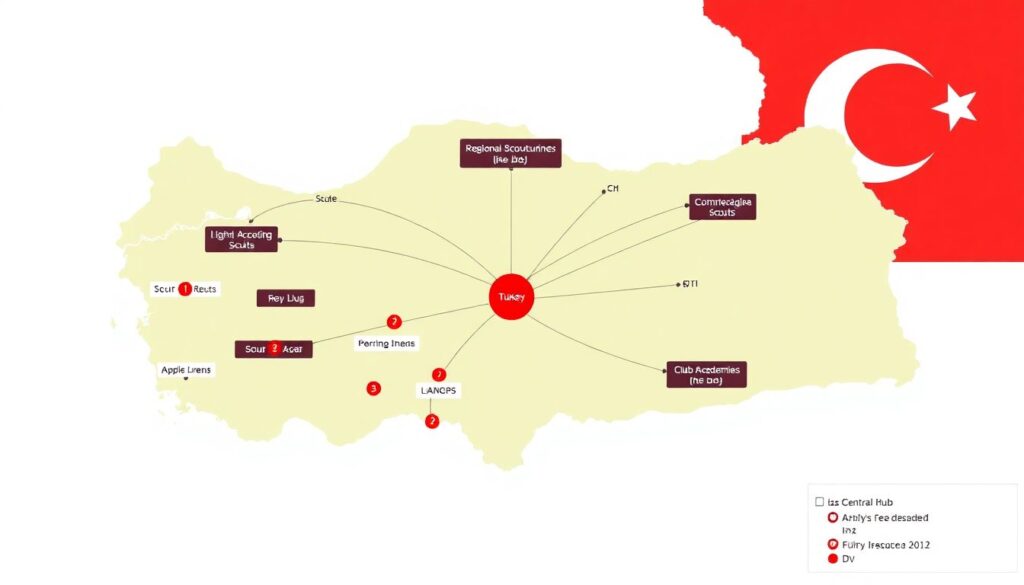
- Layered networks work best: a central coordinator, regional scouts, and strong club-academy relationships across the Turkish pyramid.
- Data filters the market; live and video scouting confirm details like mentality, adaptability, and tactical habits.
- Underscouted regions and lower divisions can offer the best value relative to transfer cost and wage demands.
- Early dialogue with families, agents, and clubs reduces contract, adaptation, and welfare risks.
- Compliance with FIFA, TFF, and work-permit rules must be built into every step of the process.
- Missed opportunities often come from positional bias (e.g., focusing only on wingers/attackers) and ignoring late developers.
How European Clubs Structure Their Scouting Networks in Turkey
For football scouting Turkey to be sustainable, European clubs need a clear structure, defined responsibilities, and safe working practices.
This approach suits:
- Clubs with a medium-to-long-term strategy for integrating Turkish players into first team or loan pathways.
- Clubs targeting technically strong, tactically flexible players who can adapt to different European leagues.
- Recruitment teams ready to invest in local relationships, language capability, and frequent in-country visits.
It is not ideal when:
- The club expects quick, low-cost “hidden gems” without investing in scouting structure or due diligence.
- Management changes every season, constantly resetting playing style and budget priorities.
- There is no capacity for aftercare: language-learning, integration support, and realistic game-time plans.
Typical network structure used by European clubs scouting players in Turkey:
- Central Lead Scout / Head of Recruitment – Sets profiles, oversees budget, coordinates with coaching staff, signs off shortlists.
- Turkey Country Scout / Coordinator – Lives in or regularly travels to Turkey, manages regional scouts and local partnerships.
- Regional Scouts – Cover Istanbul, Aegean, Central Anatolia, Mediterranean, Black Sea, and East/Southeast where relevant.
- Specialist Analysts – Provide data reports and video breakdowns on shortlisted players and benchmark them to current squad level.
- Trusted Local Partners – Relationships with specific clubs, academies, and turkey football talent scouting agencies for tips and early information.
Data and Metrics: What Clubs Track and Why
Before deciding how to scout football players in turkey, define what “good” looks like for your club in objective and subjective terms.
Core requirements and tools:
- Event and tracking data platforms – To monitor league, cup, and youth games across Turkey.
- Video scouting tools – For on-demand match footage, clipped actions, and searchable databases by metric and position.
- Centralized scouting database – Shared system for reports, ratings, injury notes, and contract information.
- Communication and workflow tools – To coordinate reports and approvals across time zones and departments.
| Metric Category | Examples of Metrics | Typical Data Sources | Typical Threshold Style (Non-Numeric) | Why Clubs Track It |
|---|---|---|---|---|
| Offensive contribution | Chance creation, progressive passes, dribbles leading to shots | Event-data providers, in-house tagging, video analysis | Consistently above league average for position and age | To identify players who influence final third actions, especially attacking midfielders and wingers. |
| Defensive activity | Pressing intensity, duels won, interceptions, defensive positioning notes | Data providers, manual coding, GPS where available | Reliable engagement and efficiency versus comparable players | To find players who fit high-press or compact block systems without major adaptation risk. |
| Physical profile | High-intensity runs, repeat sprints, aerial involvement, robustness indicators | Tracking data, fitness tests from club visits, medical records | Comfortable within the club’s typical physical standards | To reduce injury risk and ensure players can handle the tempo of target league. |
| Consistency and availability | Minutes played, consecutive starts, time missed through injury or suspension | League databases, club medical staff, agents | Stable pattern of availability over several seasons | To avoid players with recurring availability issues that can derail adaptation. |
| Tactical suitability | Roles played, formation exposure, pressing triggers understood | Video, live scouting reports, coach interviews | Regular experience in roles similar to target usage | To limit the learning curve when changing systems or positions. |
| Behavior and mentality | Body language, reactions to errors, leadership actions, training feedback | Live observation, staff interviews, background checks | Consistent professional behavior with no major red flags | To protect dressing-room balance and ensure resilience under pressure. |
| Market and contract factors | Contract length, release clauses, salary expectations, ownership details | Agents, lawyers, clubs, federation records | Negotiable within the club’s wage and fee structure | To avoid dead-end pursuits and ensure deals are realistically completable. |
In practice, European clubs scouting players in Turkey use this matrix to create early “traffic-light” ratings: strong, acceptable, or risky versus club standards, before investing in on-the-ground work.
On-the-Ground Methods: Local Scouts, Trials, and Strategic Partnerships
Before executing on-the-ground work, consider these core risks and their mitigations:
- Information bias – Relying too heavily on one contact; mitigate by cross-checking with multiple independent sources.
- Overexposure risk – Turning up visibly at games too early; mitigate by using discreet visits and video first.
- Contractual surprises – Hidden clauses or third-party claims; mitigate via early legal checks with trusted Turkish counsel.
- Cultural misunderstandings – Misreading communication styles; mitigate by involving Turkish-speaking staff in key conversations.
- Player welfare issues – Poor relocation support; mitigate with clear integration plans before signing.
-
Map the Turkish football ecosystem – Identify priority leagues, age brackets, and pathways.
Segment your coverage: Süper Lig, 1. Lig, 2. Lig, regional youth leagues, and strong academies. Add regular tournaments and school competitions where the best young football players in turkey for transfer may appear earlier than in senior squads.
-
Build a reliable local scout network
Recruit or partner with scouts who understand local styles, club politics, and training habits.
- Define regions and match quotas per scout.
- Standardize report templates to make comparisons easier.
- Require cross-checking: at least two independent scouts on each serious target.
-
Leverage clubs, academies, and agencies safely
Develop strategic relationships with key clubs, respected academies, and carefully vetted turkey football talent scouting agencies.
- Set clear boundaries: no exclusive dependency on one intermediary.
- Ask for mixed showcases with players from different sources to reduce bias.
- Document all discussions on rights and representation from the start.
-
Use video and live scouting in layers
Start with video to build a broad watchlist, then target live visits for high-priority games.
- Watch full matches, not only highlights, to assess off-ball work and resilience.
- Re-watch games where the player struggles to understand limitations, not just strengths.
- Alternate scouts to avoid single-observer bias.
-
Organise controlled trials and training observations
When possible, arrange trials either in Turkey or at your own club under safe, transparent conditions.
- Ensure all paperwork and insurance are in place before travel or training.
- Replicate tactical conditions similar to your first or B team.
- Include physical and psychological testing within the trial schedule.
-
Conduct structured background and character checks
Speak with multiple coaches, teammates, and staff across current and former clubs.
- Ask about training habits, punctuality, reactions to rotation or dropping.
- Look for consistent feedback patterns rather than single stories.
- Be sensitive to local hierarchies and avoid asking leading questions.
-
Align recruitment decisions with club strategy and budget
Compare each Turkish target with internal academy options and alternative markets.
- Run scenario analysis: immediate first-team impact versus development and loan plans.
- Include relocation, language support, and tax implications in cost projections.
- Stop or pause if any non-football risk (legal, medical, welfare) remains unclear.
Assessing Player Fit: Tactical, Physical, and Psychological Criteria
Use this concise checklist during reports and internal meetings when assessing how well a Turkish player fits your environment.
- Does the player already perform roles and tasks similar to those in your game model, not only the same nominal position?
- Can their physical profile (intensity, repeat efforts, contact tolerance) match your league’s usual tempo without major reinvention?
- Have you seen enough full matches to judge defensive work, transitions, and off-ball discipline, not just highlight actions?
- Do multiple scouts agree on key traits and weaknesses, or is the case built on one especially positive report?
- Is the player’s mentality robust: response to setbacks, substitution, hostile crowds, and adverse scorelines?
- Have staff checked language-learning capacity and openness to cultural adaptation in your country?
- Is there a realistic route to minutes (first team, B team, partner club) within the first two seasons?
- Do medical, legal, and character checks show no unresolved high-risk flags?
- When you compare this target to similar profiles in other markets, is the value proposition clearly stronger?
- Is there a clear exit strategy if the player does not fully reach the projected ceiling (loan, resale markets, contract structure)?
Regulatory, Cultural, and Logistical Constraints Impacting Recruitment
Common mistakes and how to avoid them:
- Ignoring federation and FIFA rules – Not checking TFF regulations, training compensation, or international transfer rules can derail deals late. Always involve legal experts early.
- Underestimating work-permit barriers – Assuming caps or youth status will be enough. Simulate work-permit scenarios before investing heavily in scouting one player.
- Overlooking schooling and family needs – Especially for minors or young seniors. Establish education and family-support options before finalizing offers.
- Poor communication with Turkish clubs – Using confrontational or informal negotiation styles that damage relationships. Appoint culturally aware negotiators.
- Last-minute travel and logistics – Booking rushed trips leads to missed matches or limited observation. Plan scouting trips around stable fixture blocks and backup games.
- Assuming one city shows the whole market – Focusing only on Istanbul and ignoring other regions. Spread coverage using regional scouts and cross-country tournament visits.
- Inadequate documentation – Verbal promises without written confirmation about rights, fees, and representation. Keep detailed written records and confirmations.
- No structured post-transfer support – Signing players without language lessons, cultural briefings, or mentoring. Build a standard integration program for all foreign recruits.
- Leaning on a single agent or fixer – Creating dependency and information bottlenecks. Diversify contacts and rotate intermediaries where possible.
Missed Opportunities: Undervalued Regions, Positions, and Pathways
Several patterns often lead to missed opportunities when clubs design how to scout football players in Turkey:
-
Underexplored regions and divisions
Beyond the top clubs in major cities, provincial teams and lower divisions can hide late-developing players with strong motivation. Example: a defender moving from a regional 2. Lig team to a European mid-table club after targeted live scouting and data screening.
-
Less fashionable positions and profiles
Clubs often over-focus on attackers and creative midfielders. Deep-lying midfielders, full-backs comfortable in multiple structures, and flexible center-backs may offer better value. Some of the best young football players in turkey for transfer may initially stand out for intelligence rather than highlight skills.
-
Alternative development pathways
Players who moved between academies, were released once, or came through school/university teams can be undervalued. Case: a player discarded by a big academy but thriving after a role change at a smaller club, identified through continuous league-wide tracking.
-
Strategic use of loans and partner clubs
Instead of waiting for fully proven stars, some clubs secure promising Turkish players early and develop them via loans. European clubs scouting players in Turkey can combine early acquisition with structured loans in neighboring leagues to grow value and reduce risk.
Practical Concerns and Solutions for Scouts Operating in Turkey
How can a small club start football scouting Turkey without a big budget?
Prioritize one or two regions, use affordable video platforms, and partner with credible local scouts on clear, limited mandates. Focus on specific positions rather than trying to cover every league at once.
What is the safest way to work with local agents and intermediaries?
Vet intermediaries through federation records and cross-check with multiple clubs. Avoid exclusive arrangements, keep all terms in writing, and never rely on a single agent for both information and negotiation.
How many live games should we watch before moving on a Turkish player?
Aim to see the player in different contexts: home and away, strong and weak opposition, and at least one “bad day”. Combine this with robust video review before any final decision.
How do we reduce adaptation risk when bringing a Turkish player to Europe?

Provide language support, assign a dressing-room mentor, and design a realistic playing-time plan. Include family integration and cultural guidance in the first-season plan.
Are trials in our country better than observing players in Turkey?
Trials help assess adaptation to your environment but can be misleading if players are tired or nervous. Use trials as an additional filter after strong evidence from league games and data.
What role do turkey football talent scouting agencies play for European clubs?
They can provide access to local tournaments, school games, and mixed showcases. Use them for reach and logistics, but keep internal standards and final decision-making strictly within your club.
When should we target the best young football players in turkey for transfer?
Ideally before they become regular starters at top clubs, when valuation is still accessible. However, only move early if your development and loan pathways are clearly prepared.